 National Puerto Rican
Parade Predate
The NiLP Network on Latino Issues (May 28, 2014)
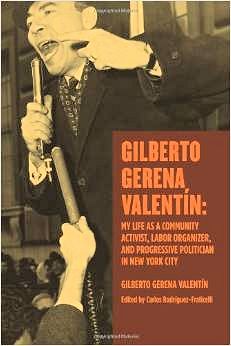 Note: As June 11th approaches and a badly battered National Puerto Rican Day Parade gets ready to march up Fifth Avenue, we thought this was a good time to review the founding and early history of the Parade. We are fortunate to have the memoirs of the legendary Puerto Rican community leader, Gilbert Gerena Valentín, in a book just published by the CUNY Centro de Estudios Puertorrqieuños, "Soy Gilberto Gerena Valentín: memorias de un puertorriqueño en Nueva York," which is also available in English as: "Gilberto Gerena Valentin My Life as a Community Activist, Labor Organizer an Progressive Politician in New York City." It can be purchased from Centro's website (Centro Store), as well as from Amazon.
Gerena, who was there at the founding of the Parade in 1954, provides us with a rare look at the event's beginnings and early years. With all of the trials and tribulations the Parade has undergone this past year, Gerena's account presents the many challenges that have confronted what has become a 57-year tradition from its birth. It's a history lesson that puts the Parade's current situation in a much-needed context and makes us more fully appreciate its significance for the Puerto Rican community..
---Angelo Falcón
The Origins of the
Puerto Rican Day Parade
By Gerena Valentin
Chapter 25 from from Gilberto Gerena Valentin My Life as a Community Activist, Labor Organizer an Progressive Politician in New York City by Gilberto Gerena Valentin, edited by Carlos Rodriguez Fraticelli and translated frm Spanish by Andrew Hurley (New York: Centro Press, 2013)
 |
|
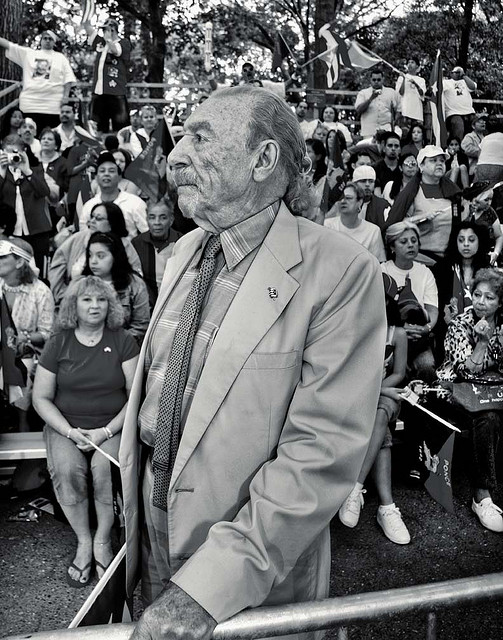
Gilberto Gerena Valentín at 2007 Parade
|
When they arrived in the United States, many European immigrants created their own cultural organizations. Several of these groups, including the Italians, also founded parades to commemorate their national heritage. Spaniards held theirs on October 12, the Día de la Raza. Until the early fifties, Latin Americans took part in those activities, but with the rapid growth of the Puerto Rican community in the city, at the first annual meeting of the Congreso de Pueblos in 1954 the idea of holding a Puerto Rican parade was presented.
That same year, as president of the Congreso de Pueblos, I appointed a committee to meet with officers from the various ethnic parade-organizing committees so we could learn more about parade logistics and organization. The committee was made up of Luis Ríos, of Barceloneta; Johnny Meléndez, of Fajardo; Juan Benítez, of San Juan; and Manolo Román, of Arecibo. The committee met with the organizers of the Italian, Greek, Irish, and Jewish parades. One of the people who helped us in our efforts was Fortune Pope, owner of radio station WHOM, whose Spanish-language programming was very popular in the Puerto Rican community.
Since at this time we were encouraging the entire Hispanic community of the city to come together in a united front, we invited leaders from other Hispanic groups to join us, and we proposed the creation of a Puerto Rican parade promoting exactly that: Latino unity. The first meeting to discuss the idea of one big parade incorporating all the Latino and Hispanic population in the city was held in the home of Gregorio Domenech at 121st St. and Park Avenue in Manhattan. In addition to Gregorio, two other members of the Congreso de Pueblos were present: Dora Orta, from Arecibo, and I. Also attending were Juan Mas, a leader of the Cuban community who worked in the hotel industry; Manuel Mora, a Spaniard who owned a hardware store in Harlem; and the Basque nationalist Jesús de Galíndez, who taught international law and was completing his doctorate in history at Columbia University.
Although we were all in agreement about the importance of creating a parade, differences of opinion very quickly arose with respect to its name and composition. Mora and Galíndez argued that it should be held in October, on specifically the 12th, the Día de la Raza. Mas suggested that it be called the Hispanic Parade, and the Spaniards were in agreement with that. We Puerto Ricans were opposed, arguing that the name should reflect the fact that the Puerto Rican community was the largest and would also have the greatest possible participation in the activity. The meeting ended in a stalemate over the name for the parade. We did, however, agree to meet again two weeks later. Meanwhile, we asked Galíndez, who was a columnist for El Diario de Nueva York, to write an editorial in support of the idea and urging all Hispanics in the city to join our enterprise. We also agreed that the Congreso de Pueblos would be in charge of mobilizing people for the event.
The next week, Galíndez had his editorial ready. As we had agreed, he gave it to me beforehand to look over. After discussing it with Domenech and Dora Orta, I reorganized it a little. The next day, as I had agreed with Galíndez, I went to his apartment on Fifth Avenue in Greenwich Village to take him the revised document. When I spoke to the doorman, he told me that Galíndez wasn't at home, but that he was probably up at Columbia University. So I went uptown, but I was told that Galíndez had called in sick. Given this situation, I went back to his apartment. Since Galíndez had not come in yet, I gave the envelope with the document to the doorman, who promised to give it to Galíndez personally.
But Galíndez never returned to his apartment. His disappearance was reported to the police, but no one could find him. A short time later, there began to be rumors that he had been kidnapped by agents of Dominican dictator Rafael Leonidas Trujillo and flown to the Dominican Republic, where he had been assassinated. The rumors turned out to be true. Galíndez had lived in Santo Domingo for several years before moving to New York City. In New York, he had become an outspoken critic of Trujillo. Two weeks before his disappearance, he had completed his PhD dissertation, which was titled "The Trujillo Era: A Casuistic Study of Dictatorship." Years later, we learned that he had been tortured and thrown to the sharks. (He was granted his doctorate posthumously.) Galíndez' disappearance was cause for great sadness among us, and a blow to the Hispanic community. We lost an excellent public-relations man and a force for consensus. But his loss did not stop our project. El Diario de Nueva York published his editorial, which was brief, to the point, and convincing. It was very well received in the Spanish-speaking community. Many people joined our cause, and that, in turn, forced us to find other places to meet, since Domenech's house was too small for the growing number of people interested in the project.
With Galíndez' disappearance, the unity among the Hispanic groups began to weaken, and the debate over the nature and name of the parade intensified. One group, which I was in, wanted to call it the Puerto Rican Day Parade of Hispanic Unity, while another, led by Víctor López and Chuíto Caballero, and with the support of well-known Puerto Rican columnist Luisa Quintero, argued for the Puerto Rican Day Parade, period. To try to achieve the unity of the Puerto Rican community that we all wanted, we met in the Alamarc Hotel to try to reach an agreement. Attorney Oscar González Suárez represented the López-Caballero group, while lawyer Felipe Torres represented our group, the Congreso de Pueblos. After two days of discussions, we finally reached an agreement: the parade would be called the Puerto Rican Day Parade. In April 1957, the Committee for the Puerto Rican Day Parade, Inc. was registered in Albany with the aid of the two attorneys.
The Parade was sponsored by the Congreso de Pueblos. Archilla and I were in charge of coordinating it. We coordinated that first parade with absolutely no idea of how to do such a thing. When we went to request a permit to march along the traditional route used by the Irish, Italian, Greek, and Jewish community- starting at 43rd St. and running to 86th St. along Fifth Avenue, and ending at Third Avenue-we met another obstacle. The administration of Mayor Robert F. Wagner, Jr., refused our request. After a great deal of lobbying on our part, they gave us a permit to march through El Barrio along Fifth Avenue from 116th St. to 96th St. Then it turned out that no one wanted to contribute money for the parade's expenses, which included the cost of materials and labor for the dais, banners, ribbons for the grand marshal, and then money to pay assistants. All the money eventually came out of the organizers' pockets.
Finally, on April 15, 1958, the first Puerto Rican Day Parade was held. We dedicated it to Jesús Galíndez in recognition of his part in organizing the activity. Tony Méndez, who was our political leader in El Barrio, was the Grand Marshal. Over 15,000 Spanish-speaking people marched in the parade, the vast majority of them Puerto Ricans. There were very few floats, but lots and lots of automobiles belonging to the poor people in El Barrio, full of family members and friends and decorated with crepe paper.
That day we faced a series of problems. It started pouring rain on Saturday and didn't stop until Monday. Since the banners hung across the streets were made with water-based paint, the paint ran, and when we arrived at 96th St. we found that the main banner was just a long piece of white cloth running from one side of Fifth Avenue to the other. Then, everybody wanted to be on the dais. Built by Paco Archilla out of recycled wood donated by Mora, since we didn't have any money to buy new wood, the platform collapsed. Then Tony Méndez arrived late and had to run like crazy for three blocks to get to the head of the parade, which he finally did at 113th St. He was totally out of breath. But despite the rain and all the other problems, the people would not be prevented from having their day. They marched in the rain as happy as larks. Somebody said it was the baptism that God gave the parade as a sign of his blessing.
In 1959 we held the second parade. This time, the board of directors, which was controlled by the Congreso de Pueblos, decided that Víctor López would lead the parade and Chuíto Caballero would be the treasurer. Manuel Martínez was the coordinator.
That year, 1959, was the year for the Democratic primaries. Unfortunately, the divisions within the party were clear for all to see. Mayor Wagner needed the vote of the Puerto Rican community if he was going to win. He asked for my support, and I told him that in principle I had no problem supporting him, but he had to give us a permit for the parade to take the official parade route, that is, up Fifth Avenue from 43rd St. to 86th St. and Third Avenue. We also asked him to attend a press conference called by the Congreso de Pueblos to announce that we'd been given the permit. Wagner accepted, and from that year on, the Puerto Rican Day Parade has taken the same route as the ones for the Irish, Italians, Greeks, and Jews.
Not everyone was pleased that we Puerto Ricans were going to march along Fifth Avenue. The day before the 1959 parade, I received an urgent phone call telling me that I needed to get over to Fifth Avenue immediately to see what had been done to the shop windows. When I arrived, I found that practically all the store windows along the avenue, from 43rd St. to 80th, were covered with plywood panels, and that many had signs reading "Puerto Ricans, go home," with the Puerto Rican flag upside down. I called Paco Archilla and told him to find a pickup and a helper and, starting at midnight that day, to take down the panels. We took down every single business's plywood panels. The next day we marched without having to face that insult, which was intended to provoke the parade's participants and create a situation that would discredit the event. But that was not the only hiccup. To make our event look bad, laxative was given to the police horses, which were marching at the front, so they would dirty the streets we were going to march down. At the end of the parade, the Health Department came in with fire hoses to clean the streets, and they soaked the people along the route. We pulled Mayor Wagner aside and gave him an ultimatum: "If this situation is not taken care of, you will not have the Puerto Rican vote." Wagner knew we were serious, and he ordered those provocations to stop.
Meanwhile, López and Caballero's management proved ineffective. There was growing discontent among the members of the parade committee since they were not called to meetings or informed about the use of the money we had collected. In a meeting held in 1960, López and Caballero were forced to resign. With the backing of the Congreso de Pueblos, Manuel Martínez took over the parade management and I became coordinator. We democratized the processes and set all the finances straight. In 1963 I was elected president of the parade, and I coordinated until 1974. By that time, the Puerto Rican Day Parade was one of the main ethnic activities in New York City.
_______________________________________________________________
Stay tuned to The NiLP Network on Latino Issues for updates . . .
If you have any information about the Parade, positive or negative, that should be widely known in the Latino community, please let us know at info@latinopolicy.org. Your name will be kept confidential if requested.
The NiLP Network on Latino Issues is an online information service provided by the National Institute for Latino Policy (NiLP). For further information, visit our website at www.latinopolicy.org.