National Latino Opinion Leaders Survey
Latino Leaders on the
NCLR Rebranding to UnidosUS
By Angelo Falcón
The NiLP Report (July 18, 2017)
Rebranding is the process of changing the corporate image of an organisation. It is a market strategy of giving a new name, symbol, or change in design for an already-established brand. The idea behind rebranding is to create a different identity for a brand, from its competitors, in the market.
---The Economic Times
 The announcement that the National Council of La Raza (NCLR) was changing its name to "UnidosUS" drew a decidedly mixed reaction from Latino leaders and activists across the country. The NCLR is the largest Latino national civil rights organization, founded in 1968 and, according to their latest publically available financial report (2015), have a budget of $35.8 million and net assets of $57.3 million. The news coverage on this issue ranged from that which was mostly positive to that which was very negative, with no consensus emerging from these initial reactions.
Given the importance of NCLR as an advocate on Latino issues in the United States, especially in this Age of Trump, we were interested in exploring this reaction a bit more more deeply by asking Latino opinion leaders from across the country their reactions to this name change through our National Latino Opinion Leaders Survey. Our survey is a unique independent source of elite Latino opinion not currently available elsewhere. This online survey on the NCLR rebranding was conducting on July 12-17, 2017 with 139 respondents. Reasons for and against the change were culled from news coverage of the issue. Although changes in the organization's logo are also part of the rebranding process, we do not address this aspect in this survey.
For or Against the Change?
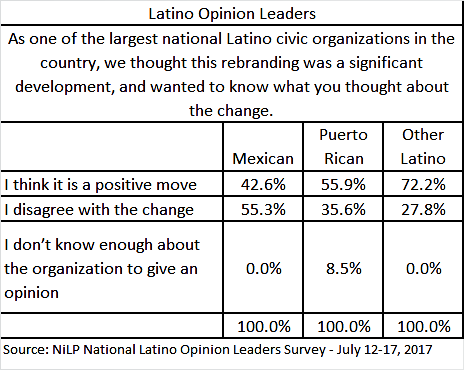
Overall, there was support for the name change by the Latino opinion leaders. However, there were striking differences between the three groups of the leaders. Although mostly split on the subject, a majority of the Mexican opinion leaders (55 percent) opposed the change. This opposition is in contrast to 56 percent of the Puerto Ricans and 72 percent of the Other Latinos who support the change. The greatest concern about the name change, therefore, came from the NCLR's original base in the Mexican-American community. The fact that the Puerto Rican and Other Latino opinion leaders were in strong support of the change validates the goal of the name change to allow the organization to reach out to the broader Latino community.
Reasons to Support the Change
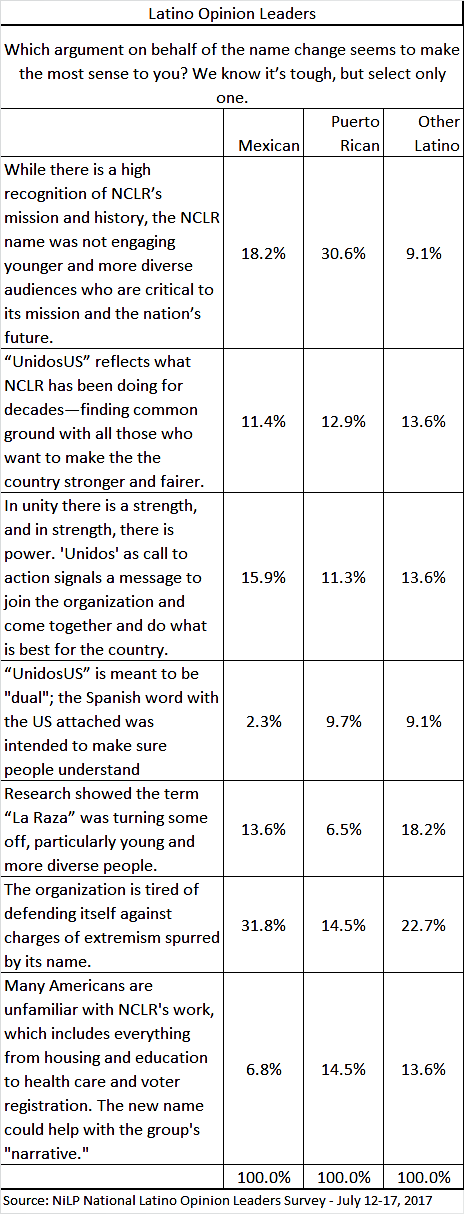
There was no consensus on the reasons supporting the NCLR name change among the Latino opinion leaders. The main reason given by the Mexican (32percent) and Other Latino opinion leaves (23 percent) was that "The organization is tired of defending itself against charges of extremism spurred by its name." For the Puerto Rican leaders (31 percent) it was that "While there is a high recognition of NCLR's mission and history, the NCLR name was not engaging younger and more diverse
audiences who are critical to its mission and the nation's future.
"
Reasons Against the Change
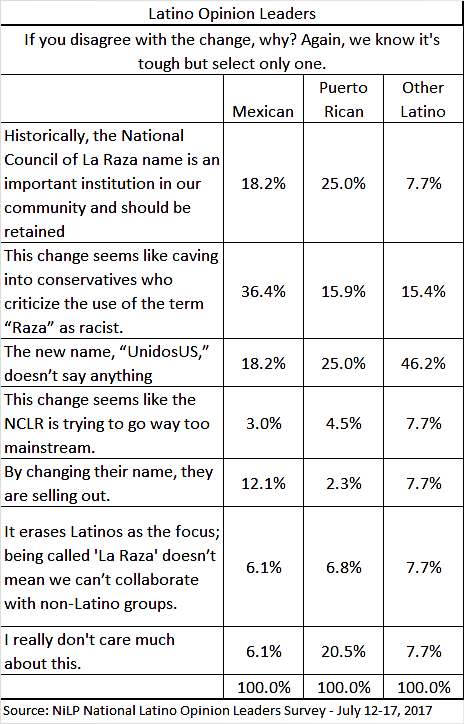
Among those opposing the name change, there also was no consensus. The top reason given by the Mexican opinion leaders (36 percent) was that "This change seems like caving into conservatives who criticize the use of the term 'Raza' as racist." For the Other Latino opinion leaders (46 percent), the top reason given was that "The new name, 'UnidosUS,' doesn't say anything." For the Puerto Ricans, their two top reasons: "Historically, the National Council of La Raza name is an important institution in our community and should be retained" and "The new name, 'UnidosUS,' don't say anything." There continue to be significant differences between the different Latino subgroups of opinion leaders in reaction to the name change.
Discussion
In our experience, organizational name changes like the type NCLR has undergone always seem to receive much initial skepticism. However, depending on the organization's track record following this change, this skepticism usually recedes, and the change is more generally accepted. However, this initial reaction is interesting in raising many issues concerning the organization's history, the significance of the name that is being replaced, and speculations about the effectiveness and relevance of the organization.
In a
July NiLP survey
of Latino opinion leaders, we found that the NCLR, before the name change, was viewed as one of the most effective national Latino organizations, They were seen as the second most effective by the Mexican and Puerto Rican opinion leaders, and the most effective by the Other Latino opinion leaders.
Much of the controversy over the name change was over the dropping of the term "La Raza." One issue is that the term identified the NCLR as a Mexican-American or Chicano-focused organization at a time when the organization has been working to become more pan-Latino. In the 1980s the organization had been criticized by Puerto Ricans as promoting "Chicano imperialism" as it sought to extend its reach outside of the Southwest. With Mexican-Americans making up over 60 percent of the nation's Latino population, it is not that clear how important this aspect of the renaming is, but it explains the resentment of the change by those in this community about the organization moving away from its roots.
This term has also been seized upon by the Right as a criticism of the NCLR and the Chicano movement in general as evidence of a racial agenda that is un-American and divisive, with a subversive open borders agenda. This has no doubt been frustrating for NCLR because of the way it has distorted what is basically their very mainstream liberal approach to policy and political issues. Despite their approaching their 50th anniversary next year, the continual cynical and relentless Rightwing attacks on NCLR serve to cloud public perceptions of their actual mission and work. This name change indicates they felt that using the acronym, NCLR, to avoid speaking the term "La Raza" wasn't working. Whether a name change will result in ultimately addressing this problem, only time will tell.
There has also been the criticism that this name change represents the NCLR's attempt to politically mainstream itself (some saw this as their "selling out") to attract (or maintain) its donor base. The problem with this criticism is that the NCLR is widely perceived by many as already being too mainstream. More than one insider has commented that since NCLR President Janet Murguia's 2014 appropriate and sensationalistic criticism of President Obama as "Deporter-in-Chief," the organization has become more cautious given its fallout at the time with the Democratic Party Establishment. It is, therefore, not entirely clear how it could become any more mainstream than it is now, short of endorsing Trump. If this mainstreaming message is a good or the bad thing is, well, in the eye of the beholder.
While our survey found that, overall, the Latino opinion leaders supported the change, it was significant that the Mexicans were the most divided and most critical. This is clearly reflective of the bigger buy-in of the organization's Mexican-American/Chicano base. This also demonstrates the importance of taking national-origin sub group differences into consideration when making such changes in a Latino organization. These findings also support one of NCLR's objectives in making the name change of appealing to a wider pan-Latino constituency.
Of the reasons were given for supporting the change, the two groups of Latino opinion leaders --- the Mexicans and Other Latinos --- felt most strongly that "The organization is tired of defending itself against charges of extremism spurred by its name." As the two groups with large undocumented populations, this tying of the response to the anti-immigrant debate makes sense. The Puerto Ricans, who on the other hand are all U.S. citizens, mostly felt that "While there is a high recognition of NCLR's mission and history, the NCLR name was not engaging younger and more diverse constituency."
Among those in our survey who opposed the NCLR name change, the Mexican opinion leaders (36 percent) top reasons were that "This change seems like caving into conservatives who criticize the use of the term 'Raza' as racist." This ethnically-based response is in contrast with the Puerto Rican and Other Latino opinion leaders who had in common as their top choice that "The new name, 'UnidosUS,' doesn't say anything."
It is clear from these findings that the NCLR needs to pay special attention to the needs of their Mexican-American/Chicano base when making changes. This means that it also needs to maintain a delicate balancing act when reaching out to non-Mexican-American Latinos groups it also seeks to serve and represent. This is an ongoing tension that they will need to address regardless of the name change.
This debate over this name change can be seen in the end as a positive development in acknowledging the national importance of NCLR (I mean UnidosUS). In so doing, it also opens up their mission and work to a broader community scrutiny than usual, perhaps leading to greater accountability to the people they purport to serve. With the current unfortunate national Latino leadership vacuum, perhaps by repeating "UnidosUS" over and over again, like a hypnotist would, it will lull Latinos to finally come together in some miraculous way (beyond just acting like a gaggle of chickens) But, on second thought, this may be too much to ask of a rebranding.