Click here to read this email as a page in your web browser


STAY INFORMED – TALKING POINTS – ACTIONS – VOICES – STORIES MAKING NEWS

Obsession with Israel Blinds the World to Widespread Suffering


When rapper Macklemore was dropped from Ed Sheeran’s U.S. tour after accusing Israel of ‘genocide’ on stage, all other opening acts pulled out of the tour in solidarity. Sheeran said he simply wanted to play music. He never wanted to be an activist musician but intended his shows to be about unity and humanity. Even his subsequent expression of sympathy for Palestinians did not spare him from the wrath of anti-Israel musicians and activists.


Sheeran played his next show in Philadelphia alone. In his opening remarks, he condemned the Oct. 7 Nova music festival massacres as “horrific and compounding centuries of Jewish pain.”  He went on to call the situation in Gaza catastrophic.


Israel has been the focus of a global obsession unlike any other country in the world. In 2024, the world’s media devoted more coverage to Israel than any other nation besides the U.S. – even though Israel is a country the size of New Jersey. The world’s fixation defies reason: one small country commands more attention than actual genocides, famines and kidnapped children worldwide.


From Costume to Crusade


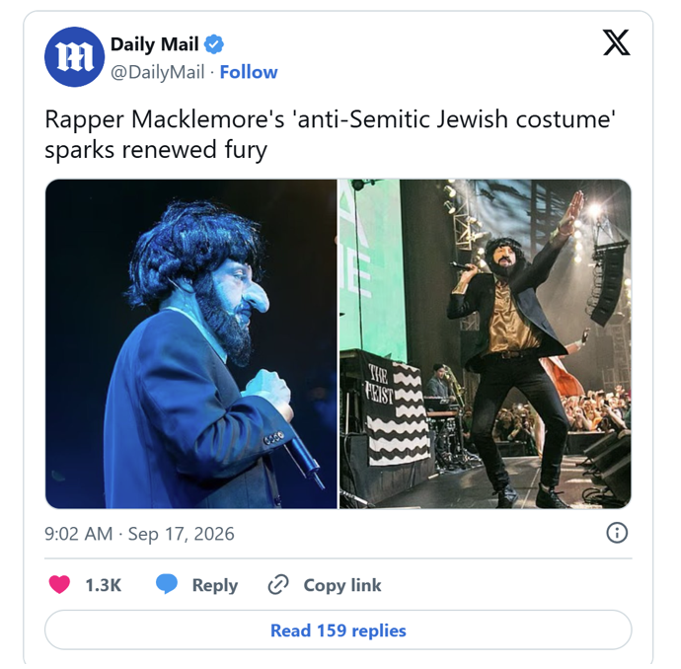
In 2014, the singer Macklemore performed in a costume with a large hooked prosthetic nose, black wig and bushy beard – a grotesque antisemitic caricature. In his eventual apology, the rapper said he had only meant to “surprise the people at the show with a random costume” and conceded it could be “ascribed to a Jewish caricature.” The Anti-Defamation League’s then-director, Abe Foxman, accepted the apology and Macklemore urged fans to support the ADL. The images resurfaced recently as the Sheeran controversy grew.

This time, there was no apology. Opening for Sheeran at New Jersey’s MetLife Stadium, Macklemore performed “Hind’s Hall” – his tribute to the violent protesters who broke into and occupied a Columbia Univ. building in 2024. The anti-Israel activists held two janitors hostage and called them “Jew-lovers,” according to a lawsuit the janitors filed against them. Columbia settled separate complaints they brought against the school.


The rapper also declared his support for a “Free Palestine” as images of Gaza played on screen. Addressing Jewish fans, he insisted: “To all of my Jewish brothers and sisters: criticism of Israel, criticism of apartheid, being against genocide in no way is a criticism of you.” The ADL disagreed, citing his record of “demonizing Israel and Israelis, falsely accusing Israel of genocide and engaging in antisemitic rhetoric and behavior.”


New England Patriots owner Robert Kraft barred Macklemore from performing at Gillette Stadium, calling out his “broader history of antisemitic rhetoric and imagery.” Macklemore pledged his entire $1 million in tour earnings to six Gaza aid organizations, including three with alleged ties to Hamas. He publicly challenged Kraft to match it – Kraft answered with $2 million to “fight this humanitarian crisis.”


No Jews, No News


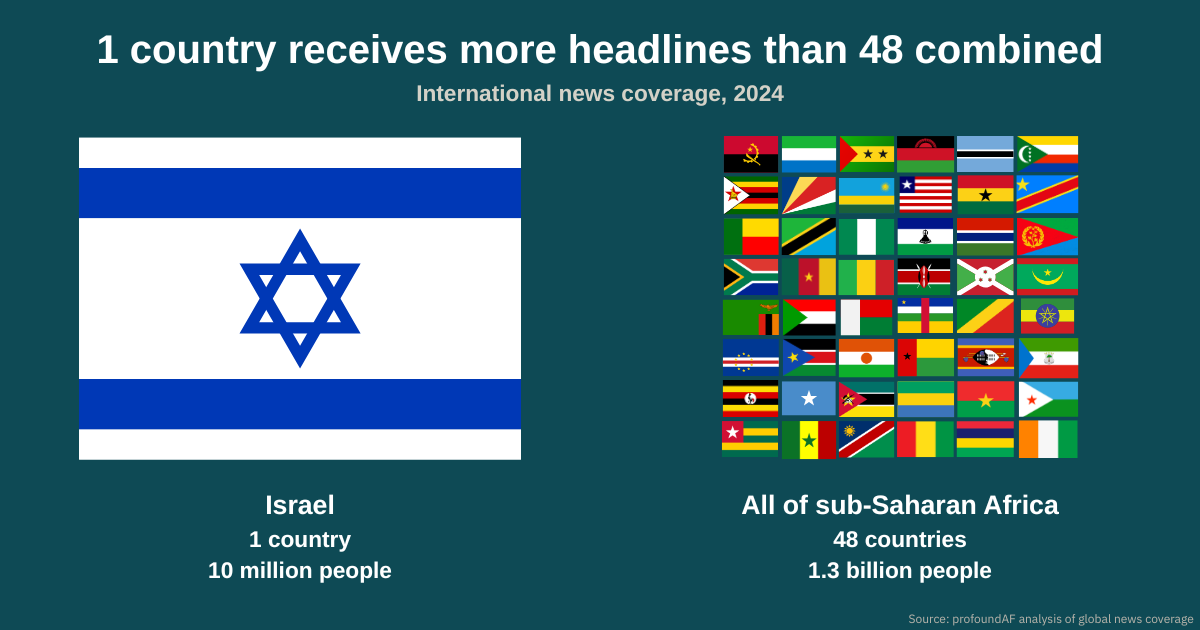
The anti-Israel obsession is widespread. The world news media published more than twice as many stories about Israel than 48 countries in Africa combined in 2024.


When X-Files actress Gillian Anderson asked her Instagram followers to help children suffering in Sudan’s civil war, the comments filled with demands that she talk about Gaza instead. Anderson noted that Sudan is “not always in the news” – and she was right.


The United Nations has described the African nation as the world’s largest humanitarian crisis. Multiple NGOs as well as the U.S. State Dept. determined that an actual genocide and ethnic cleansing were underway in Sudan, along with widespread famine – unlike the false accusations hurled against Israel. Yet, this crisis has barely registered in the news – no campus protests across the country or any city-council resolutions passed. For every one news story on Sudan’s actual genocide, there are 40 media stories about Israel’s alleged ‘genocide.’


Nigeria shows how quickly the world can look away. In April 2014, Boko Haram kidnapped 276 schoolgirls from their dorm, most of them Christian. Boko Haram is an Islamist terror group whose name translates to “Western education is forbidden.” The world rallied behind #BringBackOurGirls, and then-First Lady Michelle Obama delivered the president’s weekly address to plead for their return. Twelve years later, 87 girls are still missing – and their parents are begging the world not to forget them.


Sudan and Nigeria are not exceptions. An analysis of nearly 15 million news articles from the past decade found that in 2024, one in every 26 news stories worldwide mentioned Israel. The world’s press also covered Israel more negatively than Iran, North Korea and China. Media coverage of other crises faded within months, but coverage of Israel is unrelenting.

‘We are not running away’


The obsession takes its toll on Jewish communities – in the U.S. and around the world. Antisemitic attacks have skyrocketed, including recent synagogue attacks during Jewish High Holiday prayers.


An LA rabbi began his Rosh Hashanah sermon by reminding congregants where the exits are – mentioning that there are volunteers in place if “we need to evacuate the children in the youth program.” In San Francisco, flyers on synagogue seats told worshippers to run, hide or fight in the event of an attack. The American Jewish community is forced to spend more than $1 billion annually on security just for Jews to pray in peace.


Rather than retreat, Jewish leaders are calling on their communities to stand up. In his Yom Kippur sermon, NYC Rabbi Ammiel Hirsch, a well-known Reform rabbi, warned the damage will not stop with Jews: “Unhinged and obsessive loathing of Israel is corrupting American values. If allowed to spread, it is not only Jews who will pay the price. America will too.” He urged Jews to “stay and fight” through advocacy and political action – and challenged young Jews: “Be heroic. Join the struggle. Do not sit it out.”


Young Jews are answering that call. Several hundred Jewish middle and high school students gathered to pray and sing outside NYC Mayor Mamdani’s residence days before Yom Kippur. “We stand here because we want to show that we are unafraid and that the campaign to diminish our love for Israel will not work,” a rabbi told them. “We are not running. We are standing here in the open in the streets of NY.” One student told the crowd: “Every single time, we are here, still lighting candles, still telling stories, still choosing to live Jewish lives.”

1. The world’s newsrooms are disproportionately fixated on Israel


Even in peacetime, Israel cannot escape the media’s crosshairs. In 2019, a year with no Hamas-Israel war, the world media still ran more stories about Israel than seven of the 10 most populous nations – accounting for nearly three billion people. The Associated Press once had more than 40 staffers covering Israelis and Palestinians – significantly more staff than it had for all 48 countries in sub-Saharan Africa combined. Scrutiny this relentless is not journalism – it is a perverse fixation.


2. Decades of negative coverage turned one small democracy into the world’s villain


Many blame Israel’s prime minister for the country’s declining popularity, but the fixation predates him and will likely outlast him. The false genocide charge against Israel dates back to Soviet propaganda campaigns of the 1970s. The loss of civilian lives in Gaza is tragic, but nowhere near the threshold of genocide. The charge is a Big Lie intentionally wielded against Israel and its supporters. Repeat a lie often enough and people come to believe it. The result: Yale’s incoming freshmen are now more critical of Israel than of China. Media coverage that repeats lies is not responsible journalism.


3. The Israel obsession crowds out real crises, abroad and at home


Ethiopia’s war in Tigray killed an estimated 600,000 people, yet it barely registered on American TV news. The world’s press used the word “genocide” in 13% of its Israel coverage last year, and in fewer than 1% of stories on China’s genocide of the Uyghurs. About 100 American city councils spent hours debating Gaza resolutions, for a war thousands of miles from their own streets. Americans are struggling with rising costs, concerns of artificial intelligence risks and threats to democracy. These are the core issues that celebrities and politicians should address rather than their relentless obsession with Israel.


4. Standing up to bullies and liars is not censorship


The loudest voices against Israel have the biggest megaphones yet none belong on an entertainment stage. Concert goers buy tickets to hear music not political lectures. U.S. Rep. Alexandria Ocasio-Cortez accused Robert Kraft of convincing other NFL stadium owners “to censor speech” – yet Macklemore was quickly offered a free, city-sponsored concert in Dearborn, Michigan. On the right, podcasters Tucker Carlson and Candace Owens broadcast to millions every week. No one is silencing them.


5. Jewish resilience and shared purpose are reasons for optimism


Author Dara Horn describes a “relentless campaign to erase Jewish civilization and push Jews out of public life.” In response, many Jews are showing renewed pride – wearing visible symbols of their Jewish identity and deepening ties to Jewish communal life. Thousands of college students celebrated Rosh Hashanah with Hillel this year, and NY’s Met Council marked a record High Holy Days food distribution for families in need. These acts of courage and connection show that identity, unity and moral clarity remain stronger than hate.


  • Thank those who defend Jews and Israel: Anyone who speaks out against attacks on Jews and Israel – including a colleague, classmate, neighbor, friend, politician or celebrity – can be attacked for it. British musician Boy George was vilified when he recently announced a concert in Israel. Reach out and thank those who speak up.


  • Help the children the world forgot: Support aid for children caught in Sudan’s civil war or back efforts to bring home the 87 Nigerian girls still missing. Help shine a light on other conflicts that receive little attention because of the world’s obsession with Israel.

When NY City Hall Stood with Israel


Excerpts from a New York Daily News op-ed by Herbert Block, executive director of the American Zionist Movement:


“While Mayor Mamdani’s statements on Israel have drawn much attention, a prior mayor’s tenure offers a powerful paradigm for transcending controversy to pursue mutually beneficial partnerships.


“When I served as the Jewish liaison at City Hall for Dinkins, New York’s first Black mayor, the city experienced some of its most difficult years in modern history. 


“In 1991 during the First Gulf War, as Iraqi Scud missiles rained down on Israeli cities, he traveled to Jerusalem and Tel Aviv on an emergency solidarity mission. It was organized within days and lasted only 24 hours, but its symbolism mattered enormously. It conveyed a simple message: when Israel is under attack, New York stands with Israel.


“In 1975 he was a founder of BASIC – Black Americans In Support of Israel Committee – formed to counter the false narrative that Zionism equals racism, then under debate at the UN. In December 1991 I was proud to be on the floor of the General Assembly with Dinkins to witness the UN finally repeal that odious resolution.


“Ultimately, standing with Israel means standing with New York.”

Stories of Resilience


Stories Impacting American Jews


Stories Impacting the U.S. and Israel


Stories from Around the World


CLICK BELOW TO ACCESS ADDITIONAL FOCUS PROJECT RESOURCES:

STAY INFORMED

SPEAK UP

TAKE ACTION


Want to Read More of Our Talking Points?

Did you miss a recent edition of The Focus Project? No need to search your inbox. Our most recently published editions are available on our website. Click below to continue reading.

The Focus Project develops and distributes news, background, history and weekly talking points on timely issues to inform individuals and organizations about issues affecting the American Jewish community and Israel, and help readers speak with more consistency and clarity. The editions also provide potential responses for addressing incidents of antisemitism and anti-Zionism. With input from a spectrum of major American Jewish organizations, we focus on that which unites us, rising above political and individual agendas.


Recognizing that hatred of Jews comes in many forms and directions, we strive to address all sources as they arise, and educate our growing audience on topics ranging from inter-religious relations to relevant international developments. From week to week, we may focus on issues arising from the political left, university campuses, from the political right and from institutions, government, and corporations. We don’t try to address all issues in each edition. We hope you will find this information useful in your writing and/or speaking. We are always open to your feedback: info@focus-project.org.

Copyright © 2026 The Focus Project, All rights reserved.

www.focus-project.org