|
In this week's issue...
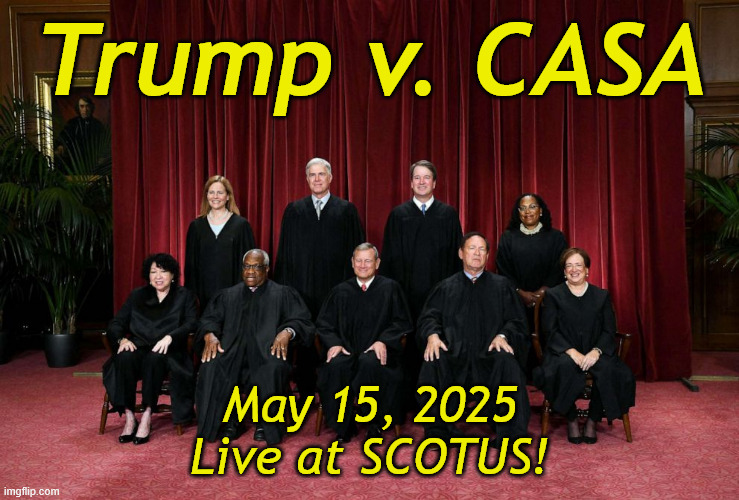
In today’s one big beautiful policy update, we share details of several provisions in the major tax legislation approved by the U.S. House Ways and Means Committee this week that could affect nonprofits. We provide information about other parts of the U.S. House budget reconciliation proposal of interest to nonprofits. This week’s update also provides details of the NC House of Representatives proposal for the state budget, which will be up for a vote next week. We share the latest on a Supreme Court case that could have major implications for court challenges to Trump Administration actions affecting nonprofits. To help keep you in the loop on all these recent policy developments and about information for nonprofits at risk of losing federal funding, we also provide information about a pair of free webinars – one from the Center and one from the National Council of Nonprofits. Note: At the request of others on the Center’s staff, we have added memes to illustrate the items in this week’s policy update.
| | |
Many Tax Provisions in One Big Beautiful Bill Act Would Affect Nonprofits
On Tuesday, the U.S. House of Representatives Ways and Means Committee approved a 389-page tax bill that would extend and expand many parts of the 2017 Tax Cuts and Jobs Act and make a wide variety of other changes to federal tax laws. Yesterday, the House Budget Committee incorporated these tax provisions into the One Big Beautiful Bill Act, the 1,116-page bill that Congress hopes to pass through the budget reconciliation process this spring or summer (see the next item for more details).
The Center has prepared a summary of key nonprofit provisions in the House budget reconciliation proposal that include:
- Re-establishing a temporary, limited, above-the-line tax deduction for charitable contributions for 2025-2028, which would be capped at $150 per year for individuals and $300 per year for married couples. While the caps are quite low, this proposal could still lead to an increase in charitable giving.
-
Increasing the tax rate for investment income of large private foundations from a flat 1.4% rate to a graduated rate that would be as high as 10% for large foundations. These higher taxes would mean that large private foundations would have fewer assets available to make grants to charitable nonprofits, both now and in the future.
- Setting a floor of 1% of taxable income on charitable deductions for corporations. This could lead to a reduction in corporate giving, particularly by small businesses.
-
Making permanent and expanding the higher standard deduction from the 2017 Tax Cuts and Jobs Act. This could mean that even fewer people would use the charitable deduction on their taxes over the next four years, potentially leading to further reductions in individual giving.
-
Limiting the value of itemized deductions for high-income taxpayers. This would likely mean that some wealthy donors would give less to nonprofits.
-
Extending and expanding exemptions from the estate tax. This could lead to fewer and smaller charitable bequests in the future.
-
Establishing Money Accounts for Growth and Advancement or MAGA accounts as a new type of savings account that parents of children under the age of eight years old could create for their children. Under the proposal, tax-exempt nonprofits, including private foundations, could make unlimited contributions to MAGA accounts to all children within a qualified group, such as a school district or educational institution or any other type of group that the Treasury Secretary "deems appropriate." The creation of MAGA accounts would create more competition for limited philanthropic resources as some individual and foundation contributions would be diverted from supporting charitable nonprofits to supporting MAGA accounts.
-
Giving the U.S. Treasury Secretary broad authority to revoke the tax-exempt status of “terrorist supporting organizations.” This provision is virtually identical to a bill (H.R. 9495) that the House passed in November 2024 by a 219-184 margin. Under existing law, the Treasury Secretary can revoke the tax-exempt status of organizations that the federal government has designated as terrorist organizations. This provision would expand the Treasury Secretary’s ability to revoke the tax-exempt status of “terrorist supporting organizations,” which is a much broader and less clearly defined set of nonprofits than those that are covered by the current law. While this provision is troubling for nonprofits, it appears likely that it would violate the Byrd Rule in the Senate, which prohibits provisions in a budget reconciliation bill that would not have a budgetary affect.
-
(Re)-expanding unrelated business income tax (UBIT) to parking and transit expenses. The provision would require nonprofits to pay UBIT - an income tax - on expenses that they incur to cover parking and transit costs of their employees. The Center and other nonprofits were successful in getting a similar tax on nonprofits repealed in 2019. Other provisions in the bill would expand UBIT to nonprofits’ name and logo royalties and to more research income of nonprofits.
-
Increasing tax rates on endowments of some nonprofit colleges and universities. This change could significantly reduce the resources that some nonprofit colleges and universities in North Carolina have for need-based financial aid and other important services. It could mean that these colleges and universities would need to be more active in their private fundraising, creating greater competition with other local nonprofits for limited philanthropic resources.
-
Expanding the tax on certain highly compensated nonprofit employees (Section 112020). This provision would expand an existing 21% excise tax on tax-exempt organizations that pay more than $1 million in compensation to employees in any year. Under current law, this excise tax is only applicable to payments made to the five highest compensated employees of the organization. This provision would expand its coverage to all current and former employees of tax-exempt nonprofits who receive $1 million or more in compensation in any year. This could increase taxes for some very large nonprofit institutions with multiple staff who earn more than $1 million per year.
We encourage you to read the Center’s full analysis of the House tax proposal for more details on these provisions and other parts of the proposal that could affect some nonprofits.
| |
Congress Could Pass Budget Reconciliation as Soon as Next Week
The U.S. House of Representatives Budget Committee released the full text of the One Big Beautiful Bill Act yesterday. House leadership is expected to make some changes to the bill over the weekend, and the full House could vote on it as soon as next week. While most legislation requires 60 votes to pass the U.S. Senate, a budget reconciliation bill can be used to pass major legislation that affects federal taxes or spending with a simple majority vote in the Senate. Budget reconciliation is most frequently used when the same party controls both houses of Congress and the White House. In the past, Congress has passed bills like the 2010 Affordable Care Act, 2017 Tax Cuts and Jobs Act, and 2022 Inflation Reduction Act through the budget reconciliation process.
| |
Medicaid Proposals in U.S. House Budget Reconciliation Bill Could Be Significant for North Carolina
On Tuesday, the U.S. House Energy and Commerce Committee approved a variety of provisions that will be a part of the House version of the One Big Beautiful Bill Act. Several of these provisions make changes to Medicaid, including provisions to:
- Require work requirements for Medicaid recipients;
- Add verification of citizenship and immigration status of Medicaid recipients;
- Reduce the federal cost share for Medicaid expansion (from 90% to 80%) for states that allow "illegal immigrants" to access Medicaid benefits; and
- Limit the ability of states to finance their portion of Medicaid through "provider taxes."
These changes could reduce the number of North Carolinians receiving health care through Medicaid and could increase the cost to the state of North Carolina to provide health care services.
| |
U.S. House Committee Proposes SNAP Changes
On Tuesday, the U.S. House Agriculture Committee approved a variety of provisions that will be a part of the House version of the One Big Beautiful Bill Act. Several of these provisions would make changes to the Supplemental Nutrition Assistance Program (SNAP). One provision would shift a portion of the cost of SNAP to states, based on their current "error rates" for SNAP beneficiaries. North Carolina would likely be responsible for paying 20% of the cost of SNAP benefits in our state, which would place significant financial burdens on our state budget. Other provisions would increase the maximum age for work requirements under SNAP from 54 to 64 and would eliminate SNAP eligibility for people who are not U.S. citizens or green card holders.
| |
NC House Begins State Budget Process
Yesterday, seven appropriations subcommittees of the NC House of Representatives met to approve their plans for various parts of the state budget for FY2025-27. The budget details, which comprise most (but not all) of the full House budget proposal, were spread throughout 15 different documents that were released yesterday morning. House appropriations and provisions relevant to nonprofits include:
- Some new funding for nonprofits providing a wide variety of services. The Senate’s budget proposal would have included virtually no new funding for nonprofits. For perspective, the state budget for FY2023-25 included about $1.5 billion in (mostly one-time) directed grants to more than 640 nonprofits.
- A provision that would claw back $500 million in state funds that had been appropriated to NC Innovation, a relatively new 501(c)(3) nonprofit, and would redirect those funds to be used for Hurricane Helene recovery efforts in western North Carolina.
- A provision that would enable North Carolina to add work requirements for Medicaid recipients. While the budget doesn’t specify the details of these work requirements, other work requirements for federal and state benefits have included “mandatory volunteerism” provisions that can create challenges for nonprofits by requiring some people to volunteer with nonprofits – often in a way that creates new costs, liabilities, and burdens for nonprofits – to maintain their government benefits. This provision could help facilitate new federal requirements if Congress adds work requirements for Medicaid (see the third item in today’s policy update for more details).
- $60 million in additional funding to increase child care subsidy rates.
- Expanded funding for the NC Partnership for Children (much of which will support local Smart Starts) to support a child care workforce pilot program and mental and behavioral health programs in child care settings.
- Funding for most (perhaps all) of the nonprofits that had previously been part of the NC Department of Health and Human Services (DHHS) competitive grants program for nonprofits. The Senate budget didn’t provide funding for some of these organizations.
- Significant investment in programs to respond to the impacts of the opioid epidemic, including directed grants to 44 nonprofits across various parts of the state.
- Elimination of several government offices related to diversity, equity, and inclusion, including environmental justice programs at the NC Department of Environmental Quality and the Office of Health Equity at DHHS.
- Funding for a new statewide electronic payment processing system with a limit of a 2% transaction fee on electronic payments. This system could address concerns that nonprofits have expressed about the inability of some state agencies to make electronic payments on their state grants and contracts.
- An increase in the maximum weekly unemployment benefits from $350 per week to $450 per week, beginning in July 2025. Earlier this year, the NC House of Representatives passed a bill (H.B. 48) that would increase maximum weekly benefits to $450 per week. The Senate budget would increase the maximum weekly benefits to $400 per week.
- A provision establishing a $10 paper filing fee for nonprofits and businesses that don’t file documents with the NC Secretary of State electronically.
The House plans to release the full version of its state budget proposal next Monday evening and then hold committee hearings on it throughout the day on Tuesday. The full House will vote on the budget next Wednesday and Thursday. The Senate approved its version of the state budget last month. Once the House passes (spoiler alert!) its version of the state budget next week, House and Senate leaders will work together on a compromise version of the budget to send to Governor Josh Stein next month.
| |
U.S. Supreme Court Hears Oral Arguments in Case with Broad Implications for Nonprofits
Yesterday, the U.S. Supreme Court heard oral arguments in Trump v. CASA, three consolidated cases in which several states, nonprofits, and individuals are challenging President Trump’s Executive Order (EO 14160) ending birthright citizenship. The Court’s hearing yesterday did not focus on the substance of the Executive Order but rather on the Trump Administration’s argument that federal courts should not have the authority – or at least should have very limited authority – to issue nationwide injunctions (sometimes known as universal injunctions). The Court is likely to issue an opinion in the case in June or July.
The Court’s ruling in this case could have significant implications for several other pending lawsuits that are significant to nonprofits. Over the past four months, several federal courts have issued nationwide injunctions in cases challenging a variety of Executive Orders and other executive actions of the Trump Administration, many of which were initiated by nonprofits. For example, the U.S. District Court for the District of Columbia has issued a nationwide injunction in the National Council of Nonprofits v. Office of Management and Budget case stopping the federal government from implementing a broad freeze on federal grants. If the Supreme Court were to rule that federal trial courts lack the authority to issue nationwide or universal injunctions or were to place limits on the types of cases in which trial courts may issue nationwide injunctions, some or all of the executive actions that have been stopped by these injunctions could be put back into effect.
| |
Let Us Know: Has Your Nonprofit Experienced Redundant Government Audits?
Over the years, the Center has heard from some nonprofits that have had issues with redundant auditing and/or reporting requirements from various federal agencies, state agencies, and accrediting bodies. The Center is working with state officials to try to identify ways to streamline audit and reporting requirements for nonprofits with government funding and to minimize state audit and reporting requirements that are redundant of what is already required by federal funds or accrediting bodies. Let us know if your nonprofit has had issues with redundant federal or state auditing or reporting requirements, so we can keep you in the loop on these conversations.
| |
Join a Free Webinar on Cancellations to Federal Grants
The National Council of Nonprofits is offering a free webinar for nonprofits on responding to federal grant cancellations. The webinar on Monday, May 19 at 3:30 p.m. will cover how grants are being cancelled, steps grantees should take to prepare for the risk of cancellation, and considerations for organizations after cancellation. Register now. Note: This webinar will not be recorded. Space is limited, so please do not register if you cannot attend the live event.
| |
Join a Free Webinars to Learn More About State Policy Developments Affecting Nonprofits
Readers of these weekly policy updates have probably noticed there have been many significant policy developments affecting nonprofits this year. To help you keep track of the latest on key state-level policy issues, the Center is offering a free webinar this afternoon (Friday, May 16) from 1:00-2:30 p.m. to provide an update on recent state policy developments affecting charitable nonprofits. Register for the state policy webinar. Note: This webinar will be recorded, and we'll send the recording link to all registered participants.
| |
NC House Gives Final Approval to State Budget Amendments
On Tuesday, the NC House of Representatives gave final approval to a bill (H.B. 74) that would make a variety of changes to the state budget for FY2023-24 and FY2024-25. Among other things, the bill would:
- Extend the deadline for nonprofits that received earmarked appropriations in the FY2022-23 budget to expend these funds through June 30, 2026. Any unexpended funds from these appropriations were scheduled to revert back to the state on December 31, 2024. For a list of affected nonprofit appropriations, check out the Center’s analysis of nonprofit appropriations and provisions in the 2022 state budget.
- Change the recipients of several directed grants to nonprofits. In some cases, these changes appear to simply correct the name of the nonprofit receiving the earmark. In other cases, the changes appear to replace an appropriation to one nonprofit with an appropriation to another nonprofit.
- Expand the types of real property interests that can be donated (often to nonprofits) for environmental, historic preservation, and public trails and be eligible for a tax credit.
The Senate approved the bill two weeks ago, so it now goes to Governor Josh Stein for his consideration.
| | | | |