|
Deal of the Week
by Andy Kaufman
Oh My! What A Difference A Lead Makes Part 3
In continuation of my theme around the “art” of opening leads that sometimes will lead to stark differences in results, I will provide some general guidance in this and future articles around the subject of opening leads.
There are normally many examples in your daily games where the choice of an opening lead can lead to making or defeating a contract, or impact under and overtricks. This is a fairly broad subject, so I will not be covering all topics, but hope to provide the reader with some good advice to improve their game and results at the table.
Opening leads can be separated into two main topics: vs. Suit Contracts and vs. Notrump Contracts. The key to making the “best” opening lead is that the player must first stop and think and consider all data available since their choice may ultimately impact the fate of the contract.
The first step is to review the bidding and understand any implications based on all actions and your hand. Also consider the form of scoring (IMPs vs. Matchpoints) and vulnerability. In general, at IMPs you are attempting to set the contract at the risk of allowing overtricks based on the reward versus risk tradeoff. At Matchpoints, the player is attempting to maximize their result on each board compared to the entire field. This form of scoring gives a premium for informed opening leads and accurate defense, since allowing contracts to make or to allow overtricks will be very detrimental to your Matchpoint results. In today’s article we will look at Matchpoint opening leads and additional points to consider:
-
Have the opponents avoided bidding NT? If opponents have bid 3 suits, lead the unbid suit even if holding AQx, since RHO won’t hold the K since he didn’t bid NT.
-
Did your partner fail to overcall at the one level? Be cautious about leading these suits since likely partner won’t be too strong in the suits especially when marked with some high card values. The exception is if you hold a good honor sequence.
-
Is there going to be a long and strong side suit in dummy? Since this is a potential source of tricks for declarer an attacking lead is called for! Lead from an honor in an unbid suit, but never lead a trump or from bad holdings such as xxx.
-
Has your partner bid? It is normally right to lead partner's suit unless you have a strong sequence of your own. Guidance for leading partner’s suit is:
- With any doubleton lead the higher.
- With 3 to an Honor (10 or higher) in partner's suit lead low.
- With 3+ small cards holding of 9 or lower, lead the top if you have supported partner's suit, but lead the lowest if you have not.
- If holding the Ace regardless of length lead the Ace.
- Holding two adjacent honors regardless of length lead the higher honor.
- Holding 4+ with a single honor lead 4th best or 3rd/5th depending on your agreement.
- Occasionally holding Kxxx or Kxxxx you may choose to lead the King to allow you to hold the trick so you can make an intelligent shift at trick two, especially with likely singleton in dummy.
-
Do you expect to see ruffing power in dummy? Does dummy's bid imply support for the trump suit? This mostly occurs when two suits are bid and the partner prefers the second suit, which implies shortness in openers first suit (i.e. 1S-P-1N-2C-P-P-P). Leading a trump often works best especially when you have a good holding in declarer's first suit.
-
When else is it a good idea to lead trumps? A must when partner passes your takeout double at the 1, 2 or 3 level (i.e. 2H-Dbl-P-P-P). Just close your eyes and lead a trump 😊. A second must is when your side has most of the high card strength and the opponents are obviously sacrificing (i.e. 3D-Dbl-4D-4S-P-P-5D-Dbl). A third situation is versus a slam and you don’t hold an ace or supported honor sequence (i.e. QJ10x or KQxx). It is usually ill advised to lead away from an unsupported honor holding (i.e. Qxx or Kxxx) which will more often give the contract away.
-
When it might be right to lead a short suit? A short side suit lead can be very effective especially when holding control of the trump suit (ie. Kxx, Ax, Axx). In this way declarer can’t draw trumps before you can get in to lead to partner’s entry to get your ruff(s). A corollary to this situation is when you have a long side suit yourself along with a trump control. Here you expect your partner to be short, so you should be able to create ruffs for your partner. A word of caution when holding 4+ trumps especially with natural tricks (ie. QJ10x, J109x). Leading short suits should be avoided at all costs and you should lead your long side suit. This has the benefit of setting up a forcing defense where you force declarer to ruff shortening their trump holding. It is never beneficial for your side to try for ruffs with natural trump tricks.
-
Best Leads against a suit contract? Leading from a suit suit headed by AK is likely the best. Partner can signal whether they hold the Q or doubleton so that a potential ruff can be had. Leading the top card from an honor sequence is a strong lead, especially when holding 3 consecutive honors. It is an acceptable lead if only holding 2 consecutive honors especially if holding the 4th card in the sequence (i.e. QJ9x or KQ10x). Leading from the K or Q of an unbid suit is normally better than leading from xxx.
-
Leading from 3 small in a side suit? There are different opinions about this topic but I recommend leading small (count card) on opening lead from xxx. This gives partner count of the suit and ensures if leading high that it is from shortness. Some like to lead MUD (Middle-Up-Down) but I do not recommend this treatment.
-
Leading or Underleading an Ace? Not normally recommended to lead an Ace unless defending a slam or if it is a long suit of your own or opponents have bid the other 3 suits strongly in the auction. Underleading an Ace is quite dangerous, but it can be considered if dummy has shown a very strong hand and declarer has shown weakness.
Well, we have shared quite a few pointers to digest, but hopefully these will help improve your leads against suit contracts.
Here is just one example from a recent game I played with my Minnesota partner.
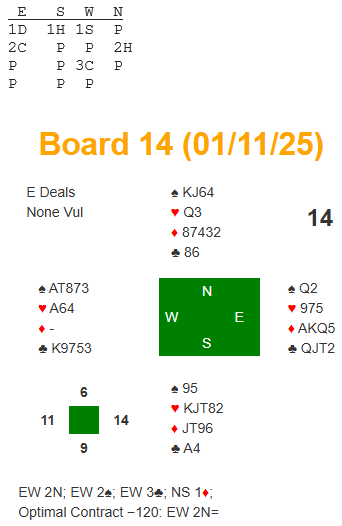
Deal #3: Over the holiday’s there was not much time for bridge. The following deal came up in the Common Game.
Here was the auction…. And what was your choice of leads by South at MP’s and why?
|