North Penn Bridge Bulletin

Greetings to the

North Penn Bridge Community!

Week of 01/27/2025

New Limits for Tuesday and Friday Games


You asked, we listened and as a result the masterpoint limits are being raised for the Tuesday and Friday games, effective Tuesday February 4:


Tuesday game 0-1500

Friday game 0-750


Please spread the word. See you at the tables!

Monday Evening Shuffle & Deal


February 3, 10 and 24.

March 10, 24 and 31.


Open to all players.

Education


Joann Glasson's January Zoom classes continue on Monday, January 27 at 10:00 a.m. See flyer for details.


Joann Glasson's February Zoom classes will be held on Monday, February 3 & 17 at 10:00 a.m. See flyer for details.


Beginner lessons with Linda O'Malley at the King of Prussia bridge club on Wednesdays from February 5 - March 19. See flyer for details.


Online lessons with Lisa Mita. See flyer for details.

  • Play of the hand part 1: Wednesdays @ 4:15 from 1/15-2/5
  • Play of the hand part 2: Wednesdays @ 4:15 from 2/19-3/12

This Week At North Penn


All games are STaC, offering silver points.

Monday

Tuesday

Wednesday

Thursday

Friday

Open.

0-1000.

Shuffle & Deal, Open.

Open.

0-500.

View Monthly Calendar

Deal of the Week

by Bucky Sydnor

(sydnoriv@yahoo.com)


What Is Partner Up To?


One of my favorite parts of the game is defense. Like bidding, but unlike declarer play, it is a chance to work with partner to accomplish a common goal. In the pursuit of that goal on defense, we need to give thought to what partner is trying to do. Let’s look at what occurred at a recent pairs game.


E/W opponents reach 3NT after W, the dealer, opens 1and the auction proceeds:

W-----.N----E-----S

1----.P----2♣----P

2-----P----3NT--P

P------P


Note: E’s jump to 3NT shows 15-17 in 2/1


Partner leads the ♠4 and here is Dummy (W) and your hand (N):


♠QJ K10763 AK64 ♣104


♠83 Q9842 109873 ♣8


Declarer plays the ♠J, you play the ♠8, giving partner count (even number, probably 2), and Declarer plays the ♠5.


At this point your thinking should be something like this. Partner led the ♠4. Using the Rule of 11, Dummy, Declarer and you have seven spades higher than the 4. Dummy has 2, you have 1, so Declarer has 4, including the ♠5 she just played. Considering the bidding, you can also deduce that E only has 4 spades, meaning that partner has 5.


Declarer then turns to the club suit and leads the ♣10, the play goes 8, 3, 7. She continues with Dummy’s ♣4, you play the 3, showing no interest in partner leading diamonds, Declarer the ♣Q, partner the ♣K. Partner then leads the 5, 3 from Dummy, and it’s your play.


What is partner up to and what should you do?


Your thought process about the heart suit itself might go as follows. Partner has led his lowest heart. There are only three hearts out there, so by leading his lowest, he could have led from the AJ5. But that is highly unlikely. So, he may have led low from either the ace or the jack. Or he may have led a singleton, hoping to find you with the AQ. Which is it?


While you are pondering that, you might expand your thoughts beyond the heart suit. Partner has not returned a spade. Since he knows you have two (or four), he has not tried to set up his possible remaining ♠K10xx, by leading the king, or his possible remaining A10xx by leading the ace.


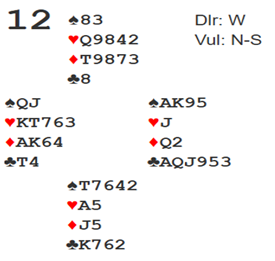
With that set of thoughts have your figured out what partner is up to? Here’s the whole deal:

Partner holds the A and is trying to steal a heart trick, namely with your Q. So do not make the routine play of your 8! His goal is to get 3 defensive tricks rather than just the obvious two your side has coming to it. He does not know you have the Q, but if you do not, it probably doesn’t matter anyway as it looks like he will get his A later (unless declarer has only 1 heart, the queen, plus the Q).


This is the fun of defending in pairs, working with partner to get all the tricks you can. In teams the goal of defense is to set the contract; one “sells one’s soul,” so to speak, to defeat the contract. Declarer’s overtricks be damned.


But at pairs, you can get a great board if you get all the defensive tricks you can, in this case 3, rather than just the 2 you “deserve”. The first 75% game I had, I was partnering with Mitch. On the first deal the opponents bid to 2NT, and when the dust settled, they had made their 8 tricks. A flat hand, I thought. Wrong! After the game, I learned that every other declarer in the room made 9 tricks; we got a top on the board.


At the beginning of play while declarer is making her plan, and later in the play as it becomes clearer which player holds which critical cards, work on determining where your tricks are, or might be, coming from. And then get them.


If you had to defend all 24 boards but always hold Declarer to only those tricks she deserves, you might end up with a 75% game. And you will have accomplished it by working hand in glove with your partner.


How fun is that!

Ask the Expert


Email your questions, or a pesky hand, or something you’d like to know about bidding or playing to Toysie Walker. She will forward them to the panel, one will be chosen, and the question and answers will be printed in the following week’s newsletter.

70% Club

Tue, Jan 14

74%

Neil Snyder & Harry Spaeth

January Birthdays

Gina Bresler

Russ Bumbry

Emily David

Leah DePaul

Joan Flanigan

Jeanne Harrington

Edward Leach

Mary McGready

Lisa Mita

Susan Morse

Dennis O'Brien

Priscilla O'Connor

Carol Roden

Christine Sgro

North Penn Duplicate Bridge Club

(215) 699-4932

NorthPennBridge@gmail.com

Visit our website