|
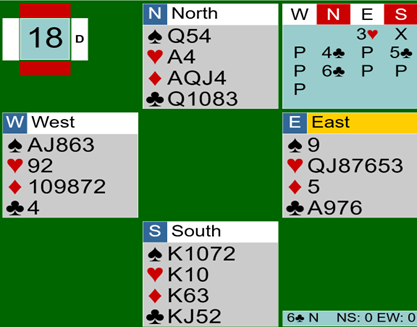
E’s opening preempt is sound and, it turns out, highly disruptive for N/S. Both opponents have opening hands and belong in game, but they must start their auction by doubling or by bidding 3♠ or higher. What’s worse, they are vulnerable. E has put the opponents under a lot of pressure.
It turns out they do not know how to handle the situation. Would you and your partner?
S doubles 3♥. S only has a 13 count (with two 10s as well). That is not enough to come into the bidding or make a call at this level when one is vulnerable, for if partner is weak he still must reply at the 3- or 4-level. The double misleads partner. Badly.
By doubling, S shows one of two hands. Her more likely hand has at least an ace more than a minimum opening (4+12=16) in order to come into the bidding at this point and it would be best if she had a king and queen better (5+12=17). The reason is that the weakest responses by N are 3♠, 4♣ and 4♦. So even if N is a weak hand, S has forced him to bid at a high level. S has to have points to back up her double.
There is a second type of hand she can have: the strong, single-suited takeout double. At this level and vulnerability it should be at least 18 playing points and a 6-card suit of her own, something like ♠AK1098x ♥xx ♦KQx ♣AQ. The longer her suit, the fewer points she requires, preferably in aces and kings, not queens and jacks.
As you can see, S simply had a minimum opening hand with no aces, which makes it even less impressive.
Once S has doubled, it is now N’s turn to show his hand. He has 15 HCP, including 2 aces! He should be ecstatic that his partner has shown at least 16 playing points, and hopefully more. Moreover, he has support for any suit she has, if she has the strong, single-suited hand. So, he needs to let S know that there are good days ahead. But the preempt has made that exceedingly difficult. To show his hand, he has to take the bidding even higher.
IF he had only 9-11 HCP he should still jump the bidding. In that case, depending on which suit he wants to bid, his bids would be 4♠, 5♣ or 5♦. But his hand is better than 9-11 HCP, much better! To show it, he needs to bid 4♥, cue-bidding the preemptor’s suit.
His other option is a NT bid. 3NT would show about 11 HCP. He is stronger than that as well. So, if he wanted to bid NT, he would have to bid 4NT, if he were sure it was quantitative. It shouldn’t be Blackwood, but it could easily be taken as “good hand: please pick a minor, partner.” Since bidding 3NT after S’s double understates the value of N’s hand, getting to 6N is now difficult.
Those are his options. Which did he choose? 4♣! (This is definitely not showing he is ecstatic!) That is one of the 3 weakest bids available to him! Nevertheless, he bid 4♣, possibly wanting to keep the bidding low. Sadly, he had more pressing duties than keeping the bidding low; he needed to show his partner his great hand.
Back to S. She had enough experience in team events to know that it can be disastrous to miss one’s games (and slams). So, she raised 4♣ to 5♣. But she has a bare minimum opening hand. If E had opened 1♥, she had doubled, and N had bid 2♣, she would have passed. She is not strong enough to do anything else. So, if she must pass after
1♥ - Dbl - P- 2♣
P - ?
then she surely must pass when the auction is at 4♣. But she didn’t.
Meanwhile, N, thinking S has shown some sort of strong hand by raising him to 5♣, now raises her to 6♣. That goes down two for as soon as N goes to draw trump, E wins her ♣A and leads her singleton spade. W takes his ace and gives her a spade ruff.
The point of all this is not to hold N and S up to scorn. Rather, when an opponent preempts, the point is to apply the principles from lower-level auctions but make the appropriate adjustments for the higher ones.
First, when you are vulnerable, and your RHO preempts with 3♥, you must have a strong enough hand to simply make a takeout double. Secondly, Doubler’s partner, Advancer, then needs to show his hand; he must not let the level scare him off. His side might have a slam; don’t let the preemptor cheat you out of it. He must trust his partner: if she has the points to make a takeout double at this higher level, then he can make the bid that shows his points, whatever that requires. Finally, the Doubler must know when to back off and when to press on.
All this is similar to managing low level takeout double auctions for the same principles apply to high level takeout double auctions. As I said above, they simply require more points and stronger hands.
Mastering takeout double auctions is well worth studying and then discussing with your favorite partners.
Post-mortem: How should the bidding have gone?
E----S----W----N
3♥--.P!---P----3NT1
All pass
Note:
- Its imps, we’re vulnerable. I am taking a shot at a game. I could have passed.
If N risks 3NT, he can make it, IF, after E’s heart lead, he drives out the ♣A first. If he mistakenly drives out the ♠A first, W will lead another heart and when N has to play clubs, E will win her ace and run however many hearts she still has. Driving out which black ace is a guess.
If N passes, which is not unreasonable, but in a team event it is not the best for winning bridge. N/S have a challenging defense ahead of them. The best defense is if S has the guts to lead a heart. Then they will set 3♥ two, for they prevent Declarer from getting any club ruffs in dummy. If S leads a spade, Declarer makes 9 tricks (1 spade, 5 hearts, 1 club and 2 club ruffs). The same thing happens if S leads a club. If she leads a diamond, the defense wins and has a chance to recover by leading hearts. Failing to switch to hearts, though, still gives E the timing to make 9 tricks.
Those nasty preempts! They can mess you up!
|