|
Deal of the Week
by Andy Kaufman
Oh My! What A Difference A Lead Makes Part 4
In our last installment we covered the “art” of opening leads for Suit Contracts considering many factors including: the auction, form of scoring (matchpoints vs. imps). Hope those pointers given last time have given you food for thought and improved your results at the table. Since opening leads are partly art and partly science one never gets this right on every hand. All to hope for is that stopping to think and consider your opening leads based on all information available will continue to improve your results. Today we will take a closer look at opening leads versus Notrump contracts. As before the first step is to review the bidding and understand implications based on all actions and your hand. Also to consider is the form of scoring (Imps vs. Matchpoints) and vulnerability. In general, at Imps you are attempting to set the contract (especially in game contracts) which may result in allowing overtricks based on the reward versus risk tradeoff with Imp scoring. At Matchpoints, the player is endeavoring to maximize their result on each board compared to the entire field in the event. This form of scoring gives a premium for informed opening leads and accurate defense, since allowing contracts to make or to allow overtricks will be very detrimental to your Matchpoint results.
Here are points to consider when defending Notrump Contracts: Everyone has probably heard the phrase “lead fourth from your longest and strongest suit”! Things are never quite that simple and need to consider other clues.
- Especially to make your partner happy 😊, you should tend to lead any suit your partner has overcalled unless you have a strong suit of your own plus an outside entry.
- In stayman auctions tend to lead a major unless opener or responder has explicitly shown a four-card holding in a major, unless you have a very strong holding there (ie. KQJ9).
- If holding a similar holding (strength and length) in an unbid major and minor, tend to lead the major since opponents won’t normally conceal a possible major fit.
- Leading from strong holdings in a four-card suit (ie. QJ10x, KQJx) is recommended vs a weak holding in a five-card suit (ie. Jxxxx).
- It is very important that partner knows whether you hold an honor in the suit led, so leading your lowest card (if playing attitude leads) or 4th best when holding an honor will indicate to your partner that it is advantageous to continue this suit when gaining the lead. If leading from a weak holding of 4+ length it is recommended to lead either top of nothing from a sequence (ie. 987x) or normally second highest card (ie. 97532) since often 10’s, 9’s and 8’s may be important cards to hold for later play. I prefer leading low from J9xx or better, but this is something to discuss with your partner. There is a helpful carding method called Smith Echo that can also indicate desire for continuation in opening led suit or desire for a switch. This will not be covered here.
- If dummy is known to have a long strong suit, it is recommended to make an attacking lead in a shorter suit (ie. QJx, KQx, AKx) versus weaker longer unbid suits.
- When your hand is extremely weak and partner is marked with values in the auction, often you should lead a short suit to try to hit partners possible long suit even when they failed to overcall.
- Many people play standard honor leads vs. NT. This would be top of a sequence of three or more honors (ie. KQJxx) or two with next non-touching honor (ie. QJ9xx). However, some prefer to play “coded 9’s & 10’s”. This includes lead of the Jack to deny any higher honors (ie. J108x), but the lead of the 9 or 10 promises either 2 higher honors or none (ie. K109xx or 1097x). These leads enable partner to the opening leader to quickly assess the honor situation around the table.
- Lead of an Ace is considered the “power” lead, which indicates the opening leader has a potential running suit but lacks one of the top honors (ie. AKJ10x). Partner is demanded to play an honor under the Ace or give count in the suit. This information will allow the opening leader to continue or switch when appropriate. Some players use the King as the power lead, but this is a partnership agreement.
- Lead of the King is top of a sequence (ie. KQ10x) or a short suit lead (ie. AKx, KQx) trying to find length in an unbid suit in partner’s hand. Partner should give attitude to this lead, encouraging if holding the ace, queen or the jack.
- There are other leading situations and signaling agreements not covered in this article, but most of the basic situations given here should give your partnership a heads up at the table.
I have shared quite a few pointers to digest, but hopefully these will help improve your leads against NT contracts.
Here is just one example from a recent game I played with my Minnesota partner where things went quite wrong.
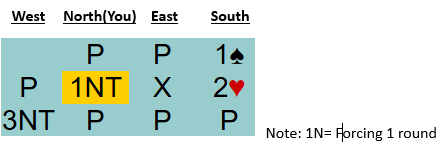
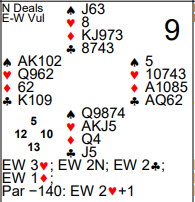
Deal #4: My Minnesota partner and I participate in the Vichill Team League played on BBO against strong competition. The following deal came up where I needed to find the “best” lead against a 3NT contract at imps.
Here was your hand as North and the auction (North Deals, E/W are Vul)….
What was your choice of leads at Imp’s and why? Decide before reading on.
----♠J63
----♥8
----♦KJ973
----♣8743
|