|
Deal Analysis
by Bruce Schwaidelson
(bruschwade@aol.com)
Can Egbert the Expert Improve Your Declarer Play?
One of my column “fans” came running up to me last week exclaiming that she had a deal she wanted me to write about, but begged me not use her real name. Anne Onimous had recently attended a bridge presentation by the famous Egbert the Expert. She told me that among other things, his spiel included a discussion about the Rule of Eleven and how declarers everywhere are forgetting that they too can benefit from the Rule, not just the opponents. She enjoyed the talk and took copious notes throughout.
Anne informed me that “Eggy,” as he likes to be called, began by posting this fairly common situation:
-Dummy (N):---♣ J93
Declarer (S):---♣ K102
Declarer is in a 4♠ contract and her LHO (West), playing standard leads, starts with the ♣8 against the unbid club suit shown above. East wins the Ace and returns the ♣7. The age old bridge question: should declarer play high or low at trick two?
Eggy suggested that unless opening leader made a tricky lead of some kind, this problem should be “over easy.” Play low, since LHO is likely short and RHO undoubtedly holds the Queen. Not only that, if his partner ruffs, East likely wants a heart returned since his ♣7 should show suit preference.
Eggy next asked: What do you do if West begins with the ♣4 this time and East again wins the Ace and plays the ♣8 next? Just about everyone in the room yelled out “put up the King,” convinced that the West held the Queen and East might be doubleton, looking for a ruff.
Eggy wondered aloud: “Really? Is everyone here quiche-ing me?” He then posed two questions:
(1) Couldn’t West have a singleton?
(2) If the ♣4 isn’t stiff, how many clubs does West have?
This time Eggy did his own answering: “Of course the ♣4 lead could be stiff, but if it’s not, then it must be low from three or four pieces but not five (!), since declarer and dummy have the ♣2 and ♣3.”
He continued: “That means East also has three or four clubs, leading us to Question 3: is there any danger in putting up the King?
“We know there is no possibility that East has a doubleton, but East may very well hold the Queen, hoping that either his partner has the King or perhaps declarer will be fooled into playing the King – exactly what you all shouted out! Hopefully, you now realize the correct play is to go low.”
But Eggy wasn’t done. According to Anne, he spent the next half hour discussing ways in which declarer can utilize the Rule of Eleven to help determine what to do at trick two in somewhat more complicated situations. He called them his “Western omelets,” as they had a few more ingredients to consider, but were not as difficult as, say, a lovely souffle.
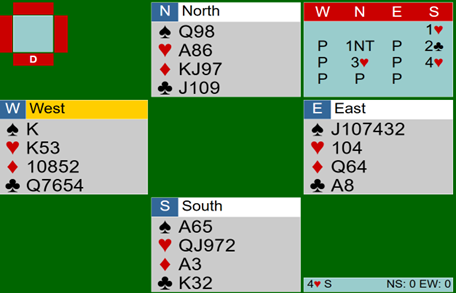
Rather than showing me Eggy’s omelet examples, Anne wanted to talk about the deal she played at North Penn. She was declaring 4♥ and here was the unbid club suit:
-Dummy (N):---♣ J109
Declarer (S):---♣ K32
West’s opening lead was the ♣6 and East took the Ace and returned the ♣8. What should Anne do?
Anne assured me she was very excited to be utilizing Eggy’s lecture points, so the first thing she did was ascertain that her opponents were playing fourth best leads, but do occasionally lead “top of nothing.”
Eggy had recommended that if the play at trick two wasn’t obvious, the next thing to do is apply the Rule of Eleven. The Rule, as you likely know, states that if the lead is fourth best you can subtract that card number (the six in this case) from eleven to obtain the number of cards higher than the opening lead held by the other three players. Thus, 11 - 6 = 5 such cards among North, South and East combined. Yet dummy had three, declarer one, and East had shown two, the ♣A and ♣8, making a total of six!
Anne’s egg-cellent conclusion: the ♣6 could not be fourth best! It could be low from three, which would be Q76, or a singleton, doubleton or even top of nothing. There was no fear in playing low. Why? If West actually holds the Queen, East has four clubs and certainly can’t ruff the third round. And if her LHO does not have the Queen, dummy will take the trick.
Here was the full deal (rotated):
|