|
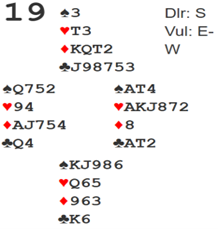
As soon as Dummy was tabled, Declarer realized she should be in 4♥, but she wasn’t. East had undervalued her hand by simply overcalling 3♥. She needed to value it as worth a power double (the strong take-out double). Then she would have doubled first, and bid her hearts on the next round. That way her partner would know he had enough to put her in game.
In the 1990s, when I was learning to play duplicate, a power double started at 18 HCP. It has since moved down to 17 HCP, at least for many of us, so one should overcall with 16 or less. But E’s hand is only 16 HCP so why is it worth a power double?
East has a 6-card suit headed by AKJ, 2 side-suits Aces – both of them A10x—plus a singleton, all making the hand very upgradeable. In fact, the Kaplan & Rubens (K & R) evaluator+ (see footnote below) scores it as being worth 20 points.
To see why her actual hand was upgradeable, notice the difference between these 16 HCP hands:
♠A104 ♥AKJ872 ♦8 ♣A102 K&R score: 20
♠A104 ♥AK6542 ♦J ♣A102 K&R score: 19
♠KJ4 ♥KJ8732 ♦A ♣KJ2 K&R score: 15.95
The first hand is her original one. In the second hand, without the ♥J, the 6-card heart suit is weaker. On top of that, the singleton ♦J has almost the same value as a ♦2. Even so, the hand has retained the other features which made the original upgradeable.
In the third hand, while the clubs and spades could, on an exceptionally good day (and with a different auction), provide 2 tricks each (when the A and Q are onside in both suits)—more than the two A10x’s could provide—they need to be set up. Either the opponents need to lead the suits or Declarer must get to Dummy several times to set up tricks.
To be sure, the 3♣ preempt* makes the opponents bidding more difficult, as preempts can. Without it, the auction would have been routine:
P – P – P – 1♥
P – 1♠ – P – 3♥
P – 4♥ all pass
Getting to the right level of a contract often depends on successful hand evaluation. Refining your evaluation and re-evaluation skills is an ongoing process, as you come across hands that were worth more or less than you thought. But there are certain standard characteristics of a hand that suggest its value in a particular auction. Work at identifying and applying those. In this hand it was the long suit headed by AKJ, 2 side-suit aces, and a singleton with no wasted honor.
Footnotes:
+ The Kaplan & Rubens evaluator is a tool for evaluating hands. You can click here in order to use the evaluator. It also includes an evaluator by Danny Kleinman. Here is some interesting information about the K&R evaluator by Richard Pavlicek: “In the early 1980s Edgar Kaplan devised a hand-evaluation method with various tweaks, attempting to translate expert judgment into a rigid formula. Jeff Rubens provided the mathematical expertise and oversight to fine-tune the project. While too complicated for practical use, it is often implemented by computer, and even to this day is highly regarded as the definitive gauge to evaluate a bridge hand.”
* I consider this preempt with only J9 sixth to be a bad one. Even adding the ♣10 doesn’t fix it. Yet the preempt worked, so how can it be bad? It only worked against a player who didn’t know how to handle it; on this particular deal it should be routine to find 4♥ even after the 3♣ preempt. Meanwhile, it is a bad preempt because it misled partner to leading away from his Kx in the preemptor’s suit, potentially giving away an important trick at matchpoints. A discussion of what are bad versus good preempts needs its own article or more.
|