|
Hand Analysis
by Bucky Sydnor
(sydnoriv@yahoo.com)
Here Is A Low-level Double That's For Penalty,
Not Take-out
You are in 1st seat and the auction goes:
1♦ – 1NT – Dbl – P
?
What does partner’s double mean?
This happened in a morning game with my weekly partner, who was sitting first seat. She took my double as take-out and decided to bid 2♠.
It was not an irrational thing to do. On auctions where Opener bids one of a suit and her LHO overcalls at the one level, double by Responder is for take-out. But in the auction above, Responder’s bid is not a negative double for take-out.
The auction
1♣/1♦/1♥/1♠ – 1NT – Dbl …
is a special auction with a standard meaning, namely, it’s a penalty double. When you add up Opener’s points and the 1NT bidder’s points, you get a minimum of 27 (12 + 15). It could be more, as Opener could have more than 12 and the 1NT Overcaller, who may be playing 16-18 1NT overcalls, could have as much as 18.
Regardless, there are not many points left for Responder and Advancer to have between them. So, when Responder has 10 or more HCP the strongest bid Responder can make is double. Mike Lawrence even lowers this to 9 points or even 8 with a good opening lead. He writes:
“Barring some distributional reason suggesting a different action, you should double a 1NT overcall with all 9-point hands and with any 8-point hand that has a good lead. Opener is not obligated to sit for the double.”
The double, then, is for penalty, not take-out.
The reason is that if everyone just has the minimum points for their bid, Dummy will only have 3 HCP, which may provide one entry to Dummy, or on a good day for Declarer, two entries. That means the defense can keep Declarer in his hand, leading away from his tenaces. He is going down. If Opener and Responder have the Maximum number of points, Declarer is probably going down a lot.
If, after the auction
1♦ – 1NT – ?
Responder does not have 10 HCP, Mike Lawrence, in The Complete Guide to Contested Auctions (1992; pp 159-172), gives four other options besides double when the auction goes 1x – 1NT - ?:
-
Raising partner’s bid: “This is a common choice when your RHO overcalls 1NT. … your side [probably] won’t have game. [So,] bidding by your side should be … competitive and not looking for a game.” Because of this, a jump raise by Responder is always preemptive, not invitational to game.
-
Bidding a new suit: “Bidding a new suit isn’t as safe as raising partner’s suit. … you can count on partner to have opening bid high cards but you can’t depend on him for any trump help. For this reason, you usually need a 6-card suit [with good spot cards]. [Again,]… this is not forcing. Partner is expected to pass.” Personally, I like to play this as a drop-dead bid, but Lawrence leaves the door open for partner to make another bid.
-
Passing: “It is often right to pass when the opponents overcall 1NT.You may have a hand that feels like it should enter the bidding but [if you have multiple messages to send, like two 4-card suits] you don’t have a safe way to [communicate] this, and it is best to pass.”
-
Using a convention for this particular auction: “There are a lot of conventions.” Lawrence mentions two, which he calls Hamilton (similar to Cappelletti over 1NT) and Bluhm (similar to Meckwell over 1NT). I once played yet a third: if partner had opened a minor, and her LHO overcalled 1NT, the other minor showed 4-4 in the majors. It never came up. My personal view is that this auction is so infrequent that it doesn’t warrant using up limited memory by having a convention to play.
What, then, if Responder and Opener have all of the outstanding HCP? Won’t they miss game? It’s possible, though game is not guaranteed, while setting 1NT is very likely. Exceptions to setting Declarer do exist. For instance, Declarer could hold 7 tricks in her own hand, say with
♠xxxx ♥Ax ♦Ax ♣AKQ10x
a hand, too strong to open 1NT, but OK to overcall 1NT. As long as the club suit comes in and the opening leader doesn’t hold 7 running spades.
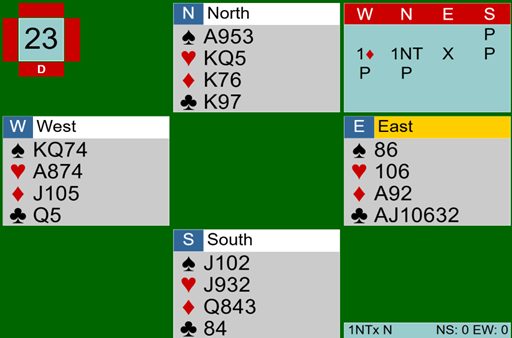
All this leads to today’s hand, which occurred in an evening game of that same day with the same partner. That morning, we had the auction above and she took my double to mean take out and bid on. We discussed the deal afterwards. Then that evening, her regular partner was unavailable so we played again. On the next to the last board, this was the deal and auction:
|