North Penn Bridge Bulletin

Greetings to the

North Penn Bridge Community!

Week of 07/13/2026

This Week At North Penn


All games this week are Silver Quest offering 33% Silver points

Mon, noon

Tue, 10a

Wed, 9:30a

Wed, noon

Thu, noon

Fri, 10a

Open

0-1500

Bid & Play

Open

Open

0-750


Handicap Swiss Teams


Upcoming Special Events


NAP Qualifiers on 7/20, 7/22, 7/23, 7/24

7/27-31 is STaC week


Evening Pizza

Board Meeting

Handicap Swiss Teams

4 Is Enough

0-750 Swiss Teams

Handicap Pairs

Friday, 07/24 (Pizza at 6:00, Game at 6:30)

Monday, 07/27

Thursday, 07/30

Wednesday, 08/12

Friday, 08/13

Thursday, 08/20

Bid & Play


This week Mitch will lead the group.

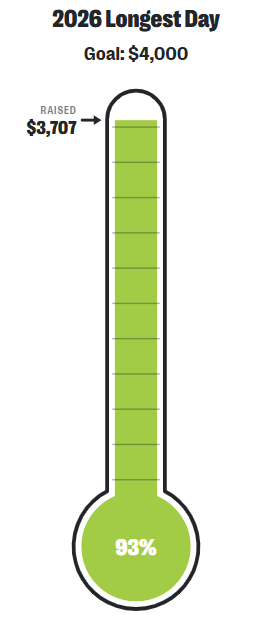
Do What You Love to End ALZ

(formerly known as Longest Day)


We have raised $3,707 to date.


You can still donate through the end of July:


  1. Online by clicking here
  2. Mail this form to the Alzheimer's Association
  3. Cash or check at the club in designated box


Deal Analysis

By Bucky Syndor

(sydnoriv@yahoo.com)


The In-N-Out Burger


Have you heard of the In-N-Out Burger? If you don’t have reason to visit California for more than a brief stay, and especially if you don’t have friends or relatives you visit there, then you may not have. In-N-Out Burger is primarily, though no longer exclusively, a California phenomenon. Over the decades In-N-Out Burger has developed a highly loyal customer base and has been rated one of the top fast-food restaurants in several customer satisfaction surveys.


But my interest in In-N-Out Burger right now is not its food or its history as a business, but why its name should be remembered when playing bridge.


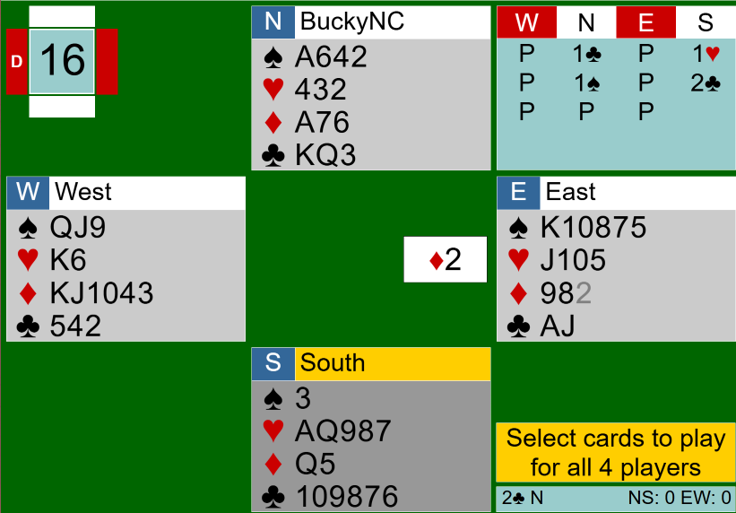
I was in a weekly BBO game, when in second seat, white vs red, I was dealt

♠A642 ♥432 ♦A76 ♣KQ3


I opened 1♣ and the auction went

P – 1♣ – P – 1♥

P – 1♠ – P – 2♣

all pass


When the dust settled I had taken 10 tricks for a 66% result. Here is the full deal.

My 10 tricks resulted from lucky declarer play and poor defense, which I will not go into here. Rather I hope that you find a 66% result for making 10 tricks in 2♣ a strange result for a pairs game, especially a large pairs game. It is strange because there is a problem on this deal back in the auction. Do you see it?


In the first round of bidding E failed to overcall 1♠; he failed to get into the auction at his earliest and easiest opportunity. If E doesn’t enter the auction immediately, his side probably will never find a good contract (2♠ or 3♠) worth fighting for.


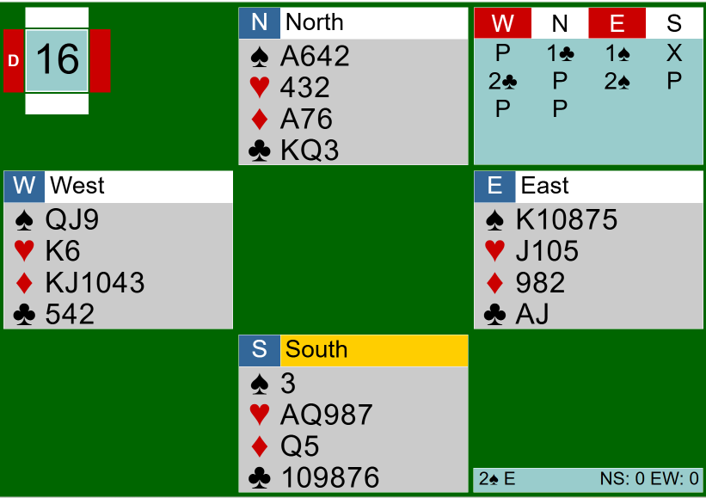
This is what happened at another table when E did overcall 1S:

E/W have 9 tricks in spades, losing a trick in each suit, even though spades are 4-1. It is surprising, or another “strange item” if you will, that S at favorable vulnerability did not compete to 3♣.


When I first learned bridge, a 1-level overcall usually showed at least a 5-card suit and a hand that would have opened had my RHO passed. That suggested a 1-level overcall was made with 12-16 points. By 1980, Michael Lawrence in his The Complete Book of Overcalls had shaved that down to 10 HCP, or a great 9 (e.g., ♠AJ109x with A1098 in a side suit).


Today some pairs play that, white vs red, a major headed by KQ109x and out is enough to join the auction. If your overcalls are lighter than, say, 10 HCP, you must remember the In-N-Out Burger: get In as early as you can, N get Out of the auction early as well. That type of aggressive overcalling led to the adage “get in early and get out early.” Otherwise, you might get doubled and go down a bundle.


Indeed, the range of points for overcalls is so different among partnerships that the convention card has a place for you to note your overcall range.


Moreover, how the Advancer (Overcaller’s partner) responds needs to take into consideration that the Overcaller may not have an opening hand. So, while a single raise is still 6-9, if partner’s overcall is at the two level, a single raise is increased to about 8 to a bad 11. Regardless, with a good 11 or higher, Advancer makes a cue-bid.


So you need to give some thought to how low your partnership with make a non-vulnerable one-level overcall. It is often the same for a vulnerable one-level overcall. But once partner has made a two-level overcall, especially if your side is vulnerable, the points (or “values”) needed for your bid rises.


Once you have clarified your overcall range, you are ready to get into the opponents’ auctions early with your one bids, possibly finding a decent contract, like 2♠ or 3♠ on the deal above, all the while making the opponents search for a good contract more difficult. That, for you, can also be a plus as they may end up in the wrong contract.


And if you’re ever in California, do stop by an In-N-Out Burger at least once.


Postmortem:

Regarding what happened at the second table, above, letting opponents settle in 2♠ when they have a fit and are red and you are white, is a matchpoint no-no. But that’s for another article.  

Ask the Expert


Email your questions, or a pesky hand, or something you’d like to know about bidding or playing to Toysie Walker. She will forward them to the panel, one will be chosen, and the question and answers will be printed in the following week’s email.

July Birthdays


Linda Brockway

Elaine Clair

John Dickenson

Lynne Kaltman

Cynthia King

Evelyn Melchiorre


Beth Milton

Sherry Scena

Tedd Stickel

Hans Toegel

Toysie Walker

North Penn Duplicate Bridge Club

(215) 699-4932

NorthPennBridge@gmail.com