North Penn Bridge Bulletin

Greetings to the

North Penn Bridge Community!

Week of 09/07/2026

This Week At North Penn


Mon, noon

Tue, 10a

Wed, 9:30a

Wed, noon

Thu, noon

Fri, 10a

Open

0-1500

Bid & Play

Open

Open

0-750

Labor Day Party (lunch at 11:30, game at 12:00


4 Is Enough


Handicap Pairs

Swiss Teams


Upcoming Special Events


4 Is Enough

Board Meeting

Handicap Swiss Teams

Handicap Pairs

Evening Pizza

D4 NAP Flight B Finals

0-750 Swiss Teams

Wednesday, 09/09

Monday, 09/14

Thursday, 09/17

Thursday, 09/24

Friday, 09/25 (Pizza at 6:00, Game at 6:30)

Saturday, 10/03 (10:00 & 2:15)

Friday, 10/09

Bid & Play


This week Mitch will talk about Play of the Hand.

Deal Analysis

By Bucky Sydnor

(sydnoriv@yahoo.com)


A Look At Slam Bidding Without Using Blackwood


You may not be used to bidding a slam without using your partnership’s version of Blackwood, but with highly distributional hands it has its merits, especially when part of the distribution involves a void.


Today’s deal comes from a game on BBO. My interest in the deal is just with the bidding. When focusing on the bidding, I think it is helpful if you do not know the full deal initially so you can experience what goes on in the head of one player during the auction.


You are South and here is your hand, all 8 HCP of it.

       ♠Q10543 ♥K105 ♦K9654 ♣–


N dealt and opened the auction with 1♥. E jumped right in with 2♣.


Looking at only S’s hand and considering only N’s 1♥ opening, S had several options if the auction had been uncontested. S clearly had heart support; his issue would have been whether to support hearts immediately or bid 1♠ first. With the ♥K10x, 8 HCP and a void, his hand was worth a limit raise (but with only three trumps). Moreover, he had two kings and a queen for his 8 HCP with a 10 or 9 to go with each of them. That 8 HCP is far, far better than, say, a queen in every suit and low spot cards behind them.


But the interference changes how S should proceed. E’s overcall of 2♣ had increased the value of S’s hand, making his club void clearly valuable. One way to assess the new value of S’s is to consider that S may possibly be able to ruff the first two rounds of clubs, or has, in bridge jargon, first and possibly second round control. That makes his club void similar to holding the ♣AK. Now no oen but no one values a useful void as 7 points: in standard hand evaluation, a void is worth 3 points when you have 3-card trump support. So, one must be careful when mixing these two ways of viewing a void. But the former view is helpful in appreciating how powerful the void is. To repeat myself, the void gives N/S a first round control of clubs and possibly a second. Considering the interference, S decided to evaluate his hand as invitational and to show his spade suit en route to showing support later with 3♥.


W raised his partner’s overcall to 3♣ and N continued with 3♥. With E now passing—he was getting OUT of the auction, as you will see he should—the auction is back to S:

N------E----.S.....W

1♥ – 2♣ – 2♠ – 3♣

3♥ – P – ? 


How should S proceed? With both opponents bidding clubs, S’s club void has increased so much in value that S decided he now wants to go to 4♥, and maybe higher. For example, if the opponents sacrifice with 5♣, he was considering 5♥, since the strength of his hand is not in high card points alone but in the club void alongside his two kings and a queen. The point is that S’s hand has great offensive potential but holds limited defensive potential.


Since S is now sure his side should be in 4♥, he decided that on his way there he should show his club control by cuebidding 4♣. This tells N that S had either the ♣A or a club void. In addition, it showed support for N’s hearts; indeed, it showed exactly three hearts because the way S has bid, he would have shown four heart support at his first response. So the cuebid could be useful information to partner as the bidding proceeded, and it turned out to be so.


W doubled the cuebid and N bid 4♦. That showed the ♦A and an interest in playing more than just 4♥. E passed. The auction was now:

N-----E----S-----W

1♥ – 2♣ – 2♠ – 3♣

3♥ – P – 4♣ – X

4♦ – P – ?


It was now time for S to slow down. He bid 4♥, telling partner that while, earlier, he could bid 2♠ over E’s 2♣ interference before he supported hearts, he had nothing more than the minimal points that he promised. Meanwhile W chimes in with 5♣, leaving the auction thus:

N-----E----.S----W

1♥ – 2♣ – 2♠ – 3♣

3♥ – P – 4♣ – X

4♦ – P – 4♥ – 5♣

?


While S was waiting for his partner’s call, he decided that if N passed or doubled 5♣, he would bid 5♦, showing both the ♦K and a desire to play 5♥ rather than to penalize 5♣.


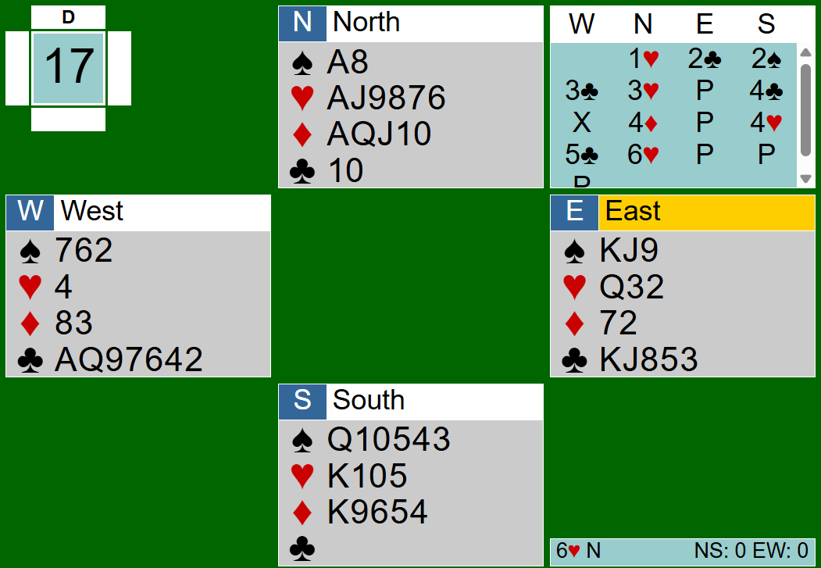
But none of that was necessary: N closed out the auction with 6♥. Here is the full deal.

As you can see, 6♥ is cold; the only potential loser is the ♥Q. N’s spade loser is discarded on Dummy’s 5th diamond.


A major reason N/S found their slam was poor interference by E/W. (Yes, one can interfere poorly!) With 58 tables (116 pairs), only 7 pairs got to slam, and one of them in 6♦. So, because the slam is based on so few high card points (24!) and many E/Ws preempted more aggressively than in the deal above, most N/S pairs were in only 5♥, having been prevented from exchanging enough information to get to slam. That was the value of interference. But looking at what good interference would be on this deal would require another article.


The lesson from this article is that going slow in slam bidding can lead to a good slam, but your partnership needs to be clear on what the bids mean after a fit is established.

Ask the Expert


The auction goes: 1D X P 2D

P 2H P  3S


What is the meaning of the 3S bid, and what would 2S or 4S mean in this sequence?


Bill Bauer. The 2D advance of partner's T/O DBL is game forcing. The 3S bid sets the trump suit and implies interest in slam. 2S would be looking for a fit and 4S would say I have no interest in going further.


John Dickenson. Not all partnerships play the cue bid as a game force; some play it as forcing until a suit is agreed upon. It is always 12+ hcp. But doubler could have a shapely 10 count and I could have values in the opponent's suit, so we should be able to stop in three of a major especially at matchpoints.


I generally agree with what Bill said - 3S must show a long and strong suit with some slam interest.


Whether 2D is a game force or only forcing until suit agreement is achieved, 2S by advancer has to deny four hearts and promise four spades, looking for an eight card fit.


The question about a cue bid followed by a 4S bid must be how is that hand different from bidding 4S directly over the double? I suggest the first auction is stronger.


Tom Salter. My first thought was misclick. I'm sure John and Bill have given the right and simplest explanation. The cue bid is the strongest bid advancer can make, and all strong hands need to start there. The rest follows logically.

However, all sorts of ideas went through my head: splinter supporting hearts, a Texas [non-]cue bid trying for 3NT, a misapplication of the Baze convention. Discuss it with your partner. Don't make bids your partner won't understand.


Mitch Snyder. I agree with Bill and John.


Dennis O’Brien. After the 2D cue bid, 3S sets the trump suit and encourages, strongly suggests partner cue bid a control. It is absolutely forcing to game. In this sequence 2S would show about an opening hand and asks partner to further describe his hand. 4S would show a hand with little interest in slam.


Email your questions, or a pesky hand, or something you’d like to know about bidding or playing to Toysie Walker. She will forward them to the panel, one will be chosen, and the question and answers will be printed in the following week’s email.

September Birthdays


Pat Andrews

Diane Basile

Lorna Bearn

Michelle Clemens

James Dowling

Nancy Gerhardt

Jane Havighurst

Edward Heater

Carole Levin

Joyce Levin

John Moser

Carolyn Per

Louis Primavera

Ed Ritvo

Sue Shaffer

Larry Umphlet

Jack Wilkinson

North Penn Duplicate Bridge Club

(215) 699-4932

NorthPennBridge@gmail.com