|
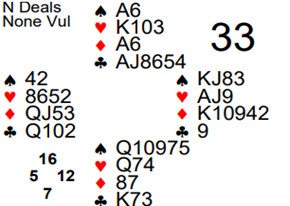
E’s opening lead was the ♣9. When the dust settled, I made 9 tricks, losing 2 spades, 1 heart and 1 diamond for +140.
There is something odd here. Do you see it?
E, my LHO, never entered the auction. My opponents can make 3♦ if E, who would declare 3♦, treats his ♥9 as the ♥10 and takes a double finesse in hearts for his 9th trick.
How does E get to 3♦, much less get to play it, instead of N/S playing 2♠? The first step is to get into the auction, overcalling N’s 1NT opening. There are numerous conventions by which that can happen.
Moreover, once E/W can get into the auction, all sorts of good things can happen for them:
- They can find and make a contract of their own;
- They can cause N/S to underbid or overbid;
-
They can cause N/S to miss their best contract or wind up “wrong-siding” it with the weaker hand as declarer;
- Or they may even succeed in suggesting a good opening lead to their partner if they defend and partner ends up on lead.
Bad things that can happen, too.
- The opponents successfully double you and you go down a lot. Indeed, if you begin to interfere with the opponents’ NT auction, this bad thing will almost certainly happen once in a while, so do not be surprised when it does.
- If the N/S side declares, the information gained from you bid(s) will help them declare, and against good players they will have lots of information at their fingertips.
-
N/S may land in their perfect contract. But that was almost certainly happening if you had never interfered, so in that case just move on to the next deal.
In comparing the good versus the bad, taking the risk is well worth it, for it will pay off more times than not, under the right circumstances.
What are “the right circumstances.” Being white against red is a big one. But most important is having the right hand to interfere. It has become standard practice to interfere only with one of two types of hands, either a long (and decent) suit of 6 or more cards or, secondly, two suits ideally 5-5 in length, but they can be 5-4 in length. E’s hand fits the latter description perfectly with his 5 diamonds and 4 spades.
As mentioned above, there are many systems for interfering. I learned Cappelletti in my early days, moved on to DONT and then happily settled into Meckwell. But DONT is by far the easiest to learn, remember and utilize.
Marty Bergen created DONT, i.e., Disturbing Opponents’ No Trump. That part about “disturbing” is valuable because it is a reminder that your primary goal when you interfere over the opponents’ strong 1NT opening is just that, to disturb their auction.
Sure, in rare cases you and you partner might have all the outstanding points other than the Opener’s 15 HCP, but that is exceedingly rare. DONT can even cater to that (see Larry Cohen’s article here for an excellent and complete explanation of DONT) if you and your partner are willing to do all the memory work and then review it frequently so that when it comes up once every five or more years both of you know exactly what to do. But you can learn the simplified version, the non-advanced version, and do a lot of “disturbing” over the weeks and months to come, with much less memory work.
Back to today’s deal, this is how the auction could have started if E/W were playing DONT, and had interfered:
Me E S W
1NT - 2♦@ - 2♠ - 3♦
?
2♦ is alertable and shows “diamonds and a higher suit” in DONT. 2♠ is a weak bid basically saying, “Partner, in my opinion, we should play here, not higher, but I do not know everything about your hand.” 3♦ furthers the 2♦ interference.
The bidding is then back to N. Now you and I know that N/S can make 9 tricks and so 3♠ is a good bid. But they cannot see all the cards; they don’t know that. As part of N’s ignorance, he doesn’t know what S’s 2♠ is based on. It could be as bad as 2 points (some maniacs will have zero!) or as good as 7 HCP. Moreover, N only has 2 spades so going on to 3♠ is unwise. In addition, since N opened 1NT, his partner is in charge of the auction for their side. So, N would or at least should pass. E, of course, is passing; his side’s work is done, they have not only disturbed the opponents’ NT auction, but they have even found a contract for themselves. Life is good!
So, back to S. He, too, is in the dark. All that he really “knows” is that N does not have 4 spades, for if he had, he’d probably have bid 3♠. But S has no knowledge about whether N has a “bad” 15 or a “maximum” 1NT opener. Being in the dark, it is wise for him to pass as well, hoping to set E/W or to have been saved from a bad 2♠ contract (though we know it wasn’t).
So, with all that, the auction might go
Me E S W
1NT - 2♦@ - 2♠ - 3♦
All pass
In that case, E/W will go +110 rather than -140. That is a very nice swing in a Swiss match.
I haven’t spelled out the bids for DONT; you can get them by clicking on the link to Larry Cohen’s article above. Rather, I want to emphasize two things made above which you should remember as you start to interfere with your opponents’ NT auction. First, you need a hand with tricks. That is considered either a single-suited hand of 6 or more cards or a two suited hand with 5-5 in a perfect world, or perhaps 5-4. Interfering with a 4-3-3-3 or 5-3-3-2 hand just because you have points is unwise.
Secondly, remember that your primary goal is to disrupt the opponents’ smooth communication; you are not trying to compete, as in a part-score bidding contest with opponents between, say, your hearts and their spades. You need a good reason to go to the 3 level; e.g., having a likely 9-card fit as in today’s deal.
May your opponents never enjoy a smooth auction after their strong 1NT opening … when you have the right hands to interfere.
Postscript: For those of you who use such tools, Mel’s (Colchamiro) Rule of 8 is an interesting test for whether to interfere after the opponents’ strong 1NT opening. It’s simplest part is that you must have 6 HCP, as well as the distributional features mentioned above. The full rule reads: “If the number of cards in your two longest suits minus your losing trick count equals 2 or more, and you have at least 6 HCP, intrude [i.e., get into the auction]!”
|