North Penn Bridge Bulletin

Greetings to the

North Penn Bridge Community!

Week of 12/01/2025

This Week At North Penn


All games are Club Membership offering extra points for no extra cost.

Mon, 12/01

Tue, 12/01

Wed, 12/03

Thu, 12/04

Fri, 12/05

Open

0-1500

Open

Open Handicap Swiss Teams

0-750

Education


Joann Glasson's December Zoom classes will be held on Monday, December 1 and 15 at 10:00 a.m. See flyer for details.

Deal Analysis

by Bucky Sydnor

(sydnoriv@yahoo.com)


Discarding Doesn't Have To Be Frustrating


Early last month I was on BBO’s Tuesday 7:10 PM game with other refugees from the former (and great) North Penn Tuesday evening game. My partner was a regular at North Penn as were our opponents on this deal.


I was 4th seat, holding

109843 K32 10532 3


I was not expecting to be involved in the action, only the defense. I was wrong; I was involved in both. S dealt and opened 1 and the auction proceeded

S  Partner N Me

1 - Dbl – 1 - ?


Normally my 3 HCP would not be enough points to come in the auction and make a “free bid” but I decided my hand had too much value to my partner not to let him know about my spades, so I piped up1. Nevertheless, the auction ended rather quickly:

S  Partner N Me

1 - Dbl – 1 - 1

3NT all pass


3NT in this auction usually shows Declarer has a long running minor, here it would be clubs, and enough outside strength to give him a reasonable chance to make 3NT. (S would bid 2NT if he simply had a normal 18-19 HCP and balanced distribution.) N could have more than a single bid hand, but that was all he had shown. If he had had significantly more than a minimal response, he would show it with his response to 3NT. But the bidding by the opponents and Responder’s final pass suggested he was a minimum.


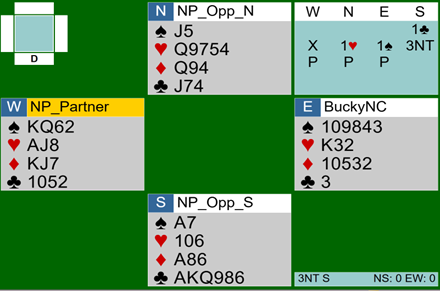
With the auction over, I awaited my partner’s lead, which was the K. Here is what I saw:


J5 Q9754 Q94 J7


K---------------------------------109843 K32 10532 3


Reviewing the auction, I reminded myself that partner did not have to have a full opener for his double. But with the bidding and Dummy’s hand, it was almost certain he did. For his take-out double of 1♣, partner either had 3 or 4 rags in hearts (i.e., no ace or jack) and the AK or he had the A and either A or K. Either way, for his call his holding in the red suits would go along with his ♠KQ—revealed by his opening lead—to give him a full minimum opening. Between dummy and my hand, there weren’t enough important cards out there for him to have anything less. If he did, Declarer would have to have more and would have bid differently.


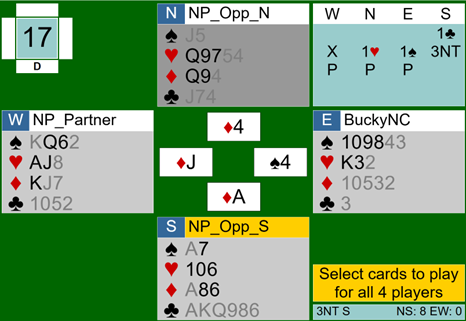
Declarer won the ♠A and I played the ♠3, encouraging (upside down carding). He played the ♣A next and then he led low to Dummy’s jack. It was time for me to plan my discards.


The two principles I use in discarding are “What suit(s) do I need to hold on to?” along with the complementary issue, “What suit(s) should I leave to my partner to hold?” So, my discarding job was simple: I was to keep my spades so that when partner gets in he’ll cash his ♠Q and come to me in spades (or hearts). Or, if I get in with my K, I will lead to partner’s ♠Q and he will return the suit. Either way, that meant out go my diamonds.


It turned out Declarer had a 6-card club suit to go along with his very upgradeable 17 HCP. So, I needed to make 5 discards after playing my singleton club.


Here’s the full deal (rotated):

Importantly, I should make a positive discard in hearts first and then pitch my diamonds as the clubs rain down on me. Easy peasy. Here is the 5-card ending that my partner and I should have achieved after Declarer runs the clubs and cashes the A:

No matter what Declarer did next, we should have taken the last 5 tricks, except…


Sadly, my brain was not up for playing good bridge during this deal. Instead of the obvious information available to me—partner’s TO double of 1, Dummy’s cards and Declarer’s jump to 3NT—my mind got obsessed with the diamond suit. So, I bungled the discarding and didn’t keep enough spades.


As you can see, S had 8 tricks off the top, and once I failed to hold onto my spades—I foolishly tried to hold spades and diamonds, an impossibility and thus a serious, serious misjudgment—we no longer had 5 tricks. Declarer got his 8th and 9th winners on the final two tricks and made his contract.2


To repeat, the issue in discarding is to figure out early on which suit (or suits) you should hold on to and leave the other(s) to partner. With partner using the same principle, your partnership will have a plan to handle discarding, along with clarity as to what unnecessary cards to throw away. Sometimes “unnecessary” cards are honors; those can be hard to give up, but out they must go.


So, with a plan discarding does not have to be frustrating.


But beware: if Declarer has you over a barrel, e.g., in a squeeze, then there is nothing you can do … but be frustrated.


Footnotes:

  1. Overcalling 1 here is a risky action as my hand is about a king shy of what one should have for a free bid in this auction. A better bidding plan would be to pass initially and then come in later at as high as 3♠, which would describe this hand quite nicely. Bidding 1 here does have its merits, but it also has several demerits against it. Two major ones are, first, if the opponents end up winning the contract and we are defending, my partner will expect that I have more for the defense than just one king. Secondly, if my partner has the big hand on this deal, rather than S, he may well jump immediately to 4 and I could easily go down 1 trick, if not 2. It is beyond the scope of this article to go into this matter in detail, or rather, more detail than I already have.
  2. My specific discarding errors have no instructive value for discarding so I have not reproduced them. If you would like to see my blunders, you are welcome to view them by clicking here (board not rotated). If you do click through and play the entire deal, you will see that Declarer saw my bad discarding and did not cash his A before exiting. Rather, after winning his 7th trick he exited a low diamond. Eventually Dummy’s Q and 9 were Declarer’s 8th and 9th tricks.

Ask the Expert


Playing 2/1, matchpoints and nonvulnerable, you hold

AK752 AJx 874 72 in first seat. The opponents pass throughout

and the auction goes 1S - 2C. What is the opener's rebid?


John Dickenson. It’s totally dependent on your 2/1 agreements. If our agreement is 2S rebid promises 6 pieces, I must rebid 2N with any 5-3-3-2 hand. If we are allowed to rebid a 5 card spade suit, and 2N rebid promises stoppers in the unbid suits, I should rebid 2S.


Elaine Clair. It depends on your style of 2/1. I would bid 2NT to show a balanced hand, either minimum or big.


John Dickenson. Elaine makes a good point - the 2NT rebid promises a 5-3-3-2 shape and either 12-14 or 18-19. If the latter, opener bids 4NT quantitative over responder's rebid of 3NT.


Bill Bauer. First, I will not rebid 2S as that call promises six spades. With balanced shape, I'd rebid 2NT.


Dennis O’Brien. I'm going after this problem in, shall we say, a less traditional way. If we are heading to 3NT, I want to discourage a diamond lead and encourage a heart lead. I will bid 2D and if partner bids 3D I will bid 3NT. This shouldn't prevent us getting to 4S if partner has spade support.


Mitch Snyder. 2S or 2NT depending on your agreement.


Email your questions, or a pesky hand, or something you’d like to know about bidding or playing to Toysie Walker. She will forward them to the panel, one will be chosen, and the question and answers will be printed in the following week’s newsletter.

December Birthdays

Don Adams

Susan Bailey

Michael Carver

Vincent Coll

Ross Currie

Ellie Davis

Doug Goldberg

Peggy Jennings

Pradip Khan

Arlene Lessack

Dennis Parenti

Joan Regenbogen

Rex Saffer

Judi Shinberg

Ann Tuteur

Erma Waters

North Penn Duplicate Bridge Club

(215) 699-4932

NorthPennBridge@gmail.com