|
Greetings to the
North Penn Bridge Community!
Week of 12/23/2024
| |
|
Wishing very happy holidays to all of our members and friends.
| |
|
Monday Shuffle & Deal
Time Correction
In last week's newsletter, we incorrectly stated 5:30 PM as the start time for the Monday evening Shuffle & Deal session.
The correct start time should be 6:00 PM as of January 6, 2025.
We apologize for any confusion that we may have caused.
| |
|
This Week At North Penn
Tuesday: Closed
Wednesday: Closed
Friday: 0-500 - The last club championship game of the year
| |
|
Deal of the Week
by Bucky Sydnor
(sydnoriv@yahoo.com)
To Return Or Not To Return:
Is The Suit Partner Led Really Our Suit?
When we learn defense, one of the fundamental tenets is that if partner’s opening lead is a low card, we are honor-bound to return it, either after winning the first trick or when we get in later. Many, many defenses go astray by not following that maxim. But this is bridge and nothing is every set in stone 100%.
Let’s look at a couple of examples where opening leader's partner (3rd hand) should not have followed that rule. For the first one, why don’t you be E, 3rd seat, all white, holding
♠J10932 ♥A10 ♦942 ♣A82
The auction goes pass, pass, pass, 1NT, all pass. Your partner tables the ♦3 (fourth best) and you see Dummy (your hand repeated for convenience):
♠86 ♥J953 ♦J1075 ♣J75
♠J10932 ♥A10 ♦942 ♣A82
Declarer plays the 5 from Dummy, you (dutifully) play your 9 (third hand high, though Eddie Kantar would advise low, to make it clear to partner you have no help in the suit) and Declarer plays his ♦K. He then leads the ♣3 to Dummy’s jack, which you win.
What do you return?
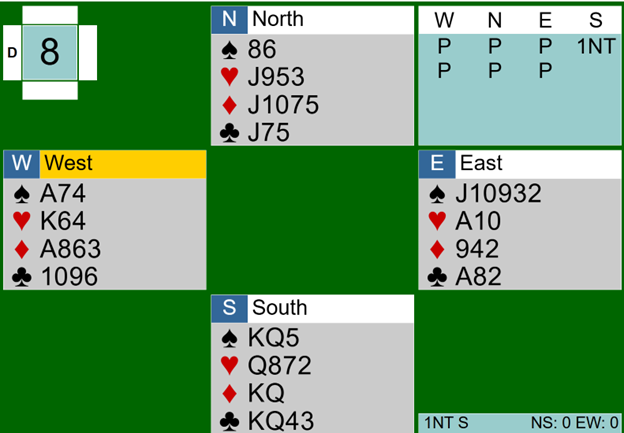
The answer: not diamonds. Why? The biggest clue is that with the ♦K gone, partner holds, at best, the ♦AQ. Leading diamonds will start the process of setting up Dummy’s ♦J. A second clue is, with the lead of the ♦3, W has only 4 diamonds. That gives Declarer two. Why didn’t he play Dummy ♦J or 10? A strong possibility is that Declarer’s second diamond is the queen.
E, seeing that diamonds is not a source of tricks for the defense—and they need a lot: 6 for book, 7 to set—needs to find a switch. The nice spade suit headed by the ♠J109 is a strong candidate since Dummy holds a small doubleton. Here’s the whole deal:
| |
|
The defenders will have no problem beating the contact by 2 tricks after shifting to the ♠J.
Let’s look at a second example. Again, you are E, 3rd seat, this time white against red, holding
♠J ♥A983 ♦K1062 ♣J752
The auction by the opponents, uncontested, goes 1♠, 2♠, 4♠, all pass. Your partner leads the ♥2 (low from an honor, either 3rd or 4th best) and you see Dummy (your hand repeated for convenience):
♠652 ♥Q1065 ♦A43 ♣1083
♠J ♥A983 ♦K1062 ♣J752
Declarer plays the 5 from Dummy, you (dutifully) play your ace (third hand high) and Declarer plays his ♥7.
What do you return?
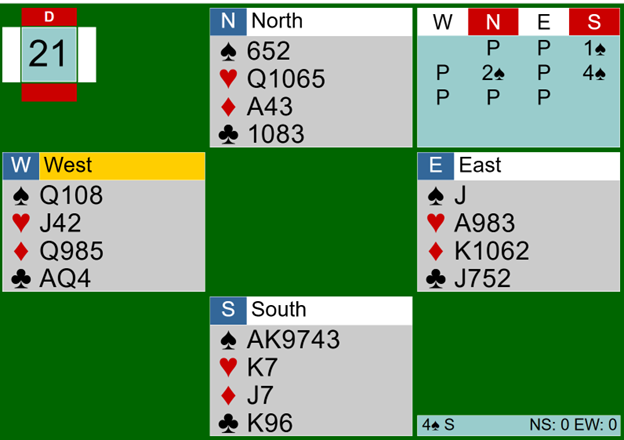
The answer: not hearts! Why? The biggest clue is, again, Dummy’s holding in the suit. Under the best of all possibilities, partner led from ♥KJ42 or KJ2. If you return a heart that will set up Dummy’s ♥Q and maybe, eventually, its ♥10. (If W holds KJ42, declarer had a singleton 7, which means he has to pitch rather than ruff to set up the Q.)
Instead, E, seeing that hearts will not be a good source of tricks for the defense, needs to find a switch. A low club is a strong candidate. Why? Because Dummy’s clubs are so weak, there’s a chance partner will have some values in clubs.
But the best defense (double dummy) is a diamond shift, with the view of cutting Declarer from Dummy before Dummy’s ♥Q is established.
Here’s the whole deal:
| |
|
Click here to call up the deal and then repeatedly click “Next” to see the play at the table.
As you can see, S seriously overvalued his hand and they were doomed to go down. How many they go down depends on the defense. Declarer has 5, maybe 6 losers: 1 spade, 1 heart, 1 diamond, and 2 or 3 clubs.
In both examples, two clues strongly suggested a switch to another suit:
- The cards played at trick one, and
- Dummy’s holding in the suit partner led.
The maxim of returning partner’s suit is one to ignore with great caution. Indeed, great, great caution. Though this article has been about spotting when to switch suits, if you never follow its advice but always, blindly return partner’s suit, you will be better off than those who do not return partner’s suit but make a switch willy nilly.
But you will become a better defender as your judgment improves regarding when to return partner’s suit and when to consider a switch.
| |
|
Ask the Expert
Email your questions, or a pesky hand, or something you’d like to know about bidding or playing to Toysie Walker. She will forward them to the panel, one will be chosen, and the question and answers will be printed in the following week’s newsletter.
| |
|
Adams, Don
Bailey, Susan
Carver, Michael
Coll, Vincent
Currie, Ross
Fleischer, Lamis
Jennings, Peggy
Khan, Pradip
| |
|
Lessack, Arlene
Parenti, Dennis
Regenbogen, Joan
Saffer, Rex
Shinberg, Judi
Waters, Erma
Weintrob, Sharon
| |
North Penn Duplicate Bridge Club
(215) 699-4932
| | | | |