Northeast Drought Early Warning News | | |
May 28, 2026
Drought Conditions Improved in Northern New England, but Worsened in Southern New England and Southeastern New York
| | |
Current Conditions
Precipitation varied across the region over the past 30 days. Areas of western and central New York, Vermont, and much of New Hampshire and Maine were wet, receiving at least 150 percent of normal precipitation. With a few days left in May, Buffalo and Rochester, New York have already had their 3rd wettest spring (March-May) on record (period of record 1871-2026). Meanwhile, it was dry across much of Massachusetts and Rhode Island, western Connecticut, and southeastern New York. Eastern Massachusetts was the driest of these areas, receiving no more than 70 percent of normal precipitation during this period.
Drought in the Northeast
Improvements in Northern New England
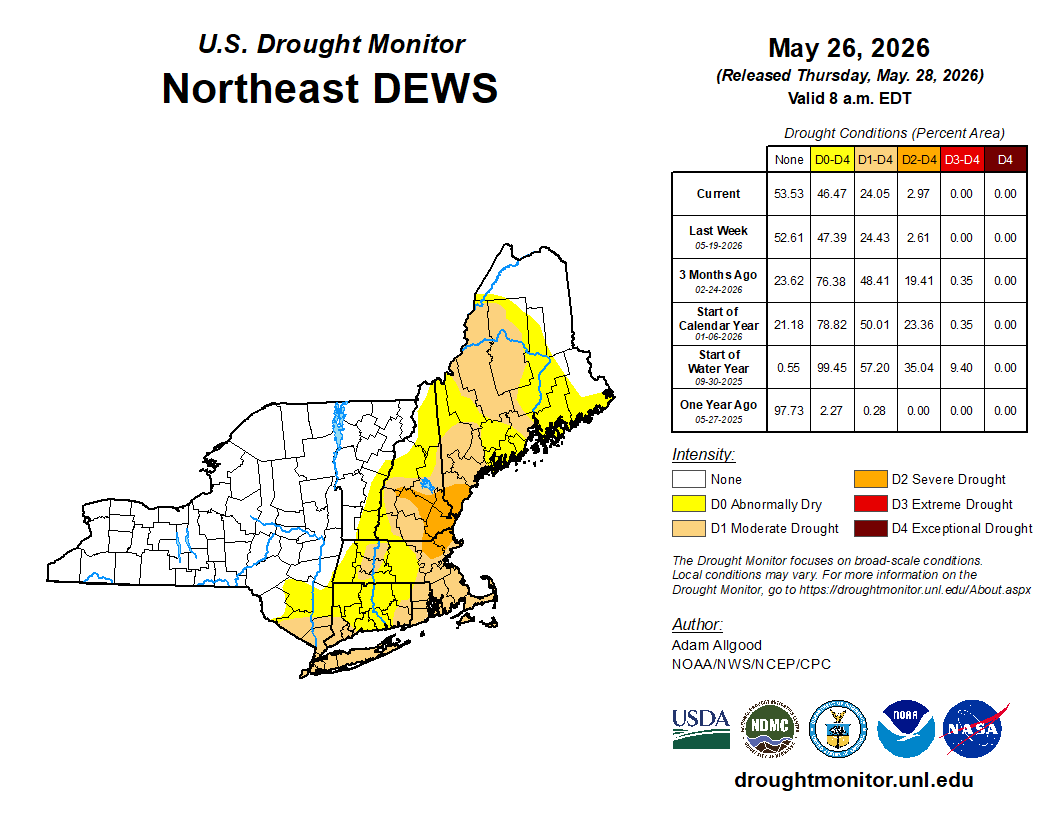
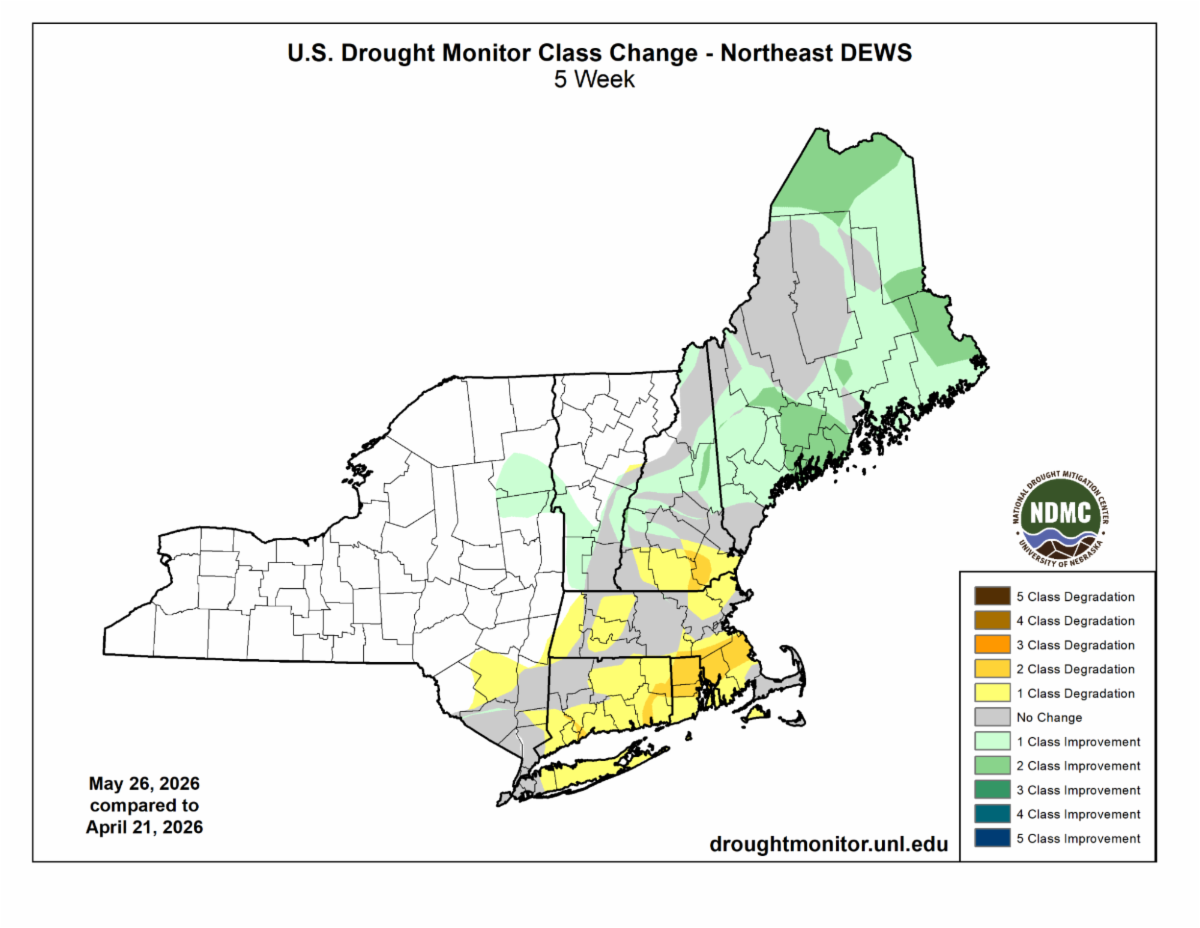
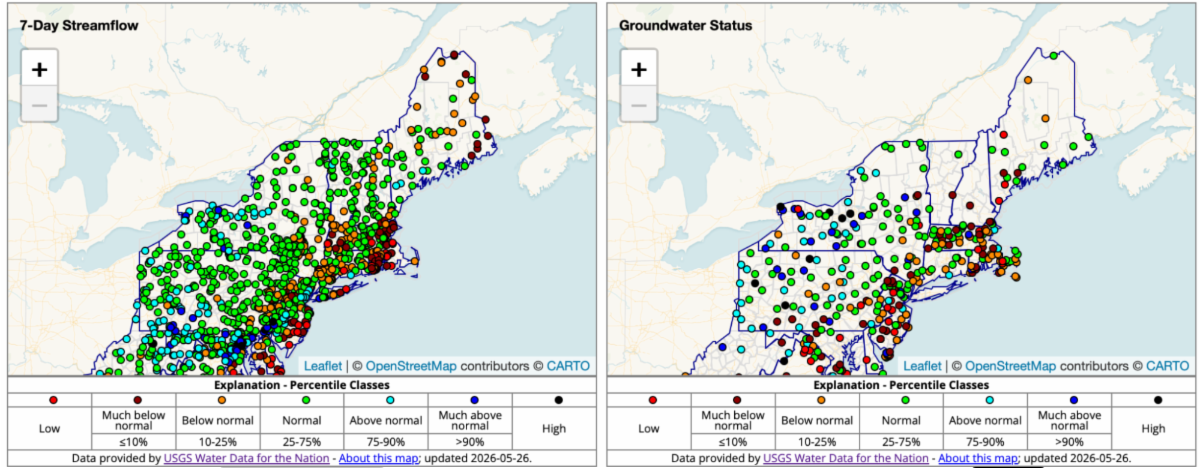
Plentiful precipitation further improved streamflow and groundwater conditions across Maine and central portions of New Hampshire, leading to further improvements in drought conditions according to the U.S. Drought Monitor. Severe Drought (D2) and Moderate Drought (D1) retracted in both states. Abnormally Dry Conditions (D0) were removed from northern Maine, western Vermont, and northeastern New York.
Worsening Drought in Southern New England
Conversely, areas of southeastern New York and southern New England missed out on this precipitation, and drought conditions worsened. Severe Drought (D2) spread into northeastern Massachusetts and southeastern New Hampshire, while Moderate Drought (D1) expanded across southern New Hampshire, eastern Massachusetts, Rhode Island, southern areas of Connecticut, and Long Island in New York. Moderate Drought (D1) developed in part of western Massachusetts as well. Continued below-normal precipitation and declining streamflows and groundwater levels in northeastern Massachusetts prompted the state to recommend residents and businesses in this region stop all non-essential outdoor watering.
| | |
Looking Ahead
The June outlook from the National Weather Service Climate Prediction Center indicates equal chances for above-, below-, and near-normal temperatures and precipitation for the Northeast. The three-month outlook (June-August) favors above-normal temperatures and precipitation for almost the entire region this summer. The exception is western New York, where forecasters predict equal chances for above-, below-, and near-normal temperatures and precipitation. The U.S. Seasonal Drought Outlook indicates drought improvement or removal are likely across Maine, southern New Hampshire, eastern Massachusetts, southern Connecticut and Rhode Island, and southeastern New York.
| | Join the Next Northeast Regional Climate Center Monthly Webinar | | |
The Northeast Regional Climate Center hosts a monthly webinar to address timely weather and seasonal topics. The next webinar will be Thursday, June 30, 2026 at 9:30 a.m. ET. The webinar will feature a review of June conditions and a guest speaker discussing a special topic. The webinars are recorded and are available within a week after the live webinar. To receive notifications about upcoming webinars, email nrcc@cornell.edu. Register >
| | Tracking the Thirst of the Atmosphere: NOAA’s National Weather Service Incorporates EDDI, A Tool to Better Monitor Drought | |
An innovative, experimental drought tool developed by NOAA Research will now be supporting the National Weather Service drought products that decision-makers rely on in times of water shortage.
The Evaporative Demand Drought Index (EDDI), which measures the “thirst of the atmosphere,” has been transitioned to the National Weather Service’s (NWS) Climate Prediction Center (CPC) as a new drought-monitoring and early warning guidance tool. The CPC, one of the nine National Centers for Environmental Prediction, is responsible for predicting and monitoring climate variations like temperature and precipitation, including drought, on timescales ranging from weeks to years. Learn more >
| | Provide Public Comment on Redesigned Drought Outlooks | NIDIS and the National Weather Service Climate Prediction Center (CPC) partnered to implement a redesign of the CPC’s drought outlook maps. The NWS is soliciting public comments through July 10, 2026 on two areas: (1) a redesign of the drought outlook display to improve stakeholder usability, understanding, and interpretation for decision-making and (2) the addition of a new category to make the outlooks parallel for both the improvement and degradation of potential outcomes. Learn more > | | NIDIS/CIRES Is Hiring a Regional Drought Information Coordinator! | | |
The Cooperative Institute for Research in Environmental Sciences (CIRES) and NIDIS are seeking a full-time Regional Drought Information Coordinator to work as part of an interdisciplinary team as the coordinator for selected regional NIDIS Drought Early Warning Systems (DEWS). NIDIS is a federal interagency and interstate effort to establish a national drought early warning information system in the U.S.
The successful applicant will advance drought science and preparedness through coordination and integration of drought monitoring, forecasting, planning, and information at national, tribal, state, and local levels. We are looking for an applicant who has significant, proven professional work experience in the western United States in one or more of the following: drought, water resources, natural resources, hazard mitigation, disaster response, climate extremes, public policy or related fields. Please share with your networks! The deadline for applications is June 10, 2026. Learn more >
| | Forwarded This Email? Subscribe for Updates | | Subscribe to the National Integrated Drought Information System's Northeast DEWS list to receive drought status updates, webinars, and other drought news for New York and New England. | | For more information about the Northeast Drought Early Warning System, contact Acting Northeast Drought Early Warning System Coordinator Crystal Stiles, CIRES/NOAA/NIDIS. | | The Northeast DEWS is a collaborative federal, regional, state, and local interagency effort to improve drought early warning capacity and build long-term drought resilience throughout the region. The Northeast DEWS currently includes New York, Vermont, New Hampshire, Maine, Massachusetts, Rhode Island, and Connecticut. NIDIS is an interagency program within the Climate Program Office, which is part of NOAA's Office of Oceanic and Atmospheric Research. | | | | |