|
Why don’t we take the profession of ‘management’ seriously?
Because, anyone called a ‘manager’, can sit at an office desk and boss people around?
No qualifications required, beyond being available?
Because, in public policy and management, political leadership comes from the hoi-polloi, dumped on us, with no thought as to their experience or expertise?
No qualifications required, beyond being on the back benches.
In the HSJ yesterday, a prime example.
Speaking at the launch of the Global State of Patient Safety 2025 report, Wes Streeting said;
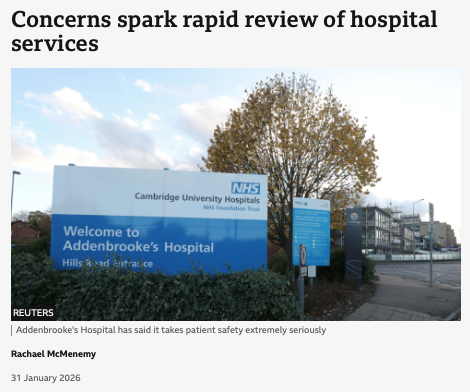
‘… the government will approach integrating the NHS’s ‘successful’ safety watchdog into the ‘failing’ Care Quality Commission with ‘enormous care’…
… and you ask me why the epithet, ‘Silly Boy’ has stuck!
Political leadership is often beguiled by entrepreneurialism. They think they should, ‘move fast’ and trusting judgement… clashing with the ‘corporate-ness ’ of the public sector that slows things down and survives by trusting process.
The best political leaders know when to switch gear. Most never do.
Political leadership has power without proximity and without the inconvenience of living with what happens next.
Managers are held responsible for outcomes they have little power to shape.
When managers push back, politicians rush to the newspapers and pronounce them obstructive... or broken.
Political leadership has become so dominant that management no longer balances it. It absorbs it. It’s submission.
No manager in their right mind, would embark on the cacophony of changes we are seeing, right now. Nor the time table, neither the costs.
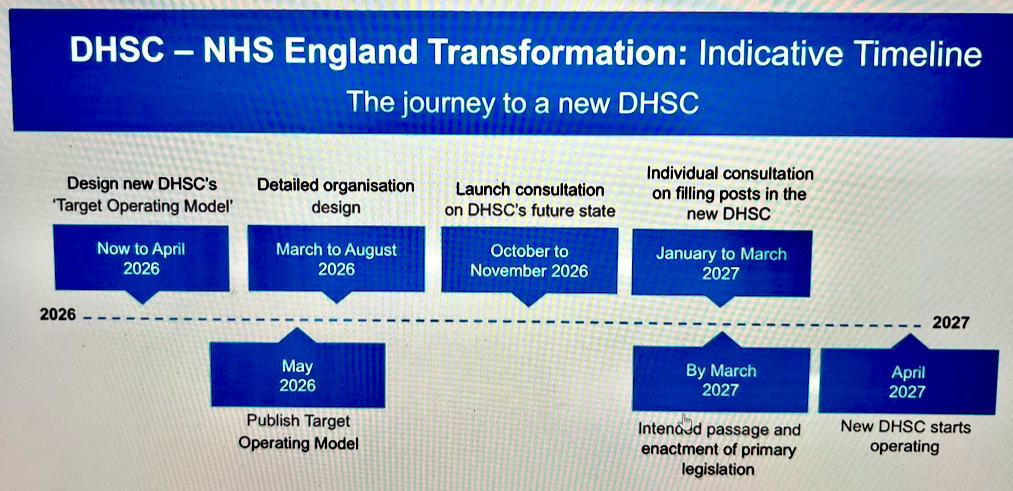
The deadline of next April is a nonsense. It’s not a delivery milestone. It’s a fiscal and political reset point, imposed on a system that needs to be thoughtful about radical change.
If this were about improving care, moving care, doing care differently it would take time. However, it’s about control, bravura and optics... compressed into under 300 days.
April is not about outcomes, it is about authority… using time-pressure to overwhelm scrutiny and force compliance, because…
… political leadership is unchecked, deadlines have replace evidence. April has become a weapon, rather than a plan.
There is no better an elegiacal reminder of what happens when political imperatives collide with management logic than when NASA ended their Shuttle programme.
The agency allowed its most experienced engineers to leave…
… they were expensive, questioning, and inconvenient to the next round of ‘lean and modern’ reforms. What walked out the door was not just technical skill, but decades of tacit knowledge…
… the workarounds, the memory of past failures and successes that no manual could capture.
Once lost, this knowledge proved irreplaceable and left lasting consequences for every programme that followed. The US fell years behind.
We know, the NHS is replaying the same error. Every major reorganisation in the last 30 years, from the introduction of NHS trusts, through the 2006 and 2012 structural overhauls, to today’s Integrated Care Board shake-ups…
… has created waves of redundancies and managed exits.
The Health and Social Care Act 2012 alone, cost more than £600 million on redundancy payouts.
After each reorganisation, the NAO and others reported; promised efficiency gains were marginal at best. Operational disruption was substantial.
Staff uncertainty, broken networks. Lost institutional memory were consistent outcomes, undermining the NHS.
Cesar Hidalgo’s book, The Infinite Alphabet explains why this matters.
He describes organisations like alphabets. Every experienced person represents a letter.
-
The more letters you retain, the more complex ‘words’, the sophisticated solutions, judgements, and risk assessments you can construct.
-
Lose letters and even simple problems become harder to solve.
-
Knowledge, the kind embedded in long-serving managers and specialists… perhaps the most valuable letter of all...
... remove it, and the organisation loses not just capacity but the very grammar that makes decision-making intelligent.
Social capital destroyed. Informal networks are broken. Long-standing relationships that allow rapid problem-solving, risk management and cross-team collaboration...
... all lost.
Morale plummets. Recruitment suffers. Remaining teams, stretched thin. Attention diverted from improving services, to managing change.
The system pays twice.
Once to shed experience in the name of efficiency.
Twice, to buy it back through delays, failure demand, mistakes and consultancy.
NASA and now the NHS are examples of the self sabotage that happens when organisations discard critical 'letters' and do things in a rush…
… and we all know; in the rush hour, nothing moves.
|