Weekly update from the National Housing Conference | | News from Washington | By Brittany Webb | | |
HUD seeks feedback on BABA implementation as bipartisan bill targets delays
The U.S. Department of Housing and Urban Development (HUD) is seeking public comments on the availability of homebuilding materials that comply with Build America, Buy America (BABA) requirements, responding to concerns that the current waiver process is slowing affordable housing development. The 2021 BABA law requires that construction materials and certain other products used in federally funded infrastructure projects be produced in the United States, but its application to smaller-scale subsidized housing developments has become a focus of bipartisan efforts to reduce barriers to housing production. The Federal Register notice says HUD is seeking “comprehensive and up to date information” on the domestic market for BABA-compliant products and product categories used in HUD-assisted housing programs and other infrastructure projects.
The request follows calls from Senators Susan Collins (R-Maine), Cindy Hyde-Smith (R-Miss.), Jeanne Shaheen (D-N.H.), and Dave McCormick (R-Pa.) for HUD to review its waiver process for certain homebuilding materials, citing delays in the construction of affordable units. A group of labor organizations also recently asked HUD to streamline smaller project-specific waivers.
The notice comes as Representatives Mike Flood (R-Neb.) and Maggie Goodlander (D-N.H.) introduced the bipartisan Build Housing Affordably Act, which would temporarily pause HUD’s BABA enforcement for covered affordable housing projects until the department assesses the law’s impact on affordable housing production. The bill would also require HUD to report to Congress on BABA’s effect on development costs and timelines and create a 90-day review period for affordable housing waiver requests, with waivers deemed granted if HUD does not act within that window.
Comments to HUD are due by July 20.
| | | |
We are grateful for the overwhelming support and look forward to celebrating with housing leaders from across the country.
If you would like to be added to the waitlist, click here.
| |
Housing groups weigh in on Basel capital proposals
Banking and housing groups, including the National Housing Conference (NHC), submitted comments to federal banking regulators on proposed changes to Basel III capital standards, urging the agencies to ensure the final rule supports safety and soundness without unintentionally restricting mortgage credit or affordable housing investment. The Basel III rule has undergone multiple comment periods in recent years as regulators and advocates seek an appropriate balance of risk and investment. The latest proposal was welcomed by housing organizations seeking to bolster homebuilding.
NHC wrote in support of more risk-sensitive residential mortgage risk weights but cautioned that higher loan-to-value loans are not inherently unsafe, particularly when supported by private mortgage insurance. The comments also called for lower capital treatment for Low-Income Housing Tax Credit investments, recalibrated treatment of mortgage servicing rights and warehouse lines of credit, and clearer standards for multifamily exposures for government-backed loans to better align capital requirements with observed risk and support stable, well-supervised housing finance markets.
| |
Federal financial regulators purge records, reduce staff
The Consumer Financial Protection Bureau (CFPB) has removed thousands of previously public records from its website, including supervisory reports, consumer advisories, speeches, press releases, congressional testimony, and other materials documenting prior agency activity. The move is being perceived as another step towards the Trump administration’s wider attempt to dismantle the agency altogether. The removals include Supervisory Highlights reports, which have historically provided public summaries of CFPB findings across consumer finance markets, including mortgage servicing, fair lending, and other areas relevant to housing finance. Common themes for removed items were enforcement, mortgages, banking, and rulemaking. Former agency officials and consumer advocates raised concerns that deleting the materials reduces transparency for consumers, industry participants, state regulators, and Congress.
"This whole exercise is futile and counterproductive; it serves no one to erase the past," said Mark McArdle, senior vice president of regulatory affairs and public policy at Newrez, and a former CFPB employee. "If you want to go in another direction, do so, but many of the resources published over the years are useful to both consumers and industry—if for no other reason than as a record of what the bureau did."
The Office of the Comptroller of the Currency (OCC) is also planning staff reductions as part of an effort to allow the agency to “operate more efficiently and effectively to accomplish its mission,” according to reporting. The plan targets staff in the Chief National Bank Examiner, Enterprise Governance and Ombudsman, management, and chief of staff offices, as well as professionals in communications and community affairs. Like previous agencies, OCC staff are being offered buyouts “to help minimize the need for a reduction in force.” The agency’s total employee count has already fallen from more than 3,600 employees in 2024 to around 2,600 in 2026, and its 2027 budget forecasts an additional 5% decrease in personnel costs.
|
| | |
VA launches new partial claim program
The Department of Veterans Affairs (VA) launched its new VA Partial Claim Program, a home retention tool intended to help veterans experiencing financial hardship avoid foreclosure and remain in their homes. The program has been widely anticipated after the original COVID-era partial claim program sunset last year, and advocates stressed the need for a replacement. The program allows mortgage servicers to identify veterans in default who may qualify for assistance and place them on a three-month trial payment plan to determine whether they can resume making payments.
After a veteran successfully completes the trial period, the mortgage servicer will advance the overdue amount needed to bring the loan current, and VA will reimburse the servicer for that amount. VA said it worked with mortgage servicers to help 173,000 veterans avoid foreclosure in fiscal year 2025.
“MBA applauds the VA’s release of its partial claim program and updated loss mitigation waterfall, following a collaborative stakeholder feedback process that helped strengthen the proposed policies,” stated Bob Broeksmit, president and CEO of the Mortgage Bankers Association. “We are pleased to see that veteran homeowners will have access to a key loss mitigation option available to other borrowers with government-backed mortgages, that can allow veterans to remain in their homes without increasing their monthly payments.”
| |  | |
Fed holds rates steady once more
The Federal Reserve Board’s Federal Open Market Committee (FOMC) voted unanimously to hold the target federal funds rate at 3.5%–3.75%, the first vote with newly confirmed Chairman Kevin Warsh. FOMC said economic activity continues to expand at a solid pace despite elevated uncertainty tied in part to the conflict in the Middle East. The statement maintained the Fed’s focus on inflation, noting that price pressures remain elevated above the goal of 2%.
Warsh’s leadership change is evident even in the text of the release. A redline comparison of the statement shows the Committee removed prior language saying it would assess incoming data, the evolving outlook, and the balance of risks when considering additional rate adjustments. It also omits previous language that identified how each governor voted. “On that score, you might have already noticed something, a difference in today’s policy statement. It’s a bit shorter, a bit simpler, and it dispenses with some older language.
That statement just gives you the facts as best we can judge it. Absent also is so-called forward guidance, which we agreed was not well suited to the current policy conjuncture,” Chair Warsh stated in a press conference.
| | | |
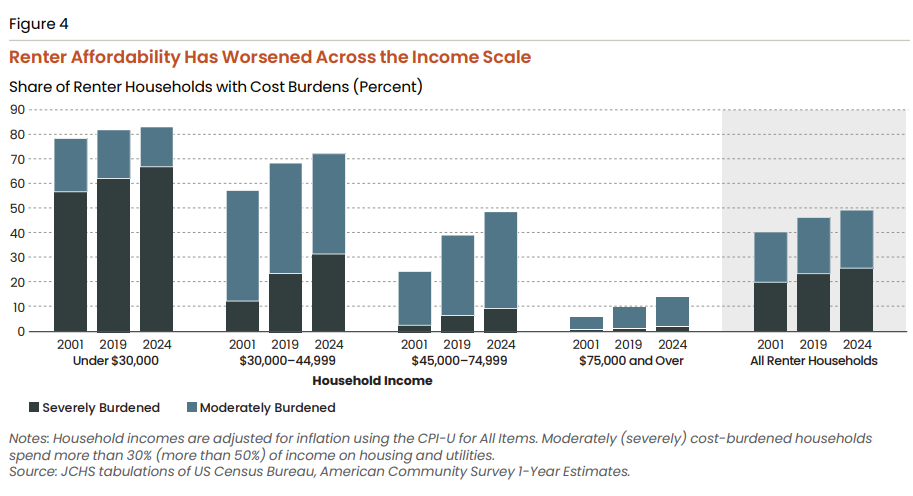
Housing affordability pressures deepen for renters at every income level
Harvard’s Joint Center for Housing Studies released its State of the Nation’s Housing 2026 report, which offers a broad look at national housing conditions, affordability, and market pressures. According to the report, the share of renter households facing cost burdens has increased across all income groups since 2001. The most severe burdens remain concentrated among renters earning under $30,000, though clear severity increases are also shown among households earning between $30,000 to $44,999 and $45,000 to $74,999, suggesting that affordability challenges are spreading well beyond the lowest-income renters. Even among households earning $75,000 and over, cost burdens have risen, indicating that housing costs are outpacing incomes across a broader swath of the rental market.
| | |
FHFA published its 2025 Annual Report to Congress covering the agency’s risk-based examination of Fannie Mae, Freddie Mac, and the Federal Home Loan Banks to assess capital adequacy, asset quality, management, earnings, liquidity, market risk, and operational risk across each entity. Both Enterprises reported lower net income in 2025. The report also covers conservatorship activities and includes legislative recommendations on mortgage fraud enforcement, third-party service provider oversight, and enterprise capital requirements.
A Smart Cities Dive op-ed by Michael Pugh, president and CEO of LISC, argues that the U.S. cannot build its way out of the housing crisis while losing existing affordable homes every day. The piece highlights how rising insurance premiums, property taxes, and unaffordable basic repairs are forcing stable homeowners into debt, while heirs’ property issues lock families out of financing and strip away generational assets. The op-ed suggests that home preservation must become a core component of housing policy through flexible repair financing, expanded legal services, and streamlined delivery systems.
HousingWire reports that mortgage rates stabilized and dipped modestly after the U.S. and Iran confirmed a deal to end hostilities, with 30-year rates falling to 6.73%. The piece explains that the deal reduced investor uncertainty and oil-driven inflation fears that had previously pushed rates higher, marking a shift from the volatility seen over the past months as tension in the Middle East disrupted bond markets. The stabilization could help ease pressure on delayed homebuyers who have faced elevated borrowing costs, though continued monitoring will prove whether the changes will hold.
A NeighborWorks® America 2025 Annual Report titled “Built to Deliver: Creating Homes, Building America” documents the organization’s housing activity over the past fiscal year, including 17,600 new homeowners, 11,400 preserved homes, 216,800 rental homes, and repairs on 66,900 homes nationwide. The report credits the organization’s approach as community-driven, informed by local insights that shape how funding, training, and services are deployed across different markets. NeighborWorks® America noted that it continues to focus on efforts towards affordable homeownership, rental housing, home repair, and workforce development for housing professionals.
| | |
Monday, June 22
Housing Abundance Roadshow: Practical Solutions For Local Growth, June 22 – June 26
Tuesday, June 23
2026 Terwilliger Center Summit on Housing Supply Solutions, 9 AM – 5 PM ET
MBA's Research Showcase 2026, 12 – 5 PM ET
Wednesday, June 24
2026 Housing Visionary Awards Gala, 5 – 9:30 PM ET
Thursday, June 25
No events posted.
Friday, June 26
No events posted.
Saturday, June 27
2026 Building the Future We Deserve: Solutions for America's Fair and Affordable Housing Crisis National Conference | NFHA, June 27 – June 30
| | The National Housing Conference is a diverse continuum of affordable housing stakeholders that convene and collaborate through dialogue, advocacy, research, and education, to develop equitable solutions that serve our common interest. | | Defending Our American Home since 1931 | | Copyright © 2024. All Rights Reserved. | | | | |