Greetings from home
We hope that you and your loved ones are well and safe. Since our last newsletter, there have been 18 reported cases of coronavirus in Nunavut. The cases have appeared in several communities, but the largest outbreak is in Arviat. Nunavut has an aggressive program to control the coronavirus, and we can only hope that these outbreaks can be contained promptly and effectively.
We wish you and your family a safe, socially distanced holiday season, and we look forward to a new, improved 2021.
|
|
Cape Dorset artists started experimental printmaking in 1957, and this led to the first annual release of limited edition prints from Cape Dorset in 1959. Cape Dorset has continued to issue an annual print collection, an unbroken line of 61 collections.
The early Cape Dorset print collections featured two types of graphics: stonecuts and stencils. As the name suggests, stonecuts are analogous to woodcut prints: the design is cut into a flat surface on a stone, ink is applied to the stone, paper is laid over the ink, pressure is applied, and the paper is removed, revealing a print.
Stencil prints involve a simpler process: a design -- the stencil -- is cut out of a stiff surface, the stencil is positioned over paper, and ink is brushed onto the parts of the paper that are exposed by the stencil. The first stencils were cut from sealskin, but most stencils were in fact made from heavily waxed posterboard, notwithstanding the handwritten legends on the prints saying "sealskin stencil."
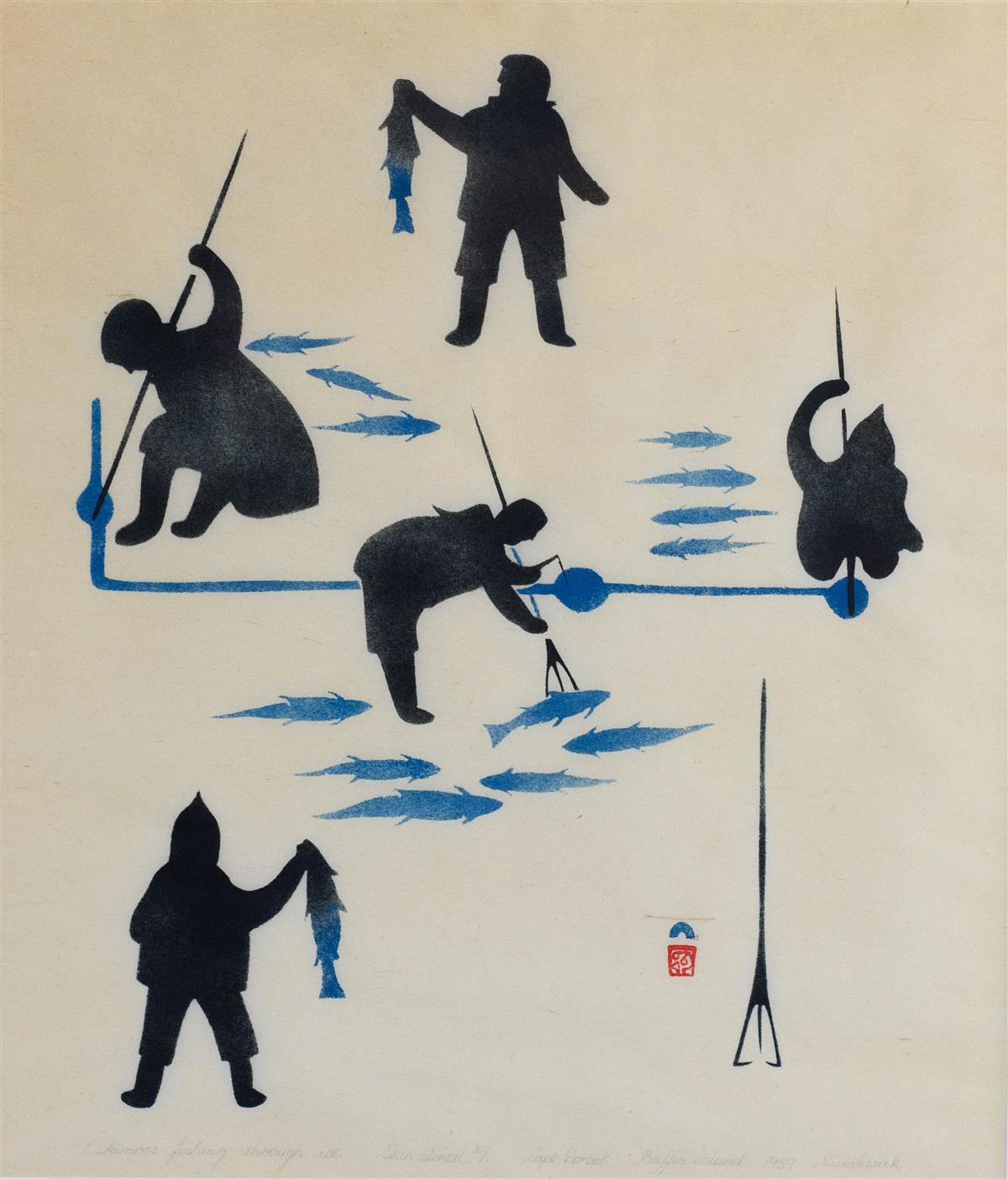
Niviaxiak's "Eskimos Fishing Through Ice," above, was included in the first, 1959 print collection. It is a stencil that uses only two colors, blue for the fish and water features, and black for the fishermen and their fish spears. The fishermen are simple silhouettes, but their attitudes are relaxed and drawn from life. The composition is asymmetric, and efficiently conveys the communal activity of fish camp.
|
|
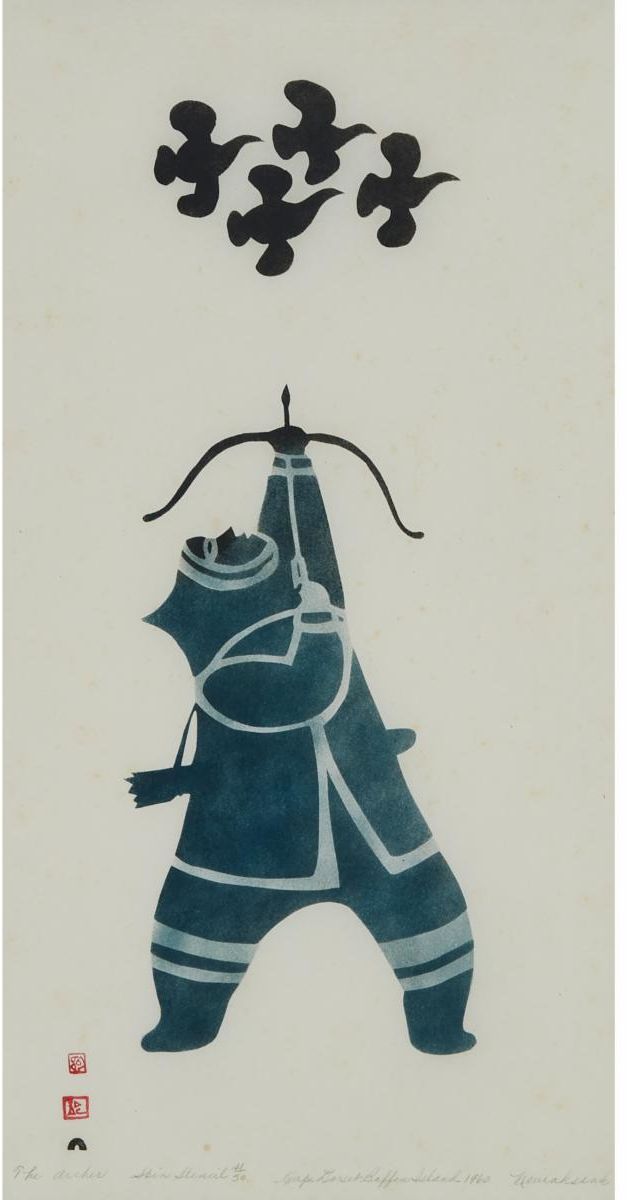
Niviaxiak's "The Archer," above, is a stencil from 1960. The print still uses only blue and black ink, but its design is far more sophisticated. The archer is shown in silhouette, but white lines detail his arms, the arrow, and the lines of his parka, pants and boots. The outline has been streamlined, unlike the naturalistic silhouettes of 1959. The archer is concentrating intently on the flock of birds overhead, symbolized by four highly stylized birds. The energy of the drawn bow makes the image dynamic, rather than static. |
|
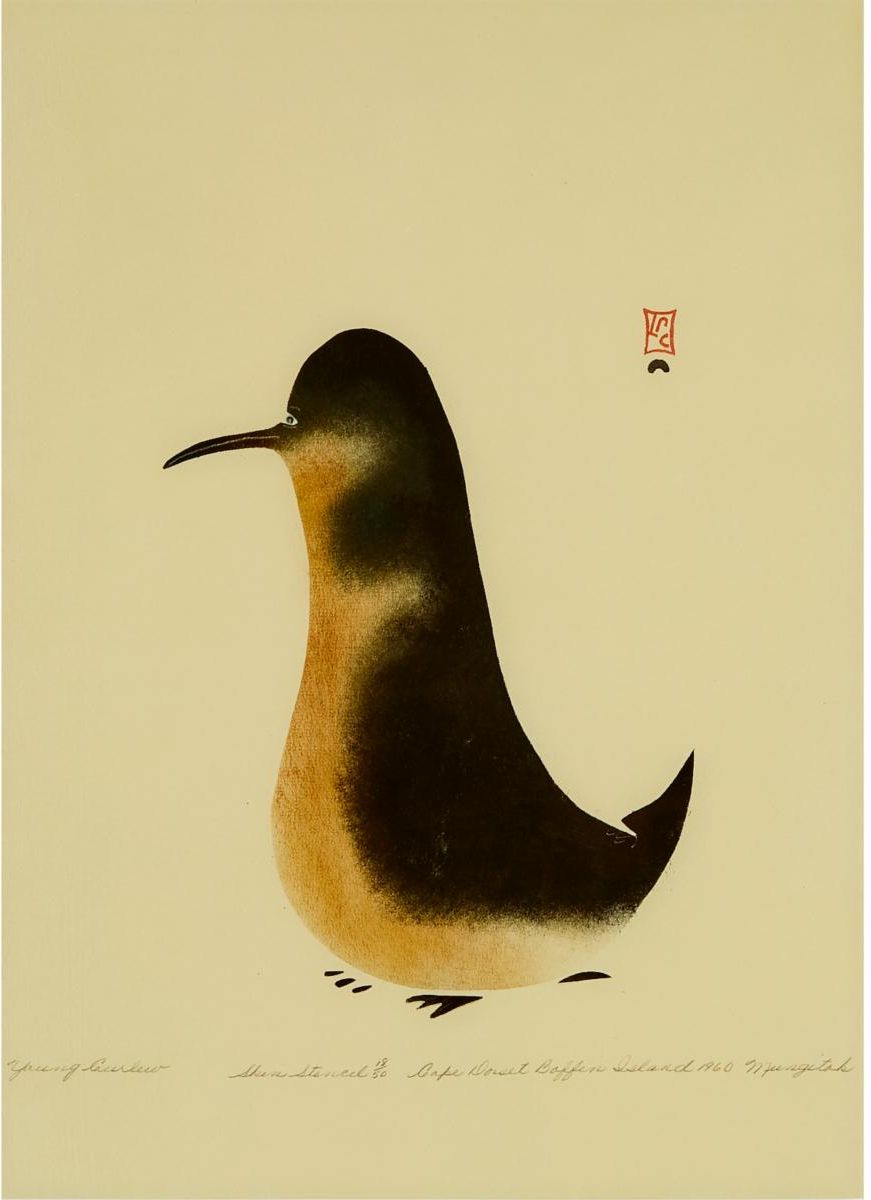
Kellypalik Mungitak's "Young Curlew," above, is also a stencil from 1960. Like The Archer, the Young Curlew explores greater possibilities of the stencil technique than the 1959 print. Young Curlew also uses a limited palette, but the rose and brown ink are applied with different densities, giving the image depth. The perky attitude of the young bird is simply irresistible.
Both Eskimos Fishing Through Ice and Young Curlew come from the collection of the late Arthur Houghton, former president of Steuben Glass and chairman of the Metropolitan Museum of Art. Houghton was one of the first southerners to visit Nunavut to learn about Inuit art, and he and his friends were guided by James Houston, who introduced printmaking techniques to the Inuit.
|
|
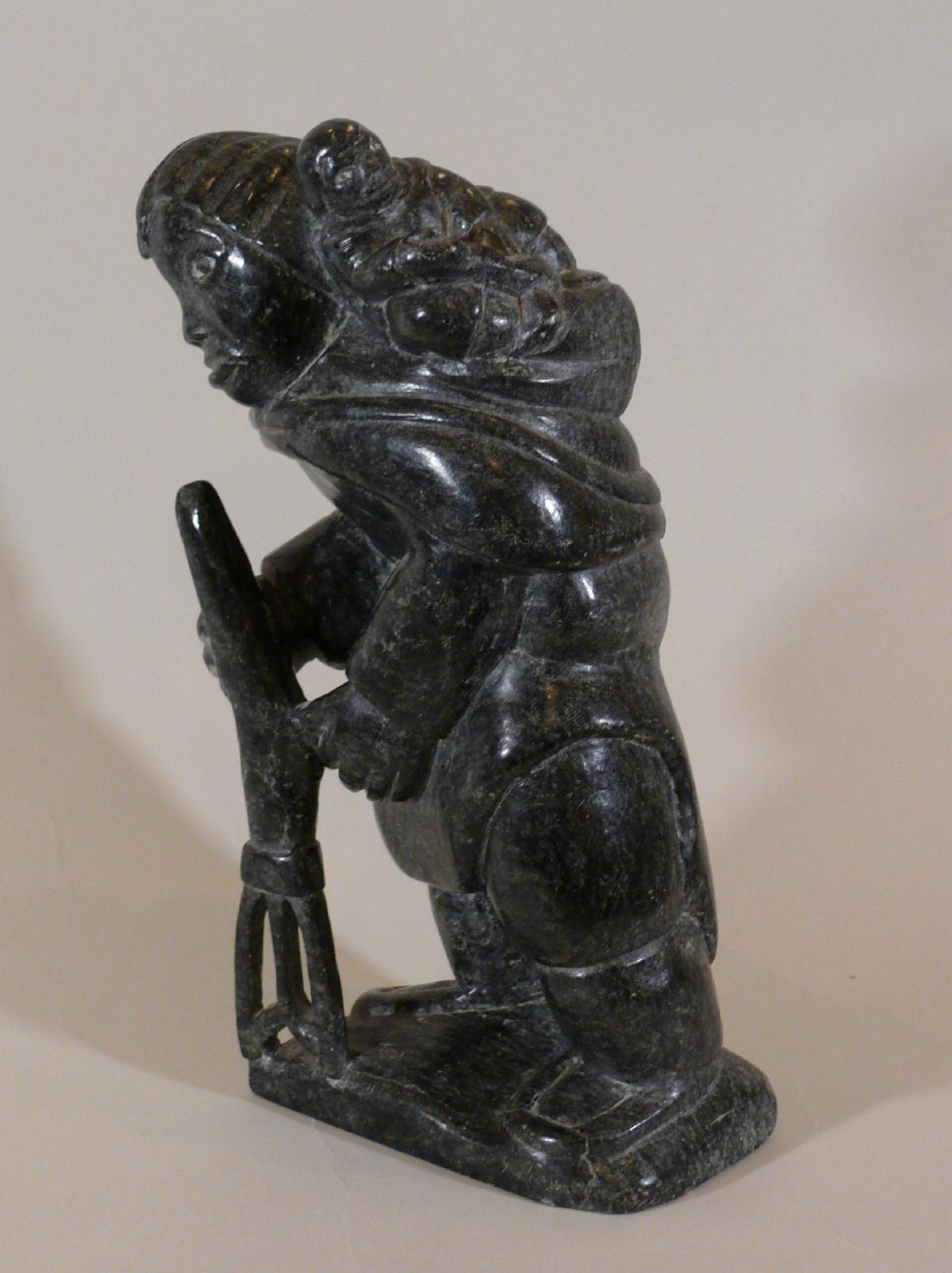
A fisherwoman
All of the figures in Eskimos Fishing Through Ice are men. This unusual carving shows a mother carrying a child in her amaut, holding a fish spear. It is signed "Evie." Whoever the artist is, she brought imagination to this carving. The fish spear poses serious challenges of negative space. The child has almost climbed out of the mother's amaut. The subject is unusual, the child's activity is unusual. On the whole, an intriguing carving that leaves us wishing to know more about its creator.
This is another example of the difficulties of artist identification. Our Inuit artist search tool suggested seven possible matches. We think that this is probably the work of Eva Tuukkaq Kupirkruakuk, of Kuujuaq in Arctic Quebec. There are, however, two other artists named Evie from Broughton Island who are also possibilities. The stone, style and subject are consistent with work from Arctic Quebec. Broughton Island did not produce a great deal of carving, and the examples that we could find in Swinton's large survey of Inuit art were not particularly close to this piece stylistically. Of the other four possibilities, we were able to eliminate three based on their communities (two from Salluit, whose stone is consistently light grey, one from Taloyoak, which has no carving stone). The last was an artist from Kimmirut; his work is very different in style, and he generally works in serpentine, a distinctly green stone.
|
|
The National Museum of the American Indian is streaming "Angry Inuk" online from November 20 through November 25. Click here for details. This fascinating film takes you to Nunavut today, and explores the social and economic importance of seal hunting to the Inuit, and the unintended consequences of international restrictions on the hunt.
NMAI's summary: In her award-winning documentary, director Alethea Arnaquq-Baril joins a new tech-savvy generation of Inuit as they campaign to challenge long-established negative perceptions of seal hunting. Armed with social media and their own sense of humor and justice, this group is bringing its own voice into the conversation and presenting themselves to the world as a modern people in dire need of a sustainable economy.
|
|
About
Alaska on Madison
In keeping with our self-description as a virtual gallery run by collectors for collectors, we offer a limited number of pieces. Every piece is one that we would be happy to have in our personal collection, and the description of each piece explains why.
We are happy to assist you with inquiries, with searches for particular pieces or artists, with organizing your collections and with buying or selling at auction. Our Inuit artist search tool is available on our website, and we would be delighted to help you use it. If you prefer to puzzle things out for yourself, Deciphering Inuktitut Signatures will help you to identify artists.
We are always pleased to answer questions or just chat. You can contact us by email or by phone at (908) 487-5757.
Our very best wishes to you all.
Ann and Michael Lesk
|
|
|
Alaska on Madison | (908) 487-5757 | alaskaonmadison@gmail.com | www,alaskaonmadison.com |
|
|
|
|
|
|