|
Good day!
We had one Native Prairie Speaker Series presentation in October, Andrew Didiuk, recently retired from Environment and Climate Change Canada, spoke about Great Plains Toads and Northern Leopard Frogs. The recording of the presentation is available on our YouTube Channel!
Our November Native Prairie Speaker Series presentation will occur on November 24th at noon, with Dr. Nicola Koper from the University of Manitoba talking about oil development and noise on grassland songbirds. You can register for free here.
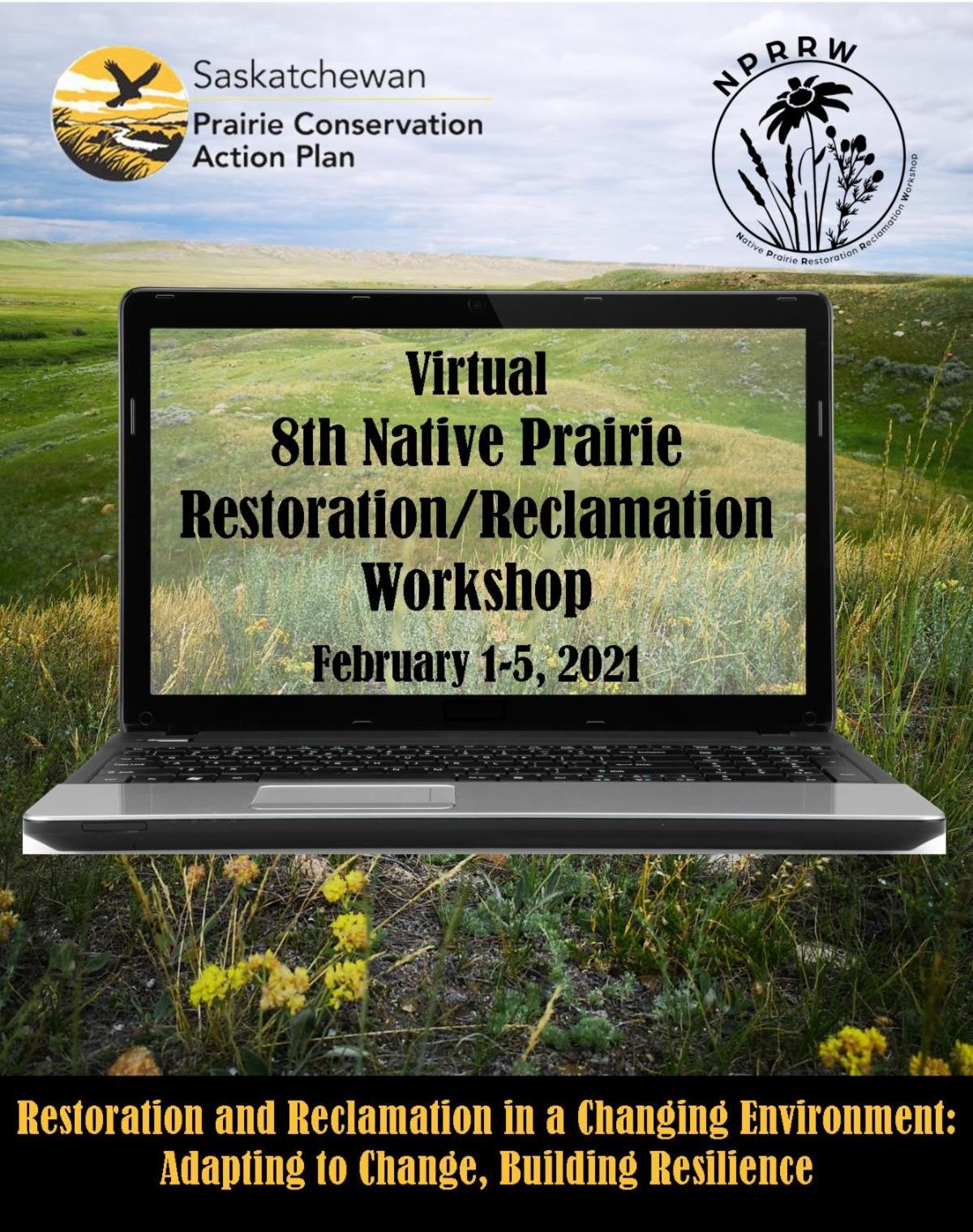
Registration for the 8th Native Prairie Restoration/Reclamation Workshop will open next week! Sponsorship and tradeshow information are also available! The Call for Posters is open and the deadline is December 4th! Please see below!
If anyone is interested in the virtual delivery of our education programs, Adopt a Rancher and Taking Action for Prairie, you can contact our Education Coordinator, Julie-Anne (pcap.education@gmail.com). There is more information below, if you are interested or know someone who might be!
And finally, we would like to thank our sponsors for their generous support : Camp Wolf Willow, EcoFriendly Sask, K+S Potash, Pembina Pipelines, Ranchers Stewardship Alliance Inc, Saskatchewan Cattlemen's Association, SaskPower, SaskTel, Wildlife Habitat Canada and Environment and Climate Change Canada, as well as the continuous support of all the PCAP Partners.
Stay safe and take care! Happy November!
Carolyn Gaudet, SK PCAP Manager
Ph. 306 352 0472
pcap@sasktel.net
|
|
The 8th Native Prairie Restoration/Reclamation Workshop will be on the PheedLoop virtual platform and will include presentations, tradeshow booths, poster session and a panel discussion.
There will presentations on:
planning a project, invasive species, how to read a seed certificate, soil, climate change, orphan wells, and many more!
Registration:
Registration will open November 9th! Stay tuned!
Early-bird registration (before January 15th) : $150+GST
Regular registration (after January 15th) : $200+GST
Student registration (no deadline) : $100+GST
Tradeshow:
Virtual Trade Show Booths will be in the "Exhibit Hall." Exhibitors will have their own profile to manage which includes company information and description, as well as links, videos, etc. Exhibitors will be able to engage in private or public chats with workshop participants. An upgrade is available for organizations who wish to have video chats with workshop participants as well as retrieve leads.
Corporate Tradeshow Booth: $275+GST
Non-profit Tradeshow Booth: $250+GST
Upgrade (video chat and lead retrieval): $100
You can find the Tradeshow application here.
Poster session:
New this year, poster presenters will have their own profile in the "Show Case" tab of the virtual platform. There will be designated poster session times during the week and we encourage poster presenters to be available during those times. The Call for Posters can be found here. The submission deadline is December 4th, 2020.
Networking:
Designated virtual networking sessions will be taking place throughout the week. Sessions will have specific topics and be scheduled in the event program. Workshop participants will have a choice of discussion groups and topics and they will communicate through chat boxes in the virtual platform.
If you have any suggestions for discussion topics, please send them our way!
More information will become available on the PCAP website shortly. In the meantime, please contact Carolyn Gaudet, SK PCAP at pcap@sasktel.net.
|
|
PCAP Partner Spotlight...
South of the Divide Conservation Action Program
Submitted by Diego Steinaker, SODCAP Inc.
The South of the Divide Conservation Action Program Inc. (SODCAP Inc.) is an environmental non-profit organization that has been working with producers and industry to enhance habitat for species at risk over the past six years. With funding from various sources, SODCAP delivers a variety of Stewardship Programs to producers and First Nation communities in the "South of the Divide", in southwestern Saskatchewan. We believe that success lies in developing programs cooperatively, making habitat management for species at risk an important priority while also ensuring economic sustainability on the landscape.
SODCAP delivers a variety of Stewardship Programs. Habitat Management Agreements, for example, are long-term agreements signed between SODCAP and land owners aimed to improve and maintain critical and important habitats for species at risk. Habitat Restoration Agreements are another type of program aimed to recreate the grass composition, structure, and functioning of native prairie on currently cultivated lands. Result-Based Conservation Agreements provide financial incentives to producers who meet or exceed habitat targets, at the site level, for a particular species at risk. These habitat targets are measurable and quantifiable, based on the current state of knowledge and within the ecological potential of the range site. SODCAP is also collaborating with the Saskatchewan Stock Growers Association to engage producers who own or manage critical and important habitat for species at risk, to enter into Term Conservation Easements. Overall, all these Conservation Agreements pursue to encourage producers to make species at risk and habitat conservation a priority in their management decision making on their ranches.
More than 250,000 acres of critical habitat and native grasslands are currently under some type of SODCAP conservation or restoration agreements on private and public lands, involving 45 individual projects. Producers who own or manage important or critical habitat for species at risk in southwestern Saskatchewan are eligible to sign new agreements.
In addition to these conservation agreements, SODCAP, in collaboration of the Saskatchewan Wildlife Federation and the Saskatchewan Water Security Agency, are working to restore and conserve priority riparian habitats for threatened Mountain Sucker and other aquatic species with producers that manage lands intersecting the Frenchman River and tributaries creeks. In partnership with the Frenchman Wood River Weed Management Area, SODCAP is also implementing integrated weed management projects that focus on leafy spurge control. In another project, SODCAP has teamed up with Parks Canada's Grasslands National Park and the Saskatchewan Stock Growers Association to implement two Grass Banking initiatives with local producers, with the goal of creating habitat for multiple species at risk.
SODCAP is also partnering with the Saskatchewan Ministry of Agriculture and other Watershed Stewardship Associations to provide support and expertise for producers in submitting applications for funds to the Farm Stewardship Program (FSP) and the Farm and Ranch Water Infrastructure Program (FRWIP). These projects include habitat enhancement through improvement of grazing management and water developments.
SODCAP demonstrates remarkable innovation in programming by working in Niche Product Branding initiatives with two livestock operations and individual ranchers, to market their beef produced on grasslands that are managed for conservation purposes. SODCAP in the process now of promoting these certified beef products.
Finally, SODCAP works on educating and increasing awareness on habitat conservation, through a variety of outreach activities and communication channels including E-newsletters, articles in producer's magazines, workshops, meetings and technical assistance.
For more information about our programs, please follow SODCAP on Facebook, Instagram, and Twitter; and visit us at www.sodcap.com. Your input matters, we are pleased to receive your questions, comments and suggestions. Thanks!
|
|
History of Shand Greenhouse
Shelley Heidinger, SaskPower
Almost 30 years ago, an out-of-the-box, forward thinking idea was brought to life with a focus on mitigating environmental impacts of emissions that come from generating power from fossil fuels.
The idea was to develop a greenhouse that recycled waste heat from the adjoining Shand Power Station which became one of SaskPower's most notable environmental initiatives. The greenhouse came to be known as the Shand Greenhouse. It began operation in October 1991. The greenhouse acted as a subsidiary until 2013, when it was integrated into the Environment department at SaskPower.
The decision was made to grow mostly native trees and shrubs as the best way to offset carbon dioxide. The first crop sown was completed by hand with many lessons learned along the way. The first trees from the Shand Greenhouse, which included just over 190,000 seedlings, were distributed in 1992. Seedlings were distributed to customers around the province through a partnership with TREEmendous Saskatchewan.
Throughout the 1990s, there was a steady increase in yearly production numbers. Many projects were completed. including the topsoil study at Boundary Dam in partnership with the Prairie Farm Rehabilitation Administration (PFRA), development of educational programming for students, adult education opportunities such as tree planting workshops, research trials on crop growth, fertilizer, and many others.
During this time, the Shand Greenhouse started working on growing native grass and forb species for groups looking for options to grow the seed they had collected for various projects.
By 2000, some bigger changes were underway, including remodeling both the greenhouse space and additional programming. A second set of shade houses and some offices were added, and the display area became a more useable greenhouse space as two smaller research areas. The program Our Treehouse to You was established; it included growing the seedlings and distributing them to clients.
The Shand Greenhouse programming gained momentum, which led to the Western Red Lily Centennial Project, one of the most visible success stories of the Shand Greenhouse. Many hours of work by many people were put into research and production methods culminating in the production of more than 80,000 lilies for the province's centennial in 2005.
Although some programs have been discontinued, other projects have been undertaken and the greenhouse has reached a point where roughly 500,000 seedlings are produced each year. These are distributed around the province to individuals, groups, organizations and others who plant the seedlings to better the environment.
By 2020, roughly 12.5 million tree and shrub seedlings including many forb and grass seedlings have been grown and distributed across the province.
The Shand Greenhouse continues to support conservation and habitat restoration projects throughout the province, striving to find innovative solutions to use plants to reduce greenhouse gas emissions.
|
|
|
|
|
|
|
SK PCAP Native Prairie Speaker Series
Plan to attend our November Native Prairie Speaker Series webinar!
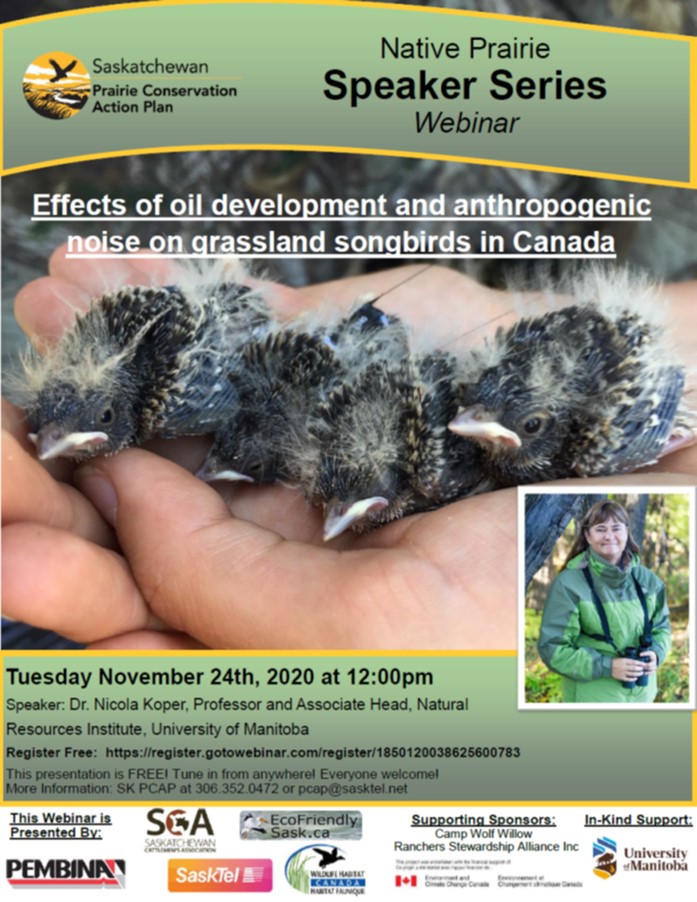
Presenter: Dr. Nicola Koper, Professor, Resources Institute, University of Manitoba
Tuesday November 24th, 2020 at 12:00pm
|
|
Upcoming Events!
November 3, 2020 @ 10 AM CST
November 5, 2020 @ 7 PM CST
November 6, 2020 3:30 CST
PHJV Policy Webinar
November 12, 2020 11:00 CT
November 16, 2020 @ 7 PM
Regina Public Library film theatre (2311 12th Avenue)
November 18-19, 2020
November 20, 2020 @ 3:30 CST
|
|
SK PCAP's Education Programs have been modified for virtual delivery!
Taking Action for Prairie
Grades 6-8 Curriculum Aligned to Diversity of Life Units
Taking Action For Prairie will engage Regina and surrounding schools with an interactive 1.5-2 hour in class program for Grades 6-8 students and teachers followed by a class led conservation project to "Take Action for the Prairie."
The objective of the program is to increase awareness and appreciation of the native prairie ecosystem and its conservation through the development and implementation of an Action Project by each grade after program delivery.
Grade 6 Diversity of Life to SK PCAP's Cultural Goal:
Native prairie is a valued part of our culture and identity as Saskatchewan people.
Topics: biodiversity, native species at risk, invasive alien plant species, cultural history, stewardship
Grade 7 Interactions with Ecosystems outcomes to SK PCAP's Ecological Goal: Native prairie ecosystem health and biodiversity are conserved and restored as part of a functioning landscape.
Topics: human impact, ecological footprints, sustainability, stewardship
Grade 8 Water Systems on Earth outcomes to SK PCAP's Economic Goal: Sustainable uses of native prairie improve the livelihoods of Saskatchewan people.
Topics: water quality/conservation, ranching, ecological goods & services, climate change, stewardship
Adopt A Rancher ***Available in English and French***
Grade 10 Curriculum Aligned to Sustainability of Ecosystems Science
SK PCAP has developed an interactive, hands-on learning opportunity for Grade 10 classes in Saskatchewan entitled Adopt a Rancher. The program has been integrated in schools across Saskatchewan
Students in the Adopt a Rancher program analyze a ranch ecosystem in a case study that they develop themselves. By using a student guide and online resources and communicating with the adopted rancher, students will answer this question: How can ranching protect Saskatchewan's native grasslands while providing economic benefits for Saskatchewan people?
|
|
Online resources -incase you still need them :)
Explore.org - bison cam at Grasslands National Park
|
2020 Speaker Series
Supporting Sponsors
Camp Wolf Willow
Ranchers Stewardship Alliance Inc.
|
2020 Education Programs:
Presenting Sponsors:
2020 Education Programs
Supporting Sponsors:
|
|
Carolyn Gaudet, Editor, Saskatchewan Prairie Conservation Action Plan Newsletter
306-352-0472 |
|
|
SK PCAP gratefully acknowledges financial support in 2020-2021 from:
Camp Wolf Willow, Ducks Unlimited Canada, EcoFriendlySask.ca, K+S Potash, Parks Canada - Grasslands National Park of Canada, Pembina Pipelines, Ranchers Stewardship Alliance Inc., Saskatchewan Cattlemen's Association, Saskatchewan Ministry of Agriculture, Saskatchewan Ministry of Environment - Fish and Wildlife Development Fund, SaskPower, SaskTel, University of Saskatchewan - College of Agriculture and Bioresources, Water Security Agency and Wildlife Habitat Canada.
SK PCAP gratefully acknowledges in-kind support for 2020-21 from:
Agriculture and Agri-Food Canada - Science and Technology Branch, Canadian Parks and Wilderness Association, Canadian Western Agribition, Environment Canada - Canadian Wildlife Service, Friends of the Royal Saskatchewan Museum, Friends of Wascana Marsh, Meewasin Valley Authority, Native Plant Society of Saskatchewan, Nature Conservancy Canada, Nature Saskatchewan, Parks Canada - Grasslands National Park, Prairie Wind & Silver Sage, Ranchers Stewardship Alliance Inc., Redberry Lake Biosphere Reserve, Saskatchewan Association of Rural Municipalities, Saskatchewan Association of Watersheds, Saskatchewan Bison Association, Saskatchewan Burrowing Owl Interpretive Centre, Saskatchewan Cattlemen's Association, Saskatchewan Environmental Society, Saskatchewan Forage Council, Saskatchewan Forage Industry Network, Saskatchewan Ministry of Agriculture, Saskatchewan Ministry of Environment, Saskatchewan Ministry of Energy and Resources, Saskatchewan Science Centre, Saskatchewan Stock Growers Association, Saskatchewan Wildlife Federation, Saskatoon Nature Society, SaskEnergy, SaskOutdoors, SaskPower, Society for Range Management - Prairie Parkland Chapter, South of the Divide Conservation Action Program Inc., University of Regina, University of Saskatchewan - College of Agriculture and Bioresources, Wild About Saskatoon-Nature City Festival.
|
|
|
|