|
The Corresponder
The Newsletter of the Committees of Correspondence for Democracy and Socialism
| | |
Chicago Resists State Repression
November 24, 2025 8 pm (Eastern), 7 pm (Central)
The Committees of Correspondence for Democracy and Socialism (CCDS)
Socialist Education Project (SEP)
Webinar Series on the 4th Monday
President Trump has authorized the use of repressive and terrorist policies against targets overseas and in US cities. Resistance to Trump violence is occurring everywhere, including within the United States. Resistance occurred in the electoral area on November 4. And before that masses of people have marched and rallied against No Kings. In addition, communities have risen up to defend themselves against ICE, National Guard, and police repression.
Chicago has historically been the center of manufacturing and radical politics, militant trade unionism, and vibrant interracial and international communities. It represents all that Trump opposes: workers, people of color, women, trade unions, immigrants. And thousands of Chicagoans have risen up to say NO to state repression.
This webinar, consisting of a panel of Chicago progressives, describes and analyzes resistance to state repression in Chicago.
To Register: https://us02web.zoom.us/meeting/register/yCJuf9zjQd2LJjpldgrLjg
| |
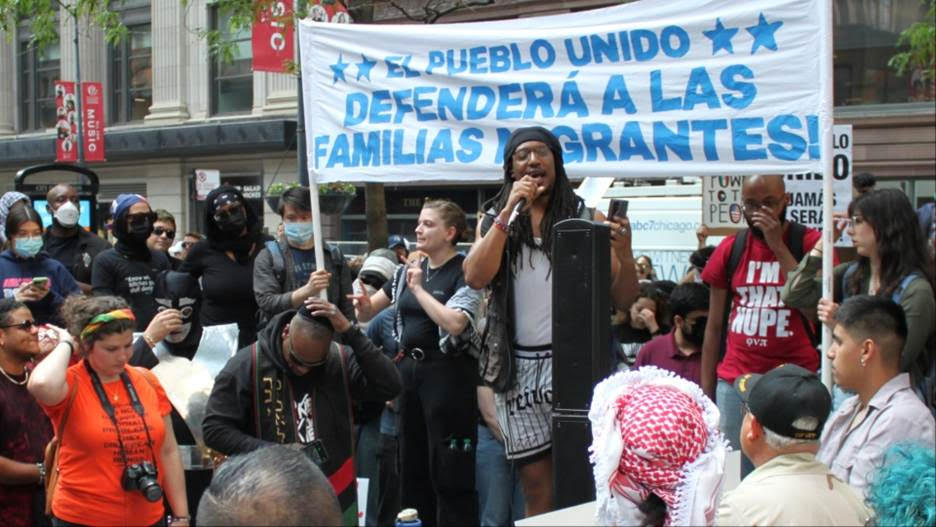
Inside Chicago’s growing resistance movement against Operation Midway Blitz: ‘Small acts have huge consequences’
By Andrew Carter | acarter@chicagotribune.com | Chicago Tribune
PUBLISHED: November 8, 2025 at 5:00 AM CST
Baltazar Enriquez began wearing his whistle in June, when the threat of the Trump administration’s immigration raids was more focused and the fear perhaps less widespread in Chicago. The whistle — green plastic, attached to an orange lanyard — was at first a small gesture of preparedness. It has since become a symbol of resistance.
In the beginning, the sight of it around Enriquez’s neck prompted questions and confusion in Little Village, one of Chicago’s proudest Latino neighborhoods. He remembers people asking him, perplexed: “What is a whistle gonna do?”
“And we said, ‘Well, the whistle is in case immigration is around, and you start blowing. The whistle is for people who are undocumented to go away, to lock their doors, lock their gates and not open the door.’
“And it grew like wildfire. Now everybody’s using it.”
Top Videos Mothers detained protesting ICE arrest at Chicago daycare
For the past two months of President Donald Trump’s so-called Operation Midway Blitz, federal agents have engaged in a norm-defying assault on the Chicago area. In Little Village, where Enriquez is president of the community council, restaurant doors have remained locked and business along 26th Street has slowed.
The resistance born there, though, has spread. A movement that began in Chicago’s Latino enclaves has arrived in neighborhoods everywhere, breaking through segregation and boundaries long defined by race and socioeconomic status. A city known for its resilience and a take-no-nonsense attitude has found another reason to unite.
And in its unity, the city has made a statement, an unmistakable message akin to the one a woman packing whistles at a recent “Whistlemania” event on the Northwest Side hoped to send.
“Show ’em that you don’t (expletive) with Chicago,” she said.
The whistles have become part of the city’s soundtrack, the sight of them around people’s necks as common as Bears jerseys. But the resistance to U.S. Immigration and Customs Enforcement officers and U.S. Border Patrol agents, often dressed in tactical gear, toting weapons built for war through city neighborhoods and suburban subdivisions, has taken many forms. A movement has grown through acts large and small.
Resistance is a woman documenting the deployment of tear gas in Broadview. It’s neighbors coming together to grab one of their own from the grasp of federal agents in Old Irving Park. It’s a white suburban mom rushing from her house in Mount Prospect, phone camera in hand, to scream at federal agents to get out of her village.
It’s a 24-year-old man, the son of Mexican migrants, who alerted dozens of day laborers of the presence of ICE during a recent raid in the northwest suburbs, and then sheltered and protected them. It’s a young Black man on the South Side recording the detainment of several U.S. citizens following an apparently warrantless raid and sharing that video with the world.
And it’s hundreds of high school students who walked out of their classes and into the streets of Little Village, carrying flags and signs and blowing whistles, literally and figuratively.
In Little Village alone, Enriquez said, he and his colleagues on the community council have distributed almost 10,000 whistles. In the earliest days of the Chicago resistance, he said ICE and Border Patrol officers responded with bewilderment when people began blowing them in their presence. Enriquez can remember one agent who smirked and laughed at the sound.
“But he didn’t, once he saw people locking their doors and getting away,” he said.
The movement, like the noise, has only grown more intense.
‘No longtime activist’
She resisted because others inspired her to resist. Because for weeks she’d watched videos of protests at an ICE detention facility in Broadview and of standoffs between Chicagoans and federal agents in Brighton Park and the East Side and everywhere else. Videos that, at times, showed the targets of the raids “literally fighting for their lives.”
She resisted, ultimately, because agents showed up on her street on a random Sunday afternoon in October. Outside her door. On her quiet block in Mount Prospect. That’s when Lisa Porter ran outside.
“It was sort of like I was finally able to find a place to put my rage,” she said later, “and try to be a little productive instead of feeling so helpless.”
Lisa Porter in her dining room filled with artwork made by her three children on Nov. 5, 2025, in Mount Prospect. Porter was one of several neighbors who confronted federal agents when they blanketed her neighborhood on Oct. 19. (Stacey Wescott/Chicago Tribune)
Porter, 53, had never been all that politically active. She’d never been much of a protester. She’s a suburban mother of three — a 13-year-old daughter and twins who are 11. “I’m no longtime activist,” she said.
Her resistance began that day “by running out and screaming at people.”
“Now, granted,” she said, “I recognize that that’s not necessarily a tactic that everyone thinks is terribly effective. (But) I had been seeing a lot of it on those videos, and really it seemed to be the thing that got them to back down.”
There were agents in two SUVs down her street that day, and others circling nearby blocks in four or five more vehicles. She remembers their masks. About 20 of her neighbors had gathered outside to bear witness, with some of them, like Porter, rushing to protect anyone who might be targeted. Rumors swirled up and down the street and in the aftermath: that it was a cartel member they were after. Or a sex offender. Or a murderer. Or someone who was all three?
The “worst of the worst,” as the Trump administration has often put it.
“There were several different stories that they told,” Porter said, but she knows that at “no point did they say, ‘Stay in your houses. There’s a dangerous criminal on the loose.’”
She cannot be sure whether the agents ultimately apprehended anyone. If they did, she didn’t see it, which leads her to believe it didn’t happen. She was, after all, trailing the vehicles — confronting the agents inside, screaming at them. A Tribune photographer captured Porter in mid-scream, her face twisted in rage, the masked agents on the other end of her ire avoiding eye contact.
The one in the driver’s seat is looking away from her. The other straight ahead.
She was yelling “a lot of not-safe-for-work things,” she said.
She remembers one interaction, when an agent that day asked her if she was “OK with criminals in the neighborhood.”
“You’re the criminals,” she told them. “You’re the ones kidnapping people off the street.”
About two weeks later, Porter received a text from a neighbor. ICE was back. Porter made her way to her neighbor’s house but by the time she arrived the agents were gone. It left locals feeling uneasy and angry again. On the way home, Porter noticed a young man mowing a nearby lawn. She flagged him down and offered a warning:
“I just want you to be safe,” she told him. “ICE is in the area.”
But he already knew. What he said in response has lingered in Porter’s mind.
She can still hear him saying it:
“They came and took my dad 10 minutes ago.”
‘These are my people’
He resisted because he identifies with those who’ve been targeted and deported. Because he has never forgotten the sacrifices his parents made or their journey from Michoacán, Mexico, to West Englewood, where he “didn’t grow up in one of the best neighborhoods,” but where he found opportunity, nonetheless.
He resisted, ultimately, because “these are my people.” That was one of Efrain Cuevas’ first thoughts when he noticed the caravan of Ford Explorers with Texas plates last month. And there was a moment, however brief, when his mind offered an alternative to what he was seeing.
“I guess people from Texas are visiting,” he said to himself. But at the same time he knew. He knew those vehicles carried federal agents and he saw them as they came closer. That was when Cuevas began shouting. Began screaming, with as much force as he could muster:
“La Migra! La Migra!”
“Which is ICE, in Spanish,” he said. “Everybody just started running.”
Read more
| | | |  | |
Migrants
by Seymour Joseph
A world of people,
A world of differences:
Color, language, customs.
But all we call the human race.
They move about,
Here, there and everywhere,
If moving is their decision.
A wonderful mixture enriching all.
Yet now there's a break in the chain,
Ill will by some for others —
Fomented by those who gain by division.
Exclusion replaces inclusion.
Our lamp has been doused,
On the welcome we call emigration.
!"
| | |
The Bill to End the Shutdown Is Full of Giveaways to Republicans
The alleged “compromise” is a boon for the GOP, and especially those who helped Trump dispute the 2020 election result
by Joan Walsh
reprinted from The Nation
(Tom Brenner / Getty Images)
Last night, eight Democratic senators caved and voted for a bill to open the government without restoring the Affordable Care Act subsidies they’d promised to fight for. You might think Donald Trump would appreciate the olive branch, but you’d be wrong. That very same night, Trump’s Justice Department announced a mass pardon for almost 80 individuals involved in Trump’s campaign to overturn the 2020 election. This list included Rudy Giuliani, Sidney Powell, and John Eastman.
But that’s not the only gift to the Republicans who tried to help Trump overturn the 2020 election. Tucked inside the bill is a measure that would create a slush fund to enable senators who’ve had their phone records subpoenaed, without their knowledge, to sue over invasion of privacy, for at least half a million dollars. It’s basically free money for Lindsey Graham, Marsha Blackburn, Bill Hagerty, Josh Hawley, Dan Sullivan, Tommy Tuberville, Ron Johnson, and Cynthia Lummis, all of whom had their metadata subpoenaed by Jack Smith. (No messages were included.) If they all won in court, they’d pocket at least $4 million collectively.
The bill would limit the government’s defense against such claims, removing qualified or sovereign immunity as grounds for such a move to fight a lawsuit over the issue.
In last-minute maneuvers, Senate majority leader John Thune, who has called Smith’s phone subpoenas “Biden’s Watergate,” added the provision personally. “Leader Thune inserted that in the bill to provide real teeth to the prohibition on the Department of Justice targeting senators,” Texas Senator Ted Cruz declared.
“I am furious that the Senate Minority and Majority Leaders chose to airdrop this provision into this bill at the eleventh hour,” New Mexico Democratic Senator Martin Heinrich said in a statement. “This is precisely what’s wrong with the Senate.” In case you missed it, that’s a slap at Senate minority leader Chuck Schumer, who presided over last-minute negotiations on the package but voted against it. Oregon Senator Ron Wyden, a privacy advocate, nonetheless slammed the provision as “very troubling” to Politico.
There are obviously other troubling provisions in this alleged compromise, which, remember, keeps the government open only until January. The good news is that it funds SNAP through next year—recipients don’t have to worry about losing food benefits during another stalemate in at the beginning of 2026. Other measures touted as victories—furloughed workers getting back pay, some fired workers getting their jobs back—likely would have happened anyway. Senate Dems did get a promise from Thune to hold a stand-alone vote on restoring ACA subsidies, but there’s no guarantee he’ll do it; even if he does, it’s unlikely to pass; and House Speaker Mike Johnson has already announced that he won’t bring the measure up for a vote. So it’s DOA.
Another problem with the cave-in was its timing, coming only days after Democrats won huge election victories in Virginia, New Jersey, California, Pennsylvania, and Georgia. Schumer is reportedly claiming he got the Democratic defectors to hold off until after the elections, to avoid depressing turnout (a sign Democratic leaders knew the cave-in would be unpopular with their base). He couldn’t have asked them to take maybe another week, to avoid snubbing the Democratic activists who worked so hard on those election victories?
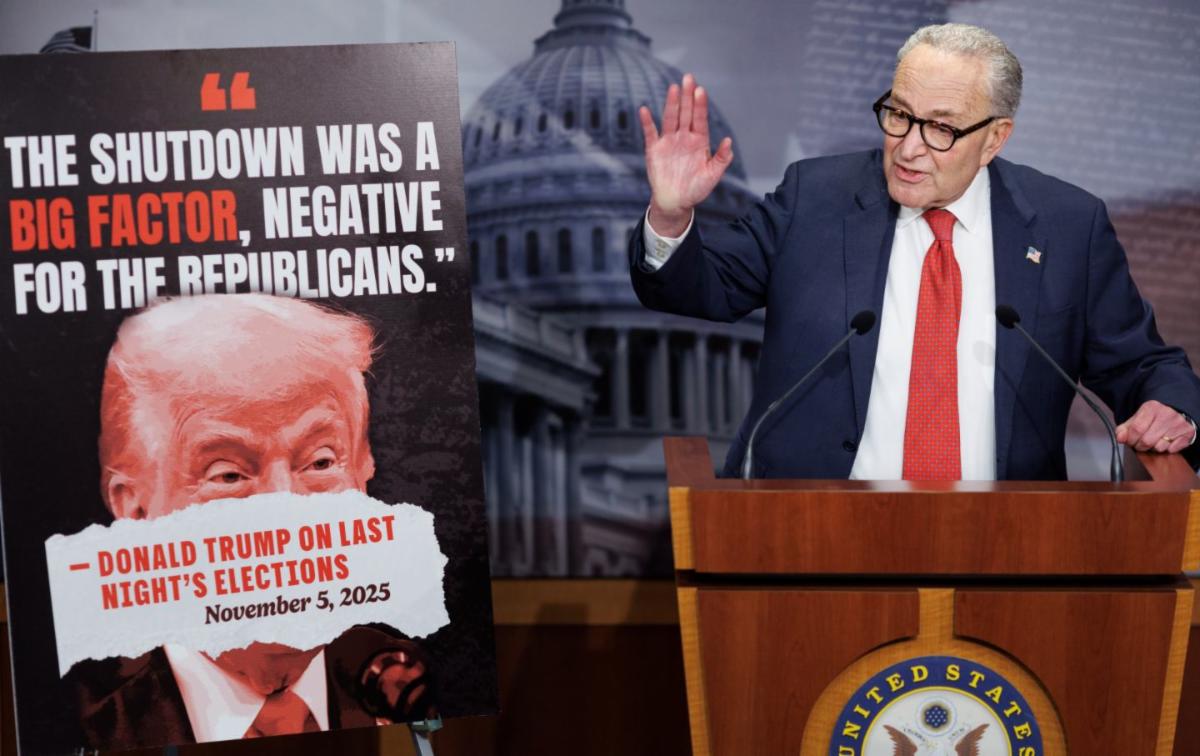
Meanwhile, Zeteo reports that Trump officials are celebrating the Democratic surrender, calling party leaders “losers” and “pussies,” after Trump himself already admitted that the shutdown contributed to GOP losses last Tuesday.
The bill still has to pass the House. Is it possible outraged Democrats will be joined by some Republicans and reject the Senate GOP’s self-protection? Or will House GOP leaders add a similar provision for their members—at least one, Pennsylvania Representative Mike Kelly, also had his phone metadata released to Smith. Anything is possible in Johnson’s caucus circus. The bill could fail for other reasons, even though Johnson claims he has the votes. We’ll find out Wednesday, when House members return from their long vacation to vote.
Joan Walsh, a national affairs correspondent for The Nation, is a coproducer of The Sit-In: Harry Belafonte Hosts The Tonight Show and the author of What’s the Matter With White People? Finding Our Way in the Next America. Her new book (with Nick Hanauer and Donald Cohen) is Corporate Bullsh*t: Exposing the Lies and Half-Truths That Protect Profit, Power and Wealth
\
| |
November 4, 2025 At The Tipping Point:
MAGA Fascists Are Losing Ground
by Carl Davidson
reprinted from Leftlinks
There are probably a dozen important lessons we can draw from Tuesday night's vote tallies, now that the Nov 4, 2025 election is in our rear-view mirror. We'll start with a philosophical one: the future is open, and many new events are possible. But that doesn't mean we can do just as we please, as the Old Mole warned us.
An emergent present does not balance on a knife's edge. It can stretch into new possibilities ahead, while it also brings memories from the past along for the ride, and those shape our course as well.
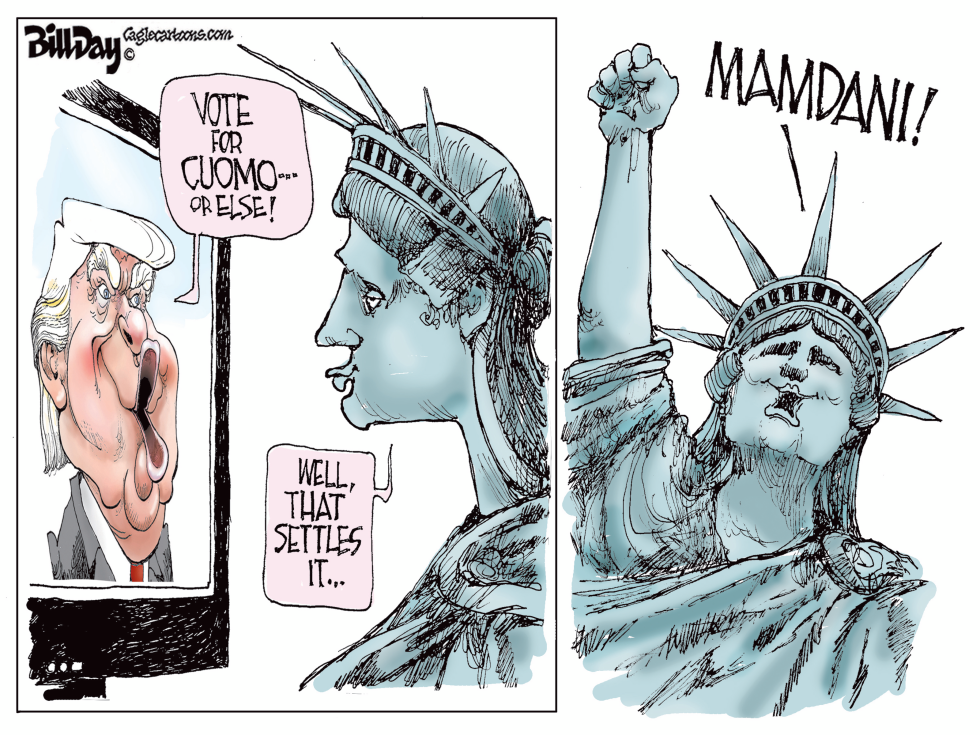
Let's start at the top: Tuesday night's victor of the hour, New York City's Mayor-elect Zohran Mamdani. Like many young progressives, he was inspired by Bernie Sanders and his decision to run on the Democratic line in the 2016 and 2020 presidential races. Mamdani joined DSA in 2016 and became active, assisting several other New Yorkers running for local posts. In 2020, he decided to run for the State Assembly District 36 set in the primary race. The district is in Queens County, between LaGuardia Airport and Manhattan. It is very multinational and has a wide range of incomes. About half the population are immigrants, born outside the U.S. With the local DSA's help, he ran against a lackluster Democratic incumbent, Aravella Simotas, and won 8410 to 7986, or a slim margin of 424 votes. Even so, hardly anyone outside of Queens had ever heard of him.
There's a pattern here, and it starts with Bernie Sanders. The greatest gift of his two campaigns was bringing the term 'socialist' back into acceptable public discourse, even if it's a minority position on a broader electoral terrain. It brought tens of thousands of new members into DSA. Bernie also inspired Alexandria Ocasio-Cortez, AOC, to run as a socialist in 2018, unseating a powerful centrist Democrat. She also brought tens of thousands of new members into DSA and inspired a dozen others to run and win similar congressional races across the country, forming 'The Squad,' which stood to the left of the 100 or so members of the Congressional Progressive Caucus, also founded by Bernie.
It started a new ball game. There were now three groupings under the Dem tent — the progressives, the centrists, and a small, shrinking group of Blue Dogs. While some on the left couldn't see it, their much-longed-for Third Party had emerged right in front of their noses, but not as they expected. It was the AOC-led Justice Dems under the Dem tent. The job was not to have it 'break away,' but to build it into something larger and more powerful, uniting with centrists against Trump and MAGA candidates, while also struggling against them on issues like Gaza, and replacing them when possible. Would the centrists try to purge them and split the party? Or would they submit to 'second fiddle' status in a transformed organization? We don't know. Call it 'the Way of the Whigs' option. As noted above, the future is open.
The key lesson for Mamdani, along with the rest of us, is that none of this would have been possible without visionary organization-building. To use a Chicago term, good ideas are needed, but they're not enough. To win, you need clout. And going forward, you need clout to govern well.
In the broader scope of things, being a New York state assemblyman from Queens did not mean much in the way of clout. Most importantly, it gave Mamdani a good view of the terrain and the inner workings of state and local government. He could see both openings and obstacles and plan accordingly.
So Mamdani pulled together a solid core of NYC DSAers to work for the larger prize: the mayorship of the country's largest and world-famous city. The core had to be internationalist, given the vast diversity of the city's immigrant communities, not just Puerto Ricans and Blacks, but also Indians, Jamaicans, Nigerians, Palestinians, and many more. They all had to be united and respected. The Black community would be tough, with its extended support for incumbents.
New York City also has the largest population of Jewish Americans outside of Israel. This would require some political skill. The 'Jewish vote' was internally diverse, even with a majority bloc that was pro-Zionist and pro-Israel. There was also a younger bloc of Jews who were anti-Zionist and who respected the rights of Palestinians. They joined Mamdani in large numbers. Finally, his core had to be connected with the working class, especially those in unions, which have considerable clout in city politics.
Mandami's victory was not isolated. The Democrats also won governorships in New Jersey and Virginia, prevailing in their legislatures as well. The victors leaned more toward the center than Mamdani did, but they were solidly anti-MAGA. In Pennsylvania, the Democrats also re-elected their Supreme Court judges to another 10-year term. The PA GOP was working to defeat them, so they might impose new voter suppression measures. In California, a solid two-thirds of voters backed Prop 50, the measure designed by Governor Grant Newsom to counter the Texas GOP's redistricting to take five seats away from the Democrats.
All in all, the November 2025 outcomes signal a clear turning point against MAGA and fascism, in favor of Democrats and the left. The 'Three B's' cited by Convergence Magazine and Liberation Road are instructive: Block, Broaden, and Build. We block when we deny MAGA its objectives, as with the vote in favor of retaining PA's judges. We broaden when we see the need to back more centrist Democrats, as in the New Jersey and Virginia races, as well as Mamdani's winning a third of NYC's Jewish voters. Hopefully, we will build by consolidating and expanding the political infrastructure that Mamdani and his DSA team put together to win a majority against his two rivals.
Finally, ideas still matter. Good policy requires clarity. Voters respond best to clear, actionable platforms--particularly on economic issues, healthcare, and climate change. Ambiguity or internal divisions can dilute our impact. Clarity is also needed to make a reasonable assessment of the terrain. It's required to build effective coalitions with moderates and independents on shared goals. Alienating the center unduly or focusing solely on ideological purity delivers weakness, not strength. Last, keep in mind Tip O'Neil's maxim, 'All politics is local.' National messages do not always translate to local victories. Successful campaigns always tailor their platforms to local needs and concerns. All voters are local, and winning them is where organization begins.
| |
CCDS Condemns President Trump’s Aggression
Towards Latin America
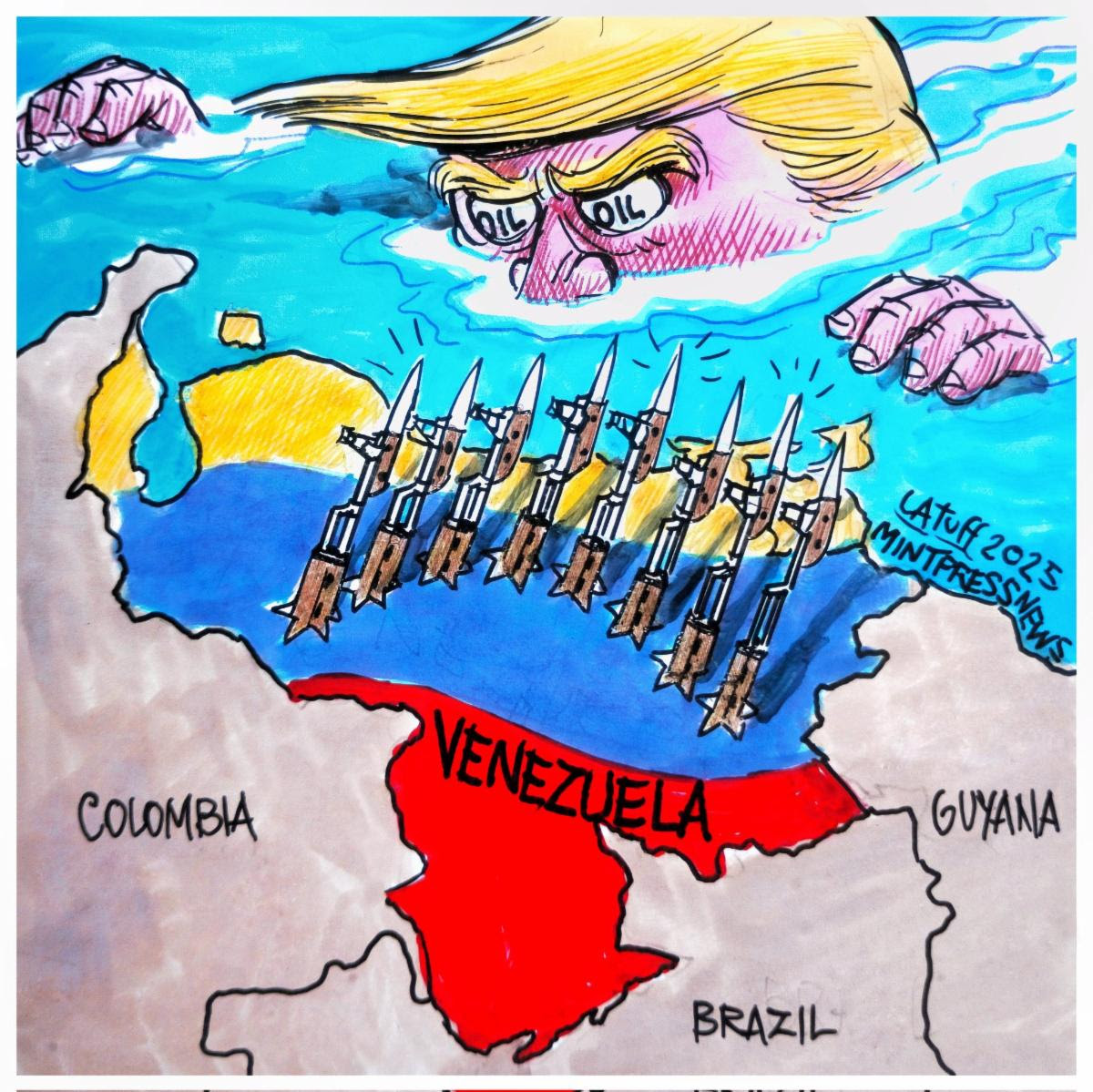
No war on Venezuela!
No Military aggression against Colombia or Mexico!
No deadly US assaults on boaters!
CCDS condemns the far-right cabal in the White House for its unprovoked aggression against our Latin American neighbors. We simultaneously condemn the US military's naked aggression and murders, from September 2 through November 12, 2025, of 75 people on 19 boats off the coasts of Venezuela, Colombia, and Mexico. These murders by US armed forces are simply piracy that violate international and US law, including Article I, Section 8 of the US Constitution.
We note the Commander of the US Southern Command, Admiral Alvin Holsey, announced his early retirement supposedly in response to President Donald Trump's actions against Venezuela. Nonetheless, we demand the court martial of military brass who've overseen the assassination of unarmed civilians on the high seas. We call for international court indictments of those US officials who've ordered this policy.
Trump's assault includes threatening B-52 bomber flights, intervention by the CIA, and the stationing of a full aircraft carrier group with 15,000 troops off the Caribbean coast of Venezuela. Without evidence, these actions are based on a fabrication that President Nicolas Maduro is responsible for the operation of a Venezuela drug cartel. Trump has further fabricated a claim that the export of illegal drugs constitutes an act of war.
We demand that Trump cease his threats against Venezuela, and more recently against Colombia and Mexico. Such belligerence is calculated to destabilize those societies. This may very well be a prelude for a much larger military attack and invasion. Imposition of the dominance and will of US foreign policy elites and corporations is the overall goal.
With specific regard to Venezuela, Trump’s assault is based on his avaricious stance toward its vast reserves of oil as well as mineral deposits. Despite the Maduro government's offer to open up Venezuela's natural resources to US oil and mining firms, the US has continued to press its assault.
The military threats are also aimed at the growing progressive majority in Venezuela. US elites seek to bring about an end to the Bolivarian Revolution. Through this Revolution, the majority is raising living standards, building housing, providing extensive medical care, and expanding higher education.
CCDS says "Defend the Venezuelan, Colombian, and Mexican peoples!"
"Solidarity with all Latin American people against US attack!"
| |
|
Diary of a Heartland Radical
Wednesday, November 12, 2025
CONNECTING PEACE AND JUSTICE:U.S. FOREIGN POLICY AND THE STRUGGLE AGAINST HUMAN MISERY
Harry Targ
A Repost from November 18, 2018
(We must act on the connections between war and militarism, Israeli genocide, support for war in Ukraine, terrorism, military bases overseas, sanctions against over 30 nations and ICE terrorism across the United States, cuts in food assistance, opposition to affordable healthcare, institutionalizing-again-racism and patriarchy, and environmental devastation everywhere. Call it socialism, the United Nations Declaration on Human Rights, humanism or whatever. US foreign, domestic, and economic policies must change. 11/13/25)
The need of a constantly expanding market for its products chases the bourgeoisie over the entire surface of the globe. It must nestle everywhere, settle everywhere, establish connections everywhere. Karl Marx and Friedrich Engels, The Communist Manifesto, 1848.And here let me emphasize the fact and it cannot be repeated too often that the working class who fight all the battles, the working class who make the supreme sacrifices, the working class who freely shed their blood and furnish the corpses, have never yet had a voice in either declaring war or making peace. It is the ruling class that invariably does both. They alone declare war and they alone make peace. Yours not to reason why; Yours but to do and die. Eugene V. Debs, June 16, 1918, Canton, Ohio.
Somehow this madness must cease. We must stop now. I speak as a child of God and brother to the suffering poor of Vietnam. I speak for those whose land is being laid waste, whose homes are being destroyed, whose culture is being subverted. I speak for the poor of America who are paying the double price of smashed hopes at home, and death and corruption in Vietnam. I speak as a citizen of the world, for the world as it stands aghast at the path we have taken. Dr. Martin Luther King, April 4, 1967, Riverside Church, New York.
The Capitalist System is a War System
Marx and Engels declared in their famous 1848 manifesto that capitalism was a world system. Due to cutthroat competition every corporation, every bank, every small business would need to expand or it would be defeated in the marketplace by more successful competitors. Therefore, competition would lead to consolidation, a shift from many economic actors to declining numbers of them. This process of capital accumulation extended to the entire globe.
Lenin argued that by the dawn of the twentieth century, competition had led to monopolies within countries. States driven by monopolies expanded all across the globe. Competing states often engaged in war. Their expansion also generated resistance, rebellion and revolution around the world. In sum, the capitalist system by its very nature was a war system.
In addition, capitalist economies, particularly imperial powers such as the United States, required natural resources, cheap or slave labor, land, customers for products, and opportunities to invest accumulated profits in overseas corporations, and banks. In the post-World War II period, capitalist expansion even required the establishment of a global debt system that would increase the possibility of penetrating the economies of countries that incurred debts.
The realities that Marx identified in the nineteenth century are relevant today in two ways. First, given technological advances, what economists call neoliberal globalization is the logical extension of his insight that capitalism needs to “establish connections everywhere.”
Second, given episodes of resistance to capitalist expansion, conflict and violence in the global system are likely to occur from time to time among capitalist states (each seeking to enhance their own monopolies), between capitalist states and emerging socialist states that reject the very premises of capitalist economics, and between capitalist states and marginalized people who rebel against capitalist/imperialist intrusion.
In the twentieth century hundreds of wars and covert interventions resulted in deaths exceeding 100 million people. Between 1945 and 1995 the United States alone was involved in wars, civil conflicts, and covert operations that cost more than 10 million deaths. Most of this violence was justified as a response to a demonic Soviet Union and “international communism” threatening “the free world.” The defense of the “free world” usually was fought out in the Global South. In fact, in the twentieth century the vast majority of victims of the capitalist war system were people of color, primarily non-combatants. And adding to the direct human cost have been the devastation of the land, the extraction of basic resources, and the destruction of the environment.
Impacts of the Capitalist War System in Imperial States
Foreign policy has always been inextricably connected to the struggles for social and economic justice; including worker and human rights. And, as a consequence, foreign policy has always been used as a tool to distract, divide, and cloud the consciousness of working people everywhere. Eugene V. Debs, leader of the Socialist Party and four-time candidate for president of the United States, was jailed for his speech in Canton, Ohio decrying United States participation in World War I because of its profoundly negative consequences for the working class at home.
Debs pointed out that American “democracy” allowed no real opportunity for workers, the people who fought its wars, to determine whether to go to war or not. Workers were not allowed to hear and read all about the consequences of military participation. Before and during World War I, the United States government created a propaganda arm, The Committee on Public Information, to disseminate information to the citizenry promoting the United States entry into the war in Europe. Opponents of the war, such as Debs, were silenced. It was during the war that the Bolsheviks seized power in Russia and began to establish an alternative to the capitalist war system. President Wilson and his Secretary of State Robert Lansing warned of the danger of this threat to “democracy” and “freedom.”
As Debs implied, the capitalist war system needed impressionable military recruits to fight the wars in the name of a higher good while banks and corporations expanded their presence on a worldwide basis. But the capitalist war system which recruited foot soldiers also required the accumulation of money capital to pay for the wars and the capacity to develop “connections everywhere.” And after the second world war, during the Cold War, trillions of dollars have been wasted on the establishment of a worldwide network of military bases and outposts; troop deployments; space, drone, aircraft, and nuclear technologies; and a security apparatus that has its electronic and personnel tentacles in virtually every other country.
In addition, the development of a military capability to maintain and expand the capitalist system became a profitable business in its own right. What President Eisenhower called “the military-industrial complex” is a dense network of profitable connections between huge corporations, banks, universities, think tanks, and manufacturing facilities in virtually every city, town, state, and most importantly, Congressional District. The United States after World War II created what Andrew Bacevich, international historian, called a “permanent war economy.”
Economic Consequences of the Capitalist/War System
Dr. Martin Luther King, in his famous speech at Riverside Church in New York City, spoke of the devastating consequences of the Vietnam War on the Vietnamese people and the poor and oppressed at home. To him, the carnage of war not only destroyed the targets of war (their economies, their land, their cultures) but the costs also misallocated the resources of the nation-states which initiated wars.
Every health and welfare provision of the government, local, state, and federal, was limited by resources allocated for the war system. Health care, education, transportation, jobs, wages, campaigns to address enduring problems of racism, sexism, homophobia, environmental revitalization, and non-war related scientific and technological research were reduced almost in direct proportion to rising military expenditures. Over half the US federal budget goes to military spending past and current. And the irony is that the money that is extracted from the vast majority of the population of the United States goes to military budgets that enhance the profits of the less than one percent of the population who profit from the war system as it exists.
“I speak for the poor of America who are paying the double price of smashed hopes at home, and death and corruption in Vietnam.” Since 1967 when he made that speech, Dr. King would surely have added a long list of other wars to the Vietnam case: wars in Central America and South America, the Middle East, Asia, and Africa. and the more than 1,000 bases and outposts where US troops or hired contractors are fighting wars on behalf of capitalist expansion. Meanwhile the gaps between rich and poor people on a worldwide basis have increased dramatically with some twenty percent of the world’s population living below World Bank defined poverty lines.
The Meaning of the Capitalist/War System for Today’s Progressive Movements: Bringing the Peace Movement Back In
Paradoxically, the left and progressive forces in the United States are intuitively aware of the points long ago proclaimed by Marx, Debs, and King. Libraries are full of analyses and data that corroborate the basic arguments made above. But the recent resurgence of a new socialist left and an energized progressive majority, have not developed analyses and programs that make the necessary connections between capitalism and human misery at home and the war system abroad.
First, discourse on the left has been derailed by an overzealous concentration on alleged connections between Russia and the outcome of the US election. Mountains of hyperbolic allegations about the alleged source of evil, Vladimir Putin, have led the media (and many progressives) to channel foreign policy discussion away from military budgets, bombings of Syria, sending more troops to Afghanistan, covert operations in Latin America, reversing steps toward normalization of relations with Cuba, to a renewed Cold War with the successor state to the Soviet Union.
Second, many grassroots activists, seeing the need to target their energies to local and state politics, and single issues nationally, have taken the view that adding foreign policy to the agenda, complicates movement building. In fact, the exciting campaign of Bernie Sanders also dealt only marginally with foreign policy. And Sanders mostly spoke of foreign policy when his opponents, including the Hillary Clinton campaign, raised questions about his visits to Nicaragua and Cuba in the 1980s. In retrospect, it seems obvious that progressives should link the possibility of a financially sustainable health care system or free tuition for college to reductions in military spending.
Third, progressives have tactically avoided pressing and necessary conversations about the past and present, and how a progressive United States government could participate in the future international system. For example:
There needs to be a serious discussion of twentieth century socialism: both governments and movements. Sectors of the left in the United States have been unwilling to have a textured analysis of the strengths as well as the weaknesses of socialist regimes, what some refer to as “really existing socialism,” and how distortions of those systems were connected to US imperialism.
There needs to be a serious conversation about twenty-first century developments in Cuba, Vietnam, China, the state of Kerala in India, and what remains of the Bolivarian Revolution in Latin America. As long as such conversations are avoided, the progressive base will be diverted by the twentieth century trope about the “evils of communism.”
There needs to be detailed analyses of military spending. Much of that work is being done by the War Resisters League, The Cost of War Project, and others, but little of it finds its way into grassroots campaigns for progressive politicians or campaigns in support of single-payer health insurance.
Finally, there is a need to address important questions not often discussed. Two stand out: first the doctrine of the inevitability of war which cripples everyone’s political consciousness; and second, the celebration of grotesque violence in popular culture. These are not abstract issues that belong only in the classroom or the church sermon. They need to be highlighted. And the writings and speeches of Marx, Debs, and King would support the view that assumptions about the inevitability of war and the glories of violence are intimately connected to the capitalist/war system.
In short, the emerging socialist movements, the burgeoning progressive campaigns, and the peace movement must reconnect in fundamental ways: theoretically and practically. War, the preparation for war, and human misery everywhere are inextricably connected.
| |
November 12, 2025
“Regime Change” in Venezuela is a Euphemism
for U.S.-Inflicted Carnage
Medea Benjamin - Nicolas J. S. Davies
reprintered from CounterPunch
Image by María Alejandra Mora, Wikipedia.
For decades, Washington has sold the world a deadly lie: that “regime change” brings freedom, that U.S. bombs and blockades can somehow deliver democracy. But every country that has lived through this euphemism knows the truth—it instead brings death, dismemberment, and despair. Now that the same playbook is being dusted off for Venezuela, the parallels with Iraq and other U.S. interventions are an ominous warning of what could follow.
As a U.S. armada gathers off Venezuela, a U.S. special operations aviation unit aboard one of the warships has been flying helicopter patrols along the coast. This is the 160th Special Operations Aviation Regiment (SOAR) — the “Nightstalkers” — the same unit that, in U.S.-occupied Iraq, worked with the Wolf Brigade, the most feared Interior Ministry death squad.
Western media portray the 160th SOAR as an elite helicopter force for covert missions. But in 2005 an officer in the regiment blogged about joint operations with the Wolf Brigade as they swept Baghdad detaining civilians. On November 10, 2005, he described a “battalion-sized joint operation” in southern Baghdad and boasted, “As we passed vehicle after vehicle full of blindfolded detainees, my face stretched into a long wolfish smile.”
Many people seized by the Wolf Brigade and other U.S.-trained Special Police Commandos were never seen again; others turned up in mass graves or morgues, often far from where they’d been taken. Bodies of people detained in Baghdad were found in mass graves near Badra, 70 miles away — but that was well within the combat range of the Nightstalkers’ MH-47 Chinook helicopters.
This was how the Bush–Cheney administration responded to Iraqi resistance to an illegal invasion: catastrophic assaults on Fallujah and Najaf, followed by the training and unleashing of death squads to terrorize civilians and ethnically cleanse Baghdad. The UN reported over 34,000 civilians killed in 2006 alone, and epidemiological studies estimate roughly a million Iraqis died overall.
Iraq has never fully recovered—and the U.S. never reaped the spoils it sought. The exiles Washington installed to rule Iraq stole at least $150 billion from its oil revenues, but the Iraqi parliament rejected U.S.-backed efforts to grant shares of the oil industry to Western companies. Today, Iraq’s largest trading partners are China, India, the UAE, and Turkey—not the United States.
The neocon dream of “regime change” has a long, bloody history, its methods ranging from coups to full-scale invasions. But “regime change” is a euphemism: the word “change” implies improvement. A more honest term would be “government removal”—or simply the destruction of a country or society.
A coup usually involves less immediate violence than a full-scale invasion, but they pose the same question: who or what replaces the ousted government? Time after time, U.S.-backed coups and invasions have installed rulers who enrich themselves through embezzlement, corruption, or drug trafficking—while making life worse for ordinary people.
These so-called “military solutions” rarely resolve problems, real or imaginary, as their proponents promise. They more often leave countries plagued by decades of division, instability, and suffering.
Kosovo was carved out of Serbia by an illegal US-led war in 1999, but it is still not recognized by many nations and remains one of the poorest countries in Europe. The main U.S. ally in the war, Hashim Thaçi, now sits in a cell at the Hague, charged with horrific crimes committed under cover of NATO’s bombing.
In Afghanistan, after 20 years of bloody war and occupation, the United States was eventually defeated by the Taliban—the very force it had invaded the country to remove.
In Haiti, the CIA and U.S. Marines toppled the popular democratic government of Jean-Bertrand Aristide in 2004, plunging the country into an ongoing crisis of corruption, gang rule, and despair that continues to this day.
In 2006, the U.S. militarily supported an Ethiopian invasion of Somalia to install a new government—an intervention that gave rise to Al Shabab, an Islamic resistance group that still controls large swaths of the country. U.S. AFRICOM has conducted 89 airstrikes in Al Shabab-held territory in 2025 alone.
To replace him. The U.S.-backed president Juan Orlando Hernandez turned Honduras into a narco-state, fueling mass emigration—until Xiomara Castro, Zelaya’s wife, was elected to lead a new progressive government in 2021.
Libya, a country with vast oil wealth, has never recovered from the U.S. and allied invasion in 2011, which led to years of militia rule, the return of slave markets, the destabilizing of neighboring countries and a 45% reduction in oil exports.
Also in 2011, the U.S. and its allies escalated a protest movement in Syria into an armed rebellion and civil war. That spawned ISIS, which in turn led to the U.S.-led massacres that destroyed Mosul in Iraq and Raqqa in Syria in 2017. Turkish-backed, Al Qaeda-linked rebels finally seized the capital in 2024 and formed a transitional government, but Israel, Turkey, and the U.S. still militarily occupy other parts of the country.
The U.S.-backed overthrow of Ukraine’s elected government in 2014 brought in a pro-Western leadership that only half the population recognized as a legitimate government. That drove Crimea and Donbas to secede and put Ukraine on a collision course with Russia, setting the stage for the Russian invasion in 2022 and the wider, still-escalating conflict between NATO and Russia.
In 2015, when the Ansar Allah (Houthi) movement assumed power in Yemen after the resignation of a U.S.-backed transitional government, the U.S. joined a Saudi-led air war and blockade that caused a humanitarian crisis and killed hundreds of thousands of Yemenis—yet did not defeat the Houthis.
That brings us to Venezuela. Ever since Hugo Chavez was elected in 1998, the U.S. has been trying to overthrow the government. There was the failed 2002 coup; crippling unilateral economic sanctions; the farcical recognition of Juan Guaido as a wannabe president; and the 2020 “Bay of Piglets” mercenary fiasco.
But even if “regime change” in Venezuela were achievable, it would still be illegal under the UN Charter. U.S. presidents are not emperors, and leaders of other sovereign nations do not serve “at the emperor’s pleasure” as if Latin America were still a continent of colonial outposts.
In Venezuela today, Trump’s opening shots—attacks on small civilian boats in the Caribbean—have been condemned as flagrantly illegal, even by U.S. senators who routinely support America’s illegal wars.
Yet Trump still claims to be “ending the era of endless wars.” His most loyal supporters insist he means it—and that he was sabotaged in his first term by the “deep state.” This time, he has surrounded himself with loyalists and sacked National Security Council staffers he identified as neocons or warhawks, but he has still not ended America’s wars.
Alongside Trump’s piracy in the Caribbean, he is a full partner in Israel’s genocide in Gaza and the bombing of Iran. He has maintained the global empire of U.S. military bases and deployments, and supercharged the U.S. war machine with a trillion dollar war chest—draining desperately needed resources out of a looted domestic economy.
Trump’s appointment of Marco Rubio as Secretary of State and National Security Advisor was an incendiary choice for Latin America, given Rubio’s open hostility to Cuba and Venezuela.
Brazilian President Lula made that clear when he met Trump in Malaysia at the ASEAN conference, saying: “There will be no advances in negotiations with the United States if Marco Rubio is part of the team. He opposes our allies in Venezuela, Cuba, and Argentina.” At Lula’s insistence, Rubio was excluded from talks over U.S. investments in Brazil’s rare earth metals industry, the world’s second largest after China’s.
Cuba-bashing may have served Rubio well in domestic politics, but as Secretary of State it renders him incapable of responsibly managing U.S. relations with the rest of the world. Trump will have to decide whether to pursue constructive engagement with Latin America or let Rubio corner him into new conflicts with our neighbors. Rubio’s threats of sanctions against countries that welcome Cuban doctors are already alienating governments across the globe.
Trump’s manufactured crisis with Venezuela exposes the deep contradictions at the heart of his foreign policy: his disastrous choice of advisers; his conflicting ambitions to be both a war leader and a peacemaker; his worship of the military; and his surrender to the same war machine that ensnares every American president.
If there is one lesson from the long history of U.S. interventions, it’s that “regime change” doesn’t bring democracy or stability. As the United States threatens Venezuela with the same arrogance that has wrecked so many other countries, this is the moment to end this cycle of imperial U.S. violence once and for all.
Medea Benjamin and Nicolas J. S. Davies are the authors of War in Ukraine: Making Sense of a Senseless Conflict, available from OR Books in November 2022.
| | |
Why is Trump Threading War with Venezuela
by Carl Davidson
reprinted from Leftlinks
Despite the expected massive outpouring of anti-Trump protests on 'No Kings' day tomorrow, we may find our country at war with Venezuela shortly thereafter. President Donald Trump has already bombed and killed the occupants on 5tmotorboat near Venezuela, while flying B-52 bombers over the South American country, and probing its Caribbean coastline with helicopters.
Alongside Trump's ongoing false accusations and threats against the government of Nicolás Maduro, the President's 'War Secretary,' Pete Hegseth, announced the abrupt resignation of Adm. Alvin Holsey, the head of the U.S. Southern Command (All of South and Central America). Hegseth gave no reason, although it's known that Holsey differed with Hegseth on matters concerning the region. Hegseth has also been going out of his way to remove top officers who are people of color and/or female. Holsey is an African American. Trump has also signed a secret 'finding' allowing the CIA to conduct a range of activities inside Venezuela, including armed subversion. Why Trump publicized a secret missive is a matter for his shrinks to explain. 'Egomania' is a good starting point.
The resignation of a top U.S. admiral is no small matter. Admirals rise to their positions through decades of service and are rarely compelled to walk away in protest. That one would resign following the administration's heavy-handed moves against Venezuela should serve as a wake-up call to Congress and all of us. It signals not only internal dissent but also deep concerns about the legality, effectiveness, and morality of the White House's chosen course.
For its part, Venezuela has denounced these and other measures in the UN Security Council as an illegal and unjust effort at regime change. At the same time, Maduro offered the U.S. a range of counter-measures, including access to major untapped oil reserves.
So what's going on here? Trump has an unrelated reason for threatening war against the Maduro government, which has little to do with Venezuela directly. He's seeking a justification for invoking the 1798 Insurrection Acts, which require an invasion by a foreign power to be invoked. So Trump is concocting a string of flimsy and false arguments that most drug gangs in the U.S. are branches of the Venezuelan 'Tren de Aragua' gang, one that developed in U.S. prisons. Its ties to any drug exporters in their homeland are weak, and there is no evidence that the government is connected there. But Trump still asserts that the gang is an arm of the Maduro government, and Maduro is running the whole string, and thus 'invading' the U.S. with gangsters and poisonous contraband.
It's nonsense. In effect, Trump is on the verge of going to war abroad to get a legal justification to go to war at home against 'the enemy within,' starting with the Democrat-governed states and 'Big Blue' cities. The lower federal courts are mostly resisting with injunctions against military engagements on U.S. soil.
Even Trump's CIA has rejected his arguments as implausible. The most obvious is the fact that most drug traffic bound for the U.S. arrives via the Pacific Coast, and Venezuela's coast is entirely Caribbean. Nearly all fentanyl or its components arrive on the West Coast via Southeast Asia.
Trump's gamble is that his five Justices on the U.S. Supreme Court will overturn the lower courts.
If so, we will witness an expansion of the last line of defense, the ultimate guardrail against tyranny, the people themselves. The Supreme Court will have to oppose both the 5th and the 10th Amendments. In the Fifth, we note that none of us residing here shall 'be deprived of life, liberty, or property, without due process of law.' And in the Tenth, "The powers not delegated to the United States by the Constitution, nor prohibited by it to the States, are reserved to the States respectively, or to the people."
The last four words of the Tenth here, 'or to the people,' are radical and show the influence of John Locke. It means our rights are not bestowed on us by any state; instead, we hold them in large and expansive numbers simply because we are human. They are attributes of our nature, not our governments.
A state may try to restrict or otherwise deny our rights. If so, then we have the right to rebel. The Founders spelled it out in the Declaration of Independence: "…when a long train of abuses and usurpations, pursuing invariably the same Object evinces a design to reduce them under absolute Despotism, it is their right, it is their duty, to throw off such Government, and to provide new Guards for their future security."
Why does this framework matter so much today? Because we are watching it all unfold in the streets of Chicago. Having been inflicted with a train of abuses by ICE, residents of Chicago's working-class neighborhoods, mainly but not solely Mexican American, are self-organizing defense networks to block ICE-neighborhood patrols, blasting car horns, linking Signal accounts for passing warnings widely, secretly, and securely, organizing teams that will link arms and block off streets, and more.
Trump is going all out to declare this mass organization illegal, when the opposite is true. Without the consent of state governors, Trump's invasions and occupations are illegal, and those opposing him in the streets are 'providing new Guards' for our future security.
All out tomorrow for 'No Kings!' We will end Saturday Morning Coffee early so we can all attend. Bring all friends you can find who have never been to a rally before. It's a first step in experiencing solidarity and abolition democracy, our magic weapons that can change the world.
| | |
Sudan and Gaza: Same System, Same Slaughter
Why the struggle against imperialism must be unified
AHMAD IBSAIS
reprinted from State of Siege is a reader-supported publication
NOV 09, 2025
They want you to believe these are separate tragedies. Gaza over here, a “conflict” they tell us, while Sudan bleeds over there, a “civil war” barely worth the ink. But if you follow the money, the weapons, the propaganda, you find the same blood-soaked fingerprints on both crimes. The United Arab Emirates funds the Rapid Support Forces slaughtering Sudanese civilians while maintaining flights to Tel Aviv throughout the genocide. Britain sells weapons that end up in RSF hands while arming Israel’s extermination campaign. The United States declares Sudan’s crisis a genocide while sending $14.3 billion in additional military aid to Israel during its own genocidal assault.
A coincidence?
In Gaza, at least 63,000 Palestinians have been murdered, and 1.9 million displaced. In Sudan, hundreds of thousands dead, 15 million displaced, 8 million facing emergency or famine-level food insecurity. Both populations watch their children’s bodies consume themselves from starvation while those who claim to oppose hunger continue arming their killers. Dr. Tanya Haj-Hassan, who volunteered in both Gaza and Sudan, said: “Atrocities in Palestine, atrocities in Sudan that relate to malnutrition, that relate to famine, are a consequence of underlying structures that enable these things to happen.”
The structures she names have names themselves. Charles George Gordon. Herbert Kitchener. Arthur James Balfour. The British Empire that carved up Sudan and Palestine alike, that massacred 12,000 Sudanese at Omdurman with machine guns against spears, that promised Palestine to Zionist settlers while the land’s indigenous population had no say. In 1898, Kitchener watched through binoculars as Sudanese bodies stacked in heaps, remarked they received a “good dusting,” then retired for the day. That casual brutality, that conviction that some lives don’t register as loss, didn’t die with the British Empire. It metastasized into the system that starves Gaza and arms Sudan’s warlords today.
Both Britain and its successor empire, the United States, deliberately kept their colonies in states of dependency. In Sudan, they denied a strong centralized state, locked the economy into marginal agricultural production subordinate to British interests, deployed divide-and-rule tactics invoking racial doctrines for potency. In Palestine, they handed the land to European settlers and called it self-determination, then spent the next seventy-seven years funding Israel’s apartheid regime. The pattern is identical: fracture, extract, dominate, then leave the population to tear itself apart while you profit from the wreckage.
The UAE learned well from its Western handlers. Mohammed bin Zayed’s regime backs Mohamed Hamdan Dagalo, the RSF warlord whose forces have committed widespread mass sexual violence and genocide in Sudan, while simultaneously providing a safe haven for Israeli soldiers implicated in genocide to party in Dubai. The RSF, which the UAE created through the “Khartoum Process” to serve as Europe’s border guard blocking African migrants, now uses that power to commit atrocities. Meanwhile, UAE flights to Ben Gurion airport continued throughout Gaza’s extermination, transporting materials to aid Israel even as they blocked humanitarian aid trucks for three months.
The propaganda runs parallel too. Israel calls Palestinians “terrorists” to justify genocide. The UAE calls Sudan’s military “Islamists” linked to the Muslim Brotherhood to justify backing the RSF’s slaughter. Both deploy the same tired script of framing resistance as extremism, manufacturing consent for mass murder, then claiming they’re fighting radicalism while they fund the most radical violence imaginable.
And where is the world? The UN appeal for Sudan is only 25% funded. USAID has been cut to the bone while military aid to Israel flows uninterrupted. Europe cuts humanitarian assistance to Sudan while selling weapons that end up in RSF hands. The same governments that vetoed every UN ceasefire resolution for Gaza ignore Sudan entirely, except when there’s gold to extract or a trade route to secure.
This is what Dr. Haj-Hassan witnessed driving through Sudan’s agricultural fields to treat malnourished children: “You think, how, in this modern world?” She remembered watching famine in Ethiopia as a child, thinking it was environmental, climate-driven, an act of God. “And you grow up, you mature, and you realize these things are man-made.”
Man-made, yes. But made by which men? Made by the same imperial architects who decided some populations deserve statehood and others deserve starvation. Made by the weapons manufacturers profiting from both death machines. Made by the Western powers who install dictators, arm militias, then wash their hands when the bodies pile up. Made by the UAE, which pushes divisive propaganda across the Muslim world to deter anti-imperialist struggle while collaborating with Israel to dismantle any resistance to occupation.
Some will say Gaza and Sudan are different. One is settler colonialism, the other is civil war between militias. But strip away the details and you find the same methods of violence: external powers arming local proxies, using starvation as a weapon, targeting civilians systematically, blocking humanitarian aid, then claiming the victims brought it on themselves. You find the same international “community” that could stop both “conflicts” tomorrow if it wanted to, but profits too much from the killing.
The shift in public opinion on Palestine, the hundreds of thousands marching where once there were only thousands, proves something is changing. But we cannot let Gaza’s visibility eclipse Sudan’s invisibility. The same ghost haunts both. The British Empire’s legacy of extraction and domination lives on in every blocked aid convoy, every weapons shipment, every ceasefire violated by those who never intended to honor it.
If we are to perform an exorcism, we cannot pick and choose which demons to name. Gordon and Kitchener must be condemned as prominently as Balfour. The UAE’s role in Sudan must be challenged as forcefully as Israel’s genocide in Gaza. Arms embargoes must target not just Israel but every government backing Sudan’s warlords. We must demand sanctions until complete withdrawal from occupied territory in Palestine and prosecution of war criminals in Sudan at The Hague.
Most critically, we must refuse the lie that these are separate crises requiring separate movements. Every picket line blocking arms shipments to Israel should also block weapons flowing to the RSF. Every union striking for Palestine should strike for Sudan. Every demand for accountability in Gaza must include accountability for Darfur. The solidarity cannot be selective, because the system killing both populations is not selective in who it devours.
The world tried to teach us that compassion is finite, that we can only care about one injustice at a time, that attention is scarce. But rage is abundant. Solidarity is infinite. And the connections between these struggles are not abstract theoretical exercises. They are material facts written in weapons shipments and bank transfers and diplomatic cables.
Until we dismantle this system entirely, until we break the supply chains of death that connect Tel Aviv to Khartoum to London to Washington, the pattern will repeat. New populations. Same ghosts. Same graves.
Until Complete liberation - Nothing less will do.
https://ahmadibsais.substack.com/p/sudan-and-gaza-same-system-same-slaughter
__________________________________________
| | "It's one thing for a fascist clique to take office in DC and begin to wreak havoc. But we're a big country of 50 states, hundreds of large cities and 3000 counties. They will have to go through all of them to consolidate their fascist hegemony, the long march through the civil society institutions 'in reverse,' so to speak. But we can fight them every step of the way, from our localities, then networking outward and upward. Win on our local ground first. We rarely win at the top what we haven't already secured at the base." Carl Davidson | | The grass is dry in Cleveland. Be sure to click the play button. | | | | | |
New Studies on the Left, May 2025
Paperback $14.95
...is a journal of socialist theory and practice. It is the successor to ‘Dialogue and Initiative, published as an annual journal of the Committees of Correspondence for Democracy and Socialism in book form from 2012 to 2022. It will continue the CCDS policy of left unity, including articles with a variety of left perspectives, including debates.
This issue contains a dozen articles grouped under the headings of Analysis and Global Reach, Electoral campaigns, and Book Reviews. Some are reprinted from other sources, but many appear here for the first time.
Among the authors are C.J. Atkins, Carl Davidson, Steve Early, Bill Fletcher, Jr., Suzanne Gordon, Jerry Harris, Jay Jurie, Paul Krehbiel, Matthew Scott, Rod Such, Harry Targ, and Janet Tucker and Steve Willett.
Table of Contents
Click HERE to purchase
| | | |
With the winning of the Trump/Vance ticket along with the far right in leadership of all 3 branches of government we need to bury our differences and build the left and the Progressive Majority, a majority that we know exists on most issues of public policy.
We need to build our organizations to defend democracy, in our communities and at the state and national levels including progressive gains won over several decades.
IN GENERAL WE NEED TO REBUILD OUR LEFT: PEACE ACTIVISTS, FEMINISTS, WORKERS, ENVIRONMENTALISTS, AND ALL HUMANISTS WHO UNDERSTAND THAT. (HOWEVER WEAK) US DEMOCRATIC INSTITUTIONS ARE UNDER ATTACK AND THE VERY PEACE AND ENVIRONMENTAL CONDITION OF THE WORLD ARE UNDER ATTACK
Harry Targ
| | "Organization is the central task; revolutionary education is the key link." Carl Davidson | | |
—–Neofascism, Imperialism, War, and Revolution in the Middle East, Gilbert Achcar interviewed by by Rodrigo Utrera | July 24, 2025 Now on our blog page
The Black Nation Thesis Archive, organized by Abdul Alkalimat, Now in our History Dept.
The Long American Counter-Revolution Historian Gerald Horne has developed a grand theory of U.S. history as a series of devastating backlashes to progress—right down to the present day. By David Waldstreicher in the Boston Review.
Marxism and the Black Experience. All references by Marx, Lenin and others on African Americans, compiled by Abdul Alkalimat. Now in our Archives section.
Bill Fletcher Collection. Some of his key works available online. In our Archives.
Richard Wolff, UMass Amherst In addition to the link above and button below, CLICK HERE for more classes by Wolff. For his new book on the three contending theories of Neoclassicalism, Keynesianism, and Marxism, go HERE. Otherwise Access Here For his lectures on Vol. 2 and Vol. 3 of Capital, go HERE.
New Video Course: "This is literally a reverse Robin Hood." U.S. Rep. Jasmine Crockett slams Trump's spending bill. HERE
New Text Course: Nicos Poulantzas: 'State, Power, Socialism' by Stuart Hall. HERE.
| | Organization is the central task; revolutionary education is the key link. | | |
Our Amazing Resource for Radical Education
CURRENT FEATURE: In the 'Study Guides' Section
A 4-PART STUDY OF THE SHAPING OF THE
RUST BELT WORKING CLASS.
From the settlers to the present, and how its consciousness is conflicted. Prepared by Carl Davidson and Rebecca Tarlau,
with some help from the DSA Rust Belt group.
There are hundreds of video courses here, along with study guides, downloadable books and links to hundreds of other resources for study groups or individuals.
Nearly 10,000 people have signed on to the OUL for daily updates, and more than 150,000 have visited us at least once.
Karl Marx's ideas are a common touchstone for many people working for change. His historical materialism, his many contributions to political economy and class analysis, all continue to serve his core values--the self-emancipation of the working class and a vision of a classless society. There are naturally many trends in Marxism that have developed over the years, and new ones are on the rise today. All of them and others who want to see this project succeed are welcome here.
NEW UPDATES...
On our Blog Page:
How to Create a Future of Cheap Energy for All
The WIRED & Octopus Energy Tech Summit in Berlin was bursting with innovative ideas for reaching net zero and on working together at an ever-greater scale.
How to Build an Underground Resistance Force in 16 Steps
Lessons from Blue Virginia, a community-based organization of women
Our Latino/a Studies Dept:
Forced Amnesia: The Hidden History Of America’s Far West
An emotional and historical journey through the American West on the tracks of the pre-1848 border, to meet families that lived there since long before the US takeover.
Our History Dept:
Marcus Rediker on the Quaker Abolitionist and Seaman Benjamin Lay – History from Below after the Transnational Turn.
This seminar subtitled “The Case of a Forgotten 18th-century Revolutionary,” was given by Marcus Rediker as part of the Development Studies Seminar Series on 24 October 2017 at SOAS University of London
To get regular updates, be sure to ‘Like’ us at http://facebook.com/ouleft.org Be sure to also, under ‘Like’, pick ‘Get Notifications.’ You can also ‘subscribe’ to our FB page and send in articles for our blog at the OUL main site, http://ouleft.org
Read more
http://ouleft.org
| |
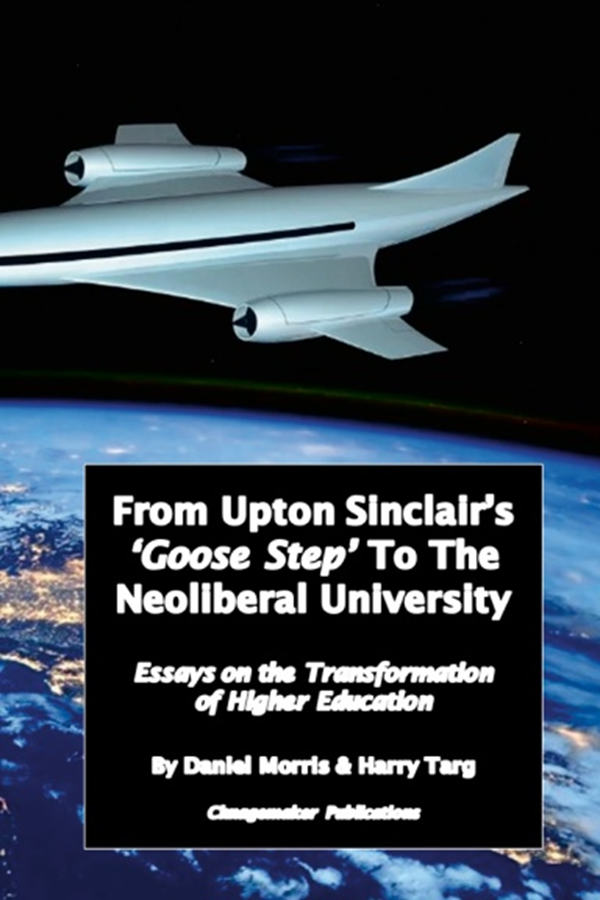
Essays in the Transformation of Higher Education: Dan Morris and Harry Targ
From Upton Sinclair's 'Goose Step' to the Neoliberal University (lulu.com)
Table of Contents
Introduction
Chapter One: Macro and Micro Analyses of Higher Education
Chapter Two: Discourses On Ideology
Chapter Three: Branding
Chapter Four: What Do Universities Do?
Chapter Five: Universities and War:
Conclusion
Appendix
Introduction
In the following pages, you are going to find a lot of specific information about what is happening at one major public research university, but we believe what is happening at Purdue is analogous to a canary in a coal mine. We believe that Purdue under Mitch Daniels, a former George Walker Bush administrator and Governor of Indiana, is becoming a high profile and influential spokesperson for the transformation of public higher education in the 21st century in directions that we find dangerous and that go against how we value higher education. We realize that, while we address extensively institutional changes and policies at Purdue, Indiana’s Land Grant University, our interest is in using this case study to illustrate larger patterns and issues that should be of concern to readers who care about the future of higher education in a broader sense.
Harry Targ's pieces do tend towards a wider-angle perspective than do those by Dan Morris, although both of us rely on our "boots on the ground" level understanding of Purdue to counteract and contest official media versions of what is happening at Purdue. We write at a moment when there is something of a "media desert" in terms of local news coverage of higher education in small markets such as Lafayette, Indiana. We have both tried to work to rectify the "media desert" landscape in our community by contributing to the Lafayette Independent, an electronic newsletter. We appreciate efforts by local journalists such as Dave Bangert and the student staff of the Purdue Exponent to offer coverage of the university in ways that are more substantial, and, often, more critical, than what one finds in the area's only mainstream newspaper, the Journal and Courier, and main local TV news source, and the Purdue NPR radio station, whose ownership in the last year has been mysteriously transferred to an Indianapolis corporation. Paradoxically the richest data for many of the essays below come from the official daily public relations newsletter from Purdue called Purdue Today. This public relations source celebrates Purdue’s latest connections with multinational corporations, the military, and state politics, and provides links to editorials published by Purdue’s President and other officials in the national press. Ironically, oftentimes what Purdue celebrates becomes the data for our more analytical and discursive writings.
Like alternative media sources, we see this book as another intervention in offering an alternative view of what is happening at our campus, but we also write with the hope that readers can apply the readings we bring to Purdue to begin conversations about the promise and problems of contemporary higher education on campuses. The authors wish to praise and encourage further research and activism around the transformations of higher education in general. We identify with what some scholars have referred to as Critical University Studies (CUS). The essays below, we believe, are part of this emerging tradition of critical and self-reflective scholarship.
The authors also wish to identify at least three major elements of the transformation of higher education. First, Purdue, like many other universities, is once again pursuing research contracts with huge corporations, and perhaps most importantly, the Department of Defense. As essays below suggest, Purdue research is increasingly justified as serving the interests of United States “national security.” Often this is conceptualized as helping the United States respond to “the Chinese threat,” rarely identifying what exactly is the threat, or considering the possibility that contributing to a new arms race with a perceived adversary may increase, rather than reduce, the possibility for conflict between nations.
Second, the work below and other writings in CUS, highlight the purposive transformation of the content of higher education. Universities are moving resources away from the liberal arts, creating new programs in “artificial intelligence” and “data science,” and in response to political pressures are diminishing programs that emphasize interdisciplinarity, intersectionality, and the structural problems of race, class, gender, and sexual preference in history and contemporary society. Essays below on “civics literacy” suggest that leading administrators at Purdue, while refusing to defend its universally praised Writing Lab after it was ridiculed on Fox News for its recommendation that student writers select gender-neutral terms such as postal worker when writing about occupations, seek to avoid the controversaries around Critical Race Theory by requiring all students to study in some fashion “civics literacy.” President Daniels has made it clear that the study of civics literacy will illustrate the “vitality” of US political institutions (as opposed to over-emphasizing the slaughter of the original inhabitants of the North American continent or the history of slavery and white supremacy).
Third, the essays below do not dwell enough on the transformation of the university as a workplace. While there have been attacks for years on the tenure system, a system of job security which was initially designed to protect faculty from external political pressures, recent additions to the transformations of the university as a work site should be noted.
Adjunctification is a term that refers to the qualitative increase in the hiring of various forms of part time instructors: full-time instructors for a set time period, instructors to teach less than a full complement of courses, and instructors with various arrangements that limit their work life, their ability to do research and prepare for their class time, and their time to serve the many needs of students. The fundamental trend in higher education is to “cheapen” and make insecure instructors, ultimately to destroy the job security that comes with academic tenure. In many cases this impacts negatively on the quality of the educational experience. (In colleges and universities in general about 70 percent of classes now are taught by instructors who are not tenure-line faculty).
And finally, every effort is made by universities to limit and derail the workplace concerns of non-teaching staff, particularly opposing their right to form unions.
One positive development from all of this-destroying the tenure system and job security, adjunctification, increased exploitation of graduate students, and finally restricting the rights and the wages and benefits of staff has been the rise of labor militancy. The American Association of University Professors (AAUP), the American Federation of Teachers (AFT), and various unions such as the United Auto Workers (UAW) and the United Electrical Workers (UE) with a history of militancy have been organizing graduate students and staff.
Finally, the authors acknowledge that in the months after we completed our manuscript, Purdue administrators and trustees have announced a series of initiatives without an appropriate level of input from university stakeholders and the wider Lafayette area community:
1. Purdue is building a housing complex near the Discovery Park part of campus to attract higher income earning technologists to relocate in West Lafayette. To encourage new high-income residents, the West Lafayette city government has authorized $5,000 cash incentives for any purchasers of these new housing units adjacent to Purdue. Such offers are not available to lower income earners or students.
2. To deal with record enrollments, Purdue has purchased a privately constructed apartment complex across from campus at a price well more than the cost of its construction.
3. Purdue officials have expanded partnerships with Saab, Rolls Royce, the Raytheon Corporation, one of the world’s five largest military contractors, and undertaken a controversial business mission with the Indiana governor to Taiwan to pursue research and production of semi-conductors, in part to respond to what Purdue officials have described as a ”Chinese threat” to national security in the United States.
4.The College of Liberal Arts has announced it will be partnering with the College of Science to develop a new interdisciplinary degree program in artificial intelligence. CLA calls its “new field” of interest, “sociogenomics.”
5. Purdue received an award recognizing its “excellence in counterintelligence,” one of only four such award recipients in 2022. Purdue joins those few universities which protect “sensitive national information from foreign adversaries.” The award announced in Purdue Today, August 24, 2022, noted that the university continues to work with the Defense Counterintelligence and Security Agency (DCSA) and the FBI.
In short, the transformation of Indiana’s Land Grant university continues at a rapid pace. And while the essays below concentrate on the developments and forces leading to these changes, the broader point of this collection of essays is to suggest that higher education in the twenty-first century is changing in a rapid and largely deleterious way. The appended essay by Carl Davidson reflects a similar critique of the university during the height of the Cold War. What we are witnessing today is a revitalization of that trend.
For those who value the university as a site for informing students about the world and debating the value of changes occurring in it, the developments highlighted in these essays are a warning. And for faculty and students alike the antidote to the militarization of the university, the transformation of the curricula, and the disempowering of those who work in universities is organizing against those elements of change that are antithetical to the educational process.
**************************************************************************************
| |
Newer Post Older Post Home
The Bookshelf
Challenging Late Capitalism
| | | | | |
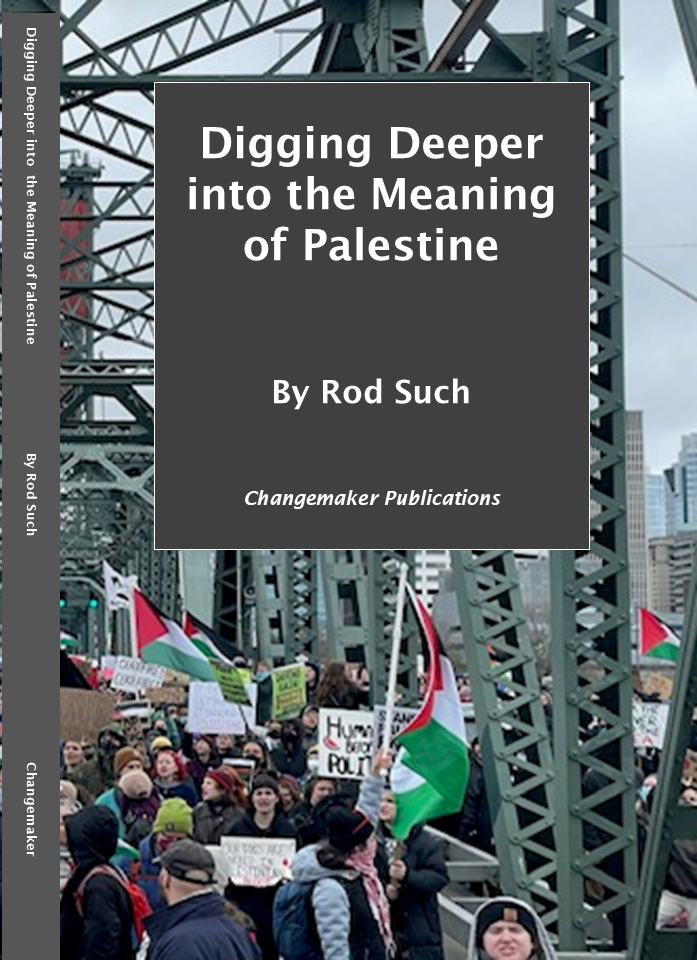
Digging Deeper into the Meaning
of Palestine
By Rod Such
Author's note: My initial decision to begin reviewing books on Palestine and the Palestinian liberation struggle was to write for political activists, rather than academics or the general public. This book, which collects dozens of reviews over a decade, might also be regarded then as a kind of wide-ranging primer or introduction to Palestine that will lead hopefully to an ongoing learning experience.
316 pages, $19.00 (discounts available for quantity), order at:
Changemaker Publications
https://www.lulu.com/spotlight/changemaker
| | | POWER TOOLS FOR UNION BUILDING | |
Timothy Sheard | 415 Argyle Rd. 6A | Brooklyn, NY 11218 US
| | With grave new challenges from the current administration, Hard Ball Press is raising our game, with new books & new Staff. | | Click go to Hard Ball Press for fresh information about organizing the workplace and building union power. | | |
Hard Ball Press is thrilled to welcome Cynthia Selene Hernandez to our staff. Cynthia will take charge of new book development, design and marketing, beginning with a children's book about Women In Construction.
Cynthia began her organizing career during the Free Trade Area of the Americas protests in Miami in the early 2000s. As a student organizer in 2006, she took part in the Justice for Janitors campaign at Florida International University, which successfully advocated for improved wages and working conditions for janitorial staff.
With the support of a Pell Grant, Cynthia joined Florida International University's Labor Center (FIU), advancing from research intern to senior research associate and instructor. Her focus on wage theft led to the enactment of seven anti-wage theft county ordinances in Florida. After nearly a decade at FIU, she became the Executive Director of the South Florida AFL-CIO. She led labor and community coalitions to enhance wages and benefits for low-income families in Miami-Dade County.
In 2018, Cynthia joined Resilience Force as Florida Director, advocating for labor protections for resilience workers. As Hurricane Ian made landfall in Florida in 2022, she returned as Resilience Force National Training and Education Director.
| | | | Be sure to check out the latest organizing tools from Labor's Book Store and the latest labor news from Work-BItes. | |
CHANGEMAKER PUBLICATIONS: Recent works on new paths to socialism and the solidarity economy
Remember Us for Gift Giving and Study Groups
We are a small publisher of books with big ideas. We specialize in works that show us how a better world is possible and needed. Click Gramsci below for our list.
| |
522 Valencia St.
San Francisco, CA 94110
415 863-6637
| | | | | |