|
USDA Announces $8 Billion Harvest Fuel Relief Program
On Oct. 19, the Administration announced $8 billion in additional assistance to farmers through the new Harvest Fuel Relief (HFR) Program. The payments will come from the Commodity Credit Corporation (CCC) and will be administered by the Farm Service Agency (FSA).
Like the Farmer Bridge Assistance (FBA) program, HFR will use a uniform formula to give simple, proportional support covering a portion of modeled 2026 crop year losses. The national loss average will be built from FSA-reported planted acres, Economic Research Service cost of production estimates, and WASDE yields and prices.
Payment rates for Title I commodities will be released in November, and the methodology for other eligible commodities will come later. USDA gave no timeline for payments, but some information on their website suggests pre-filled applications will be provided in January. It is unclear how the Harvest Fuel Relief program will affect ongoing efforts by agriculture leaders in Congress to enact a $12-$17 billion economic assistance package for the 2026 crop year.
Read the USDA's press release: https://bit.ly/484zxJY
| | |
ARC/PLC Payments, 2026-27 Sign-Up, and New Base Acres
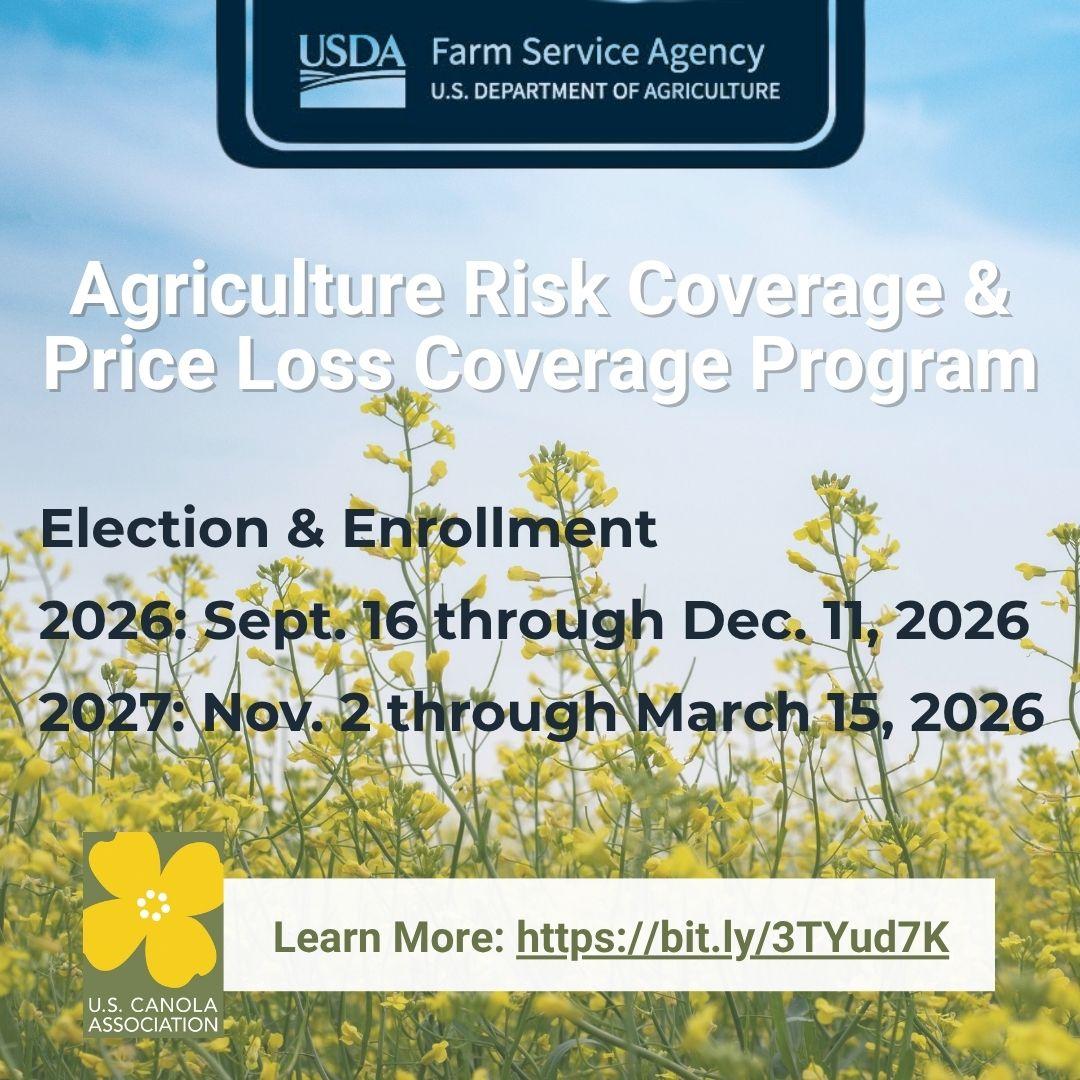
USDA announced that ARC and PLC payments for the 2025 crop year will total nearly $13.8 billion across all crops. For 2025, farmers receive the higher of ARC or PLC regardless of which they enrolled in. Enrollment is also open for the next two crop years. Producers can make elections for 2026 from Sept. 16 through Dec. 11, 2026, and for 2027 from Nov. 2, 2026, through March 15, 2027. USDA has updated the programs to add more than 30 million new base acres, as Congress directed. Because eligible acres exceeded the 30-million-acre national cap, FSA is applying an across-the-board, prorated reduction of 3.69% to all newly allocated base acres.
Read the USDA's announcement: https://bit.ly/3TYud7K
| |
USDA Crop Production Report Shows Record Canola Production
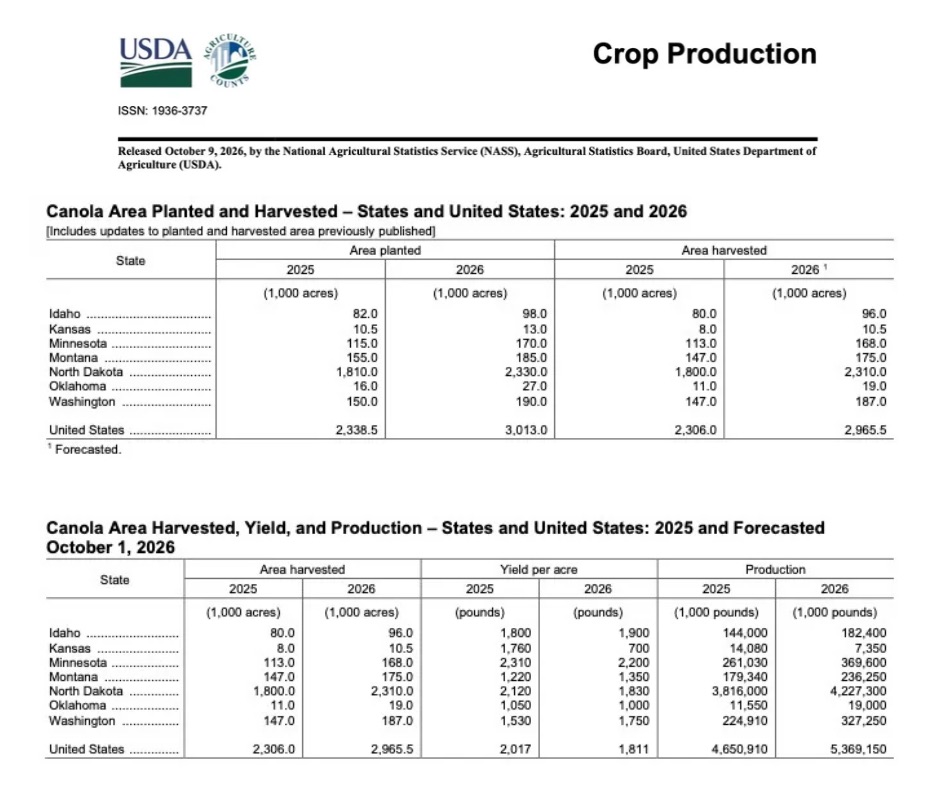
USDA’s Crop Production Report released on October 9, included the following projections for canola: The first production forecast for 2026 is a record high 5.37 billion pounds, up 15 percent from the 2025 revised production. Production in Minnesota, North Dakota, and Washington will be the highest on record, if realized. Production in Montana will be the second highest on record, if realized. Area planted for the Nation, at a record high 3.01 million acres, is up 2% from the June estimate and up 29 percent from last year.
Canola farmers expect to harvest a record-high 2.97 million acres, up 2% from June and up 29% from 2025. Acreage updates were made in several States based on a thorough review of all available data. The October yield forecast, at 1,811 pounds per acre, is 206 pounds less than last year’s revised yield but would still be the sixth-highest yield on record if realized. Compared with last year, the average yield in Montana and Washington are up 130 pounds and 220 pounds per acre, respectively. Meanwhile, average yield forecasts are expected to decline from last year in Kansas, Minnesota, North Dakota, and Oklahoma. The yield in North Dakota, the largest canola-producing State, is forecast at 1,830 pounds per acre, down 290 pounds from last year’s yield. Planted area in North Dakota is estimated at a record high 2.33 million acres, up 29 percent from last year. Planting of this year’s canola crop in North Dakota progressed ahead of last year’s pace and the 5-year average pace throughout May and June.
As of June 7, ninety-five percent of the crop had been planted, 3 percentage points ahead of last year’s pace and 7 percentage points ahead of the 5-year average. Blooming of the canola crop began in late June but lagged behind both last year’s pace and the 5-year average pace. As of June 28, twenty-five percent of the canola acreage was at or past the blooming stage, 8 percentage points behind last year’s pace and 4 percentage points behind the 5-year average pace. Harvest began in mid-August and reached 94% completion by October 4, six percentage points ahead of the 5-year average.
Read USDA's Oct. 9 Crop Production Report: https://bit.ly/4iLAWeF
| | |
EPA Proposes 100% Reallocation of Additional 2025 Small Refinery Exemption Volumes
On October 13, EPA announced its proposal to reallocate additional 2025 Small Refinery Exemptions (SREs) announced in August. EPA is proposing to reallocate 100% of the additional exempted volumes for 2025, a move supported by USCA and the biofuels industry. Back on August 31, EPA announced additional exemptions from the 2025 obligations and is now following through on its commitment to reallocate those waived volumes. There will be a 45-day public comment period on these proposed reallocations. EPA is seeking public comment through December 4 on two proposed approaches for the reallocation:
- EPA would divide the additional 2025 SRE volume equally between the 2026 and 2027 compliance years.
- EPA would reallocate all the additional 2025 SRE volume to the 2027 compliance year.
Canola Oil Use for Biofuels
The latest biofuel production report from the U.S. Energy Information Agency (EIA) shows canola oil usage at biomass-based diesel plants increased 3.1% month to month to 330 million lbs - the highest since April -- and was 51% higher than July 2025. Total soybean oil use at biodiesel and renewable diesel plants in July stood at 1.687 billion lbs, up 8.4% from June and the highest-ever consumption rate on record since the EIA began tracking inputs for biofuel production in 2021. Corn oil demand rose 24% from the previous month and was 22.1% higher compared to the same month in 2025. In the waste oils, fats, and greases category, yellow grease demand, which includes used cooking oil, decreased 11.5% in July to 610 million lbs after hitting a nearly two-year high in June. However, use of the feedstock stood 44.5% higher year over year. Tallow usage rose 2.3% month-to-month to 771 million lbs, but was 6.8% lower compared to the same month last year.
Read the EPA's RFS Reallocation of Additional 2025 Small Refinery Exemptions:
https://bit.ly/4z9CsNu
| |
Judge Maintains Stay of USDA Reorganization
On Oct. 13, a federal judge put USDA’s reorganization on hold, ruling that the fiscal 2026 agriculture appropriations bill barred USDA from spending money to close offices and relocate employees without approval from congressional appropriators, and that Congress never intended the funds for that purpose.
The stay covers about 2,600 D.C.-area employees slated to move to five regional hubs and applies department-wide rather than only to union members. Its legal footing may be short-lived, as the appropriations restrictions expire Dec. 11.
| |
USDA Announces $180 Million Seed Sovereignty Initiative to Strengthen U.S. Agricultural Security
On October 6, U.S. Secretary of Agriculture Brooke L. Rollins announced a $180 million investment to launch the U.S. Department of Agriculture’s (USDA) Seed Sovereignty Initiative, a major effort to both strengthen U.S. agricultural security by protecting the plant genetic resources that underpin American agriculture and enable breakthroughs in U.S. agricultural innovation.
This initiative will provide investments in USDA’s Agricultural Research Service (ARS) National Plant Germplasm System (NPGS), which houses more than 600,000 accessions representing over 16,000 species. Using this funding, USDA will sequence collections of major crops to unlock the tremendous potential of the plant genetic resources the United States holds and identify critical gaps.
Read the USDA Announcement: https://bit.ly/4BvLSEv
| | |
Seed Oils and Inflammation: What Does the Science Say?
Despite growing concerns about seed oils, research continues to challenge claims that oils such as canola, soybean and sunflower contribute to inflammation. Registered dietitian Fran Sutherlin explains in a recent article from The Durango Herald that linoleic acid, an essential omega-6 fatty acid, has not been shown to increase inflammation in human studies. In fact, research presented in 2025 linked higher blood levels of linoleic acid with lower markers of inflammation and improved metabolic health indicators. Sutherlin encourages consumers to focus on overall dietary patterns rather than avoiding individual ingredients, emphasizing that balanced nutrition matters more than eliminating seed oils.
Read The Durango Herald article: https://bit.ly/4i7enzD
| | |
USCA Fall Board Meeting
November 10 and November 12 | Virtual
The U.S. Canola Association will hold its fall board meeting virtually in two sessions. Each session will last up to two hours, depending on the final agenda.
The meeting agenda, Zoom link and supporting documents are available on request. For these materials or additional information, please contact the U.S. Canola Association (USCA) at info@uscanola.com.
Tuesday, November 10
Start : 11:00 ET/10:00 CT/9:00 MT/8:00 PT
End: 1:00 ET/12:00 CT/11:00 MT/10:00 PT
Thursday, November 12
Start: 11:00 ET/10:00 CT/9:00 MT/8:00 PT
End: 1:00 ET/12:00 CT/11:00 MT/10:00 PT
| |
Canola/Wheat Outlook & International Durum Forum - Minot, ND
November 17-18, 2026
The 2026 Canola/Wheat Outlook & International Durum Forum will be held Nov. 17–18 at the North Dakota State Fairgrounds Center’s FFA Hall in Minot, North Dakota. The annual event brings together canola, wheat and durum producers and industry stakeholders for market outlooks, industry insights and discussion.
This year's keynote speaker will be Jim Wiesemeyer. Growers are encouraged to attend this annual meeting to get the latest information on canola and durum production.
Register for free: https://bit.ly/3Vhsvi7
| |
2026 Idaho Grain & Oilseed Convention - Sun Valley, ID
November 17-19, 2026
The 2026 Idaho Grain & Oilseed Convention will take place November 17-19 in Sun Valley, Idaho, at a defining moment for agriculture. As producer navigate market uncertainty, rising costs and a changing landscape, this year's them, "Navigating What’s Next: Facing Challenges. Finding Opportunities" highlights the decisions, innovationa dn collaboration shaping the future of Idaho agriculture.
Tom Hance will speak on behalf of the U.S. Canola Association and the National Barley Growers Association. The convention will bring together growers, industry leaders, researchers and partners for timely discussions on markets, policy, technology adn emerging opportunities. Breakout sessions will include a discussion focused on canola production challenges and solutions, as well as a session expoloring oilseed marketing, logisitics and end use.
PNWCA producer members can receive $50 off registration.Online registration closes on Nov. 1.
To learn more and register, visit: https://bit.ly/3Rzrh08
| |
The Northern Canola Growers Association Annual Canola Research Meeting -
via Zoom
December 3, 2026 | 9 a.m. CST
The Northern Canola Growers Association will hold its 18th Annual Canola Research Meeting via Zoom on Thursday, Dec. 3, at 9 a.m. Canola growers and industry stakeholders are invited to attend and share their thoughts and ideas on research priorities important to canola growers.
To join the meeting, click on this Zoom link: https://us02web.zoom.us/j/89714870639
| |
PNWCA Announces 2027 Canola Workshop and Annual Member Meeting
February 24, 2027
The Pacific Northwest Canola Association (PNWCA) has announced that its 2027 Canola Workshop will take place on February 24 in Moscow, Idaho, with the association's annual member meeting scheduled for February 23 at the same location.
Additional details, including the workshop agenda and registration information, will be shared as they become available.
| |
North Dakota Canola Harvest Wraps Up With Record Acreage, Weather-Related Yield Losses
Barry Coleman, Northern Canola Growers Association
The North Dakota canola harvest has wrapped up across the state with some areas of the northern part of the state harvested last as weather conditions stalled harvest. A record 2.25 million acres of canola was planted, according to the most recent Farm Service Agency acreage report.
The USDA issued its first production estimate for major crops on October 9, estimating average canola yields of 1,830 pounds per acre for North Dakota. We expect the USDA to reduce this figure when it reports final production estimates for the year in January.
Excessive heat and wind took a toll on canola yields in 2026 that otherwise would have been above trendline. Some growers reported losses of 700 pounds per acre. The northern half of the state escaped the worst of the heat this year but suffered losses from strong winds in early September that hit canola that was not ready for harvest. The southern half experienced extreme heat that reduced yields in canola by approximately twenty percent. Early season moisture was adequate, and June temperatures were favorable for canola production, but the moisture ran out and the heat hit in early July and did not relent for one month.
In the past decade, canola yields in North Dakota have been increasing an average annual rate of 49 pounds per acre as the genetic potential of canola varieties continues to improve. Trendline yields would have put the canola crop at approximately 2,100 pounds per acre.
A new, interactive map of canola acreage in the U.S. has been created and can be found on the northerncanola.com website. The map shows total acres for all of the 29 states that planted canola and also shows the breakdown by county within each state. North Dakota again led the nation with approximately 75% of total canola acres.
| |
Rising Biofuel Demand Creates New Opportunities for Canola
Canola is gaining momentum as a valuable biofuel feedstock as U.S. oilseed processors expand capacity to meet rising demand. In a recent Agri-Pulse article in the High Plains Journal on October 23, Devin Mogler, president and CEO of the National Oilseed Processing Association, said crops with higher oil content, including canola, sunflower, and camelina, are expected to play an increasing role in domestic oilseed processing. Scoular's new processing facility in Kansas, which handles both canola and soybeans, is already operating at capacity, with approximately 1000,000 acres of canola grown in the region this year. With more than $7 billion being invested in U.S. oilseed processing, strong federal biofuel policies remain critical to supporting continued growth and creating new opportunities for canola growers.
Read the article: https://bit.ly/47KxuuE
| |
Canola Acreage Doubles in Brazil as Biofuel Demand Grows
Canola is gaining ground in Brazil as an increasingly important biofuel feedstock. According to a recent October 19 The Digest article, canola acreage in Rio Grande do Sul is projected to reach about 353,397 hectares in 2026, a 102.6% increase from 2025. The significant expansion reflects growing interest in canola's versatility for both edible oil and biofuel production, highlighting its expanding role in global biofuel markets.
Read the article: https://bit.ly/4ipHBd6
| |
Winter Canola Creates New Opportunities for Farmers in Illinois
Winter canola is gaining traction in southern Illinois, offering farmers new opportunities for profitability, crop diversification, and biofuel production. According to an October 15 article by Ava Splear in the Prairie Farmer, partnerships between Pioneer, Bunge, and Chevron are helping expand winter canola production by providing growers with agronomic support, guaranteed contract prices, and access to established markets. Farmers can harvest winter canola in early summer and follow with double-crop soybeans, creating additional revenue opportunities. With plans to expand production to 300,000-400,000 acres nationwide, the initiative highlights canola's growing potential as feedstock for renewable fuels and a valuable addition to U.S. crop rotations.
Read the Prairie Farmer article: https://bit.ly/4zbkWsb
| | |
USCA works to support and advance U.S. canola production, marketing, processing, and use through government and industry relations. Since its establishment in 1989, the association has helped domestic canola acreage grow from virtually zero to about 2 million. To learn more about USCA, go to: www.UScanola.com
Want to promote your products or services to canola producers and industry members? Visit our advertising pages to find specs, deadlines and rates to advertise in the Canola Quick Bytes monthly e-newsletter.
| | | | |