November 2026 || Newsletter Edition 194 | | |
In this issue:
CSU Food Systems Spotlight
Mark Your Calendar
Funding Opportunities
News, Resources, and Reading
From Our Communities
About Us
Stay Connected
| | CSU Food Systems Spotlight | |
Victoria (Vivi) Ruppenthal
Victoria is a senior in Colorado State's Livestock Business Management program which is housed jointly in the Department of Agricultural and Resource Economics and the Department of Animal Sciences. During her time so far at CSU she has focused largely on agricultural policy, trade, and sustainability.
This past summer, Victoria worked as an intern for the U.S. Meat Export Federation, learning about international marketing, trade, and communications. Additionally, Victoria has spent time working with CSU Extension, the Colorado Fruit and Vegetable Growers Association, and the Colorado Pork Producers Council. Post-graduation she hopes to work in the agricultural policy and trade, and work towards solutions that help farmers and ranchers in Colorado and beyond.
| | |
Food Security in Rural Colorado
The Boettcher Foundation's Rural Leaders Collaborative in 2026 will be held from 10:00-11:30 a.m. on Wednesday, November 4. The topic is Food Security in Rural Colorado.
Despite the vast agricultural landscapes that define our rural landscape, local Colorado families encounter a paradox of systemic barriers. On a federal level, strict income caps and recent policy tightening mean that over half of food-insecure rural Coloradans earn too much to qualify for SNAP benefits, while state-level obstacles like expansive geographic food deserts, inflation, and a lack of public transit infrastructure isolate remote towns from fresh produce. Addressing these complex systemic gaps requires deeply collaborative work. Groundbreaking regional data—such as the Colorado Department of Public Health and Environment (CDPHE) 2026 Rural Health Equity Report and the Mountain Coalition for Food and Nutrition Security six-month regional analysis—highlights how food access directly impacts life expectancy and health outcomes across our rural communities. Fortunately, trailblazing organizations are rewriting the script with innovative local services: from better access to fresh fruit and vegetables from local farm markets to collaborative work across geographic boundaries, these rural Colorado organizations can help us build a more resilient, food-secure future for all Coloradans.
Join by Zoom here.
Join us to learn from:
Betsy Dittenber, Executive Director, Chaffee County Community Foundation
Rachel Landis, Executive Director, Good Food Collective, serving Dolores, San Juan, Montezuma, La Plata and Archuleta Counties
Scott Bourbeau, Director of Programs, LiftUp of Routt County
Veronica Jacoby, President, Sparrow House Ministries, Lamar, CO
Gray Warr, Founder and Executive Director, Harvest for Hunger in Pitkin County
| |
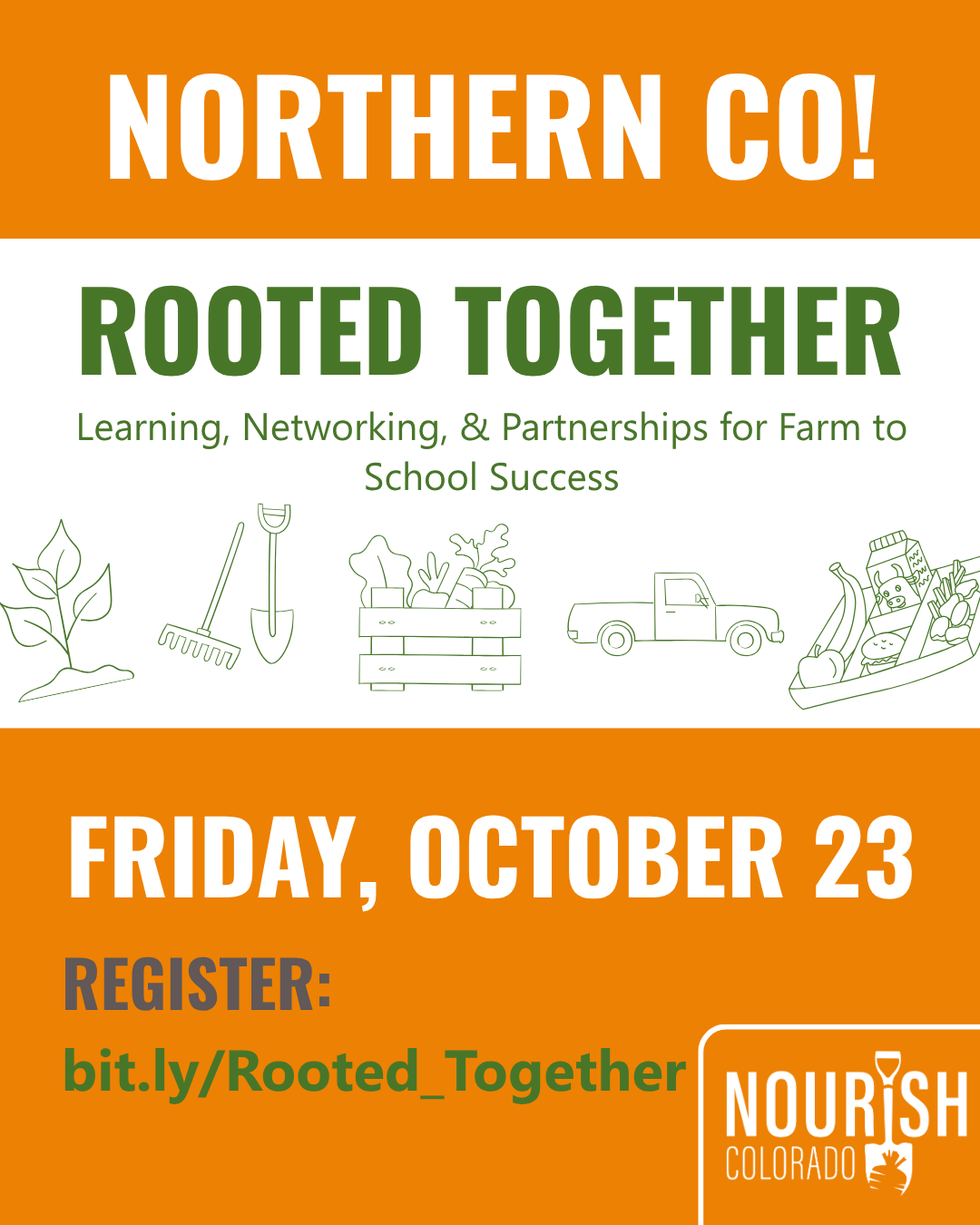
Rooted Together: Learning, Networking, and Partnerships for Farm to School Success
Join one (or multiple) "Rooted Together" events happening on Fridays, from November 6th through Dec 11th!
As a producer, when considering which event(s) to register for, think about your delivery range and/or the delivery range of any intermediaries with whom you may work. For our school district attendees, please join us at whichever location seems closest.
- November 6th - Glenwood Springs, CO - Glenwood Springs High School
- November 13th - Alamosa, CO - Alamosa Middle School
- December 4th - Pueblo, CO - Pueblo D60 School
- December 11th - Aurora, CO - Food Bank of the Rockies
These gatherings will be a chance for school meal operators to glean success stories and strategies from their peers on how to grow and/or expand their farm to school efforts. It will also be a chance for producers to meet with school meal buyers, learn more about how school meal programs work, and understand procurement timelines and strategies for accessing K-12 markets to meet increased demand. There will be plenty of time to network, connect with resources and partners in your region, and even learn a few culinary tips and tricks for weaving local foods into school menus in a way that works for your operation.
For more information or to register, click here.
| |
Annie's Project Facilitator Trainings
Annie's Project is hosting facilitator training sessions. Registration is limited to the first 20 participants. All 8-hour sessions are virtual, and there is no charge for the training.
All 8 hours must be completed to be certified as an Annie’s Project facilitator. If you are interested in hosting Annie's Project in your county, the first step is to become a trained facilitator by taking this course, offered November 9-10 (9am – 11am and 1pm – 3pm MST). Times repeated on both days.
Contact Jenny Beiermann (jenny.beiermann@colostate.edu) or Karisha Devlin (karisha@anniesproject.org) with questions or for more information.
| |
American Farmland Trust: Farms for a New Generation New Certification Program
Applications are now open for the first cohort of our Farmland Access and Transfer Navigator Certification Program, a national initiative that works to increase access to land and capital for emerging farmers and ranchers while supporting elder farmers and landowners to transfer their farms with dignity and confidence.
This 12-session program is designed for professionals working in agriculture, food systems, Extension, nonprofit organizations, educational institutions, lending organizations, and other agricultural service roles.
AFT is inviting applications from people who are committed to helping family farmers build thriving local food systems. They encourage people who are new to the subject matter to apply and are open to professionals at all career stages.
The program focuses on three key competency areas:
- Farmland Access Strategies: Focus on effective support for beginning farmers who face significant barriers to finding secure land opportunities.
- Farm Transfer and Succession Planning: Focus on effective support for landowners and farm families who are working through transition.
- Navigator Coaching, Network Building and Resource Coordination: Build the skills needed to guide clients through complex land access and transfer decisions using trusted tools, resources, and referral networks.
Find more details at Farmland Access and Transfer Navigator Certification · American Farmland Trust. Question and Answer Session held for anyone who would like to learn more on November 10, 2026 at 12:00pm MT. Applications are open until December 7, 2026.
| |
Pearls of Production
Hosted by the University of Missouri, this program offers free monthly virtual and in-person sessions to connect agricultural professionals, researchers, and producers to celebrate the International Year of the Woman Farmer.
Upcoming speakers include:
- November 18th: Tanika O'Connor
- December 11th: Dr. Temple Grandin
At the end of the year, you can join Pearls of Production for their annual in-person conference, designed to provide practical knowledge, hands-on learning, and networking opportunities for livestock producers.
Register for the speaker series and conference here.
| | |
Produce Safety Alliance Grower Training Course
Colorado State University Extension, Fort Lewis College, and the Colorado Fruit and Vegetable Growers Association will be hosting an online only Produce Safety Alliance Grower Training Course in two parts, from 8am-1:00pm on November 30 and December 1, 2026. Since it is online only, it has a very specific structure. Please read all the registration information to make sure this course and its format will work for you.
This course will provide a foundation on the FSMA Produce Safety Rule requirements, Good Agricultural Practices (GAPs) and co-management information, and details on how to develop a farm food safety plan. Individuals are expected to gain a basic understanding of:
- Requirements in the FSMA Produce Safety Rule and how to meet them;
- Microorganisms relevant to produce safety and where they may be found on the farm;
- How to identify microbial risks, practices that reduce risks, and how to begin implementing produce safety practices on the farm; and
- Parts of a farm food safety plan and how to begin writing one.
Registration is free to all farmers affiliated with a Nourish Colorado Local Food Program regional partner. For all others, the registration fee is $85. Registration includes PSA materials and a certificate of completion as required under FSMA. Registration for this course closes on November 20, 2026 in order to have time to mail out required course materials.
Learn more and register here: https://col.st/oe132
| |
Exploring the Economics of Regional Food System Investments
The USDA Regional Food Business Centers were the most recent initiative to help communities use grants and other USDA Ag Marketing Service (AMS) resources in projects and programs to grow the size, strength, market access and/or sales within regional food systems. As we wind down our Northwest Rocky Mountain Center, we have evaluated our Biz Builder program using a Local Impact Calculator available at localfoodeconomics.com (and funded by AMS). Come learn how we evaluated our projects, how you can use the calculator if you want to estimate economic activity for your food initiative, or brainstorm ways we can make future updates to the calculator most useful for our regional food system community of practice.
This webinar will be held Wednesday December 2nd, 11-12:15 MT.
Register here.
| |
Building New Supply Chains: A Look at Emerging Models
Hosted by CSU Extension, Montana Department of Agriculture and Wyoming collaborators, this webinar will offer some examples from across the West of how businesses and communities are creating new market opportunities for grain, pulse and specialty crop producers, by building capacity in their supply chains.
Case study businesses include Meadowlark Market and Kitchen, CIVC Montana, Farm Runners and Ronan Brewery. Each business is built on partnerships and investments that leveraged food system opportunities. How did these businesses organize around identifying an opportunity or encountering a constraint? If you are looking for new ideas and inspiration to activate change in your community, then this webinar is for you!
This webinar will be held Thursday, December 3, 10am-12pm MT.
Register here.
| |
Good Agricultural Practices Produce Safety Training
Have you wondered how to get started or improve your on-farm food safety program? Are you curious how Good Agricultural Practices (GAPs) apply to your fruit or vegetable growing operation?
Please join us on December 7, 2026 for a fully online Zoom-based training that covers how to identify the produce safety risks on your farm and reduce them using GAPs. Using photos and real-life examples, you will learn how to:
- safely manage and use soil amendments, and irrigation and processing water
- prevent contamination from domestic and wild animals
- maintain worker health and hygiene and safe facilities and food contact surfaces
- transport, deliver and build a traceback system for your produce
If you are selling your produce to schools, through a farmers market, CSA, or directly from your farm, this course is for you!
Time: the course has two sections:
- 11am - 3pm (MT) Comprehensive GAPs training
- 3:30 pm- 4:30 (MT) Put the concepts into action, develop your food safety plan and prepare for a GAP audit, if needed.
Cost: Free of charge!
The course is led by a multi-state team of farm food safety Extension professionals and an experienced produce farmer. A certificate of attendance will be issued to all participants. You can opt to attend one or both sessions.
Register here.
| |
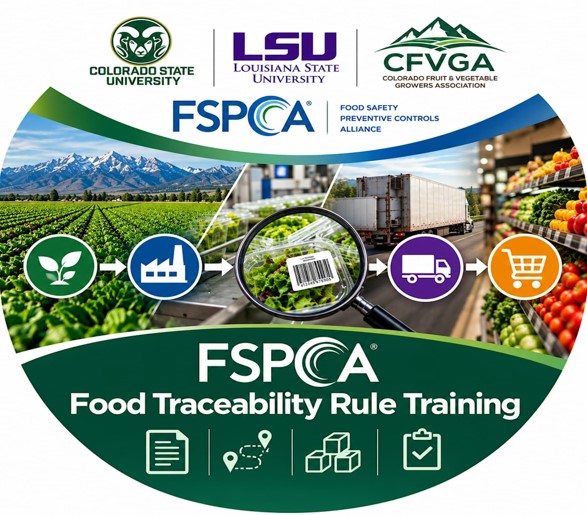
Food Traceability Rule Training (FSMA 204)
Can your organization quickly identify where a food product came from, where it went, and what records are needed during a food safety investigation?
The FDA Food Traceability Rule introduces additional recordkeeping requirements for certain foods to improve traceability throughout the supply chain and support faster responses to foodborne illness outbreaks and recalls.
Join experts from Colorado State University (CSU) and Louisiana State University (LSU) for two days of instructor-led training using the official Food Safety Preventive Controls Alliance (FSPCA) curriculum.
This training combines regulatory knowledge with practical examples to help participants understand the rule, evaluate how it applies to their operations, and prepare for implementation.
Dates: November 12-13, 2026, 9am-5pm each day
Location: In-person at CSU Spur, Denver.
Cost: $450
Registration and more information: https://www.eventbrite.com/e/fspca-food-traceability-rule-training-tickets-2003216116329?aff=oddtdtcreator
| |
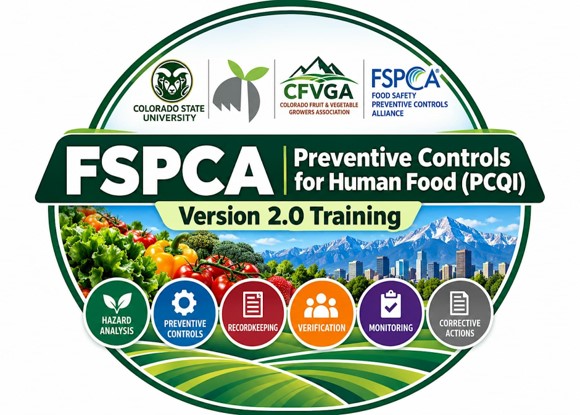
Preventive Controls for Human Food (PCQI) Training
Is your organization prepared to identify food safety hazards, implement effective preventive controls, and develop a food safety plan that meets FDA regulatory requirements?
The FDA Preventive Controls for Human Food regulation establishes requirements for hazard analysis, risk-based preventive controls, and food safety management systems in covered food facilities. Understanding these requirements is essential for developing and maintaining effective food safety programs.
Join food safety experts from Colorado State University (CSU), the Colorado Department of Public Health and Environment (CDPHE), and the food industry for three days of instructor-led training using the official Food Safety Preventive Controls Alliance (FSPCA) Preventive Controls for Human Food, Version 2.0 curriculum.
This training combines regulatory expertise, applied food safety research, and practical exercises to help participants understand preventive controls requirements and develop, implement, and manage effective food safety plans.
Dates: November 16-18, 2026, 9am-5pm each day
Location: In-person at CSU Spur, Denver. Participants may also attend live online and participate in the same instructor-led sessions.
Cost: $750
Registration: https://www.eventbrite.com/e/fspca-preventive-controls-for-human-food-pcqi-version-20-training-tickets-2003219947789?aff=oddtdtcreator
| |
Soil Revolution: 2026 Conference
The 11th annual Soil Revolution Conference will be held on Thursday, December 10th, 2026 in Boulder, CO.
This gathering seeks to increase the adoption of soil health practices and regenerative agricultural management systems among farmers, ranchers, and land stewards. Featured speakers include Maggie Hanna, Robert Sakata, Steve & Todd Olander, Helen Skiba, and Chad Resnicek.
Early-bird registration ends November 12. For a complete list of speakers, access to the agenda, and registration details, click here.
| |
35th Annual Colorado Agriculture Forum
The Colorado Agriculture Forum will take place on February 26, 2027, and serves as Colorado's primary agricultural outlook conference.
-
Date: February 26, 2027
-
Location: The Legacy Building at The National Western Stock Show, 4800 National Western Dr, Denver, CO 80216
-
Focus: The forum connects the global economic outlook to state and local production, business, and policy issues. Sessions traditionally cover commodity markets, weather outlooks, water resiliency, and agricultural policy updates.
-
Registration: Detailed scheduling and registration details can be found directly on the official Colorado Ag Forum Website. Registration opens December 1st.
| | |
Yo Soy de Rancho Programa
Yo soy de rancho es un programa diseñado para empoderar a trabajadores agrícolas con experiencia para que den el siguiente paso en sus carreras creando sus propios negocios agrícolas.
Reconociendo la amplia experiencia y dedicación de quienes llevan años en el campo, este programa ofrece apoyo específico mediante clases de desarrollo de pequeñas empresas impartidas en español. Los participantes reciben orientación práctica para crear un plan de negocios, mentoría personalizada y herramientas prácticas para convertir su experiencia en éxito empresarial.
Podemos ayudarle en cualquier etapa, ya sea que sea nuevo o ya tenga una pequeña operación agrícola.
- ¿Ha trabajado usted en el sector agrícola durante varios años?
- ¿Quieres iniciar tu negocio agrícola?
- ¿Tiene actualmente un negocio agrícola paralelo y busca expandirse?
- ¿Sabía que usted puede pedir prestamos para empezar su propio negocio agrícola?
El cupo es limitado. Haga clic aquí para completar el formulario de evaluación de elegibilidad.
Por favor, refiera a los trabajadores a:
Ruben Pacheco al 720-830-2338 o ruben.pacheco@state.co.us, o
Ricardo Garcia al 720-908-7673 o ricardo.j.garcia@state.co.us.
| | |
2027 Colorado Building Farmers and Ranchers Program
Tuesday evenings, 6:00-8:30 pm
January 12-March 9, 2027
CSU Extension's Principles of Business Planning and Management program is a series of evening classes designed to help New Farmers and Ranchers build an agricultural business and provide Intermediate and Experienced Farmers and Ranchers with tools and ideas to refine and enhance their business management, production, and marketing skills. This class will be offered in English/Spanish via live simultaneous interpretation. All class materials will be provided in English and Spanish. Learn more and pre-register here.
El programa de Extensión de CSU (Universidad Estatal de Colorado) de Principios de Planificación y Gestión Empresarial es una serie de clases por la tarde diseñadas para ayudar a los Nuevos Agricultores/as y Ganaderos/as a construir un negocio agrícola y proveer a Agricultores/as y Ganaderos/as Intermedios/as herramientas e ideas para refinar y mejorar sus habilidades de gestión empresarial, producción y marketing. Clases estarán ofrecidos verbalmente en ingles/español a través de interpretación simultánea en vivo y todos los materiales del curso estarán proporcionadas en inglés y español. Aprenda más y preinscribirse aquí.
| | |
Online Grant and Grow: A Practical Funding Toolkit for Agricultural Businesses in Colorado
Grant and Grow is an online course offered by CSU and the Colorado Building Farmers and Ranchers Program for people looking to equip themselves with the skills to identify, evaluate, and apply for funding for their food or farm businesses. Explore 70+ grant, loan, and tax credit programs, and hear from producers and grant recipients who've secured funding. This self-paced course is designed for farmers, ranchers, food businesses, and support organizations.
The course consists of 5 modules. At the end of the course you will have a complete funding application. Learners will have access to the course for a full year. Registration is $50 and the course will be available on CSU Online.
| |
Online Course for Aspiring Farmers, Ranchers, and Food System Workers: Exploring Your Farm Dream
Exploring Your Farm Dream is an online course offered by CSU and the Colorado Building Farmers and Ranchers Program for people looking to equip themselves with the knowledge, skills, and business strategies for a future in agricultural production. This self-paced course is designed for learners who have limited experience in agriculture. Visit the course website here for more information.
The course consists of 10 modules, which learners will have access to for a full year. Registration costs $150. Register for the course here.
| | |
Funding for Urban Ag in Public Gardens
The U.S. Botanic Garden and the American Public Gardens Association are partnering again this year to support public gardens and community organizations working together on urban agriculture, food growing, education, and food security.
Since 2020, the Urban Agriculture Resilience Program has awarded $2.7 million to 136 projects across 34 states and D.C., helping grow and share more than 750,000 pounds of produce and distribute 292,000+ seedlings.
Does your garden have a project that could strengthen community food growing, education, sustainability, or climate resilience? Apply now for funding of $5,000–$20,000!
Applications are due November 17, 2026, 8 p.m. ET / 5 p.m. PT. Learn more here.
| |
National Young Farmers Coalition: Next Generation Farmer Fund Grant Opportunity
The National Young Farmers Coalition is launching its largest grant program yet, a $1 million+ initiative providing direct financial support and technical assistance to beginning farmers and ranchers under 40 who steward land through sustainable practices.
Grants will range from $10,000 to $50,000, covering efforts like soil health and carbon sequestration, water quality, biodiversity, and supply chain resilience, with recipients announced in early 2027. Whole Foods Market has committed up to $500,000 in matching funds to launch the Next Generation Farmer Fund, with a goal of raising more than one million dollars.
Click here to learn more.
| |
Grants for Farms and Hubs
Looking for funding or support for your farming community or hub? Rooted Farmers recently launched three grant and scholarship programs
Click here to learn more.
| |
Airbnb Announces 'Farm to Stay' Grant Program in Partnership with American Farmland Trust
Airbnb’s partnership with American Farmland Trust will launch a new grant program aimed at farmers who want to take advantage of agritourism opportunities that support their farm business, but are in need of financial assistance to get started.
Airbnb will give farmers up to $10,000 each to support those looking to bring in revenue from agritourism, which has experienced increased demand in recent years and has created new supplemental income opportunities for farmers and their families. Applications will be accepted November 30th through December 4th. Join this webinar on November 13 at 12pm ET to learn more.
Click here to learn more.
| | |
Western Extension Risk Management Education Grants
The Western Extension Risk Management Education Center has grants available in three funded program areas:
-
Education projects to help agricultural producers improve their economic viability through targeted risk management strategies;
-
Underutilization of crop insurance projects to deliver risk management education to agricultural producers who underutilize crop insurance products or programs; and
-
Exploratory projects for new ideas that address farmer/rancher risk management education needs.
Applications are now open and will be due on November 12, 2026. Awards will be announced on February 12, 2027.
For more information, including proposal resources click here.
| | |
Restore Grants
Zero Foodprint’s Restore Grants provide up to $25,000 to farmers and ranchers implementing conservation practices that increase soil carbon and support climate-smart agriculture. The application is open October 1st and closes November 4th. Learn more here.
| | |
Growing GRASS Program
The Growing GRASS program, led by the American Sustainable Business Institute / Network and Other Half Processing, provides funding opportunities to beef and bison producers looking to build their byproduct supply chains. Whether you are a producer looking to expand existing direct-to-consumer markets or are just starting your journey selling directly to consumers, this is something to put on your radar!
Visit ggrass.org to learn more about the program, or scan the code to access the enrollment guide and see if you're eligible.
Eligible producers receive $3,000 JUST for completing the survey - if you decide it's not for you at the end, you keep it, no strings attached!
| | |
Colorado Parks & Wildlife Habitat Partnership Program (HPP)
The Habitat Partnership Program aims to work with private land managers, public land management agencies, sports persons, and other interested parties to reduce wildlife conflicts, particularly those associated with forage and fence issues related to big game ungulate species (deer, elk, moose, and pronghorn). Matching contributions from project applicants are required for every project.
Deadline: Rolling (local committee deadlines vary).
Learn more here.
| | |
USDA Protection and Recovery Resources
USDA provides a suite of disaster assistance programs to help offset losses as well as crop insurance and other coverage options to help manage risk and provide a safety net. USDA’s Farm Service Agency, Natural Resources Conservation Service, and Risk Management Agency offers a number of options.
Learn more about USDA's disaster assistance programs here, and the Noninsured Crop Disaster Assistance Program here. The Risk Management Agency of USDA has crop insurance resources here.
| | |
FACT Fund-a-Farmer Grants
Funding from Food Animal Concerns Trust can support fencing, watering systems, pasture improvements, handling facilities, animal welfare certification, and other projects that improve pasture-based livestock operations. Grants typically range from a few thousand dollars up to $10,000
.
Applications open November 1, 2026
Expected Deadline: Early January 2027
Learn more here.
| | |
National Fish and Wildlife Foundation's Southern Plains Grassland Program
The NFWF Southern Plains Grassland Program supports grazing management, grassland restoration, and drought resilience projects on working ranches in eastern Colorado, northeastern New Mexico, Oklahoma, the Texas Panhandle, Kansas, and southern Nebraska.
Next application cycle expected Fall 2026 (deadline to be announced).
Check out the program here.
| | |
Quivira Coalition's Soil to Supper Program
The Soil to Supper project helps livestock producers adopt practices that improve soil and water health while strengthening their bottom line. The project is funded through an NRCS Advancing Markets for Producers grant, which helps pay livestock producers in the Southwest to do activities that improve access to markets and put conservation practices in place.
Eligible producers can receive $10,000-$100,000 in support.
Learn more about the project, see if you're eligible, and apply at soiltosupper.org.
| | News, Resources & Reading | | |
USDA Announces $86.6 Million Investment into the U.S. Specialty Crop Industry
The U.S. Department of Agriculture announced it is awarding $86.6 million in grant funding to support the specialty crop industry through the Specialty Crop Block Grant Program (SCBGP). The program funds innovative projects designed to enhance the competitiveness of specialty crops.
Through the Colorado Department of Agriculture, Colorado was awarded $930,000 to enhance specialty crop competition through marketing, promotion, research, development, and expansion of accessibility through a variety of activities and projects with their grant recipients. To view a full list of 13 funded projects, click here.
For more information on the Specialty Crop Block Grant Program, click here.
| |
Revision to the Cottage Foods Act in Colorado, HB 26-1033
HB 26-1033 expands Colorado’s Cottage Foods Act (CCFA) allowing for the sale of homemade foods that require time and temperature control, including meat and meat products. This new law will go into effect on January 1, 2027.
All cottage food producers must take a food safety course that includes food handling training on time and temperature control, and they must acquire and maintain proof of course completion.
View an updated schedule of classes offered by CSU Extension here. This includes the current cottage foods training through December 2026 and the new training offered as of January 2027. Courses are available in both English and Spanish.
More information on eligible foods, transportation limitations and other requirements under the act can be found here.
| | |
Announcing the Good Egg Partner Program
Colorado Egg Producers is pleased to announce the launch of our new Good Egg Partner Program!
This program is designed for individuals and families who produce eggs on a smaller scale, including backyard flock owners, family farms, hobby farmers, and other small egg producers.
The Good Egg Partner Program focuses on education, responsible production practices, food safety and handling, flock health, and the care and welfare of laying hens. Members receive valuable information and resources to help them successfully manage their flocks and produce safe, high-quality eggs.
Membership benefits include:
• Educational programs and webinars
• Access to our “Ask the Vet” resource
• Important animal-health and disease alerts
• Updates from the Colorado Department of Agriculture
• Information about laws and regulations affecting egg producers
• Practical resources on flock management, biosecurity, and egg production
• Recognition as a Good Egg Partner
• A listing on the Colorado Egg Producers website
• Opportunities to connect with Colorado’s egg-producing community
Membership is only $25, and those who join now will receive membership through December 31, 2027.
Whether you operate a small family farm, maintain a backyard flock, or raise laying hens as a hobby, we invite you to become part of Colorado’s egg-producing community.
Join online today.
| |
Farmer's Market Price Reporting
CSU Extension has been collecting information on prices and units of sale for fresh fruits and vegetables, meats and eggs in several farmers’ markets around the state during the 2026 season. This information is presented in terms of weekly average prices for each product as well as the price range, by market.
Farmers marketing product pricing can be used to:
- Understand how price points differ by market,
- See what products are available in other markets, and
- Help producers plan for future production by better estimating potential revenue from the products they grow.
The price reports can be accessed at: https://foodsystems.colostate.edu/market-prices-and-information/
| | |
Cultivation Station: A Colorado Proud Podcast
Cultivation Station is a business development podcast from the CO Department of Agriculture's Colorado Proud program. The podcast dives into the rich and diverse world of food and agricultural businesses. Whether you are just beginning to think about starting a food or ag business in Colorado, or your operation is up and running, there are many expert insights and insider tips to help you be successful.
Find the full list of podcast episodes here.
| |
List Your Business in USDA AMS Local Foods Directories
The USDA Local Foods Directories allow you to market your local food business to a wider nationwide audience. AMS directories include:
To create a new listing, answer quick and easy questions about the status of your business so consumers can learn more about you.
Click here to sign up for the directory.
| |
Age Friendly Community Garden in Julesburg
In Julesburg, Colorado, local organizations are working together to create more opportunities for older adults to stay active, connected, and engaged in their community while building relationships across generations.
Sedgwick County Organized Recreation (SCOR) and Communities That Care (CTC), a youth-focused organization, are collaborating to expand recreational opportunities for residents age 50 and older. With limited amenities in this rural community and many residents living on fixed incomes, accessible opportunities for physical activity and social connection are especially important.
At the Sedgwick County Recreation Center, the project will expand senior-friendly fitness options with new equipment, including a rowing machine, treadmill, and recumbent bike. These additions build on existing programs such as chair yoga, indoor walking, and pickleball, giving older adults more ways to support their physical health and mobility.
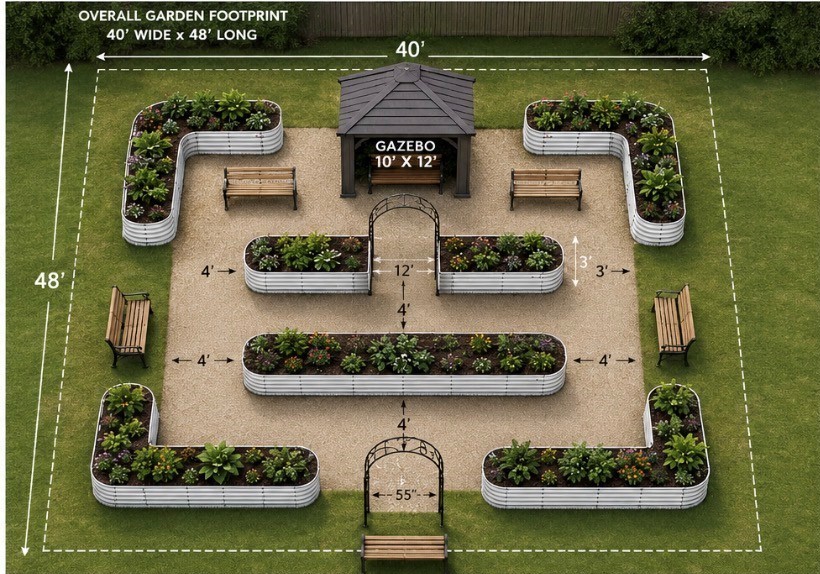
At CTC’s youth gathering space, The Cave, plans include accessible raised garden beds, shaded seating, and a gazebo. Local Master Gardeners and volunteers will help community members grow produce, share gardening knowledge, and distribute extra harvests to residents in need.
The project’s greatest strength is its emphasis on shared learning. Older adult volunteers will work alongside youth on gardening, food preparation and preservation, and practical life skills. These relationships create opportunities for young people to learn from trusted adults while giving older residents meaningful ways to contribute their experience and talents.
By bringing together community organizations, volunteers, and residents of all ages, Julesburg is investing in more than recreation and gardening. The effort demonstrates how locally driven partnerships can strengthen community connections, improve access to healthy activities and fresh produce, and support quality of life in rural Colorado.
Contact Linda Langelo to learn more.
|
Summit to Shelf Connects Colorado's Food and Agriculture Entrepreneurs
On October 5, 2026, food and agriculture entrepreneurs, business-support organizations, and industry partners gathered in Durango for Summit to Shelf, a regional convening focused on helping Colorado food and agriculture businesses develop and grow. Hosted at the La Plata County Fairgrounds, with an evening founder showcase at Subterrain, the event brought practical business-development resources and networking opportunities to Southwest Colorado.
Summit to Shelf evolved from Colorado Food Collision, an initiative launched in 2023 through collaboration between Startup Colorado and Colorado State University (CSU) Extension. Building on previous convenings, the event responded to feedback from rural entrepreneurs seeking greater access to business expertise, technical assistance, and connections to support their businesses. Hosting the event in Durango marked an intentional effort to bring these resources beyond the Front Range and strengthen support for food and agriculture businesses across Colorado.
Partners included CSU Extension, Naturally Colorado, Startup Colorado, the Colorado Office of Economic Development and International Trade, the Colorado Department of Agriculture, Natural Grocers, and Good Food Collective. Through interactive conversations, resource sharing, and networking, participants explored business challenges, connected with peers and experts, and identified resources to help move their businesses forward.
Founder Showcase Spotlight: The evening showcase highlighted food entrepreneurs putting their ideas into action. Participating businesses included Odd Bird Baking, Centaur Snack, and Delicious Details, showcasing the creativity and diversity of Colorado’s food businesses.
Summit to Shelf demonstrates CSU Extension’s role in connecting entrepreneurs with relevant expertise, business resources, and one another. By bringing partners together in regional communities, these efforts help reduce barriers to accessing business support and create opportunities for food and agriculture businesses to strengthen operations, reach new markets, and grow.
| |
ABOUT FOOD SYSTEMS
at Colorado State University
| | Food systems are the connections between natural resources, the agricultural and food industries, and the buyers, consumers, and communities to which they contribute. Research, extension and education identify and inform opportunities to bridge how production, supply chains, and eaters respond to changing markets, policy, and the environment. At CSU, we focus on these key areas to train, influence, and communicate ways to connect food-related roles and foster healthy communities, economies, and individuals. | | | Find us on social media, get farm or food systems related questions answered via email, forward to a friend, or submit your contributions to our newsletter! | | | | |