Campaigning for Democracy And Socialism | | |
Nov. 7, 2025: The Week in Review
November 4, 2025 As The Tipping Point:
MAGA Fascists Are Losing Ground
| |
|
There are probably a dozen important lessons we can draw from Tuesday night's vote tallies, now that the Nov 4, 2025 election is in our rear-view mirror. We'll start with a philosophical one: the future is open, and many new events are possible. But that doesn't mean we can do just as we please, as the Old Mole warned us.
An emergent present does not balance on a knife's edge. It can stretch into new possibilities ahead, while it also brings memories from the past along for the ride, and those shape our course as well.
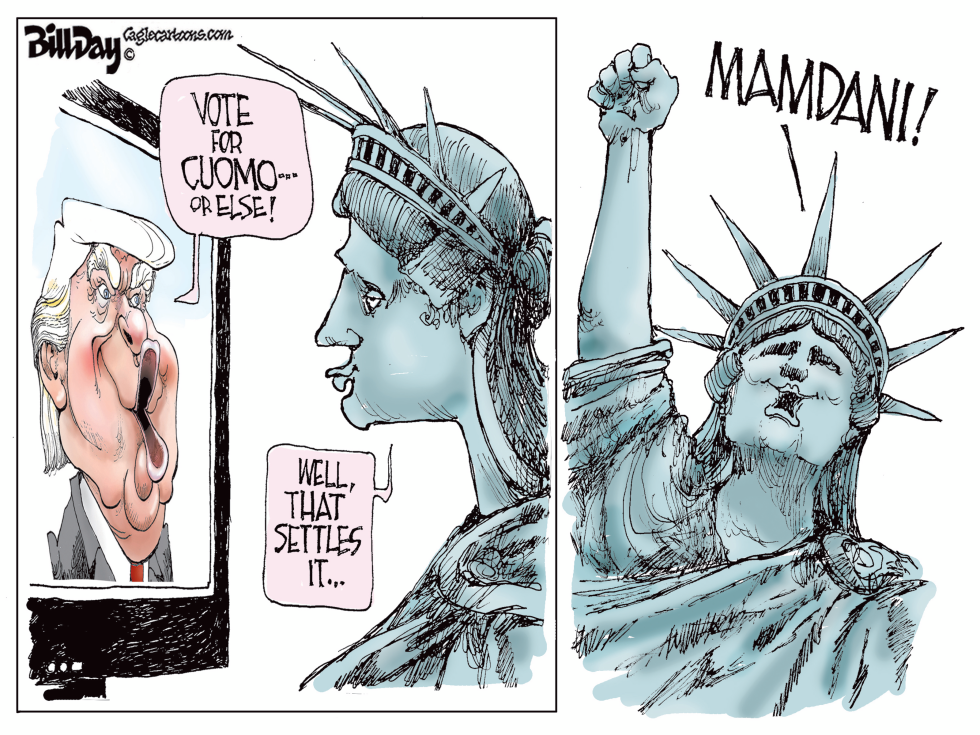
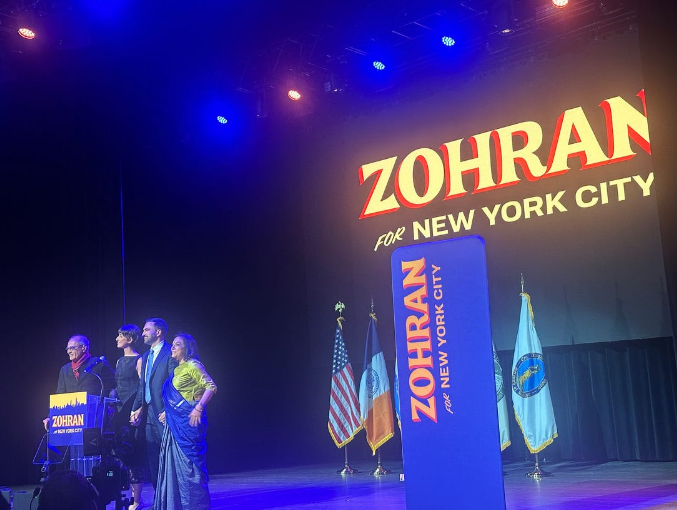
Let's start at the top: Tuesday night's victor of the hour, New York City's Mayor-elect Zohran Mamdani. Like many young progressives, he was inspired by Bernie Sanders and his decision to run on the Democratic line in the 2016 and 2020 presidential races. Mamdani joined DSA in 2016 and became active, assisting several other New Yorkers running for local posts. In 2020, he decided to run for the State Assembly District 36 set in the primary race. The district is in Queens County, between LaGuardia Airport and Manhattan. It is very multinational and has a wide range of incomes. About half the population are immigrants, born outside the U.S. With the local DSA's help, he ran against a lackluster Democratic incumbent, Aravella Simotas, and won 8410 to 7986, or a slim margin of 424 votes. Even so, hardly anyone outside of Queens had ever heard of him.
There's a pattern here, and it starts with Bernie Sanders. The greatest gift of his two campaigns was bringing the term 'socialist' back into acceptable public discourse, even if it's a minority position on a broader electoral terrain. It brought tens of thousands of new members into DSA. Bernie also inspired Alexandria Ocasio-Cortez, AOC, to run as a socialist in 2018, unseating a powerful centrist Democrat. She also brought tens of thousands of new members into DSA and inspired a dozen others to run and win similar congressional races across the country, forming 'The Squad,' which stood to the left of the 100 or so members of the Congressional Progressive Caucus, also founded by Bernie.
It started a new ball game. There were now three groupings under the Dem tent — the progressives, the centrists, and a small, shrinking group of Blue Dogs. While some on the left couldn't see it, their much-longed-for Third Party had emerged right in front of their noses, but not as they expected. It was the AOC-led Justice Dems under the Dem tent. The job was not to have it 'break away,' but to build it into something larger and more powerful, uniting with centrists against Trump and MAGA candidates, while also struggling against them on issues like Gaza, and replacing them when possible. Would the centrists try to purge them and split the party? Or would they submit to 'second fiddle' status in a transformed organization? We don't know. Call it 'the Way of the Whigs' option. As noted above, the future is open.
The key lesson for Mamdani, along with the rest of us, is that none of this would have been possible without visionary organization-building. To use a Chicago term, good ideas are needed, but they're not enough. To win, you need clout. And going forward, you need clout to govern well.
In the broader scope of things, being a New York state assemblyman from Queens did not mean much in the way of clout. Most importantly, it gave Mamdani a good view of the terrain and the inner workings of state and local government. He could see both openings and obstacles and plan accordingly.
So Mamdani pulled together a solid core of NYC DSAers to work for the larger prize: the mayorship of the country's largest and world-famous city. The core had to be internationalist, given the vast diversity of the city's immigrant communities, not just Puerto Ricans and Blacks, but also Indians, Jamaicans, Nigerians, Palestinians, and many more. They all had to be united and respected. The Black community would be tough, with its extended support for incumbents.
New York City also has the largest population of Jewish Americans outside of Israel. This would require some political skill. The 'Jewish vote' was internally diverse, even with a majority bloc that was pro-Zionist and pro-Israel. There was also a younger bloc of Jews who were anti-Zionist and who respected the rights of Palestinians. They joined Mamdani in large numbers. Finally, his core had to be connected with the working class, especially those in unions, which have considerable clout in city politics.
Mandami's victory was not isolated. The Democrats also won governorships in New Jersey and Virginia, prevailing in their legislatures as well. The victors leaned more toward the center than Mamdani did, but they were solidly anti-MAGA. In Pennsylvania, the Democrats also re-elected their Supreme Court judges to another 10-year term. The PA GOP was working to defeat them, so they might impose new voter suppression measures. In California, a solid two-thirds of voters backed Prop 50, the measure designed by Governor Grant Newsom to counter the Texas GOP's redistricting to take five seats away from the Democrats.
All in all, the November 2025 outcomes signal a clear turning point against MAGA and fascism, in favor of Democrats and the left. The 'Three B's' cited by Convergence Magazine and Liberation Road are instructive: Block, Broaden, and Build. We block when we deny MAGA its objectives, as with the vote in favor of retaining PA's judges. We broaden when we see the need to back more centrist Democrats, as in the New Jersey and Virginia races, as well as Mamdani's winning a third of NYC's Jewish voters. Hopefully, we will build by consolidating and expanding the political infrastructure that Mamdani and his DSA team put together to win a majority against his two rivals.
Finally, ideas still matter. Good policy requires clarity. Voters respond best to clear, actionable platforms--particularly on economic issues, healthcare, and climate change. Ambiguity or internal divisions can dilute our impact. Clarity is also needed to make a reasonable assessment of the terrain. It's required to build effective coalitions with moderates and independents on shared goals. Alienating the center unduly or focusing solely on ideological purity delivers weakness, not strength. Last, keep in mind Tip O'Neil's maxim, 'All politics is local.' National messages do not always translate to local victories. Successful campaigns always tailor their platforms to local needs and concerns. All voters are local, and winning them is where organization begins.
[All LeftLinks editorials, unless otherwise designated, express the views of our stalwart editor, Carl Davidson, and not necessarily any organizations he is connected with. Everyone, of course, is welcome to steal them and shamelessly pass them around, far and wide, with or without permission. A thank you note would be welcome, though!]
| | | | |
WE ARE INVITING FEEDBACK!
Please send us your letters, comments, queries, complaints, new ideas. Just keep them short and civil. Longer commentaries and be submitted as articles.
Click Here to send a letter
DIFFICULTY READING US?
View as Webpage
Food for thought: Our weekly format is missing too much of vital ideas in the news. What do you think of 'Daily Extras!' once or twice a week?
We're also considering 'Friday Night at the Movies' for 1940s Noir classics, as well as vital new films yet to gain top Hollywood status. Would you project us from a laptop onto your big screen TV and invite friends for popcorn and a 90-to-120 minute show?
Let us know.
| |
We're going to try something new, and you are all invited.
Saturday Morning Coffee!
A Zoom conversation with Carl Davidson and comrades from the Online University of the Left...and other places as well.
Started in August 2022, then going forward every week.
It will be more of a hangout than a formal setting. We can review the news in the previous days' LeftLinks or add a new topic. We can invite guests or carry on with those who show up. We'll try to have a progressive stack keeper should we need one.
Most of all, we will try to be interesting and a good sounding board. If you have a point you would like to make or a guest to invite, send an email to Carl Davidson, carld717@gmail.com
*****************
Continuing weekly, 10:30 to Noon, EDT. Here's the ongoing link:
*******************
NEW FEATURE: A summary and transcript of the previous week:
Full Text and Zoom Summary AVAILABLE HERE
******************
Meeting ID: 868 9706 5843
Let's see what happens!
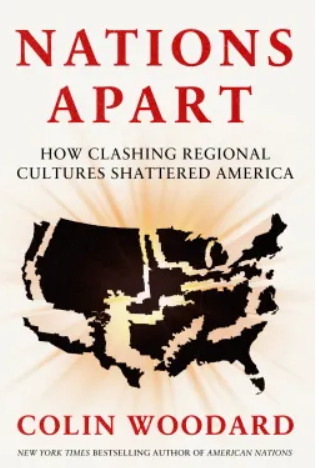
| The first shocking thing about Nations Apart, by Colin Woodard is that all the stereotypes Americans use for themselves are accurate. And unchanging. The characterizations (or assassinations) of the Deep South are accurate, and so are the New England Yankee ones, the Far West, the New France of Louisiana and El Norte of Mexican border areas. All true. That’s the premise, and it was unsettling to have to accept that as the basis for any kind of scientific analysis, because they are just mean clichés. Or are they? ...Read More | |
Indivisible
We Fight On, Together
Our democracy is under threat.
But we will not yield to fascism.
We will stand together and we'll fight back in defense of our rights, our communities, and our values.
Join Our Weekly Chat
Every Thursday, Indivisible co-founders Ezra Levin and Leah Greenberg help wade through the week’s news, answer your questions, and provide timely calls to action.
Upcoming Actions:
Register for Event
| |  | |
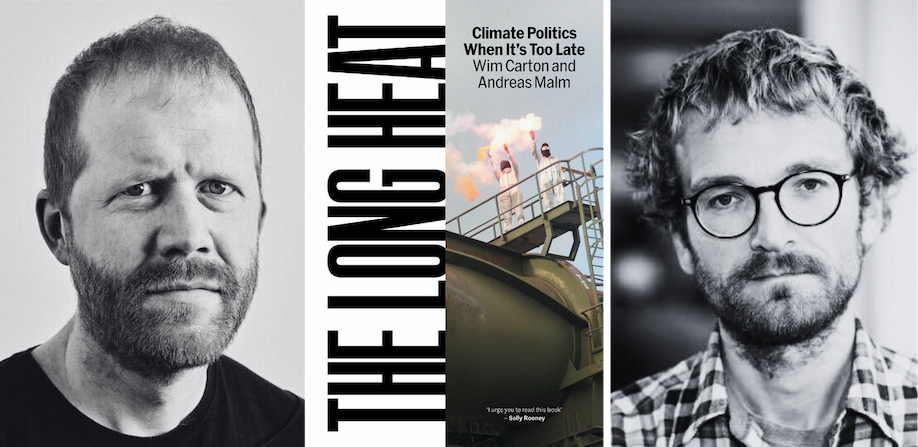
We're thrilled to announce that in this month's meeting of the Verso Book Club Reading Group, Andreas Malm and Wim Carton will be joined in discussion by Kim Stanley Robinson, renowned author of 22 novels including Red Mars, The Ministry For the Future, and The Years of Rice and Salt.
As anyone who has picked it up will readily perceive, The Long Heat: Climate Politics When It’s Too Late (one of our October Book Club picks) asks a lot of the reader. Here Andreas Malm and Wim Carton have taken a leaf from what they consider to be the two greatest climate fiction novels yet written: The Ministry for the Future by Kim Stanley Robinson and The Deluge by Stephen Markley, both epic panoramas of the breakdown, composed with the conviction that this subject deserves sustained attention.
The next meeting of the Verso Book Club Reading Group will take place on
November 30th
at 2pm EST / 7pm GMT
and is open to all active Book Club members. Join the club HERE.
| |
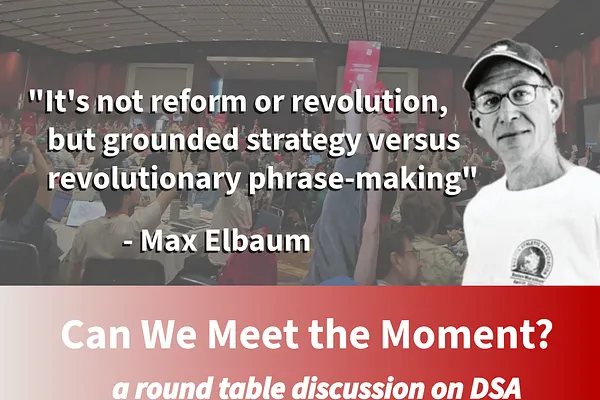
By Max Elbaum
I welcome Tom Goodkind’s article, DSA’s 2025 Convention: Can We Meet the Moment? It offers an insightful analysis of the damage being done to the Democratic Socialists of America (DSA) by an ultra-left tendency whose central mistake is failing to put defeating MAGA’s drive toward fascism at the core of left political strategy.
Below I want to supplement Tom’s analysis by adding a few points to his critique. While many people think of DSA as divided between “reformist” and “revolutionary” wings, my central argument will be that this is a mischaracterization. What makes a strategy revolutionary is an accurate identification of the main enemy of working-class advance at each stage of struggle and an action program to assemble the social forces who are capable of defeating that enemy and reconfiguring the landscape to the left’s advantage. By this yardstick, DSA’s “mass politics” tendency—often critiqued as reformist—is engaged in revolutionary politics, while the self-described “revolutionary” tendency is making strategic errors. These include:
1. Magical thinking about how the structure of the US electoral system affects the way mass movements mature from protest to politics.
Since Bernie Sanders’ breakthrough 2016 presidential campaign, there has been grudging recognition on the part of major sections of the ultra-left that their longstanding strategy of engaging elections solely via “third party” campaigns is a dead-end. ...Read More
| 2+2=5: Oscar-nominated filmmaker Raoul Peck (I Am Not Your Negro) takes a deep dive into the writing of George Orwell (1984) to explore its potent relevancy to our current times. | |
What to do if the
Insurrection Act is invoked
Here’s a starting point for how we’d respond:
1. Sound the alarm — If it happens, we move fast to make sure people know what it is and why it matters. No euphemisms. No hedging. Just the truth.
2. Push Democrats at every level to meet the moment — We’ll need every Democratic elected official using their platform to expose and challenge this abuse of power. That includes governors preemptively activating their National Guards (which may prevent federal takeover), press conferences, legal challenges, and public pressure campaigns.
3. Stay calm, disciplined, and united — Trump wants chaos. Our power is in joyful, defiant, nonviolent action. We protect each other, stay coordinated, and refuse to play into his narrative.
4. Flip the script — If Trump claims to be stopping “insurrectionists,” we remind people that he pardoned the actual ones. We shine a light on the real threat: a president using military force to suppress dissent.
5. Use ridicule to deflate his power — Strongmen hate being mocked. So we mock. Through memes, theater, satire, and creativity, we show how ridiculous and weak this play really is.
6. Plan for the long haul — This may be the opening move in a broader power grab. So we stay ready. We build legal infrastructure, strengthen communication channels, and invest in our communities’ ability to respond.
...Read More
Go HERE and HERE for more.
| |
The Marxist Education Project provides quality, nonsectarian education based broadly on anticapitalist traditions.
We present classes, reading groups, book launches, and other events of interest to the left and the public. We build on a legacy established over 40+ years by the School for Marxist Education, the New York Marxist School, and The Brecht Forum. (Also allied with the Online University of the Left).
Go Here for the YouTube Page
| | |
News of the Week, Plus More
| | |
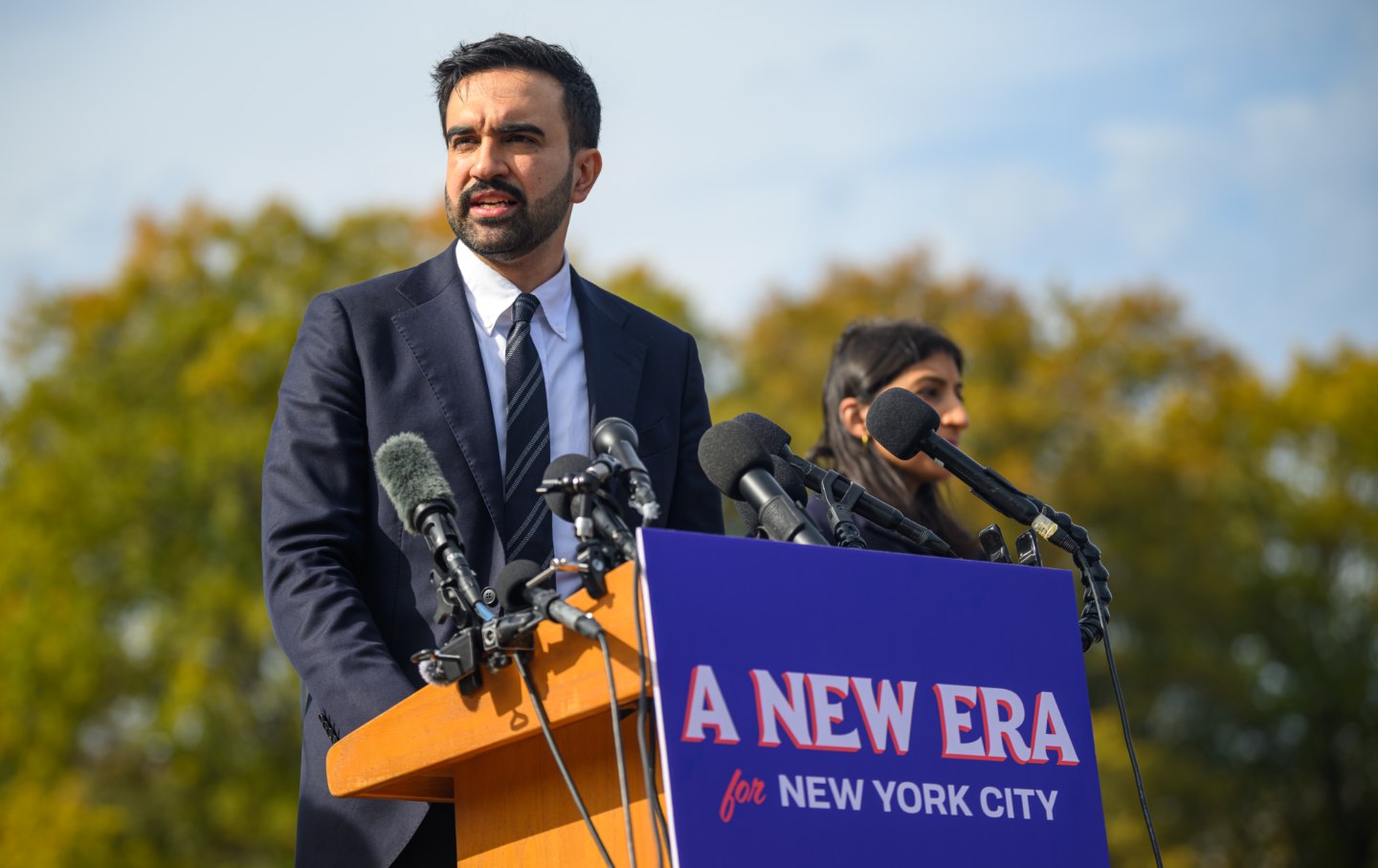
Photo: Mayor-elect Zohran Mamdani speaks during a press conference at the Unisphere in Queens, on November 5, 2025.(Alexi J. Rosenfeld / Getty Images)
The Left Is About to Take Power. The Stakes Could Not Be Higher
Zohran Mamdani’s triumph has given socialists huge power in New York City. Now they must use it well—or see the ruling class crush them.
By Álvaro López
The Nation
Nov 6, 2025 - Zohran Mamdani’s election as mayor of New York City has thrust the US democratic socialist movement into the national spotlight. If Mamdani’s triumphant affordability platform—which includes plans to provide universal childcare by increasing taxes on high-income earners—is implemented, it could lead to a significant transfer of wealth from the wealthy elite to the working class and provide a blueprint for socialist leaders across the country.
Equally, if Mamdani’s mission is stymied, the forces banking on his failure will use it as a weapon to try and banish the left everywhere. In other words, the stakes of a Mamdani mayoralty could not be higher. That’s why it’s so crucial for the left and progressive movements to adopt a mass politics orientation during Mamdani’s tenure, the 2026 midterms, and beyond.
Mamdani’s rise is partly due to the corporate elite’s failure to defend working-class New Yorkers against the city’s cost-of-living crisis. It’s also because corporate Democrats lacked a strategy to counter Mamdani’s left-wing populist economic message, which resonated with many New Yorkers who came to see themselves as renters and working people struggling with affordability because of the billionaire class.
Now, the movement behind Mamdani’s election is poised to stand up against the chaos fueled by Donald Trump’s policies, particularly those that have exacerbated economic inequality. The same strategy and message that worked so well for Mamdani can be used to challenge corporate Democrats in the midterms, holding them accountable for their inaction on the cost-of-living crisis and their failure to build a diverse coalition against authoritarianism.
Here’s how.
Win the Affordability Agenda
The Mamdani campaign transformed the New York City electorate, tapping into long-ignored Muslim and Southeast Asian communities while shoring up support among Black and Latino working-class voters—many of whom were being lured rightward by Trump. If it lasts beyond Mamdani’s win, this realignment presents an opportunity for progressive forces to become rooted in New York City’s multiracial working class and build an organized and combative political base. By doing so, they can leverage the electorate’s power to implement Mamdani’s affordability agenda.
The incoming Mamdani administration is well-positioned to build institutional working-class power by empowering unions with stronger contracts, raising the minimum wage to $30 per hour, standardizing and improving working conditions for informal workers, exploring sectoral bargaining legislation, increasing access to affordable housing, promoting public power in utilities, and encouraging community participation and civic engagement among working-class New Yorkers.
The more than 100,000 volunteers the Mamdani campaign was able to mobilize can turn their attention to the work of sustaining the movement they helped build—for instance, by training volunteers to become community organizers in support of Mamdani’s political program. A key task will involve exposing the purposefully opaque and baroque channels through which the governor and state legislature in Albany might try to stifle Mamdani’s agenda. Having organizers on the ground who can demystify the state budget process and connect working-class New Yorkers to campaigns that pressure their state representatives—for example, to tax the rich in order to fund Mamdani’s plan for free universal childcare— will be key.
This organization can help create the mass working-class movement this city desperately needs and serve as a national model for other successful grassroots electoral campaigns. By institutionalizing the Mamdani coalition, we can popularize the narrative that his campaign rode to victory.
There is not a second to lose in building up this infrastructure. That’s because the ruling class—the real estate industry, the finance sector, the charter school industry, pro-Israel forces, corporate Democrats, the right wing of the City Council and the state legislature, and, of course, the fascist Trump administration in DC—is already gearing up to try to derail Mamdani’s administration, turn public opinion against him, and attempt to fracture his political base. This coalition, which has spent decades hollowing out state capacity through ruthless austerity, will try to make an example of Mamdani’s New York City and use an “NYC in crisis” narrative for their own electoral gains in the midterms. (Republicans have wasted no time, instantly framing Mamdani’s ascent as a “national story of a party bending to socialism and the far left.”)
By staying laser-focused on winning the affordability agenda, orienting its work to organize the unorganized, and continuing to center the active participation of working New Yorkers in its campaigns, the left can take advantage of this populist moment and blunt the opposition’s narrative.
Replicating Mamdani’s ruthless message discipline can also help blunt the bigoted culture wars that both Republicans and many right-leaning Democrats seem so eager to fight. A key breakthrough that the left achieved through the Mamdani campaign was championing left-wing economic populism while demonstrating solidarity with oppressed communities. We prioritize a universalist affordability agenda not because we practice narrow economism, but because we know the cost-of-living crisis affects communities of color and other oppressed groups the hardest, and we aspire to center them as key pillars of our coalition. Applying that strategy nationwide can suck the air out of the far-right’s faux-populism and help the left in the midterms.
A Movement in Power
New York City’s left, particularly the New York City Democratic Socialists of America (NYC-DSA), of which I am a member, is not used to holding the kind of political power that Mamdani will wield. Adjusting to what Mamdani referred to in an Election Day video as the “contradictions” of office will take time. But the path that the New York left has taken to power provides some important lessons for how to use it.
How can DSA anchor its project with a mass working-class base? How can DSA position itself to organize a working class that can articulate its demands? And how does the left break away from the cycle of disillusionment that comes from building popular leaders like Bernie Sanders, Alexandria Ocasio-Cortez, and Jamaal Bowman, only to tear them down after perceived capitulations? How we answer these strategic questions should flow from our theory of change.
Two approaches have limitations: liberalism, which focuses on finding responsive politicians and building clientele organizations, and ultra-leftism, which emphasizes organizing around a specific political line without regard for expanding the coalition or enhancing mass politicization. Both approaches overlook the crucial role of class forces in shaping society, particularly the power of an organized mass working-class base.
An example of liberalism’s limitations was evident in Bill de Blasio’s 2013 election, where, without a clear plan for after winning office, de Blasio’s coalition of progressive Jewish voters, millennials, and Black and brown working-class New Yorkers wasn’t harnessed to build momentum toward a working-class majority. Instead, two years later, de Blasio was outflanked by the class struggle politics of Bernie Sanders. His administration’s governing strategy primarily depended on technocratic expertise rather than building a social base for his policies.
On the other hand, the constraints of an ultra-leftist approach were evident during the fight over expelling Jamaal Bowman from DSA in 2021. The episode shows the potential disorganizing effect of pressure tactics toward allies who are temporarily misaligned, rather than permanently obstructionist. Instead of expanding a working-class base for anti-war politics, it can functionally provide cover for our enemies to exploit our division. The Mamdani campaign shows that the left needs to be authentic, relatable, and actively engaged with the concerns and struggles of the broader population, rather than just being a vocal and ideological minority.
Elected officials make mistakes. They inevitably disappoint their voters sometimes. Mamdani will too. It will be important, when these things happen, for the left to balance accountability with an understanding of who the real enemy is. The more we focus on championing allies that help popularize previously marginal ideas and embolden a working-class base to fight for more aggressive demands, rather than prioritizing sectarian fights, the more we can build power for the long term and expand the broad coalition to fight the far right.
By building a strong foundation in the multiracial working class, mobilizing people to action, organizing a new generation of democratic socialists, and positioning the left as a beacon for working-class New Yorkers, the movement that helped elect Zohran Mamdani can drive transformative change and position the democratic socialist movement for continued success in challenging corporate Democrats in 2026 and beyond.
Mamdani’s victory is reverberating throughout the country and the world. As New York City sets the tone for the political, cultural, and financial course of our country, the democratic socialist movement should be prepared to capitalize on this historic opportunity by backing Mayor Mamdani, who has already reshuffled and reconstituted long-standing power structures, with an organized mass working-class base. This victory proves that a democratic socialist platform with a popular vision can form a majoritarian winning coalition. Now we must defend, govern, deliver, and expand the coalition for the affordability agenda. The democratic socialist movement of this country faces a crossroads: take center stage and play offense at the ballot box or retreat on the sidelines in the face of governance pressure and rising authoritarianism. ...Read More
| | |
Zohran Mamdani: 'The Future is in Our Hands'
Full Transcript of Victory Speech
By Zohran Mamdani
Lower Frequencies
Thank you, my friends. The sun may have set over our city this evening, but as Eugene Debs once said, “I can see the dawn of a better day for humanity.”
For as long as we can remember, the working people of New York have been told by the wealthy and the well-connected that power does not belong in their hands.
Fingers bruised from lifting boxes on the warehouse floor, palms calloused from delivery bike handlebars, knuckles scarred with kitchen burns: These are not hands that have been allowed to hold power. And yet, over the last 12 months, you have dared to reach for something greater.
Tonight, against all odds, we have grasped it. The future is in our hands. My friends, we have toppled a political dynasty.
I wish Andrew Cuomo only the best in private life. But let tonight be the final time I utter his name, as we turn the page on a politics that abandons the many and answers only to the few. New York, tonight you have delivered. A mandate for change. A mandate for a new kind of politics. A mandate for a city we can afford. And a mandate for a government that delivers exactly that.
On January 1st, I will be sworn in as the mayor of New York City. And that is because of you. So before I say anything else, I must say this: Thank you. Thank you to the next generation of New Yorkers who refuse to accept that the promise of a better future was a relic of the past.
You showed that when politics speaks to you without condescension, we can usher in a new era of leadership. We will fight for you, because we are you.
Or, as we say on Steinway, ana minkum wa alaikum.
Thank you to those so often forgotten by the politics of our city, who made this movement their own. I speak of Yemeni bodega owners and Mexican abuelas. Senegalese taxi drivers and Uzbek nurses. Trinidadian line cooks and Ethiopian aunties. Yes, aunties.
To every New Yorker in Kensington and Midwood and Hunts Point, know this: This city is your city, and this democracy is yours too. This campaign is about people like Wesley, an 1199 organizer I met outside of Elmhurst Hospital on Thursday night. A New Yorker who lives elsewhere, who commutes two hours each way from Pennsylvania because rent is too expensive in this city.
It’s about people like the woman I met on the Bx33 years ago who said to me, “I used to love New York, but now it’s just where I live.” And it’s about people like Richard, the taxi driver I went on a 15-day hunger strike with outside of City Hall, who still has to drive his cab seven days a week. My brother, we are in City Hall now.
This victory is for all of them. And it’s for all of you, the more than 100,000 volunteers who built this campaign into an unstoppable force. Because of you, we will make this city one that working people can love and live in again. With every door knocked, every petition signature earned, and every hard-earned conversation, you eroded the cynicism that has come to define our politics.
Now, I know that I have asked for much from you over this last year. Time and again, you have answered my calls — but I have one final request. New York City, breathe this moment in. We have held our breath for longer than we know.
We have held it in anticipation of defeat, held it because the air has been knocked out of our lungs too many times to count, held it because we cannot afford to exhale. Thanks to all of those who sacrificed so much. We are breathing in the air of a city that has been reborn.
To my campaign team, who believed when no one else did and who took an electoral project and turned it into so much more: I will never be able to express the depth of my gratitude. You can sleep now.
To my parents, mama and baba: You have made me into the man I am today. I am so proud to be your son. And to my incredible wife, Rama, hayati: There is no one I would rather have by my side in this moment, and in every moment.
To every New Yorker — whether you voted for me, for one of my opponents, or felt too disappointed by politics to vote at all — thank you for the opportunity to prove myself worthy of your trust. I will wake each morning with a singular purpose: to make this city better for you than it was the day before.
There are many who thought this day would never come, who feared that we would be condemned only to a future of less, with every election consigning us simply to more of the same.
And there are others who see politics today as too cruel for the flame of hope to still burn. New York, we have answered those fears.
Tonight we have spoken in a clear voice. Hope is alive. Hope is a decision that tens of thousands of New Yorkers made day after day, volunteer shift after volunteer shift, despite attack ad after attack ad. More than a million of us stood in our churches, in gymnasiums, in community centers, as we filled in the ledger of democracy.
And while we cast our ballots alone, we chose hope together. Hope over tyranny. Hope over big money and small ideas. Hope over despair. We won because New Yorkers allowed themselves to hope that the impossible could be made possible. And we won because we insisted that no longer would politics be something that is done to us. Now, it is something that we do.
Standing before you, I think of the words of Jawaharlal Nehru: “A moment comes, but rarely in history, when we step out from the old to the new, when an age ends, and when the soul of a nation, long suppressed, finds utterance.”
Tonight we have stepped out from the old into the new. So let us speak now, with clarity and conviction that cannot be misunderstood, about what this new age will deliver, and for whom.
This will be an age where New Yorkers expect from their leaders a bold vision of what we will achieve, rather than a list of excuses for what we are too timid to attempt. Central to that vision will be the most ambitious agenda to tackle the cost-of-living crisis that this city has seen since the days of Fiorello La Guardia: an agenda that will freeze the rents for more than two million rent-stabilized tenants, make buses fast and free, and deliver universal child care across our city....Read More
| | |
Photograph by Nathaniel St. Clair
No Kings, Organizing, and Winning:
A Michael Albert Interview With Our Revolution’s Larry Cohen
Michael Albert: Hello, my name is Michael Albert, and I’m the host of the podcast that’s titled Revolution Z. Our guest this time is Larry Cohen. Larry served as president of the 600,000-member Communications Workers of America from 2005 to 2015, and he has spent nearly all his adult life as a member, organizer, and officer. He is now board chair of Our Revolution, the successor organization of Bernie Sanders’ 2016 presidential campaign. Larry has also been a member of the Democratic National Committee since 2005 and was vice chair of the Unity Reform Commission, which drafted proposals adopted by the full DNC to democratize the party and the presidential nominating process. He frequently writes on worker rights, politics, and democracy for various publications. So, Larry, welcome to Revolution Z.
Larry Cohen: Great to be with you.
Michael: I feel like there are a very wide array of things I would love to ask you about. But how about if we start with the No Kings demonstrations that occurred just a few days earlier than we’re recording this on October 23rd? So how do you think October 18th happened? To what extent did it mobilize and gather people who were already eager to resist Trump by issuing a call that indicated the time and place of events that the people then eagerly joined? And to what extent did it reach out to attract new people by addressing their prior doubts and or increasing their desire and hope? Put differently, participation is reported to have risen by two million from the earlier round. How did that happen?
Larry: I think in part it happened because of the autocracy, the oligarchy as we call it, gaining steam for the last six months since round one of No Kings. It also happened through organizing. A broad array of organizations with a wide variety of strategies came together last Saturday and last June. To fight fascism, you need a broad front. At the same time, to actually win and change the country, which you know we’ve spent our lifetimes on, you need a strategy for change, not just for resistance.
Michael: And I wonder about three particular constituencies, actually, in light of what you just said: young people, minorities, and working people. I’m not sure of their participation level, but I have a feeling, mainly anecdotal, honestly, that young people in particular are a good deal less represented than their presence in the past would predict. How do you see it? If it is true, what might be done about it?
Larry: Well, I was out in Western Maryland with over a thousand people showing up in a Trump county. And, you know, a good percentage were young. You can’t go by that. That’s one of you know thousands of events that occurred Saturday. But you know, my sense is that in terms of working people and young people, I’m not as certain in terms of Black Americans, there is a huge pouring out. I mean, the Mamdani campaign in New York is very much fueled by young people, whether they’re black, brown, or white, whether they’re college-educated working people or not, immigrants as well. Pulling people together in America has always been a challenge. My 50-some years in the resistance movement, we get one group, we lose another group. Can we get everybody? How are we mobilizing? What are the strategies? What are we fighting for? You know, it’s a shit show in this country. So nothing’s changed in that regard. People like Bernie, AOC, Mamdani, are able to cut across a lot of that, but not all of it. It’s a tall order in a country with a history like this one.
Michael: Indeed. But looking forward, let’s stick with youth for a second. You probably remember, I remember, major demonstrations. What No Kings have done is larger. So that’s not the issue. But I remember campuses having feeder marches. So that, in other words, you had an outpouring from campus after campus that was organized. And the students were on the move and would go to the big demonstration, but then they would also do their own work back on the campus. And I get the feeling that that hasn’t happened yet. I have a feeling it’s about to, but I think it hasn’t happened yet. You’re probably more in touch with what’s going on across the country than I am, and I wonder whether you see that or not.
Larry: If you’re alluding to late 60s, early 70s, there’s no question that high school and college campuses were much more alive then. I grew up in North Philadelphia, and I was heavily involved organizing against Frank Rizzo, who was the police commissioner, a notorious racist, openly racist, who became the leader of the Democratic Party and elected twice as mayor as a Democrat, even though he was an avowed racist.
On May 8th, 1970, I was a key organizer in shutting down every high school and college campus in Philadelphia. There were five lines of march. We went to Independence Hall at 12 noon on a Friday and had over 100,000 people there. The attendance was reported, in the high schools, to be 10%. And those high schools were at least half black. So, in that in that moment, it was the racism of Rizzo coming together with anti-war activity and more, really.
And yes, those movements were led much greater than now by high school and college-age people. And, you know, I joke around a lot because, as you mentioned, I ended up president of a huge labor union so I’ve spoken to giant rallies outside for 55 years now. And in many ways, that one, May 8, 1970, was the largest one that I organized. I was involved in the demonstration against Iraq speaking for CWA in 2001, with well over a million in New York City. But I think your point’s right that the kind of systemic organizing among high school and college-age students that we saw 50 years ago has not been replicated, and I’d have to think more about why.
Michael: It’s a tough question. I’ve thought it has something to do with the type of youth culture then, being relatively absent now, with social media, phones, and people feeling spied on. There’s a lot of variables for sure, but it is an area in which things could get still better in terms of the resistance. And in that light, I wonder, even given No King’s incredible virtues and achievements, which really are substantial, though a lot of longtime leftists don’t don’t quite acknowledge that, though it’s true. What, nonetheless, do you think might be done in future efforts, or what might future efforts need to accomplish to in fact do as they intend, stop fascism, and even beyond that to win ongoing positive gains going into the future? I know it’s a big question, but you’ve been around, so, if you were sitting in a room, and actually I don’t know, you may well be sitting in a room with people working on the next one, when should the next one be? And how often should they be? And what, if anything, should be changed going forward?
Larry: Great questions. I don’t want to jump into answers that I’m not certain about. But on the one hand, I think resistance to the oligarchy, to fascism, to autocracy, authoritarianism, lots of words for what we face here, is very, very broad and not that deep. What is it that we are fighting?
In our revolution and the Bernie world, we’re fighting the oligarchy, not just Trump. So we try to define it as the billionaires, the technocrats, Trump, the Republican Party and a big chunk of the Democratic Party. Where does the funding come from for many Democrats when they run for election? The Our Revolution shirt that I wore Saturday, said “defund the oligarchs, fund the people.”
That means where’s our health care, early childhood education, long-term care, those things are missing from the richest country in the world. Missing or way too expensive or out of reach for giant chunks of the population.
Defund the oligarchs, and cut off the extra $150 billion that Trump put into military spending. He now rightfully calls it the Department of War. That’s what it is. That’s what it’s been for my lifetime, the only thing I might agree with him on. But that funding, as you well know, over a trillion dollars this year just for the military budget, doesn’t even include Homeland Security and many other aspects of the militarization of this country, that could fund all the things that I mentioned. Even if you cut it in half, it could fund virtually all of those things. And if we had Medicare for all, you would cut the $4 trillion in healthcare spending, twice as much as any other country spends as a percentage of gross domestic product with worse results. So, lots of easy answers here. The question is, how do we organize for that vision? And as I used to say in CWA, not just defense, offense.
If you wanted to go to a sports analogy, there’s virtually no sport where you can play only defense and change anything. The way I put it on Saturday, we’re not just fighting against oligarchs, we’re fighting for the people we love. And it’s that spirit of the people we love when we talk about healthcare and education, and workers’ rights, which has been my lifetime.
We have the worst workers’ rights support in the world in terms of organizing and bargaining rights when people want to build a worker organization, a union, and bargain with their employer. We’re at the bottom of every democracy by every measurement in terms of workers’ rights. For me, that’s the people I love as much as my own children and grandchildren. So how we cobble together enough of that to keep not only the resistance movement going, but the movement for real change, is not well articulated.
The blocks to democracy, including workers’ rights, there’s seven or eight big ones are sadly unique to our nation. In Argentina, fighting their own version of fascism right now, the majority of workers have bargaining rights, and they fight back, not only at the bargaining table, but politically with general strikes and with their own political organizations. And like most of the democratic world they have sectoral bargaining. Not bargaining at one workplace at a time, like in the U.S., instead, whole industrial sectors bargain, and the results extend to all workers in that sector. I’m going too deep on that one subject.
Another example would be the role of the federal judiciary here is like a another monarchy. They’re a lifetime in office unless they resign or retire. Oregon Senator Jeff Merkley calls it a judiciary that thinks it’s another Congress.
And then there’s our Senate, with 60 votes, initial cloture, needed to put a measure on the floor for discussion—part one of the filibuster. We rightfully focus on electing a Democratic majority in the Senate, but we need to have a Democratic majority that’s gonna get rid of initial cloture, and then regulate debate so that majority rules.
That’s already three blocks to our democracy. Steps to amend the Constitution, worst of any democracy in the world, virtually impossible. Three-quarters of the state legislatures, two-thirds of the Congress to pass an amendment. As a result of these blocks to our democracy, it is harder to mobilize people in this country. I’m still thinking about high school and college students and why they’re not leading as they have at other times and in other countries. ...Read More
| | |
Resisting ICE: Our Weekly Roundup
By Susan Weiss
LeftLinks
VIDEO ABOVE: Finding that federal immigration enforcement agents repeatedly used force that “shocks the conscience” and then lied about their actions, U.S. District Court Judge Sara Ellis issued a sweeping injunction Nov 6 designed to permanently rein in agents’ use of tear gas, pepper balls and other crowd control measures. Ellis ruled that there was ample evidence that federal agents had violated Chicagoans’ First Amendment rights to free speech and free assembly to protest what the Trump administration calls “Operation Midway Blitz” while also impermissibly preventing the free exercise of religion by targeting members of the clergy with force.
“The use of force shocks the conscience,” Ellis said. “This conduct shows no sign of stopping.”.
| | VIDEO BELOW: California: Protesters gather on an Oxnard street in response to ICE agents' presence | | Article Below: ICE in Colorado | | |
ICE Raids In Colorado Highlight How Violent The U.S. Has Become
After migrating to Canada, a journalist reckons with the grief and gratitude of having left.
By Krista Langlois
High Country News
November 6, 2025 - On Oct. 27, U.S. Immigration and Customs Enforcement (ICE) officers took two children and their father from outside a middle school in Durango, Colorado. The kids and their parents, who were originally from Colombia, had come to the United States seeking safety and opportunity, as so many immigrants have done before them. They had applied for legal asylum, with paperwork to prove it. Now they’re separated, traumatized and afraid. ...Read More
| | |
A Changed Landscape For Health Care Reform
Republicans have stopped pretending to care about universal coverage, a prerequisite for bringing costs under control.
By Merrill Goozner
GoozNews
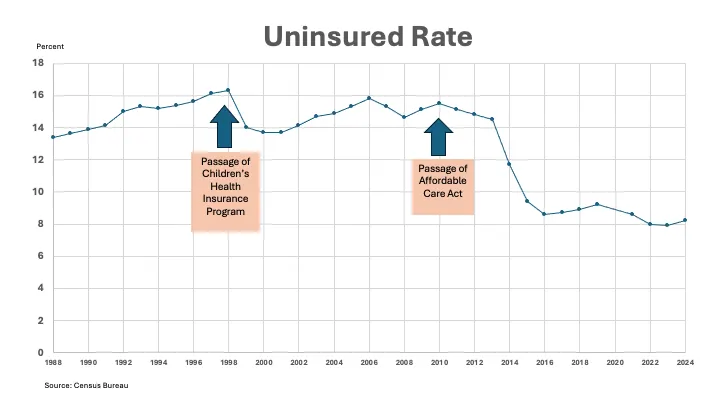
Nov 07, 2025 - The Trump administration’s wrecking ball has succeeded in shattering one of the core beliefs of centrist health care reformers, which states: Incremental reforms will eventually lead the U.S. to the promised land of health insurance for all—something most advanced industrial nations achieved more than 75 years ago.
Even many Republicans once signed onto the gradualist approach to achieving the goal of universal coverage. In the early 1970s, President Richard Nixon proposed covering everyone through insurance industry-managed plans. In the 1990s, a Republican-controlled Congress authorized universal coverage for children. Even President Trump in 2017 vowed to replace Obama’s Affordable Care Act with a new plan that would provide “insurance for everyone.” Ultimately, he failed to either release a plan or repeal Obamacare.
But now, for the first time in its history, the U.S. is making a sharp U-turn on the long road to health care for all. The GOP not even pretending that universal coverage is a desirable national goal. It is deliberately raising the ranks of the uninsured.
The One Big Ugly (not Beautiful) Bill signed by the president last July will drive an estimated 17 million people from the insurance rolls by 2034, according to KFF. More than two-thirds of those losses will come from cuts to Medicaid. Half those cuts, which establish bureaucratic roadblocks for obtaining coverage, won’t be reversed even if the Democrats succeed in forcing concessions from the majority party during the shutdown negotiations, which are still underway as of this writing.
Thanks to legislation Democrats passed during Joe Biden’s administration, the national uninsured rate fell last year to 8 percent, which is within hailing distance of universal coverage (generally considered to be 5 percent or less). Some states are already below that threshold, which might have occurred nationally had not 10 Republican-run states, including populous Texas (still 16.4 percent uninsured) and Florida (10.9 percent), refused to expand Medicaid to cover the working poor. That overall rate is certain to rise next year and for the rest of this decade. If no changes are made, it will soar into the mid-teens, nearly to the levels seen before the Affordable Care Act passed in 2010.
Universal coverage doesn’t guarantee Americans will enjoy better health. Nor does it ensure health care will be affordable. However, it is inconceivable that either of those goals can be achieved without universal coverage, which is a necessary, though not sufficient, condition for addressing the long-term health care cost crisis affecting most American households.
Step by step
The incrementalist strategy emerged in the wake of President Harry Truman’s failed attempt after World War II to implement a government-run, universal health insurance plan, similar to those adopted by many European countries. Opposition from the American Medical Association, labor unions with their newly negotiated employer-based plans, and a burgeoning health insurance industry doomed the bill.
But calls for universal coverage never ceased. A decade-and-a-half later, with the White House and Congress in Democratic hands after Lyndon B. Johnson’s 1964 landslide, the government created Medicare and Medicaid for the old, disabled, and poor. In 1997, after the Bill Clinton administration’s significant push for universal coverage failed, a Republican-led Congress included a separate plan for uninsured children in the Balanced Budget Act.
Then, in 2010, with Barack Obama in the White House and the country reeling from the Great Recession, a Democratic Congress passed the Affordable Care Act. It created a subsidized individual market for those without employer coverage; expanded Medicaid to include individuals and families earning up to 137 percent of the poverty level; and began experimenting with a host of delivery system reforms to hold down costs.
However, cost-saving measures cannot be effective unless everyone is in the insurance pool. Uninsured individuals often postpone necessary but non-emergency care. When they become so sick that they must seek care, they show up in emergency rooms, where care is the most expensive, and where their outcomes are usually worse because they waited too long. For their troubles, they are often saddled with unpaid debts.
More uninsured hurts everyone
The dysfunction wrought by a growing pool of uninsured people affects everyone’s pocketbook. Providers and insurers use the uninsured’s unpaid bills as an excuse to pass along those expenses in the form of higher prices to the privately insured, who already pay 2 ½ times what Medicare recipients pay on average. This results in not just more expensive plans for employers (the median family plan cost a staggering $27,000 in 2025), but higher co-premiums, co-pays, and deductibles for their employees, whose share of the total cost of “employer-financed” care has hovered between 25 and 30 percent for decades. (I put scare quotes around “employer-financed” because employer contributions are a tax-deductible business expense that otherwise would go to workers as wages if it weren’t spent on benefits.)
Universal coverage doesn’t guarantee that health care will become more affordable for everyone. But it reduces the level of more expensive, uncompensated care in the system, which is necessary to lower prices for everyone, including private insurers and their employer customers. Universal coverage is a crucial prerequisite for achieving more affordable health care.
Yet now, under Trump and a supine Republican Congress, America is deliberately reducing the ranks of the insured. The process has already begun. Premiums for individual plans being sold on the exchanges for next year are soaring due to the expiration of enhanced subsidies, which will discourage many people from buying plans.
Though the bill’s new Medicaid work requirements were postponed until after the 2026 mid-term elections to hide their full effects from voters, states were given the green light to begin enforcing twice-annual recertification requirements. Many red states are already moving to do that, as well as cut their Medicaid spending in response to the cutbacks in federal support for the joint federal-state program. Millions of low-wage workers will start losing their Medicaid coverage next year, not because they aren’t working, but because they become frustrated by the paperwork requirements set up by hostile bureaucrats beholden to their Republican overlords.
Democrats on Capitol Hill are singularly focused on maintaining the enhanced subsidies and restoring the cuts in Medicaid financing. That means the work requirements and other bureaucratic roadblocks will remain because they can’t be addressed in a reconciliation bill. No matter how the shutdown is resolved, a sharp decline in both coverage and access is inevitable.
That will financially harm almost everyone covered by employer-sponsored plans. This year, those rates soared at twice the inflation rate on average, according to the annual KFF employer survey of just under 1,300 firms. Mercer, a leading benefits consulting firm, says rates will rise by a similar level next year. Plan structures will undoubtedly include higher co-payments, higher deductibles, and higher co-premiums for workers and their families.
No matter how the government shutdown is resolved, the health care affordability crisis, exacerbated by the historic GOP U-turn on universal coverage, will remain a salient issue during next year’s House and Senate campaigns. The only question is whether Democrats will be able to take advantage by offering a program that addresses voters’ number one concern when it comes to health care. ...Read More
This story first appeared on the Washington Monthly website.
| | |
How The Fall Of El-Fasher Could Cement Sudan's Partition
Marking one of the bloodiest chapters in the brutal 18-month war, the fall of El-Fasher to the RSF could permanently alter Sudan's map
By Jonathan Fenton-Harvey
The New Arab
November 3, 2025 - The fall of El-Fasher has marked one of the bloodiest and most consequential chapters in Sudan’s 18-month war.
After a brutal siege that starved, bombed, and trapped hundreds of thousands of civilians, the paramilitary group known as the Rapid Support Forces (RSF) seized control of the army’s last major stronghold in Darfur, which may permanently alter Sudan’s map and solidify the country’s de facto partition.
El-Fasher represented the final urban centre in Darfur under the control of the Sudanese Armed Forces (SAF), and the army’s retention of the territory functioned as a key strategic barrier to the RSF’s western campaign.
Immediately after the RSF’s takeover of El-Fasher, the United Nations warned that “the risk of further large-scale, ethnically motivated violations and atrocities in El Fasher is mounting by the day”.
Horrifying footage of RSF atrocities and news that over 2,000 civilians were slaughtered within 48 hours of the takeover prompted humanitarian warnings of imminent famine and louder international calls for a ceasefire.
It marks a disturbing turn in a war that has ravaged Sudan since the RSF’s split from the SAF in April 2023, killing at least 150,000 civilians and displacing over 11 million.
Hardening de facto partition
In the near term, analysts believe it will embolden the RSF to continue its brutal military campaign.
“It will galvanise the RSF to further expand the war front into other regions now that they have momentum. By capturing El-Fasher, they now have a direct route to the Northern State and the Kordofans and already there are reports of violations taking place in towns and cities like Bara and Tina,” Dallia Abdelmoniem, a Sudanese political analyst, told The New Arab.
She added that both the RSF and SAF have weaponised humanitarian suffering since the war began, and since there has been no accountability or sanctioning of either side, the massacres could exceed that of the 2003 Darfur war, which saw genocide and mass war crimes committed.
In that war, the SAF and Janjaweed militias committed widespread atrocities against non-Arab ethnic groups such as the Fur, Masalit, and Zaghawa, while the Janjaweed were later rebranded as the RSF in 2013.
The incorporation of former Janjaweed fighters into the RSF underscores how years of impunity have allowed the same patterns of violence to persist, continuing under the regime of Omar Al-Bashir, who was ultimately overthrown during the Sudanese popular revolution in 2019.
El-Fasher’s capture gives the RSF not just symbolic dominance but also strategic control, consolidating the group’s supply corridors through Chad and Libya, securing its hold on gold-rich territory, and isolating the SAF’s eastern command around Port Sudan.
On the other hand, the SAF was able to repel RSF forces from the capital Khartoum in earlier 2025, while it also recaptured numerous locations in central and southern Sudan this year.
In effect, Sudan’s two main military factions now preside over distinct halves of the country.
The RSF announced a parallel administration in February and in August appointed 13 members of a new presidential council, with RSF leader Mohammad Hamden Dagalo (also known as Hemedti) appointed its head.
The takeover of El-Fasher will now harden the country’s fragmentation and de facto partition.
El-Fasher's capture highlights the failure of international efforts to end the war. In September, the United States, Saudi Arabia, UAE, and Egypt (the Quad) proposed a three-stage plan for Sudan: a humanitarian truce, a ceasefire, and a transition to civilian rule. El-Fasher’s fall has weakened that plan.
In particular, the UAE has come under renewed scrutiny over its military, logistical and financial backing of the RSF, with UN experts, US intelligence agencies and rights groups like Human Rights Watch (HRW) noting Emirati support for the faction.
While Abu Dhabi views the RSF as a counterweight to Islamist currents within the army, it also seeks to protect gold mines in which it has large investments, and that the RSF safeguards.
Analysts have also noted that it aims to preserve its influence in Sudan if the country becomes divided, following a similar approach as it did by backing secessionist groups in Libya and Yemen.
Washington faces mounting pressure to rein in on Abu Dhabi, including from within the US Senate after El-Fasher’s fall. However, Donald Trump’s administration currently prioritises mounting Washington’s financial and political ties with Abu Dhabi... ...Read More
| | |
Trump’s Reckless War Drums in Nigeria Stink
of Islamophobia and Imperial Arrogance
For the sake of Nigerian lives and the American soul, we must not allow Trump to drag America into a quagmire of his own making.
By Chloe Atkinson
Common Dreams
Nov. 7, 2025 - In yet another display of the same divisive rhetoric that defined his first term, US President Donald Trump has once again pulled the United States into the crosshairs of global instability, this time by saber rattling over Nigeria’s complex ethnic and religious conflict.
Trump not only threatened to slash US aid, but he also said he might order “fast and vicious” military strikes against what he calls “Islamic terrorists” slaughtering Christians. Aside from the fact that Trump is wrong, he is ranting xenophobic ideas, platforming American exceptionalism, and demonstrating a blatant disregard for the lives of millions caught in the cross fire of what is simply a resource war with colonial-era grudges.
Let’s be clear: The violence taking place today in Nigeria is heartbreaking and must end. Boko Haram’s extremism, clashes between farmers and herders, and general hooliganism have claimed over 20,000 civilian lives since 2020.
It is true that Christian communities in the north-central regions have suffered unimaginable horrors as raids have left villages in ashes, children murdered in their beds, and churches reduced to rubble. The April massacre in Zike and the June bloodbath in Yelwata are prime examples of the atrocities taking place in Nigeria. These incidents are grave reminders that the international community must pay more attention to this crisis.
But Trump’s response is crude and wrong. Painting all Muslims as genocidal monsters is not the answer. Calling Nigeria a failed state ripe for American liberation is not the solution, especially since the data shows otherwise. According to the Armed Conflict Location and Event Data Project, more Muslims than Christians have been targeted in recent years. Boko Haram has massacred worshipers in mosques, torched markets in Muslim-majority areas, and threatened their own co-religionists.
The crisis in Nigeria is not a holy war against Christianity. Instead, it’s a devastating cocktail of poverty, climate-driven land disputes, and radical ideologies that prey on everyone and not just any distinct group. By framing Nigeria’s conflict as an existential threat to Christians alone, Trump is not shining a spotlight on the victims. Instead, he is weaponizing right-wing conspiracy theories to stoke Islamophobia, the same toxic playbook he used to fuel his ban on Muslims, and which left refugee families shattered at America’s borders.
Americans must reject Trump’s imperial fantasy and instead demand congressional oversight on any military action.
Nigeria’s leaders are right to be astonished and furious. Presidential spokesperson Bayo Onanuga said he was “shocked” over Trump’s invasion musings, while President Bola Tinubu decried the religious intolerance label as a distortion of their “national reality.” Even opposition voices, like Labour Party spokesperson Ken Eluma Asogwa, admit the government’s security lapses but reject Trump’s extermination narrative as baseless fearmongering.
Trump should indeed be viewed as a warmonger, seeking every opportunity to sow discord and destruction in his wake. He sees every crisis as a photo op for his machismo and self-promotion. His first term was a disaster and now, in his second term, he wants to unleash drones and troops on Africa’s most populous nation, destabilizing a key partner in counterterrorism and migration management.
Unilateral strikes will only inflame the conflict’s root causes like resource scarcity and ethnic tensions. If anything, Trump’s misguided ideas to resolve the crisis will only exacerbate it by creating new waves of refugees and sowing even more discord throughout Nigeria. The country needs real solutions, not Trump’s wrong-headed conspiracy theories. He should be saving those who are vulnerable, not bombing them into submission.
A real solution would involve surging humanitarian aid to displaced families, partnering with the United Nations and African Union for joint security training, and pressuring Nigeria’s government through incentives, not threats. Real strength is in building bridges. Trump shows his weakness by building bunkers.
The Nigerian crisis is a clarion call for the world, but especially for America. Trump’s rhetoric is not just wrong; it is a betrayal of American values. Americans must reject Trump’s imperial fantasy and instead demand congressional oversight on any military action. America must recommit to a foreign policy that heals rather than divides. The world is watching, and for the sake of Nigerian lives and the American soul, we must not allow Trump to drag America into a quagmire of his own making. Nigeria deserves better. ...Read More
| | |
Jury Acquits D.C. 'Sandwich Guy' Charged
With Chucking A Sub At A Federal Agent
Sean Dunn faced a single misdemeanor after federal grand jurors refused to indict him on the felony charge sought by prosecutors.
By Ryan J. Reilly
NBC News
WASHINGTON , Nov 7 — Jurors showed no appetite for the Justice Department's case against "sandwich guy," the D.C. resident who chucked a Subway sandwich at the chest of a federal officer, finding him not guilty Thursday after several hours of deliberations.
The jury — which feasted on sandwiches for lunch Thursday, according to a person familiar with jury lunches — deliberated the charges for several hours Wednesday and Thursday before delivering the verdict.
The resident, Sean Dunn, a former Justice Department paralegal, faced a single misdemeanor count after a federal grand jury rejected more serious charges over the encounter, which took place in the nightlife area of U Street in August.
Border Patrol Officer Greg Lairmore received two "gag gifts" related to the incident — a plush sandwich and a patch featuring a cartoon of Dunn throwing the sandwich with the words “Felony Footlong” — which the defense team argued showed this was not a serious event in his life.
Lairmore had testified that the sandwich “exploded all over” his chest and claimed he could smell mustard and onions. But a photo showed that the sandwich was still in its wrapper on the ground after it hit Lairmore in his bulletproof vest.
Images of Dunn became a symbol of resistance to the Trump administration in Washington, with murals popping up on walls depicting a man throwing a sandwich, and with people placing sandwiches in the hands of giant skeletons for Halloween.
Sean Dunn told NBC News it was “heartening” to get so much support from his fellow Washingtonians, but that he’s “not comfortable” with the “hero” narrative. Asked if he thought residents — who lack full representation in Congress — were registering their dissent to the federal takeover of the city in finding him not guilty, he said, “Perhaps.”
Grand jurors in Washington have rejected several cases against defendants that were brought by the U.S. Attorney's Office for the District of Columbia, which under the Trump administration has been run by two Trump loyalists: first Ed Martin and now Jeanine Pirro.
“As always, we accept a jury’s verdict; that is the system within which we function. However, law enforcement should never be subjected to assault, no matter how 'minor'. Even children know when they are angry, they are not allowed to throw objects at one another," Pirro said in a written statement.
In closing arguments, defense attorney Sabrina Shroff argued that a sandwich could not and did not cause harm.
“This case, ladies and gentlemen of the jury, is about a sandwich,” she said. ...Read More
| | Professor Louie What Does it Mean to be Working Class? | | |
New Journals and Books for Radical Education...
Use Changemaker for Your Holiday Gifts,
Thus Lending Us a Hand, Too!
| | |
From Upton
Sinclair's 'Goose Step' to the Neoliberal University
Essays on the Ongoing Transformation of Higher Education
By Daniel Morris
and Harry Targ
Paperback USD 17.00
This is a unique collection of 15 essays by two Purdue University professors who use their institution as a case-in-point study of the changing nature of the American 'multiversity.' They take a book from an earlier time, Upton Sinclair's 'The Goose-Step A Study of American Education' from 1923, which exposed the capitalist corruption of the ivory tower back then and brought it up to date with more far-reaching changes today. time. They also include, as an appendix, a 1967 essay by SDS leader Carl Davidson, who broke some of the original ground on the subject.
Click HERE to Purchase
| |
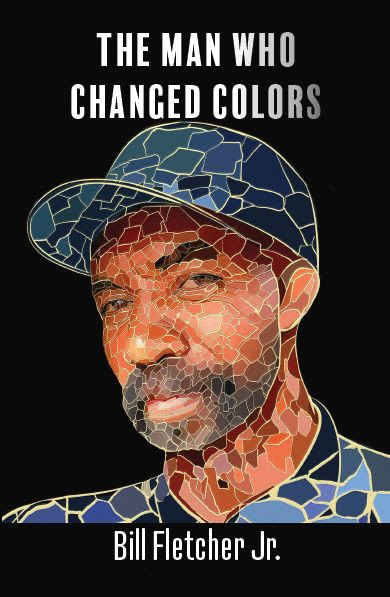
The Man Who Changed Colors
By Bill Fletcher, Jr.
When a dockworker falls to his death under strange circumstances, investigative journalist David Gomes is on the case. His dogged pursuit of the truth puts his life in danger and upends the scrappy Cape Cod newspaper he works for.
Spend a season on the Cape with this gripping, provocative tale that delves into the
complicated relationships between Cape Verdean Americans and African Americans, Portuguese fascist gangs, and abusive shipyard working conditions. From the author of The Man Who Fell From The Sky.
“Bill Fletcher is a truth seeker and a truth teller – even when he’s writing fiction. Not unlike Bill, his character David Gomes is willing to put his life and career in peril to expose the truth. A thrilling read!” − Tavis Smiley, Broadcaster & NY TIMES Bestselling Author
| | |
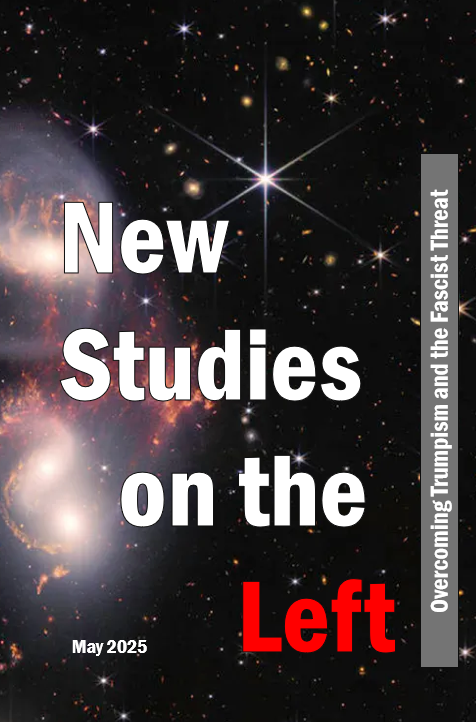
New Studies on the Left, May 2025
Paperback $14.95
...is a journal of socialist theory and practice. It is the successor to ‘Dialogue and Initiative, published as an annual journal of the Committees of Correspondence for Democracy and Socialism in book form from 2012 to 2022. It will continue the CCDS policy of left unity, including articles with a variety of left perspectives, including debates.
This issue contains a dozen articles grouped under the headings of Analysis and Global Reach, Electoral campaigns, and Book Reviews. Some are reprinted from other sources, but many appear here for the first time.
Among the authors are C.J. Atkins, Carl Davidson, Steve Early, Bill Fletcher, Jr., Suzanne Gordon, Jerry Harris, Jay Jurie, Paul Krehbiel, Matthew Scott, Rod Such, Harry Targ, and Janet Tucker and Steve Willett.
Table of Contents
Click HERE to purchase
| |
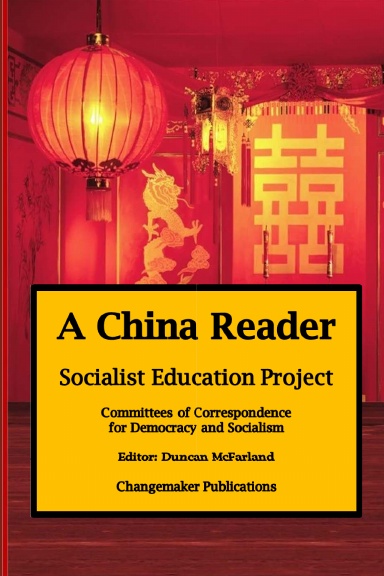
A China Reader
Edited by Duncan McFarland
A project of the CCDS Socialist Education Project & Online University of the Left
244 pages, $20 (discounts available for quantity orders from carld717@gmail.com), or order at :
The book is a selection of essays offering keen insight into the nature of China and its social system, its internal debates, and its history. It includes several articles on the US and China and the growing efforts of friendship between the Chinese and American peoples.
| | | |
Digging Deeper into the Meaning
of Palestine
By Rod Such
Author's note: My initial decision to begin reviewing books on Palestine and the Palestinian liberation struggle was to write for political activists, rather than academics or the general public. This book, which collects dozens of reviews over a decade, might also be regarded then as a kind of wide-ranging primer or introduction to Palestine that will lead hopefully to an ongoing learning experience.
316 pages, $19.00 (discounts available for quantity), order at:
Changemaker Publications
https://www.lulu.com/spotlight/changemaker
| | | |
Photo: Trump bragging to soldiers that he ended eight wars.
The Political Uses of Fakery
Scamming the Nation
By Lawrence Davidson
Counterpunch
November 2, 2025 - In the year 1922 (that is 103 years ago), the public commentator Walter Lippmann published a book titled Public Opinion. A central part of his argument was, the further from our local area we look, the more dependent we are on limited and often distorted information coming from sources we know little about. This information can manufacture “pictures in our heads,” and create or reinforce stereotypes.
Here is how Lippmann explains our predicament:
Each of us lives and works on a small part of the Earth’s surface, moving in a small circle …. Inevitably our opinions cover a bigger space, a longer reach of time, a greater number of things, than we can directly observe. They have, therefore, to be pieced together out of what others have reported and what we can imagine.
It is in times of high tension and crisis involving foreign events that we discover our own ignorance of matters that range beyond our local environment. We then turn for information to others who we assume know what is going on abroad. These are the “experts”: government officials, academics, news pundits and journalists who come to us through the media in all its forms. The problem is that such reportage is often not the same thing as truth.
An Era of Fakery
The potential for deception to masquerade as truth or proof is growing very quickly. A recent article in the New York Times (NYT) puts it this way: “Welcome to the era of fakery. The widespread use of instant video generators … will bring an end to visuals as proof.” Seeing is no longer believing. This report is actually close enough to the truth to be believed.
What is an “instant video generator”? It is an artificial intelligence (AI) computer program (often free for those with certain phone subscriptions) that allows you to “generate realistic-looking videos with AI by inputing a simple description, such as “police body-cam footage of a dog being arrested for stealing a rib-eye [steak] at Costco.” The example is juvenile but the capability for spreading disinformation by producing “fake footage” is real. Damaging and false pictorial information will now be part of the political scene. The NYT concludes that, “The tech could represent the end of visual fact … as we know it.”
Precedents
Actually, the threat to “visual fact” is not new. It’s high-tech nature just makes the process of forgery much more dramatic and the consequences more Orwellian. We can trace back the manipulation of visual information to at least Lippmann’s own time, the 1920s, and specifically to the early period of the Soviet Union.
Joseph Stalin rose to power in the Soviet Union by virtue of a struggle against several rivals, most notably Leon Trotsky. Once Stalin consolidated his position, his old rivals started to disappear from history—not only in terms of written records, but also pictorially. Essentially, this was an effort to rewrite history by laundering both the facts and the faces. For instance, there is a photo taken during the speech Vladimir Lenin gave to Soviet troops gathered at Sverdlov Square, Moscow in May of 1920. Besides Lenin, two other prominent leaders are seen in the picture: Leon Trotsky (head of the Red Army) and Lev Kamenev (soon to become deputy Premier of the Soviet Union). Both of these men became rivals of Stalin. The photo as presented during Stalin’s rule erased both men from the scene. This process of laundering was repeated with pictures showing gatherings of the early Bolshevik leadership to the point that only Stalin’s supporters remained.
Here is another, albeit apolitical example. There is an iconic picture taken in Berlin in the final days of World War II. Soviet soldiers are in the process of capturing the capital. We see them hoisting the Soviet flag atop the Reichstag. Initially, there was a problem with the photo. One of the soldiers helping to support the man with the flag is shown wearing a watch. Soviet infantry were not issued watches, so this was a tip off that this soldier had been looting. Consequently, to be able to use such an otherwise iconic photo, the watch was erased. Soon copies of the altered photo began showing up worldwide.
The folks who ran the U.S. government in the post-war era did not use the same falsifying techniques. This is not because they were technologically incapable. It may rather have been that prevailing values kept the technique at bay. Until recently sentiments supporting values such as “transparency” were politically acceptable to most U.S. politicians. That is, enough of them felt that honesty was an expected standard among American voters. In addition, egalitarianism and fairness were at least theoretically expected political goals. These essentially progressive positions were seen as a corrective for the racism that characterized much of U.S. history. Perhaps the politicians of the 1960s and 70s, when these sentiments were strongest, were blind to the deeply held racist outlook of the country’s mostly white hinterland.
Scamming the Nation
The most successful anti-progressive champion of that white hinterland turned out to be Donald Trump. Here is what he is presently telling the nation:
In the last decade Americans have witnessed a concerted effort to rewrite American history, and force our nation to adopt a factually baseless ideology aimed at diminishing American achievement. President Trump is fighting back by reestablishing truth and restoring Federal sites dedicated to American heritage.
This message has many inaccuracies. For instance, the alleged activities he criticizes date from at least the 1960s. The “rewrite of American history” which he so despises is actually an attempt to honestly betray the roots of racial problems and growing economic inequality. The claim that this effort is factually baseless is itself baseless nor is it ideologically driven—that is, unless you think the setting out of a more complete historical record is an ideological project. Indeed, one might suggest that it is President Trump who is driven to make an alliance with the conservative and fundamentalist ideologues of the radical right. Many of these people see him as “god sent.” Trump’s posturing feeds on such adoration, transforming it into an act of amour-propre.
Nonetheless, with the coming of Donald Trump and his followers, the selective falsification of U.S. history began in earnest. Stalin sought to erase individuals. Trump seeks to erase the history of just about all of America’s minorities, deny a history of pervasive racism, and, as if mimicking Joe McCarthy, transform liberal democracy into a form of left wing radicalism.
The vehicle for this anti-progressive, reactionary effort is Trump’s hijacked Republican Party. This organization is now apparently without ethics ready to: openly fix elections, pardon felons from jail, purge the historical record of the achievements of non-white heroes and leaders, destroy the greatest of the nation’s universities, and financially starve its scientific establishment. It does all of this under the slogan of “making America great again.” If Trump’s Republicans are seriously deluded so are a great number of the American white voters in the south and midwest of the country. That is where most of their support is.
It is typical of Trump that he manufactures his battlecries by loudly accusing his opposition of doing exactly what he has done. Progressives have not rewritten, so much as produced a much broader and revealing American history. It is Trump, again following in the footsteps of Stalin, who insists that only the most narrow and racially idealized stories belong in American history books—stories reflecting Trump’s worldview. His followers obviously feel comfortable in this bounded world, and their critics risk being labelled un-American.
+++
We have now entered an entirely new world of possibilities. Recent advances in the production of AI-edited images and videos reveal a troubling ability to create seemingly real but actually false perceptions. Trump has rapidly adopted the new technology. For instance, he has produced a fake video of “Barack Obama being arrested by FBI agents. This digitally manufactured footage shows Obama being pushed to the ground and handcuffed in the Oval Office, before being placed in an orange jumpsuit in a prison cell.” Throughout the video Trump looks on with a self-satisfied smile on his face.
Things are bound to get worse as AI-assisted video technology gets better. And, let’s face it, some percentage of the population, any population, while of average intelligence, will be too local in their background knowledge to easily recognize the falseness of such images. Today, Orson Welles’ 1938 War of the Worlds radio drama, if presented visually with AI assisted imagery, would give half the nation heart palpitations.
103 years ago, Walter Lippmann was prescient enough to explain the circumstances that make propaganda so effective. His explanation serves as a warning that the use of “instant video generators” needs to be regulated. Unfortunately, our present laws and culture do not encourage this sort of control of “free speech”. As a consequence, we are at the edge of a cliff and a pernicious use of AI may seduce us to take the next step. ...Read More
Lawrence Davidson is a retired professor of history at West Chester University in West Chester, PA.
| |
CHANGEMAKER PUBLICATIONS: Recent works on new paths to socialism and the solidarity economy
Remember Us for Gift Giving and Study Groups
Interested in Studying Gramsci? In a Serious way? We have a group that meets Sundays via Zoom, 11am-12:30pm, facilitated by Piruz Alemi. We go paragraph by paragraph, even line by line, reading aloud, then discussing, through The Prison Notebooks, using an online PDF. If you are interested contact Carl Davidson at carld717@gmail.com
HERE'S ONE OF THE LATEST FROM CHANGEMAKER:
| | Click William Ad Below to Go to Purchase Site | | |
HOLIDAY SALE ON EVERY TITLE BEGINS TODAY!
Hard Ball & Little Heroes Press is sharing the holiday spirit by offering a 25% discount on ALL TITLES from November 15-December 25. Enter SOLIDARITY in the discount box when you order a book, 25% will be automatically taken off your cost.
Happy holidays! Tim Sheard, editor
For the children...
Good Guy Jake...An inspiring Children’s Christmas story for Labor!
Imagine young children reading a book about a union that wins back the job of a sanitation worker unfairly fired for taking toys out of the trash. That’s what they will discover in Good Guy Jake.
For years Jake has repaired and painted broken toys he pulled from the trash on his rounds and given them to the children in the local shelter at Christmas. But when an angry motorist reports Jake to the sanitation company, Jake is fired for breaking city regulations.
His union takes the case to arbitration. There, the union brings in a crowd of children, who show the judge the toys Jake gave them and tell her that he taught them the true meaning of Christmas.
| | |
Book Review: Universal Truths, Unspoken Costs
By Jess Piper
The View from Rural Missouri
Nov 03, 2025 - There are universal truths in the Midwest.
The “tap to pay” debit card function never works the first time at Casey’s. Midwesterners refuse to follow traffic rules at two-way or four-way stops. And some agricultural practices are killing my neighbors, but we don’t talk about it.
I spoke in Cedar Rapids on Saturday night. It was the Linn County Democrats Hall of Fame to honor four local Democrats who dedicated themselves to local and national politics for decades.
Each one of them deserved the award and more.
I have a mission as of late — to speak in a way to wake up the audience. To fire them up. There is no time to waste. Not one second.
I tried to deliver a barn burner. I hope they left with fire in their soul. A spark to spread in their community and to their neighbors.
A rural Iowa event with State Senator Catelin Drey, who recently broke the Iowa Republican supermajority with her special election win. 10/11/25.
On my way up to Cedar Rapids, I was waved through a four-way stop. And then another. It’s very sweet, but it would be very confusing for anyone who isn’t from this part of the country.
On the drive, I caught myself staring at the red and orange trees showing off right now. I guess I was looking out the window too much because my car told me to keep my eyes on the road…I turned that feature off.
I like looking out the window, and no car is going to tell me what to do.
But the trees. And the farmhouses. And the little towns. And the views that stretch for miles.
And field after field after field.
And yet it’s the fields that are killing Iowans. Everyone in Iowa knows someone with cancer. Many of the people in my Iowa audiences are survivors. Everyone has lost someone, and agriculture is causing the deaths.
It’s also taboo to talk about the reason for all of these deaths — farm practices and farm policies. Fertilizers. Corporate Ag.
Government policies reward and compensate too much corn that needs too much fertilizer which runs off into too many streams and rivers and eventually kills too many people.
Leave a comment
There is so much going on each day and it’s hard to focus on any one thing. How can I focus on the ag policies of the state three miles up the road when ICE is terrorizing people and kids could go hungry soon and Trump dismantles democracy?
When I read or think too long on the situation of this country, I have to remind myself to unclench my jaw and relax my muscles.
I once watched a documentary on Teddy Roosevelt, and the narrator spoke about Roosevelt’s habit of constantly clenching his fists out of “nervous energy.” Maybe that’s what I can start calling my anxiety — nervous energy.
But back to Iowa.
I know a man from Iowa City who owns a publishing company. He publishes Iowa authors. He recently sent me a book he thought I would like. I didn’t hold out much hope because reading has been getting difficult recently. I mean, I read all day long, but it is usually snippets and short pieces. Long form is more challenging lately. My anxiety is through the roof.
Teddy Roosevelt’s nervous fist comes to mind.
I gave the book a try. Not only did I like it, but I immediately realized that I was reading a man who writes in the same plain-spoken style that I write. Some of the sentences were so familiar that I knew I was reading a kindred spirit. Another rural advocate. A fellow traveler.
I felt seen.
But this author is much better at his craft. Infinitely better.
His name is Art Cullen, and he won a Pulitzer Prize for his writing. His book is titled Dear Marty, We Crapped in Our Nest, and I was smitten from the first page. From the first rural Iowa sentence I consumed.
You know those books that you have to put down in your lap and look away to ponder the truth you just read?
It’s that kind of book.
He talks about rural Iowa and politics and ag and how we got into this mess. He talks about the booming cancer rates. He uses his community, Storm Lake, to walk us through everything from corn to school vouchers to immigration to climate change.
“In summer, a green blanket of plant life covers the gently rolling hills of Iowa. From the air, the trillions of plants in fly-over land might look like a picture of nature’s bounty. Looks can be deceiving.”
Cullen also writes about rural rage. He writes competently and truthfully about that rage and how it creates voting blocs that Republicans have come to count on.
But unlike other books on that topic, I don’t feel compelled to tear this book to pieces. I hate White Rural Rage because the authors know nothing of the rural spaces they stereotype. They have nothing on Art Cullen.
Cullen’s book is a breath of fresh, rural air. I respect his positions because he speaks on what he knows. He is rural and speaks rural.
“Everything got bigger. Farms. Machinery. Trucks. Livestock herds. Houses on the lake for doctors and ag financiers. Everything but the rural working person’s bank account. Profits that used to be held by more diverse family farms flowed to bigger corporate operations backed by real capital. The rest of us became hired help.”
Cullen speaks on farming and the environment:
“The ag supply chain is woven around government crops and predicated on petrochemicals to sustain them. Farmers, for the most part, must participate or perish.”
Cullen also tells us of the population that leaves Iowa each year:
“Fewer than half of Iowa’s public university graduates remain in the state. We call it brain drain. That doesn’t say much for those of us who didn’t leave. You begin to feel stupid. Deplorable.”
I felt that.
Share
I am not an extremely emotional person. I don’t cry often. I cried at the end of the book. Not for any particular reason other than relief.
Art Cullen managed to see what I see every day. He captured the goodness of the people he knows. The people I know.
He tells a hard story, but one with hope. There is still hope in Iowa. In the Heartland. Things can change, and the state is at a tipping point.
Art Cullen sees the soul of the Midwest. The heart of America told through the lens of a man who lives it.
This book is full of Midwestern universal truths…even if he never mentions Casey’s.
It is rare for me to be so taken with a non-fiction book. But this is a rare book.
A gem mined from the Iowa cornfields.
~Jess ...Read More
| | |
We are the World: A Neighborhood Unites
Mexico Solidarity Project from Nov 5, 2025
| | |
In her 30s, María Romero never expected to leave her native Mexico, but because of her political activities, she had to flee. Settling in San Diego near the border, she still regularly visits her family in Tijuana. She's passionate about assisting immigrants and adult learners and participates in community struggles organized through Activist San Diego. Currently, as a dedicated organizer in the City Heights Defense Committee, she works to educate and empower City Heights residents to keep ICE out of their community and to end unjust deportations and family separations.
You’re a migrant yourself. Why did you come to the US?
I’m from Mexicali, Baja California. It’s a border city with the US on the other side of the fence. When I was young, farmers went back and forth with no problem. Not like today!
In 2000, I graduated from law school, and because I wanted to work on behalf of the common people, I got a job in the local Mexican Human Rights office. But then a difficult case came to me. A young girl had been raped. Abortion was illegal, except in the case of rape — but she was denied an abortion! When I fought for her, I began getting anonymous threats from church fanatics, saying I should be dead because I was pro-choice. A Catholic priest even made threatening flyers with my name on them, calling me a lesbian criminal! It got so bad we had to leave; my husband and I moved to Oregon.
But in the US, I couldn’t work as a lawyer. I cleaned houses, did elder care, waitressed — anything! At first, I had a visa, but it ran out, and I became undocumented.
My husband was abusive, and we separated in 2009, when my son was three. In 2010 I was trying to get asylum on the basis of the threats in Mexico, but a Catholic Charities counselor recommended I file instead as a victim of domestic violence. That worked, and I got a permit to work. In 2015, I finally got my status adjusted to that of resident. I could see my family again after ten years of being unable to cross the border to home!
When Trump sent ICE into San Diego, you and several of your activist friends decided to take action. Why did you pick City Heights for defense work?
We live in City Heights! This area isn’t only rich or only poor — it has some big houses but also apartments with workers. In my building, it’s mostly Blacks, but also whites and Mexicans. A building on one side of mine houses Chinese, Laotian and Vietnamese, and on my other side, Turks, Egyptians, Africans and Haitians — within a mile, you can find the whole world! ..Read More
| | |
Adelante #4 is out! A special on immigration for the closing days of the election. Use it everywhere!
Get it here: http://ouleft.org/Adelante-4.pdf
By Bill Gallegos, excerpted from our new fall issue of “¡Adelante!”
U.S. GOP presidential candidate Donald Trump demonized Mexicans and immigrants as a central part of his 2016 presidential campaign. In 2024, he has doubled down. If elected, he promises to unleash an ethnic cleansing campaign to deport the 12 million undocumented immigrants in the U.S. This is horrible enough as a complete violation of human rights. But this pogrom is only one piece of the larger anti-democratic ‘Project 2025’ of the Heritage Foundation. They are coming for all of us. While singling out Mexican immigrants, Trump aims at all immigrant communities, including growing communities in the South, Midwest, and East.
Thankfully the political energy has shifted since President Biden dropped out of the presidential race. Vice-President Kamala Harris is now the Democratic Party candidate, and the polls show a significant shift in her direction. More than a million new volunteers have signed up for Harris, and hundreds of millions of new dollars have been contributed to her campaign.
The Biden-Harris Administration has been mixed on immigration: on one hand, it continues to support the legalization of Dreamers (DACA) and pushes for a path to legalization for the spouses of immigrants with legal residency. On the other hand, it has denied asylum protections for refugees crossing the southern border and supported legislation for increased militarization as well as new administrative hurdles. While our most important fight is against the MAGA right, the fight for full rights and protections for immigrants is a long-term struggle beyond the November elections.
The Biden dropout also creates significant opportunities for the left and progressives to advance the fight against the fascist threat, to advance a progressive platform, and to put new pressure on both Biden and the Harris campaign to demand a ceasefire in Gaza. It enables us to push back strongly against Trump’s racist threats against immigrants while advancing a positive program for immigrant rights.
| | |
|
Our Amazing Resource for Radical Education
CURRENT FEATURE: In the 'Study Guides' Section
A 4-PART STUDY OF THE SHAPING OF THE
RUST BELT WORKING CLASS.
From the settlers to the present, and how its consciousness is conflicted. Prepared by Carl Davidson and Rebecca Tarlau,
with some help from the DSA Rust Belt group.
| |
There are hundreds of video courses here, along with study guides, downloadable books and links to hundreds of other resources for study groups or individuals.
Nearly 10,000 people have signed on to the OUL for daily updates, and more than 150,000 have visited us at least once.
Karl Marx's ideas are a common touchstone for many people working for change. His historical materialism, his many contributions to political economy and class analysis, all continue to serve his core values--the self-emancipation of the working class and a vision of a classless society. There are naturally many trends in Marxism that have developed over the years, and new ones are on the rise today. All of them and others who want to see this project succeed are welcome here.
NEW UPDATES...Sept 15 2025
—Ukraine Between Empire And Revolution: Lev Yurkevych’s Anti-Colonial Marxism, by By Lev Yurkevych & Christopher Ford.Now on our blog page
New Video Course: Zohran Mamdani - Why I Joined DSA, now on our Home Page.
New Course Text: MAGA, Trump, and the Question of American Fascism. By Carl Davidson and Bill Fletcher, Jr., now on our Home Page.
Life happened fast: It’s time to rethink how we study life’s origins. It emerged far earlier, and far quicker, than we once thought possible. Now in our Science and Discovery Dept
Socrates Would Be Pleased: With a class of college students and inmates, teaching philosophy in prison is a rowdy, honest and hopeful provocation, now in our Philosophy Dept.
Trump’s Deportation Agenda Will Destroy Millions Of Jobs: Both immigrants and U.S.-born workers would suffer job losses, particularly in construction and child care. –Economic Policy Institute, by Ben Zipperer. Now in our Political Economy Dept.
To visit the OUL, go here: http://ouleft.org
Read More
|
| | |
Video for Learning: 63 minutes
Marx & Multipolarity - with Radhika Desai
| |
Harry Targ's 'Diary of a Heartland Radical' | |
This week's topic:
Assessing the Russian Revolutionary Project in the Twentieth Century
Harry Targ
Taken from a paper printed in Duncan McFarland ed. The Russian Revolution and the Soviet Union: Seeds of 21st Century Socialism, Changemaker Publications. http://www.lulu.com/spotlight/chsngemaker
Click here to access the blog.
| | Tune of the Week: Proud Mary [Creedence Clearwater Revival] ...5 min. | | |
Film Review: Why ‘Sentimental Value’
Is One of the Best Movies of the Year
The Worst Person in the World director Joachim Trier returns with a comedy-drama that blurs the lines between art, life, and family. It's phenomenal
By David Fear
Rolling Stone
SentimentalValue Stellan Skarsgard Elle Fanning
Stellan Skarsgård and Elle Fanning in ‘Sentimental Value’
Kasper Tuxen Andersen/MUBI
Nov 7, 2025 - You can never truly know your parents. And Norwegian actor Nora Borg (Renate Reinsve) is happy to keep it that way in regard to her father, Gustav (Stellan Skarsgård). A world-renowned filmmaker, he chose la vie bohème over domesticity and being present in her life ages ago; Nora and her sister, Agnes (Inga Ibsdotter Lilleaas), have been estranged from him for years. Dad came and went as they were raised by their mom in an Oslo residence that’s been in the family for generations. From the outside, the place looks like like something out of a fairy tale, where a witch in the woods might plump up kids for a meal. But inside, it’s roomy yet cozy, a homey domicile filled with both bright memories, a rich history, and the faint echoes of a decades-old tragedy.
When Nora and Agnes’ mother dies, the siblings gather friends and loved ones in the home for a memorial. No one expects Gustav to attend. No one is happy to see him when he shows up, acting as if he’s merely been absent without leave for a fortnight or two. Even more surprising: Dad has an offer for Nora, who’s just come off a successful run in an avant-garde theatrical production. After a long creative dry spell, he’s finally written a new, very personal script. Would she star in it?
Nora says no way. Gustav accepts her answer and says goodbye. Some time later, Dad shows up once more at their house. He plans on shooting his latest opus there regardless of Nora’s refusal. Gustav has also cast a way-more-famous American movie actor named Rachel Kemp (Elle Fanning) to play the lead. The young A-lister met the older auteur at a film festival, and her sudden interest in the project equals funding. It’s not a coincidence that Gustav has forced Rachel to dye her hair to resemble his daughter. Nor that a major incident in the script mirrors the same aforementioned tragedy that occurred within these four walls, back when this lion in winter was just a boy.
The lines between life and art, truth and fiction, get mighty blurry in Trier’s emotionally expansive, extremely wry film, though the family drama itself is just a spine on which to hang any number of other fixations and preoccupations. You can break down this skateboarding champ turned major cinema figure’s best work into bare-bones synopses, and people will have a vague sense of what they’re walking into. Reprise, his 2006 cannonball of a debut, centers on two aspiring, competitive writers. Oslo, August 31st (2011), follows a man determined to take his own life. The Worst Person in the World (2021), which starred Reinsve and more or less turned her into one of those “overnight” sensations that feel like showbiz mythology, is a character study of a complicated woman. All of this is completely accurate.
What makes Trier’s movies so rich, so exhilarating, so vital, is the way he and his longtime screenwriter Eskil Vogt pitch these stories somewhere between a saga and an anecdote, fit-to-burst with lifelike textures, details and detours. This is part of Sentimental Value‘s prime currency. We don’t just get a tour of this old house — we meet it, hearing its thoughts courtesy of a school essay Nora once wrote (“what the house disliked more than noise was silence”) and watching its history unfold in vignettes that span WWII to the late 1980s. There are glimpses of a backstage farce, with Nora trying to use a quickie with her married stage-manager lover (longtime Trier regular Anders Danielsen Lie) to quell a panic attack on opening night, then threatening to bolt. ...Read More
| | |
Initiated by CCDS
522 Valencia St.
San Francisco, CA 94110
415 863-6637
| | | | | |