Duke Human Rights Advocates,


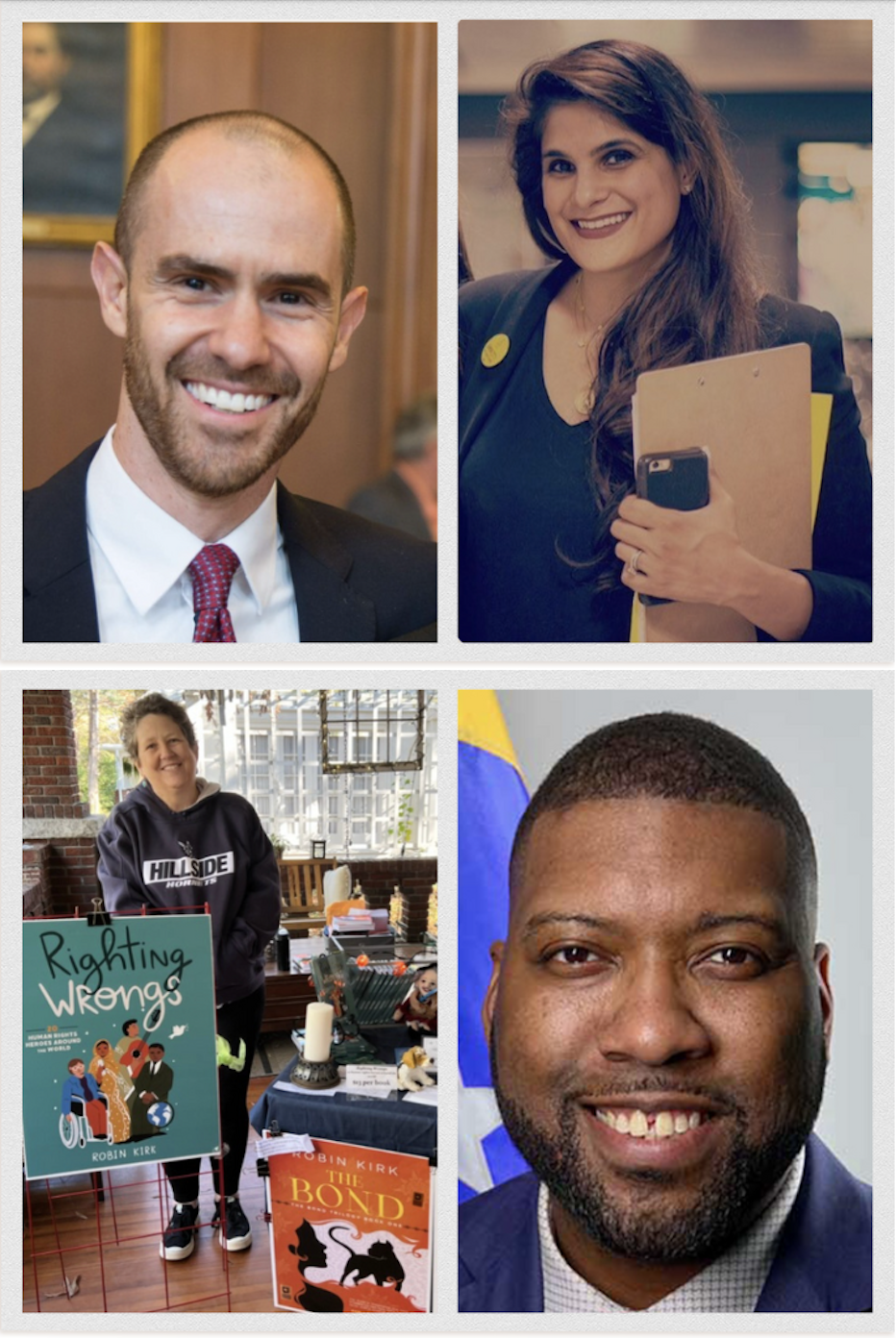
Article 3 of the Universal Declaration of Human Rights states, “Everyone has the right to life, liberty, and security of person.” This article seems to be the most prevalent theme of our fall semester here at the Duke Human Rights Center at Franklin Humanities Institute. After the shocking shooting of Dr. Zijie Yan on UNC Chapel Hill’s campus last August, DHRC intern Sarah Holehouse interviewed Duke/UNC alum Jasmeet Sidhu about how gun violence in the United States directly impacts our right to life. The three films we screened for our Rights! Camera! Action! film series this semester all related to Article 3 in some form - how the death penalty violates a person’s right to life, how mistreatment of people with mental illness violates their right to security of person, how those who bravely speak out against state oppression risk losing their most basic human right to life. And of course, our Statement on Gaza and Israel speaks directly to the right to life and liberty taken from over 1,400 Israelis in the Hamas attack on October 7, as well as to the thousands of Palestinians who have been killed over the last few weeks or denied their right to liberty for over 15 years by the state of Israel.


This semester has been emotionally difficult for many in our Duke community. As we enter into the winter holiday season, I hope you find some peace, as well as the strength to continue advocating for human rights in the new year.

DHRC@FHI Statement on Gaza and Israel


We join human rights and civil society organizations across the globe in calling for the immediate, safe, and sufficient provision of humanitarian aid to Gaza and the release of all hostages. We mourn all civilians harmed by the war between Israel and Hamas and join others in calling on the Israeli government and Hamas leadership to cease further actions that harm Palestinian and Israeli civilians. International humanitarian law (IHL) forbids the deliberate targeting of civilians, indiscriminate attacks, the use of civilians as human shields, and the imposition of collective punishment. IHL also demands the protection of medical personnel and civilian objects, including water installations and electricity, all of which have been targeted in the current war.


We join with our human rights partners and civil society organizations in the region and beyond in calling for humanitarian principles to guide all actions and the immediate cessation of all indiscriminate attacks and attacks that target civilians or employ disproportionate lethal force against them. 

It is our collective responsibility to ensure that our campus remains a safe place for our community to discuss and learn without fear. Universities should be places where hard questions can be posed and debated. Any conflict with such ghastly human cost compels us to educate ourselves about the history, engage in civil discussion, help craft solutions, and above all speak out to protect human life. On campus, we must listen to one another with sympathy and respect and speak out on behalf of our fellow human beings.  


We affirm the right of all people to live safely, free from violence and oppression. We are steadfast in our support, empathy, and care for members of our university and local communities who have suffered loss, are fearful, or worry that they cannot freely voice their opinions or concerns. We must acknowledge the collective grief of so many members of our community. 


Catherine Admay, Public Policy

Elizabeth A. Albright, Environmental Ethics & Sustainable Environmental Management

Edna Andrews, Linguistics 

Nina Balmaceda, President and CEO, Peace and Hope International

James Chappel, History

Saskia Cornes, Franklin Humanities Institute

Juliette G. Duara, Kenan Institute for Ethics

Mona Hassan, Religious Studies & History

Suzanne Katzenstein, Sanford School of Public Policy

Ranjana Khanna, Director, John Hope Franklin Humanities Institute & English

Robin Kirk, Co-Chair, DHRC@FHI & Cultural Anthropology

Claudia Koonz, Professor Emeritus, History

Robert Korstad, Duke Institutional History Project, Public Policy & History

Nancy MacLean, History & Public Policy

Ellen McLarney, Asian and Middle East Studies

Liliana Paredes, Romance Studies

Gunther Peck, History & Public Policy

Adam Rosenblatt, International Comparative Studies

David Schaad, Department of Civil and Environmental Engineering

Patrick Stawski, Human Rights Archivist

Rebecca L. Stein, Cultural Anthropology

Priscilla Wald, English

Erika Weinthal, Co-Chair, DHRC@FHI & Environmental Policy and Public Policy

Corin Zaragoza, Program Director, DHRC@FHI

Fall in Review

Interviews with

Human Rights Advocates

Student interns Sarah Holehouse (Trinity ‘25) and Aseel Ibrahim (Trinity ‘27) conducted a number of interviews this fall with people advocating for human rights in a variety of contexts. Catch up on their interviews below!


Rights! Camera! Action!

Film Screenings

Created in 2009, the Rights! Camera! Action! film series features documentaries that focus on human rights related themes across the globe. Each year, there are at least four film screenings, followed by panel discussions with Duke faculty or students, community activists, and occasionally the filmmakers themselves.


Our first film, “Bedlam,” explored the deep rooted relationship between mental health, imprisonment, and human rights violations in California. If you missed the screening and accompanying panel discussion between Duke student Billy Cao and mental health professional Jae Richardson, read our summary here.


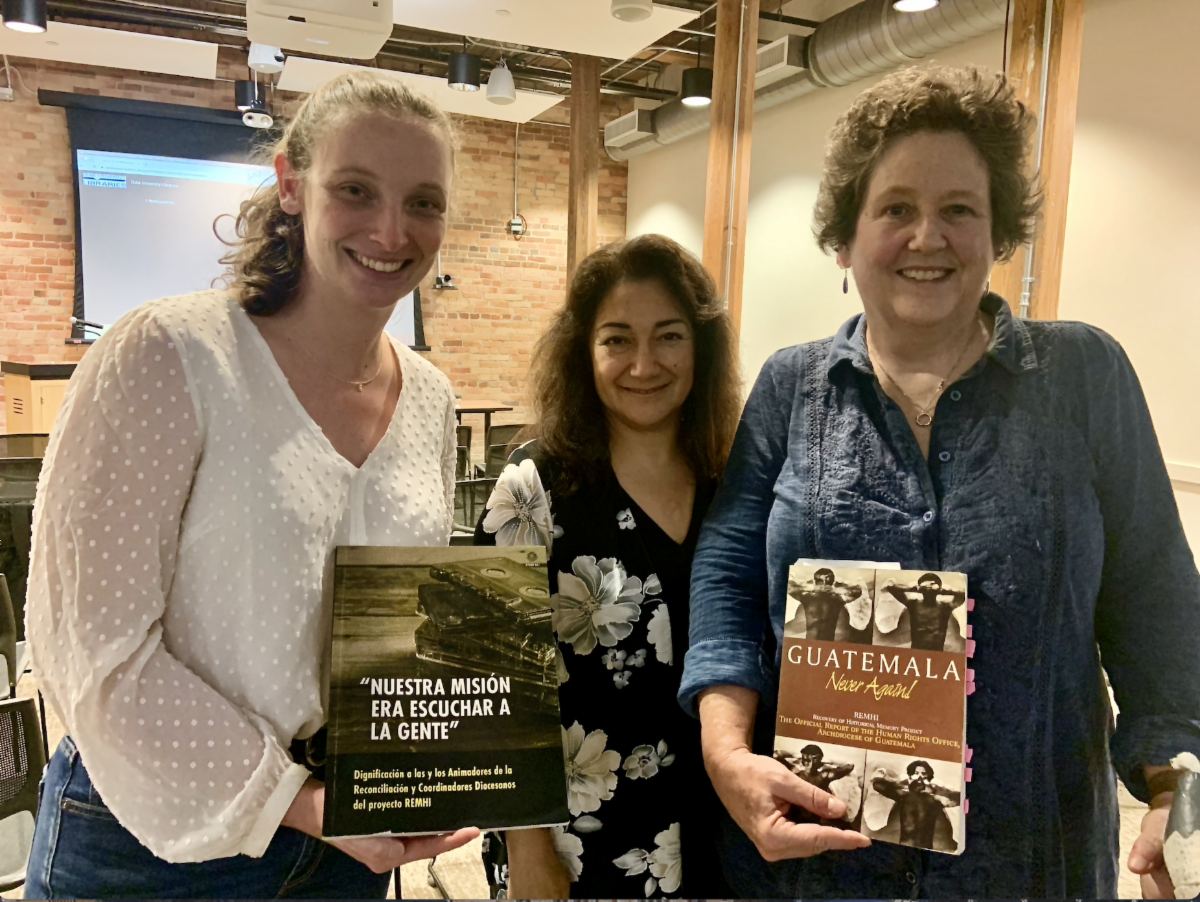
Our second film, “The Art of Political Murder,” focused on Guatemalan Bishop Juan Gerardi, who was murdered in 1998 for his role in publishing “Guatemala, Never Again!,”a document that described the atrocities committed by the Guatemalan Army during the country’s Civil War. The photo below shows panelists Emily Taylor (left) and Dr. Nina Balmaceda (center) with moderator Robin Kirk (right) holding copies of this powerful document.

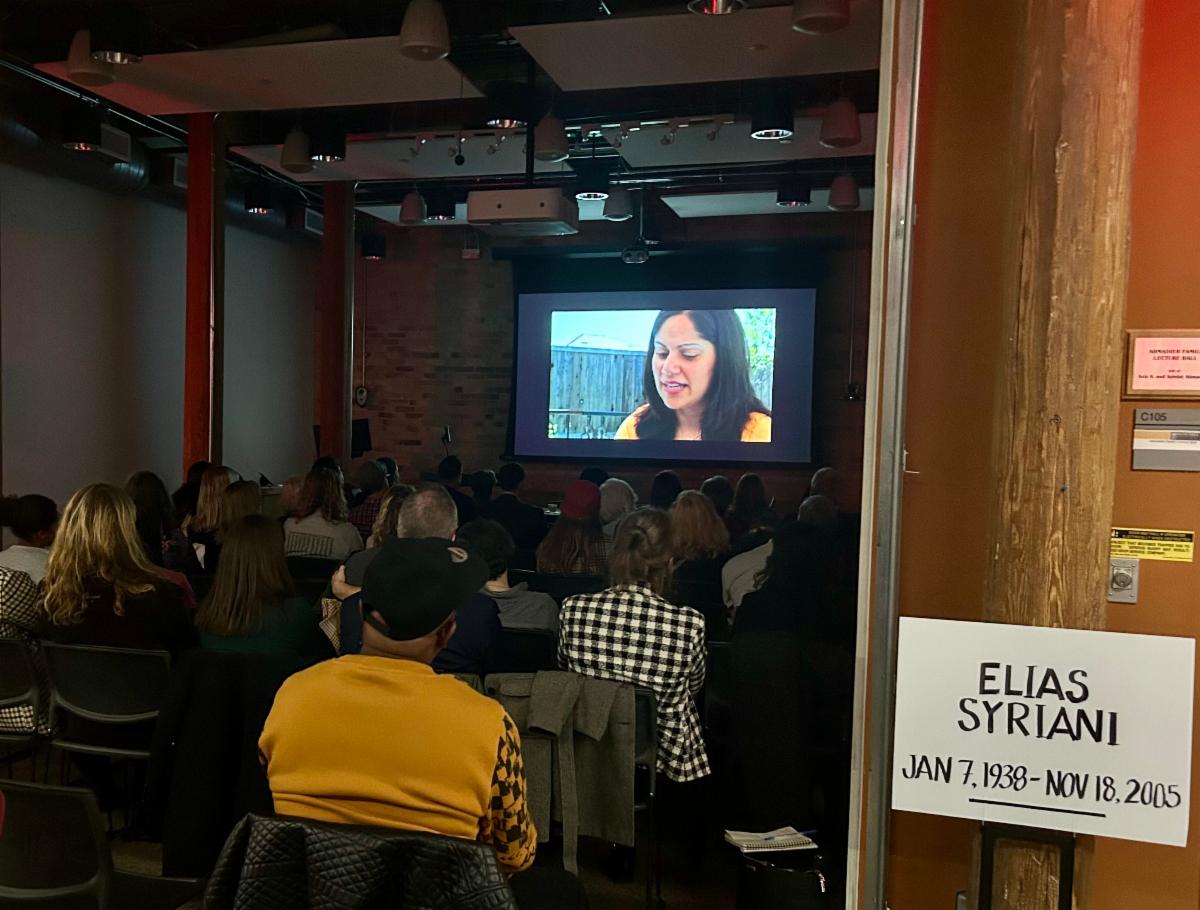
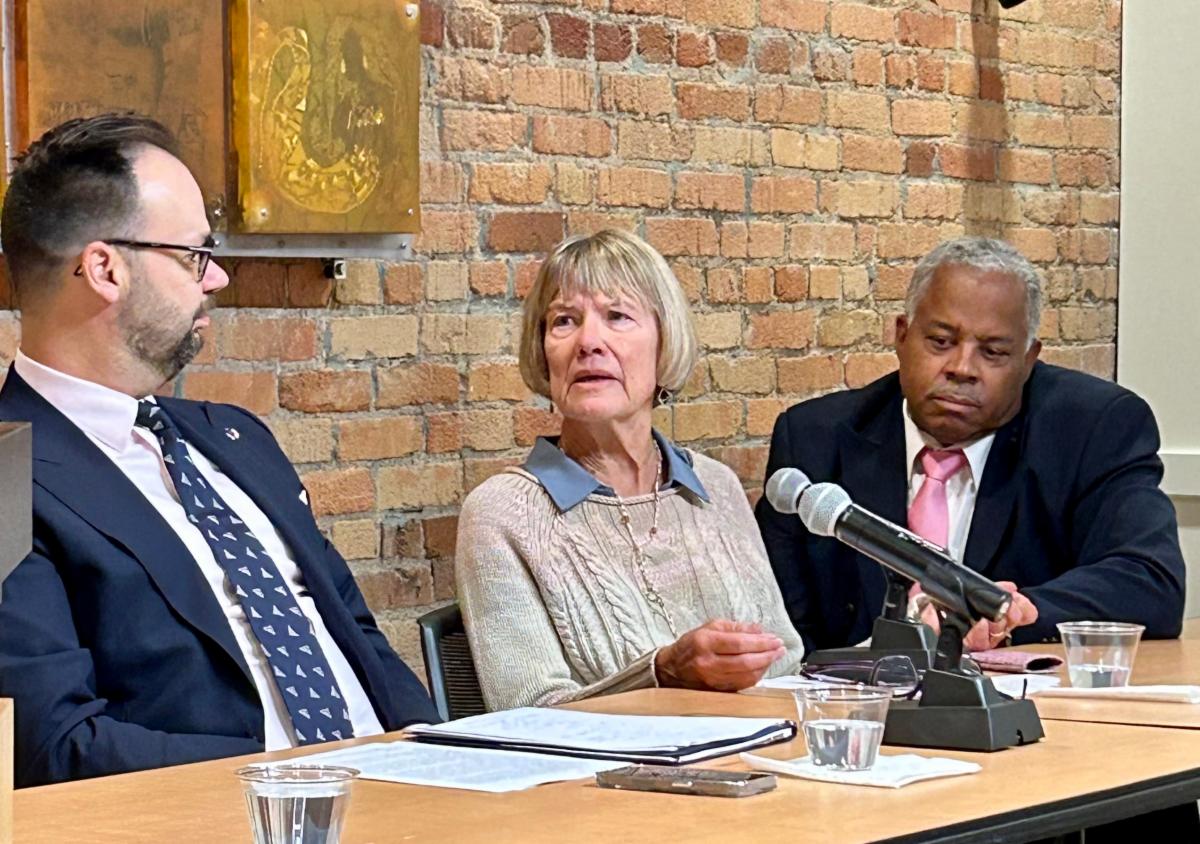
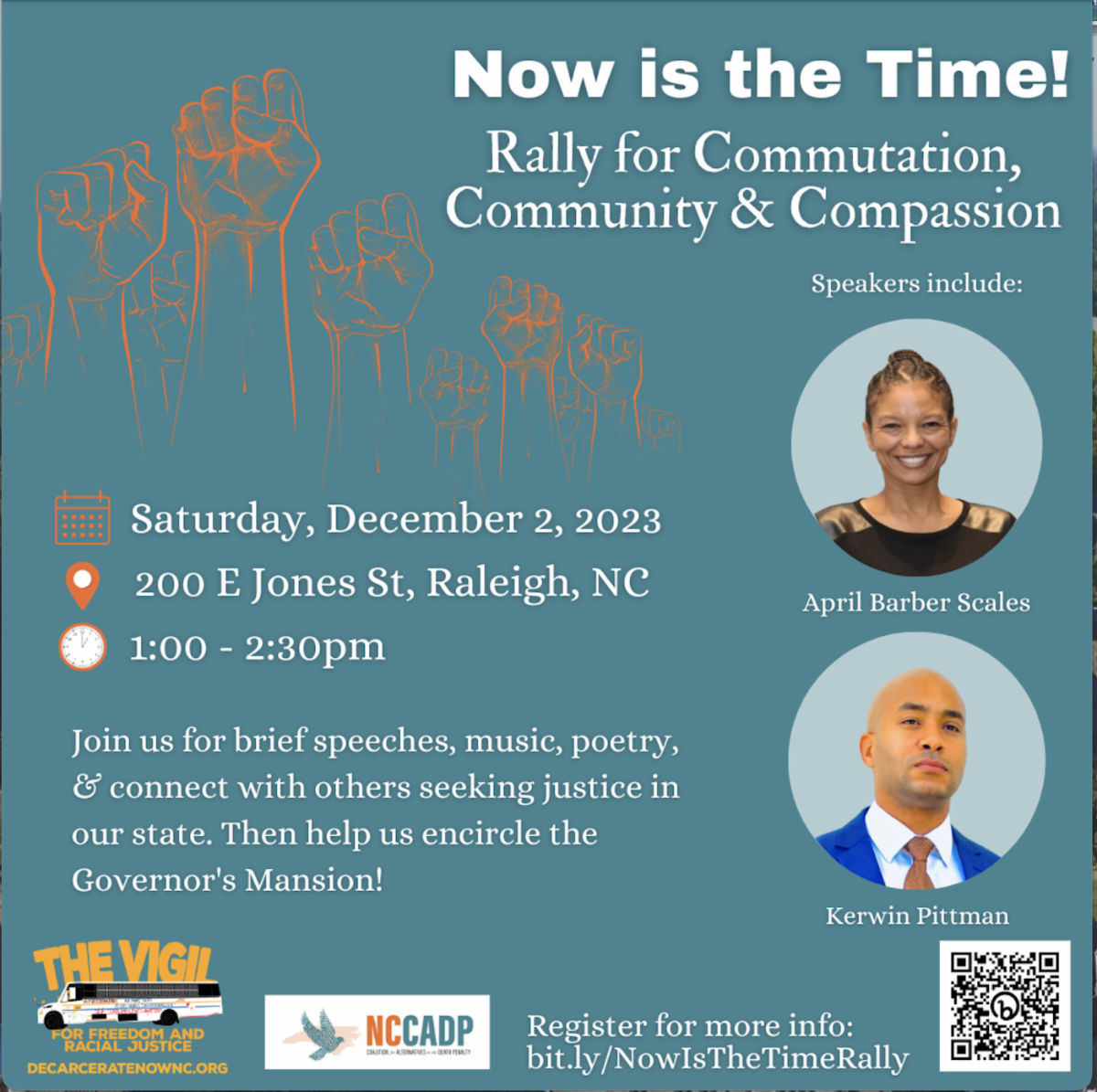
Earlier this month, we had the privilege of partnering with NC Coalition for Alternatives to the Death Penalty (NCCADP), Southern Coalition for Social Justice, and The Center for Death Penalty Litigation to screen “Love Lived on Death Row,” which focuses on the story of Elias Syriani and his four children. Meg Eggleston (below, center) and Henderson Hill (below, right), who played pivotal roles in the Syriani family’s story, spoke to a packed audience after the film. They were joined by Andy Van Pachtenbeke (below, left), political counselor at the Embassy of Belgium in the U.S., who was visiting North Carolina in support of NCCADP’s campaign to get Gov. Roy Cooper to commute all of NC’s death sentences to prison terms. You can learn more about the campaign here.

This spring, we'll feature a film that highlights the creativity and bravery of a group of LQBTQ youth in Nigeria ("The Legend of the Underground") and a documentary shot from the lens of a filmmaker in a wheelchair ("I Didn’t See You There.") More details about these events will be released soon.

Upcoming Events

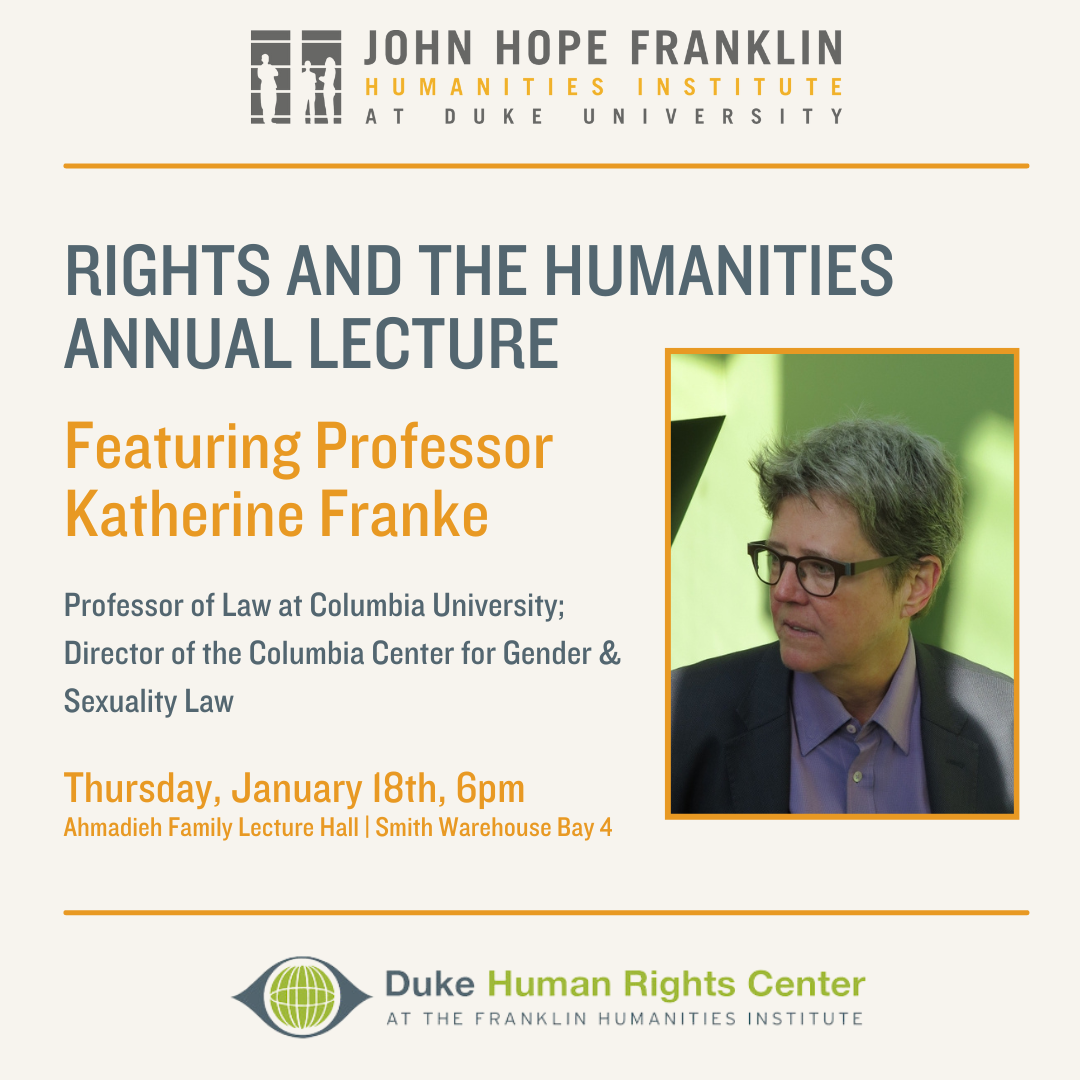
The Rights and Humanities Annual Series is jointly sponsored by the John Hope Franklin Humanities Institute (FHI) and the Duke Human Rights Center @ FHI. The series was launched in 2019 to address the links between ideas of rights and the humanities - and to more fully explore the intellectual possibilities of housing a human rights center within a humanities institute.


This year's lecture,
THE RISE OF RELIGIOUS LIBERTY: MADE POSSIBLE BY THE DECLINE OF A PUBLIC MORALITY, will be given by Professor Katherine Franke. In June 2022, in a 24 hour period, the US Supreme Court issued two very significant decisions: one that read the text of the constitution to provide extremely strong rights to carry guns in public, and the other declaring that the constitution provides no protection for the right to an abortion. Professor Katherine Franke will discuss how these two cases stand for a larger trend in the conception of rights in the US at this time in which the right has successfully captured a classically liberal conception of "rights as trumps”. In cases involving gun rights, religious liberty, and the right to resist public health measures during the COVID pandemic, fundamental constitutional rights have been successfully deployed to deconstitutionalize the state’s power to regulate in the name of public welfare. 

Event Details

Student Opportunities

Koonz Human

Rights Prize

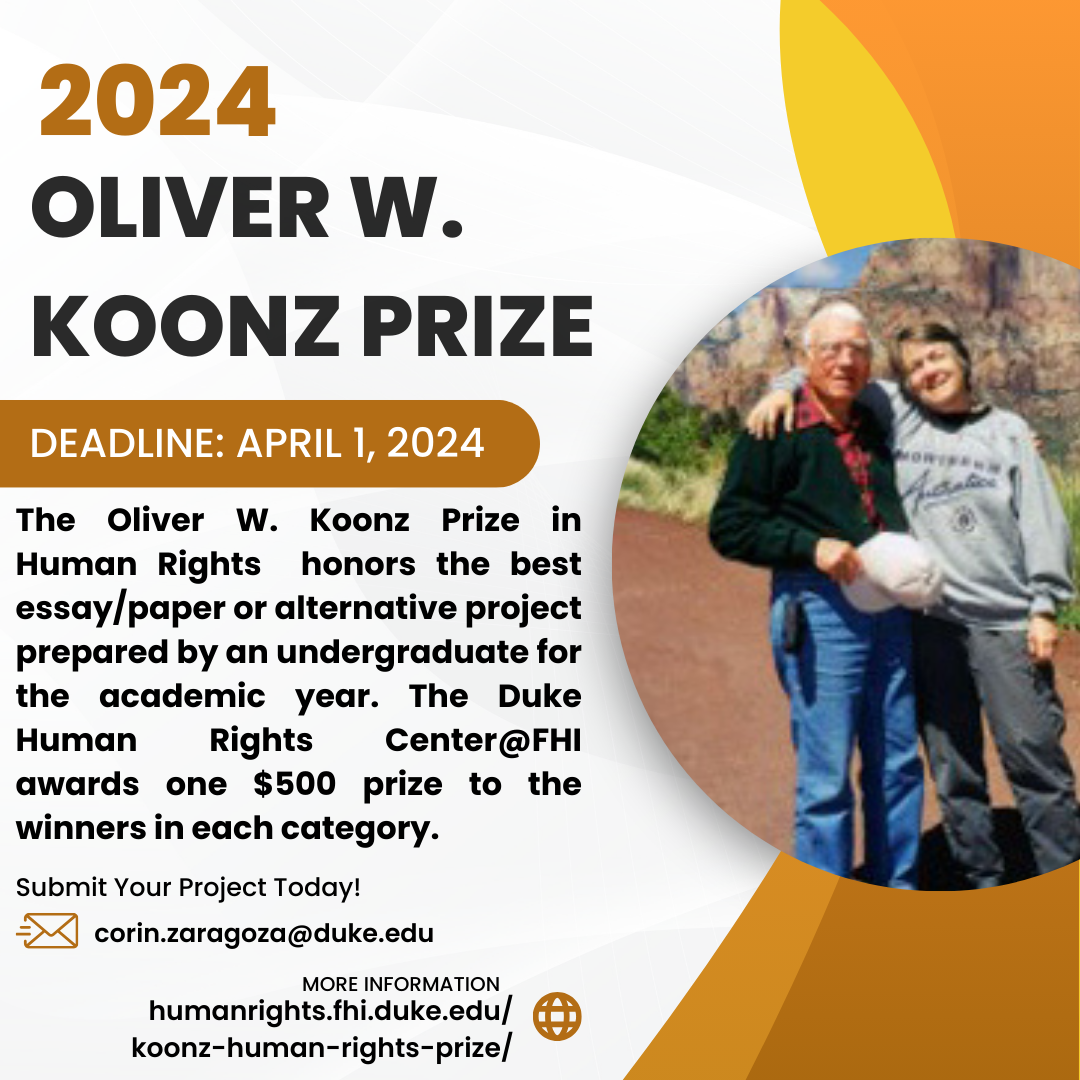
Have you written an interesting, thought-provoking, or otherwise exemplary essay/paper for one of your courses? Or perhaps created a documentary video, phone app, short story, or some other alternative project about a human rights theme? If so, consider submitting your work for the Koonz Human Rights Prize.

Learn More

Discover More

humanrights.fhi.duke.edu

Facebook  Twitter  Instagram