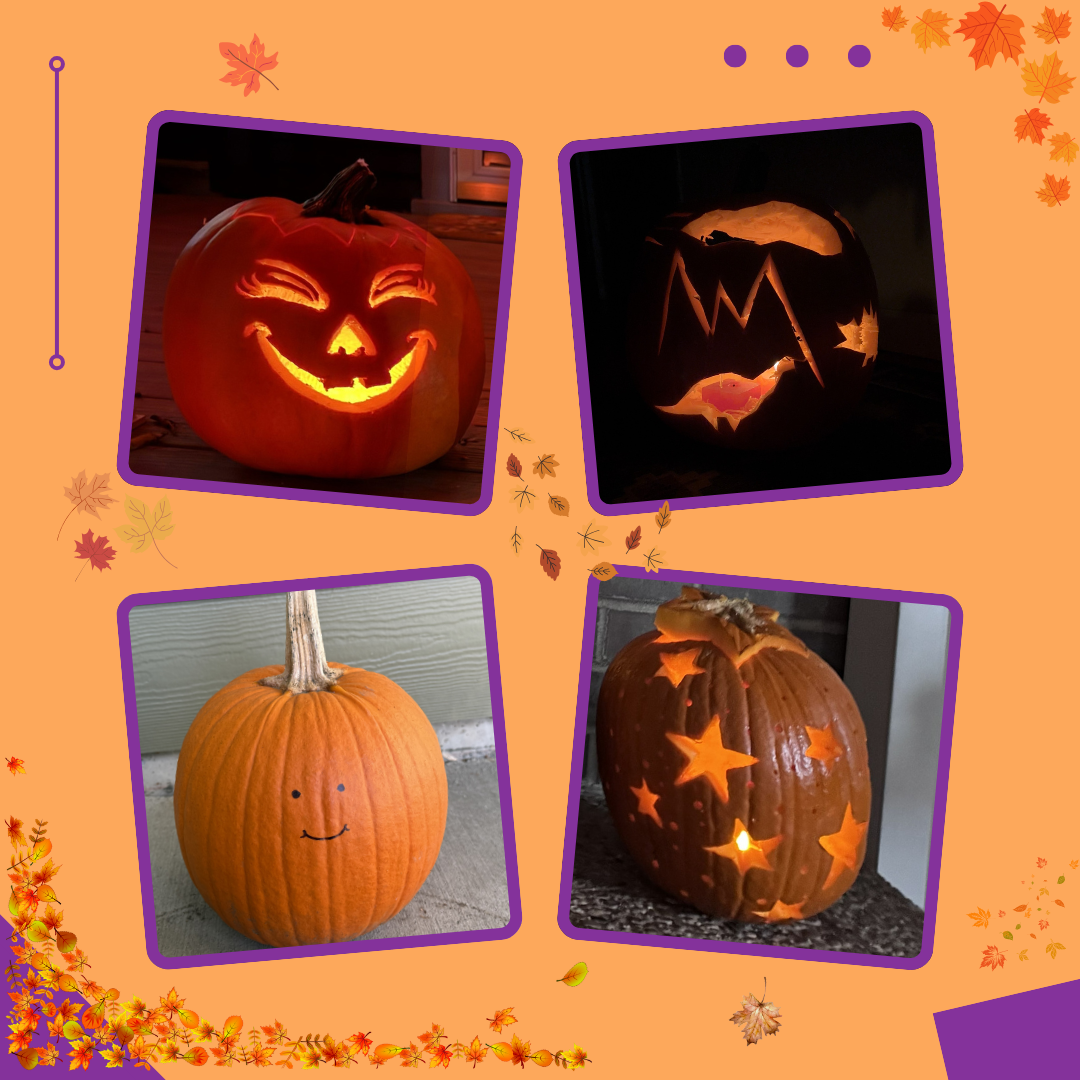
Happy November from CSTP! Enjoy some pumpkins that the team carved to celebrate the turning of the season and bring some light to the darkening days. | | WERD Book Study Winter 2026: Registration Open Now! | |
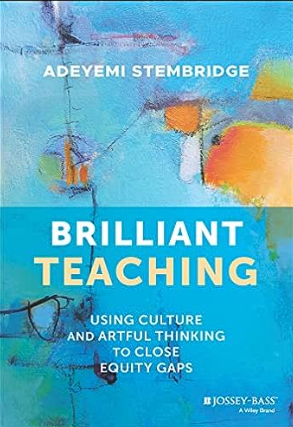
This 2025-2026 school year, CSTP is thrilled to host our Washington Educators Read and Discuss (WERD) online book study. We are happy and full of gratitude to have Dr. Adeyemi Stembridge return as a facilitator for this book study.
We will be spending time with Dr. Stembridge's second book Brilliant Teaching: Using Culture and Artful Thinking to Close Equity Gaps. Participants will connect, discuss, and reflect upon the book in small groups and be guided through our shared community learning by our amazing crew of facilitators.
This free book study is open to all Washington paraeducators, teachers, principals, administrators, and ESAs. Registration is free, and 15 clock hours will be available for purchase upon completion based on live attendance. Book study registrants will purchase and read the book on their own and then attend the live sessions (recordings will not be available).
Meetings will take place weekly on Tuesday afternoons from 4:30-6:00 PM. Below are the dates for each meeting:
Jan 13th - Preface, Chapter 1
Jan 20th - Chapter 2
Jan 27th - Chapters 3 & 4
Feb 3rd - Chapters 5, 6, 7 & 8
Feb 10th - Chapter 9, Afterword
For more information and registration, please visit our book study Zoom registration page.
| | CSTP's National Board Component Support is Open for Registration | | |
Registration is open for our CSTP-sponsored National Board Component Support cohorts.
For the 2025-26 school year, registration is still open for the following cohort:
-
Online cohort: Faciliated by Ranice Innocent. This will be Ranice's 7th year facilitating and supporting National Board Candidates/Cohorts. Foundations and all four components will be offered, with clock hours available for each section. Read more and register here.
| | Bring CSTP Expertise to Your School or District's Professional Learning | | |
As you start the school year and consider what professional learning you need for the year, CSTP is ready to collaborate with you! We provide consultation, facilitation, and coaching to support teacher leadership, teamwork, and customized professional learning in your school or district.
We bring expertise in:
-
Teacher Leadership Development, helping educators step into influential roles and contribute meaningfully at the school and district level.
-
Supporting Teacher Teams, offering structures and strategies that enhance team communication and empower collaborative, equity-focused reflective practice
-
Culturally Responsive Pedagogy, equipping educators with tools and mindsets that support all students to access rigorous, engaging work while honoring all students’ identities
Let CSTP help you design meaningful learning experiences, launch leadership frameworks, or amplify teacher-led initiatives—whether virtual or in-person. Interested in exploring how CSTP can support your school or district? Reach out to Linsdey@cstp-wa.org. We’re ready to collaborate with you!
| | Partner with CSTP to Offer Clock Hours at Your Next Training | | |
Are you running a course, professional development or book study and want to offer Washington State clock hours? CSTP is an approved Washington State clock hour provider and can approve your courses for clock hours. It is free for the instructor to apply for the course with participants paying a nominal fee.
Learn More and Apply for Clock Hours
| | National Board Writing Webinars | | |
Register today for OSPI's National Board Writing Webinars!
Who: Any National Board candidate working toward National Board Certification in 2025-2026
What: These one-hour webinars are designed to support writing for the National Board portfolio. Candidates should expect to examine their own writing and work with peers on the selected topic. These sessions DO NOT replace cohorts nor conditional loan requirements.
When: Fall-Spring, always Tuesdays, 4:30 PM-5:30 PM (choose Series A, B, or both!)
Series A (Fall-Winter) REGISTER HERE!
- Nov 18: Writing Tips: Convincing, Clear, Consistent
Series B (Winter-Spring) REGISTER HERE!
- Jan 6: Writing about Contextual Information
- Jan 20: Writing about Instructional Context
- Feb 3: Forms & Written Commentary
- Feb 24: Identifying and Writing about Goals
- March 10: Using Evidence in Written Commentary
- March 17: Integrating National Board Standards
- April 7: Writing Tips: Convincing, Clear, Consistent
Where: Zoom – Register above and select the sessions you’d like to attend. You will need an account with https://zoom.us/ and an electronic device to join. A Zoom link will follow in an email after completing the registration survey. Each session per series uses the same Zoom.
RSVP is required – registration will close day-of event. Contact OSPI National Board Program Specialist, Steven Mueller, at Steven.Mueller@k12.wa.us for any questions
| | |
We are thrilled to announce that we are able to continue to serve in our role as Sector Lead for the Education Sector with Career Connect WA! This is such a great opportunity for us to be connectors for the amazing work that is happening across the state! Below are some highlights that we'd like to spotlight about some of the incredible manifestations of great collaboration and work.
Launch of the Center of Excellence Career Navigation Website
Last year we partnered with the Center of Excellence to develop a user-friendly, student-centered and driven website that allowed students to explore all the ways to learn about what a career in education could look like for them and serve as a resource to help them fulfill their dreams! Below are some links that we encourage folks to explore and share!
2025-2027 Teachers for the People Expansion Project
We are happy to share that this biennium we received funding to support the expansion of the Teachers for the People Program serving Indigenous High School students in NWESD 189! Teachers for the People is a recipient of the CCW Program Builder (Round 13), focusing on increasing the representation of Indigenous educators in K–12 systems and centering Indigenous ways of being and knowing in educational practice.
Currently active at Mount Vernon’s Northwest Career & Technical Academy and Marysville School District, the program plans to expand to Ferndale and Bellingham. With partners Skagit Valley College and Western Washington University’s Woodring College of Education, participants can earn dual credit while completing their paraeducator certificate while in high school, culminating in full teacher certification.
We are proud to partner with the team at NWESD 189 to support the growth of this program as it continues to flourish and continue to learn from their local tribes' Indigenous practices and pedagogies that are more inclusive, culturally responsive, and equitable as they are centered from the Indigenous perspective and histories of those who have been stewards of the land since time immemorial.
| | WA STEM: Annual Summit 2025 | | |
Join WA STEM at their annual summit on November 19 from 8 a.m. to 3 p.m.
This year's summit focuses on the cradle-to-career journey. It will explore the systems, partnerships, and promising practices shaping education reform in Washington. Through the lens of data justice, it'll examine the barriers too many students face, connecting the dots between early care and education, STEM belonging, and postsecondary preparation.
Find more and register here.
| | November is Native American Heritage Month | | |
What started at the turn of the century as an effort to gain a day of recognition for the significant contributions the first Americans made to the establishment and growth of the U.S., has resulted in a whole month being designated for that purpose.
In 1915, the annual Congress of the American Indian Association meeting in Lawrence, Kans., formally approved a plan concerning American Indian Day. It directed its president, Rev. Sherman Coolidge, an Arapahoe, to call upon the country to observe such a day. Coolidge issued a proclamation on Sept. 28, 1915, which declared the second Saturday of each May as an American Indian Day and contained the first formal appeal for recognition of Indians as citizens.
The first American Indian Day in a state was declared on the second Saturday in May 1916 by the governor of New York. Several states celebrate the fourth Friday in September. In Illinois, for example, legislators enacted such a day in 1919. Presently, several states have designated Columbus Day as Native American Day, but it continues to be a day we observe without any recognition as a national legal holiday.
In 1990 President George H. W. Bush approved a joint resolution designating November 1990 “National American Indian Heritage Month.” Similar proclamations, under variants on the name (including “Native American Heritage Month” and “National American Indian and Alaska Native Heritage Month”) have been issued each year since 1994.
Read more and find resources here.
| | Ready WA Student Storyteller: Summer Plans | | |
From classrooms to courthouses! Ready WA Storyteller Lizzy joined Envision’s Intensive Law and Trial program at Stanford University during a recent summer — gaining hands-on legal experience and connecting with students nationwide. Her reflections can inspire future summer plansthat involve building new skills and friendships. Read her story here.
| | |
Join us for fun facts, obscure knowledge, and exploration of physics, genetics, etymology, art, and more!
| | |
The Quick Response, or QR, code is so useful, so scannable, and so modern. What is behind the rise of these square codes, and have they replaced the simple barcode? Both contain information inside their black and white shapes, but they encode their information differently.
Barcodes are rectangles of black and white lines. When scanned by red light, a computer can interpret the code as a string of characters based on the reflections of light off of the white spaces. This string can then be input into a database, pulling up a specific piece of information. These numbers don’t have a particular meaning outside of the specific database.
This works well with coding standards that maintain consistency across industry or countries. All published books are assigned a unique 13-digit International Standard Book Number, or ISBN, that can easily be made into a barcode. Grocery stores in the United States also share codes, here called Price Look-Up or PLU numbers. Without that agreed upon standard, the barcode is just a string of numbers without any further data.
A barcode stores information linearly, meaning that it must get longer to store more characters. A QR code, with its square shape, can store information in two dimensions, offering greater density. The longer the string of alphanumeric characters, the larger the QR code will have to be, expanding by area instead of only length. Most often, you will see a QR code containing a URL, directing you to a website or a restaurant menu online. In certain places you may find instructions or monument descriptions, all contained within the square.
The basic building blocks of a QR code are straightforward. Three corners of the square contain large squares. This is to allow the scanner to orient the image the correct way for interpretation. In a perfect world, this could be accomplished with only one identifiable corner, but the QR code has redundancy built in. The code could be poorly printed or torn at a corner, and the orientation squares will still work, allowing for greater message fidelity. In many, but not all, QR codes, you will find a smaller square in the fourth corner, offset from the edge, to further this error correction.
The standard for QR codes states that the middle does not have to contain any usable information. In larger codes you may find a logo or graphic. The scanner doesn’t need it, so it can be whatever the designer would like. The center is used otherwise for further redundancy.
With its greater data density comes more complex scanning needs. QR codes can only be interpreted through an image sensor like a camera. The humble barcode, meanwhile, can indicate numbers just by reflecting some red light. This is why, as useful as they are, you won’t see QR codes identifying your produce any time soon.
| | Your gift ensures that CSTP continues to support student achievement through a focus on teaching excellence. With you as a partner in CSTP’s mission, you directly make a difference in the lives of youth across Washington State schools. Donations are tax deductible and essential as CSTP works to support educators navigate unique models of student engagement and teacher leadership. | | Liking and sharing our posts on social media is another way you can support CSTP during these times. Thank you for sharing our message. | | | | |