|
|
Why Are You Getting This?
You signed up to receive The Privacy Professor® Tips, or initiated contact to stay in touch with Rebecca and/or Privacy & Security Brainiacs® (PSB) and consented to receive the Tips. Please read our Privacy Notice & Communication Info at the bottom of this message for more information. You may unsubscribe from there as well.
| | Image created by Rebecca Herold using ChatGPT Images 2.5. All rights reserved. | | Nobody Buys a Snow Shovel During a Blizzard | | |
There are certain lessons life teaches repeatedly. Buy the snow shovel before the snowstorm. Charge the flashlight before the power outage. Stock the pantry before the holiday guests arrive. And maybe keep the antacid handy before the second helping of Thanksgiving pie.
The same wisdom applies to privacy and security.
Unfortunately, many people and organizations treat privacy protections and security safeguards like emergency purchases. They become priorities only after a phishing attack succeeds, data is exposed, systems fail, or regulators start asking difficult questions.
The reality is that preparedness rarely feels exciting. Testing backups isn't glamorous. Running tabletop exercises won't generate headlines. Reviewing contracts, updating privacy notices, patching systems, and validating security controls aren't activities that draw applause. But these quiet efforts are often what separate inconvenience from disaster.
Think about the events that matter most in life. Weddings, family gatherings, business launches, and even retirement plans all require thoughtful preparation. Success isn't accidental; it's engineered through foresight and practice.
That's equally true for privacy and information security. The strongest programs aren't built by people who can respond heroically to every crisis. They're built by people who consistently prepare before the crisis ever arrives.
Keep reading for practical tips to help you stay safe from the sudden digital storms, or unexpected attempts to grab your personal data.
We receive dozens of questions each month. Because we do take a significant amount of time to consider all aspects and then provide a thoughtful answer (that we wrote using our own expertise and experience, not using AI) that is as succinct as possible, we decided to limit the number of questions answered to four. As we are making changes in our business, next year we will also start regularly posting to our blog again, and we will answer more questions there, and point to them from our Tips.
This month our Question of the Month asks about what is acceptable under HIPAA for sharing PHI between healthcare providers. The other three cover: whether or not VPNs are sufficient security for preserving data integrity; security and privacy risks for toys using AI; and the risks of AI generated images harming the organizations and computing devices where the images are viewed. Thank you for sending them in!
Please read to the end where we provide some important information.
Since 2005, we have been freely distributing the Privacy Professor Tips monthly publication to help both businesses and individuals, of all ages, identify risks throughout their daily lives, within their own businesses, and to help them know how to prevent security incidents, privacy breaches, and to keep from being a victim of scams.
By sharing this Tips issue with others in your organization, you are also supporting a wide range of regulatory and other legal compliance requirements to sending such awareness communications. Thank you for reading and sharing!
| | |
We would love to hear from you!
Did you find the tips we provided useful? Did you like this issue? Do you have questions for us to answer? Please let us know at info@privacysecuritybrainiacs.com.
| | |
November Tips of the Month
- News You May Have Missed
- Privacy & Security Questions and Tips
- Where to Find the Privacy Professor
| | |
Many readers are sending us alerts of privacy related news on a wide range of privacy topics. Thank you! We love getting your notices. With your help we are finding more unique news stories to share with you than ever before, along with news items that we believe are important for most folks to know, but that often do not get much mention in traditional news, or even in security and privacy news outlets.
Here are just a few of the 150+ news stories we discovered throughout the past month that provide a wide range of interesting security and privacy related news. These news items demonstrate that such types of risks exist basically anywhere in the world, and that everyone needs awareness.
We have grouped the 40 news items into four broad categories: the first expands upon this month’s topic of “Privacy and Security Require Seasonal Tune-Ups,” with tips and news to raise privacy awareness for everyone. Followed by privacy related news in the categories, “Of Broad Interest,” “Privacy in Businesses, Governments, and Other Organizations,” and “Laws, Compliance, Legal Issues, and Lawsuits Involving Privacy and/or Security Issues.”
Within each category the items are in no particular order. Some include a TIPS: to provide some advice or additional insights to specific news items. Thanks to those many readers who sent your positive feedback; we appreciate it!
Do you have interesting, unusual, bizarre or odd stories involving security and privacy? Some of the most surprising items are in local news! Or questions about any of the notes we included for the stories we listed this month? Let us know!
99% Preparation, 1% Panic: Privacy and Security Require Seasonal Tune-Ups
| | Image created by Rebecca Herold using ChatGPT Images 2.5. All rights reserved. A few of the news stories in this section inspired the idea for this image. | | |
Bulletproof privacy protection, and IT and data security, aren’t established through a single brilliant stroke of genius; as a spin on Edison’s famous line, success is 1% inspiration and 99% ongoing planning, testing, and preparation. You wouldn't host a major event without a walkthrough, yet many organizations deploy software or handle sensitive data without running a single tabletop test. Whether it's backing up critical assets, engineering privacy controls directly into new systems, or staying aware of the latest phishing tactics, staying secure requires continuous preparation. Read on to learn some real-life situations where more preparation was needed to prevent privacy breaches and security incidents.
1. SafePay is one of the most active ransomware groups and have affected businesses and critical infrastructure in North America, South America, Europe, and Australia. Many victims had internet-facing systems, exposed credentials, insufficient MFA, weak password controls, or unpatched systems. TIPS: Hope is not a privacy control. Hope does not patch vulnerabilities, enable MFA, or test backups. Every business and person with a computer that accesses, processes and/or stores data needs to patch, use MFA, make frequent backups and test them.
2. A vulnerability in a Defense Manpower Data Center system allowed unauthorized users to access files containing unencrypted personal information, including Social Security numbers and military personnel data, according to a breach notification letter reviewed by Military Times. The potential scope of the breach remains unclear. Two people familiar with the incident told Military Times that approximately four million Defense Department personnel may be affected. TIPS: Encryption after a breach is like looking for a flashlight after the power goes out. Encrypt important data everywhere, not just during transmission. Whether protecting family memories or employee records, preparation means protecting data before threats arrive.
3. ConnectWise suspends Cloud Backup service as hacker targets Microsoft 365 users. Managed service providers said an attacker used compromised credentials to gain access to tenants. TIPS: Pass the gravy, test the backups. Having backups is like having Thanksgiving ingredients; they only matter if they are available and usable when you need them. Store isolated, immutable, offline backups. When ransomware hits live networks, offline backups are the single reliable blanket that keeps business operations running, and keeps your personal data available and safe without a cybercrook compelling you to pay for your data. Also, before serving the gravy, check that you can reach the potatoes. Test recovery scenarios in which your usual backup provider, administrative account, or management console is unavailable, not just scenarios in which a file needs restoring.
4. PHP2Shell vulnerabilities prompted emergency patching and website shutdowns worldwide. Organizations rushed to patch after critical PHP flaws became public. Hundreds of websites were taken offline as concern grows over two PHP vulnerabilities. A set of vulnerabilities in one of the most popular scripting languages underpinning many websites set off alarm bells in the cybersecurity community late October 20, followed by a global scramble to apply patches on October 21. TIPS: Nobody buys a snow shovel during a blizzard. The best time to patch critical systems is before attackers begin exploiting them. Prepared is the new lucky. Organizations that maintained mature patch management programs were positioned far better, and not impacted or insignificantly impacted, than those scrambling to respond.
5. Frontline Education breach exposes school district employee data. Frontline Education is notifying school districts of a data breach after attackers exploited a vulnerability in third-party software to gain unauthorized access to its systems and steal employee information, including Social Security numbers. Frontline Education is an edtech company that provides administration and workforce management software and services used by school districts. A reader shared a data breach notification with BleepingComputer that Frontline sent to an impacted school district, stating that attackers breached its environment through a vulnerability in a third-party application. TIPS: No one accident-proofed a Thanksgiving dinner (or a network) without a plan. Third-party risk management belongs on every organization's preparation checklist, and within every individual’s personal life planning and preparation. Make sure the organizations you entrust your personal, sensitive and critical data to have strong security controls and privacy preparations.
6. 8.8 Million Records, No Break-In: What the Denmark CPR Breach Teaches About Authorized Access. Nobody broke into Denmark's national population register. Someone used a key the system had already handed out. In early October, the Danish Ministry of Research, Education and Digitalisation disclosed that the names, addresses, and personal identity numbers (CPR numbers) of about 8.8 million people had been pulled from the Central Person Register (CPR). TIPS: Preparation is the ultimate privacy control. Privacy protection requires continuous governance, not merely technical controls. The systems people trust most are often the systems that deserve the most preparation and protection.
7. In the first half of 2026, 20 state agencies, most of them attorneys general, and the U.S. Department of Health and Human Services (HHS) published 5,429 data breach notification filings. By the count from Privacy Rights Clearinghouse, those filings describe 1,969 distinct breach events and affected at least 343 million people. TIPS: Privacy, security, and snow shovels. The broader lesson is that breaches are no longer exceptional events. Preparedness must be assumed. Most organizations won't experience every threat, but every organization should prepare as though they might. The organizations praised for handling crises well are usually the organizations that prepared months or years earlier. Individuals who prepared themselves and families are not posting to social media saying they are sad and angry because they got hit by yet another scam, hack, or computer problem that destroyed their data.
8. A live copy of a Social Security Administration (SSA) database, containing the Social Security numbers of most living Americans, was reportedly uploaded to an unsecured cloud server. No hacker needed. Watchdogs describe it as potentially the largest data exposure in U.S. history, caused entirely by mishandled data. A misconfigured cloud server left an exposed copy of a database containing Social Security numbers accessible without authentication, marking one of the largest data exposures in U.S. history. The Department of Government Efficiency (DOGE) members stored a copy of a massive SSA database in a “vulnerable” custom cloud environment, putting more than 300 million people’s personal information at risk, the agency’s chief data officer said in a whistleblower complaint. The vulnerable cloud environment is effectively a live copy of the entire country’s Social Security information from the Numerical Identification System (NUMIDENT) database, that apparently lacks any security oversight from SSA or tracking to determine who is accessing or has accessed the copy of this data. TIPS: Preparation is the ultimate privacy control. Don't wait for a public disclosure to audit your cloud permission settings. Regular, automated configuration checks and restricted access controls prevent simple walk-in database exposures. For individuals, check with your cloud storage services (for photos and videos, financial data, password storage, etc.) and ask them to provide validation that they regularly (ideally, continuously) automatically scan their systems security and privacy settings and configurations to make sure mistakes are caught and vulnerabilities are mitigated right away.
9. Iranian-aligned state hacktivists deployed wiper malware across medical technology provider Stryker, wiping company computers in real-time and forcing widespread operational shutdowns. A known Iranian hacktivist group named Handala posted messages on hacked systems and on social media taking credit for the hit, which they say is partly in retaliation for the US bombing of an all-girls school in Iran. TIPS: Winter is coming. Is your recovery plan wearing shorts? Destructive malware doesn't care about your daily schedules. Test your disaster recovery plans against destructive scenarios, not just encrypted data, to verify how fast you can rebuild core operations. For individuals, plan ahead for preventing hackers who look for weak computer systems connected to the internet, not just businesses; they will target you as well. Especially when the motivation is country-based politics.
10. Attackers used voice phishing (vishing) to impersonate IT support staff over the phone, tricking personnel into providing access that exposed data for over 30 million students and staff. On May 3, 2026, the ShinyHunters extortion group claimed responsibility for breaching Instructure, the parent company of Canvas — the learning management system used by 41 percent of higher education institutions in North America. The group claimed theft of 275 million user records and 3.65 terabytes of data spanning 8,809 schools, universities, and education platforms. On May 7, after Instructure publicly stated the incident was “resolved,” ShinyHunters re-compromised Canvas, redirecting university Canvas pages — including Harvard's, Penn's, Duke's, and the University of Wisconsin's — to a new ransom message setting a May 12 deadline. Forty minutes later, Instructure replaced the active ransom message with a fake “Canvas is currently undergoing scheduled maintenance” page during finals week. TIPS: No one accident-proofed a Thanksgiving dinner (or a network) without a plan. Establish a mandatory "callback verification rule" for all inbound IT support calls and credential reset requests. Technical controls are easily bypassed if human verification steps aren't planned and enforced. This can be applied to individual’s personal experiences as well; never take actions to callers claiming they are helping you to resolve a new data security or privacy risk. Ask them for their phone number, look it up online to see if it is legitimate, and call the real spoofed business to let them know what seem to be cybercrooks are impersonating their organization.
| | Image created by Rebecca Herold using ChatGPT Images 2.5. All rights reserved. This scene relates to a news story in this section. | | |
11. Photos you take with your phone and some digital cameras can contain hidden information, including where they were taken. You can strip that data out before sharing a photo with someone, which would help to protect your location. But the image itself may still give you away. A company called Graylark says its Raven AI tool can match an indoor photo to a specific property using visual clues alone. No GPS data or view out of the window required. TIPS: Before posting photos online, look for clues in the background such as addresses, school names, family calendars, or unique landmarks.
12. Japan's Times Car service disclosed a breach affecting approximately 6.6 million accounts, including full names, department name (for corporate members), physical address, date of birth, telephone number, email address, driver's license information, identity verification document information (such as images of driver's licenses), account password, and linked service IDs. It’s a large business with a claimed 4 million active members as of August 2026, allowing online reservations for 84,000 vehicles and collecting them from one of the 29,000 stations it operates across all 47 Japanese prefectures. TIPS: Any account containing identity documents deserves extra protection. Use unique passwords and MFA wherever available. And never use the same passwords for sites with such data as you use for social media, or your employer.
13. Security researchers found roughly 16,000 publicly exposed databases tied to applications built on Supabase. Names, phone numbers, passwords, and addresses were reportedly accessible. There are widely documented cases of users misconfiguring or unknowingly exposing their databases to the broader internet, in some instances to the tune of millions of records each. TIPS: Before sharing sensitive data with a new app, ask yourself: "What happens if this database becomes public tomorrow?” Never share your data with apps if you have data on your phone you do not want the general public to know.
14. Fake social media advertisements for fitness programs, community events, and public-interest activities led victims to install malware in Singapore. Losses approached $1 million. Since April 2026, at least 62 cases have been reported. TIPS: If a social-media advertisement asks you to install software outside an official app store, stop immediately.
15. The FBI reiterates its warning to the public regarding ongoing widespread fraud schemes in which scammers impersonate US and foreign law enforcement or government officials to extort money or personally identifiable information (PII) from victims. This PSA is an update to Alert Number I-030722-PSA, published on 7 March 2022, titled, "FBI Warns of the Impersonation of Law Enforcement and Government Officials." Between January 2025 and July 2026, the FBI's Internet Crime Complaint Center (IC3) received nearly 61,000 complaints of law enforcement or government impersonation scams, with losses totaling more than $1.6 billion. TIPS: Scammers thrive on urgency. Slow down whenever someone demands immediate action or make threats. These are red flags for the request to be from a cybercrook.
16. Your secrets aren’t safe with this cute robot toy; they’re on Chinese servers ready to be hacked. Eiliko and its manufacturer, Energize Lab, are seemingly not to be trusted. Researcher Sammy Azdoufal could access 13 million conversations and what appeared to be the entire active worldwide fleet of 68,000 robots. The US is the largest market, with more than 31,000 profiles belonging to children there. Azdoufal found multiple security flaws in Energize Lab’s service. TIPS: Review app permissions and advertising settings regularly. Data sharing often occurs far beyond what users expect.
17. What to know about the $6.3B hack on Binance, likely the biggest-ever crypto theft. Blockchain firms have pointed to the attack coming from a North Korean hacking unit. The company said it has reserved more than $6.34 billion of company funds to cover the stolen assets and was beginning to recover assets for users. Binance worked with blockchain partners to freeze roughly $3 billion in affected assets. TIPS: A few actions to take: Don’t keep all your Bitcoin on a cryptocurrency exchange. There is always risk that a cyberattack, security failure, operational problem, or insolvency could prevent you from accessing your funds. Also, move long-term Bitcoin holdings into a hardware wallet. Strongly protect your recovery phrase. Enable strong exchange security and consider using a multisignature wallet for large holdings.
18. Fraudulent career sites mimicked Meta recruiting pages in order to steal Google and Facebook credentials. TIPS: Always navigate to job sites through official company websites instead of links provided in emails and messages.
19. Several major retailers, including Intermarché and Coopérative U , were hit on Monday, October 12th, by a cyberattack targeting the refrigeration control systems of the Danish manufacturer Danfoss. In some stores, temperatures were reportedly changed remotely, leading to the destruction of stocks of fresh and frozen products. In Alsace, two supermarkets, Intermarché and Super U, alone reported losses of €270,000. Nationwide, the total could reach several million euros. 300 Intermarché and Netto stores, and fewer than 100 U stores, were affected on Monday, October 12, by a cyberattack targeting the refrigeration control systems of the Danish manufacturer Danfoss, according to the two retailers. Hackers reportedly remotely altered the temperatures of the systems, causing the destruction of stocks of fresh and frozen products. Several major retailers, including Intermarché and Coopérative U, were hit on Monday, October 12th, by a cyberattack targeting the refrigeration control systems of the Danish manufacturer Danfoss. In some stores, temperatures were reportedly changed remotely, leading to the destruction of stocks of fresh and frozen products. In Alsace, two supermarkets, Intermarché and Super U, alone reported losses of €270,000. Nationwide, the total could reach several million euros. TIPS: Before purchasing smart appliances, that autonomously make AI changes within them, obtain assurances and evidence that the products underwent and passed comprehensive security and privacy tests. Check with the manufacturer to obtain information that provides evidence that they comprehensively tested their products for security and privacy vulnerabilities, and mitigated all those found.
20. AI-generated apps are accidentally exposing user data. Researchers found 16,000 exposed databases associated with rapidly built AI-generated and "vibe-coded" applications. The findings highlight how vibe-coded apps and websites can spill or expose sensitive data through basic misconfigurations and improper security. While AI tools can be used to easily build websites and apps, the generated code can often contain security flaws, or apps might require specific configuration that the developer may be ignorant of. TIPS: Convenience can accelerate development, but it should never replace security reviews and privacy testing.
| | Privacy In Businesses, Governments, and Other Organizations… | Image created by Rebecca Herold using Adobe Firefly Gemini 3.1 (Nano Banana 2). All rights reserved. A depiction of one of the news items in this section. Can you identify which one? | | |
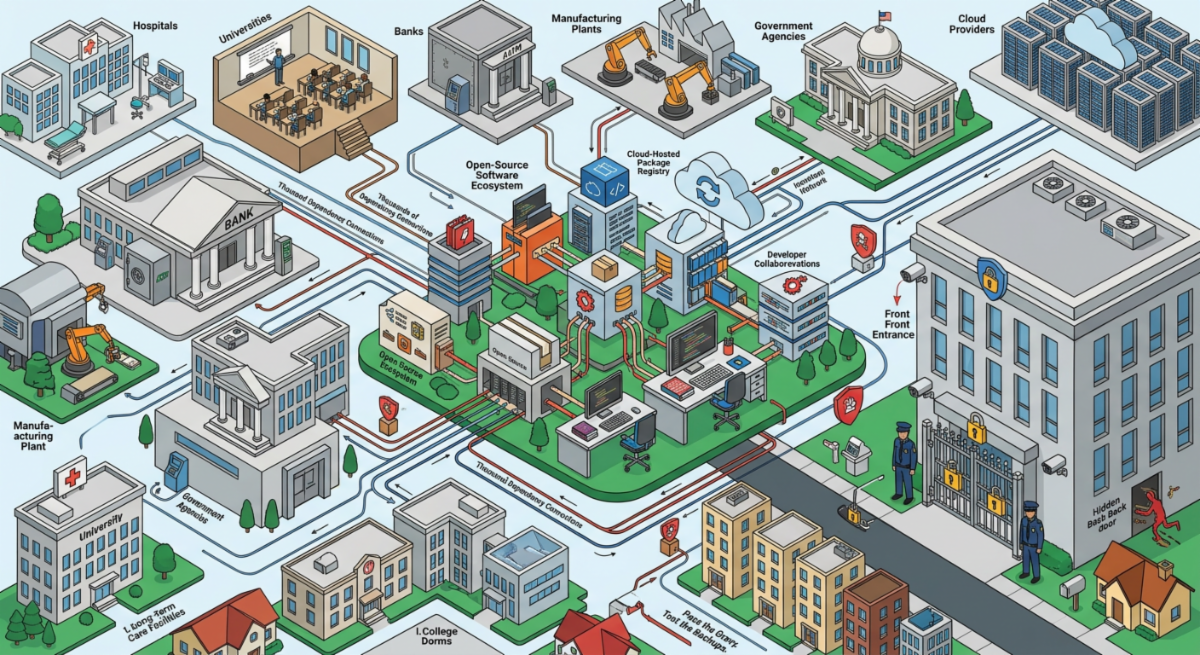
21. Cybercriminals backdoored widely used open-source software tools and developer packages, harvesting credentials from systems that implicitly trusted those packages. GitHub is just the latest victim of TeamPCP, a gang that has carried out a spree of software supply chain attacks that has impacted hundreds of organizations. One group of cybercriminals is corrupting hundreds of open source tools, extorting victims for profit, and sowing a new level of distrust in an entire ecosystem used to create the world’s software. The group appears to have automated many of its software supply chain attacks with a self-spreading worm that’s come to be known as Mini Shai-Hulud. The name comes from GitHub repositories the worm creates that include encrypted credentials stolen from victims, each of which includes the phrase “A Mini Shai-Hulud Has Appeared” along with a handful of other references to the sci-fi novel Dune. TIPS: Audit your software supply chain. Relying on third party dependencies without continuous vulnerability management leaves your internal assets exposed through trusted backdoors.
22. Over one million telecommunications customers were affected by a major ransomware attack launched by a newly emerged extortion group. An extortion group claims to have stolen data from over one million customers of one of the largest US broadband providers, Brightspeed. The extortion group Crimson Collective claimed to have breached Brightspeed, one of the largest fiber broadband providers in the United States, and stolen data belonging to more than 1 million residential customers. According to the group, the stolen data includes names, email addresses, phone numbers, billing and service addresses, and payment history; Brightspeed said it was investigating the reports and did not confirm the extent of the leak. TIPS: Store isolated, immutable (non-changeable), offline backups. When ransomware hits live networks, offline backups are the single reliable blanket that keeps business operations running.
23. China-linked hackers used agentic AI in attack on 2,250 Microsoft 365 tenants. Microsoft said Storm-0940 leveraged an open-source AI framework and credentials stolen in a ConnectWise breach to automate cloud intrusions at machine speed. A China-state-aligned threat actor compromised a ConnectWise cloud backup application and used an open-source agentic AI framework to turn its stolen credentials against more than 2,250 Microsoft 365 tenants. TIPS: Audit your SaaS integrations just like you check holiday party guest lists. Keep affected ConnectWise connections disabled until ConnectWise issues restoration instructions and do not delete enterprise applications as a first step.
24. In Texas, a data security incident reported by the nuclear power plant operator affected sensitive personal information of employees and contractors. The operator of the South Texas nuclear power plant told Texas regulators this week that a data security incident exposed personal information belonging to 1,173 Texas residents. STP Nuclear Operating Company filed the notice with the Texas Attorney General on October 28, 2026. The exposed data includes names, Social Security numbers, birthdates and other personal details. TIPS: Critical infrastructure and standard business operations share the same core security and privacy prevention preparation needs. Robust network segmentation and zero-trust authentication significantly help to prevent localized intrusions from spreading into core operations.
25. Industry analysis revealed a 60% year-over-year jump in data breaches directly involving compromised third-party vendors and contractors. More than two-thirds (69%) of data breach victims in the past year were affected by a third-party breach, a new report by financial and risk advisory provider Kroll has found. Of those individuals, most (79%) had their data accessed following the compromise of a technology company during the period June 2025 to June 2026. This is far higher than the proportion of third-party data breaches emanating from other industries, which includes finance (9%), insurance (6%) or healthcare (5%). TIPS: Extend security controls to external vendors. Include mandatory security assessment clauses, multi-factor authentication (MFA) requirements, and rapid breach notification obligations in every vendor contract.
26. Attackers leveraged a single platform flaw in Oracle E-Business Suite into a mass exploitation event affecting dozens of downstream enterprises before patches were applied. Attackers have begun probing the Internet for systems unpatched against a recently disclosed critical Oracle E-Business Suite (EBS) vulnerability. Discovered in a core component of EBS's Application Object Library and tracked as CVE-2026-101767, this flaw lets unauthenticated threat actors with HTTP network access take over vulnerable systems in low-complexity attacks. Oracle released security updates to address the issue in its October 2026 Critical Security Patch Update on October 20 and urged customers to patch their systems immediately. TIPS: Implement an expedited emergency patching protocol. Critical vulnerabilities exploited in the wild require a response window measured in hours, not weeks or months.
27. Mid-year data revealed over 450 hacking and unauthorized disclosure incidents affecting tens of millions of health records across hospitals and clinics. While August was a relatively good month for healthcare data breaches, the year-to-date figures show that 2026 is turning out to be another bad year for healthcare data breaches. Last year was the worst-ever year for healthcare data breaches, with 807 incidents reported. So far this year, 593 large healthcare data breaches have been reported to OCR. At this time last year, the total stood at 556 data breaches. That’s a 6.7% year-over-year increase. TIPS: Prioritize patient and consumer privacy protections and security safeguards. Encrypt all sensitive data at rest and in transit so that stolen databases remain completely unreadable to unauthorized parties. Update privacy and security policies and associated procedures. Perform risk assessments if you’ve not done one within the past 12 months. Provide regular general and role-based training to workforce members, and provide ongoing awareness reminders for protecting privacy and security data and technologies.
28. Misconfigurations in hospitality customer platforms resulted in publicly accessible guest documents, including passport numbers and driver's licenses. A massive cybersecurity incident involving Otelier, a cloud-based hotel management platform, has resulted in the exposure of millions of hotel guests’ personal information and reservations. The breach, which occurred between July and October 2024, involved the compromise of Otelier’s Amazon S3 cloud storage. Threat actors gained initial access to Otelier’s systems by exploiting compromised employee credentials obtained through infostealer malware. These credentials, likely stolen from an Atlassian server, provided access to the company’s S3 buckets. Once inside, the hackers downloaded approximately 7.8 terabytes of data, including millions of documents from Marriott, Hilton, and Hyatt. TIPS: Engineer and incorporate privacy and security by design from the start. Restrict personal document retention schedules and conduct privacy impact assessments (PIAs) before introducing new guest or customer-facing systems. Then take security and privacy activities to the next maturity level.
29. The University of New Mexico Health Sciences Center experienced outages that led to ambulance diversions, limited admissions, and postponed outpatient care. A ransomware group claimed responsibility, but its extensive compromise claims were not established facts: UNM subsequently said the event affected some end-user devices without penetrating core systems or servers, and critical electronic systems were restored. On October 26, UNM Health, the university’s healthcare provider, began temporarily limiting new patient admissions, diverting ambulances to nearby hospitals, and suspending outpatient surgeries and appointments. Additionally, classes at its four health sciences schools were canceled, and nonessential HSC employees were instructed to stay home. UNM Hospital and Sandoval Regional Medical Center remain open, and all clinics resumed scheduled appointments and procedures on October 27. A new ransomware group called Byod had claimed the attack. TIPS: Healthcare organizations’ downtime plans should protect people, not just computers. This applies to all other industries where such outages impact people’s safety, such as transportation, energy, financial, etc. Rehearse how essential services will continue, how staff will communicate, and how confidential information will remain protected during manual workarounds.
30. Following an intrusion involving Japan’s GMO Internet’s Onamae Desktop Cloud, the company warned customers about a threatened ransomware deployment and instructed them to disconnect and shut down computers. The company confirmed publication of company and customer data; the article reported that the threatened ransomware activation apparently did not occur. GMO Internet is one of Japan’s largest domain registrars. During the week of October 19th, the company announced it detected an intrusion on October 20 that could have installed malware on up to 26,739 customers' servers. To minimize the risk, the company shut down the servers and reduced service availability before launching an investigation. TIPS: Right now, before any incident has occurred, prepare a detailed plan, including ways to receive and authenticate urgent provider notices, and establish who can authorize emergency isolation of affected systems. Avoid treating this incident’s shutdown instructions as universal advice for every cyberattack; each organization’s actions need to be specific to the associated context of the cyberattack and the associated potential harms to the organization as well as to the clients, customers, patients, etc.
| | Laws, Legal Issues, and Lawsuits About Or Significantly Involving Privacy and/or Security Issues… | Image created by Rebecca Herold using Gemini Nano Banana 2. All rights reserved. A depiction of one of the news items in this section. Can you determine which one? | | |
31. “An $80 million settlement has been proposed to resolve a consolidated class action lawsuit against Conduent Business Services, LLC, over its 2024 cybersecurity incident and data breach. Conduent, a leading provider of front-office and back-office solutions, notified the U.S. Securities and Exchange Commission (SEC) in April that it had experienced a cybersecurity incident. An unauthorized third party first breached its network on October 21, 2024, and maintained access until January 13, 2025. The SafePay ransomware group claimed to have exfiltrated 8.5 terabytes of data in the attack.”
32. The Standing Committee of the National People's Congress of the People’s Republic of China (“PRC”) adopted the Healthcare Security Law of the PRC ("Healthcare Security Law"), which will take effect on January 1, 2027. “The new Healthcare Security Law is China’s first dedicated national legislation governing its healthcare security system and establishes a unified legal framework for medical insurance, healthcare services, healthcare security funds, supervision and enforcement, in addition to the existing PRC Social Insurance Law. With China's healthcare security system covering approximately 1.33 billion people and widely regarded as the world's largest public healthcare coverage network, the Healthcare Security Law is designed as a fundamental legal framework that seeks to balance universal healthcare access, financial sustainability, healthcare quality and regulatory compliance.”
33. California Gov. Gavin Newsom has signed Senate Bill (SB) 690, one of the most-watched privacy bills this cycle. “SB 690 eliminates the private right of action for some claims under the California Invasion of Privacy Act's (CIPA) pen register and trap-and-trace provision, California Penal Code Section 638.51, by restricting enforcement to the California Attorney General for conduct occurring on a website or mobile application. It takes effect January 1, 2027. SB 690 is the conclusion of a two-year legislative effort to stem the tide of CIPA demand letters and complaints by high-volume plaintiffs' firms looking for quick, nuisance-value individual settlements.”
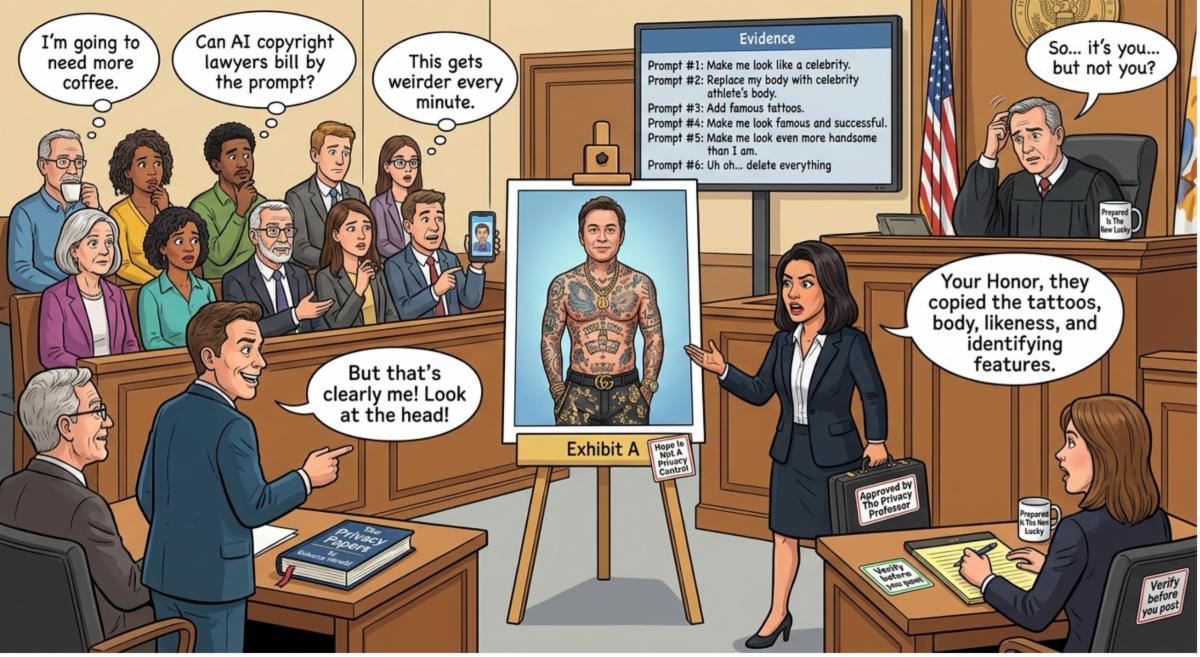
34. Just by uploading a selfie and typing a prompt, AI can make your photo look like a movie scene, turn you into a cartoon character, dress you in a different outfit, or make you appear as though you were photographed somewhere you have never been. ‘For many Filipinos, these AI-generated images are simply another form of online entertainment or a passing social media trend. But what happens when the face in the photograph is not yours? The National Privacy Commission (NPC) recently reminded the public about using AI to edit one’s own image or using another real person’s face or likeness without a lawful basis. In its notice, the NPC stated that a person’s face and likeness constitute personal information under the Data Privacy Act of 2012 (DPA). In certain circumstances, photographs and videos may also constitute biometric information that directly identifies an individual. Using an AI tool to generate an image or video from a real person’s likeness, as well as posting or sharing the resulting material, constitutes processing of personal data. This is significant because the AI-generated image may be fictional, but the person depicted in it is real.”
35. A coalition of 36 U.S. states announced a settlement requiring GM to obtain express consent before collecting or sharing driving and location data after allegations it sold driver information to data brokers. General Motors will pay $220 million to 36 states to settle allegations that it illegally sold private driving behavior and location information to data brokers. As part of the settlement, GM must get drivers’ express consent before it collects or shares their driving and location data, terms that are in line with separate agreements it previously reached with California and the Federal Trade Commission (FTC). This settlement does contain a new requirement that GM must have a third party assess the automaker’s compliance with the privacy program it has put in place.
36. Norway's Data Protection Authority imposed its largest ever fine after determining Xandr shared sensitive Grindr user data, including information revealing sexual orientation, without a lawful basis. The Norwegian Data Protection Authority has now issued an administrative fine of 92 million Norwegian kroner, equivalent to €8.6 million (USD $9.6 million), which is the highest fine it has issued to date. The essence of the infringement was Xandrs participation in so-called real-time bidding, where they acted both on the buyer and seller side. When a person opened Grindr, their personal data was in many cases relayed through Xandr to potentially thousands of actors in the advertising ecosystem. Advertisers could thereby bid against each other to present targeted adverts, completely hidden from the individual user.
37. The Italian Data Protection Authority has fined IQVIA Solutions Italy Srl €7 million. The company, part of a multinational group active in healthcare data analysis and clinical research, had created a database containing health information on one million patients of 800 general practitioners, which was used for studies commissioned by pharmaceutical companies. According to the Guarantor, the data used was not anonymous, as the company claimed. The code associated with each patient allowed them to be tracked over time. Combined with highly detailed information (year of birth, sex, diagnosis, symptoms, prescriptions, tests, vaccinations, as well as location data), it made it possible to isolate individual patients and, with reasonable means, re-identify them. The Authority also deemed IQVIA the data controller from the time the data was collected from physicians. TIPS: Pseudonymized data is not synonymous to anonymous data. However, organizations treat pseudonymous and anonymous data as being the same. Regulators continue to scrutinize re-identification risks.
38. The Federal Trade Commission announced Greenway Auto Group has agreed that its price advertisements will prominently include the actual price a consumer must pay for a vehicle, excluding only charges the government requires consumers to pay, to settle the Commission’s lawsuit alleging the company advertised prices that were thousands of dollars below what it actually charged. In addition to requiring price transparency and prohibiting deceptive prize mailers, the proposed order prohibits specific misrepresentations, including whether charges, fees, taxes, products or services are optional or required and whether any type of or source for financing is required.
39. A new complaint was filed that alleges privacy and tracking-related violations involving AI services. The complaint alleges OpenAI's advertising tracking pixel secretly intercepts users' communications with the websites they visit, including people without ChatGPT accounts, links that browsing and purchase data to the identity OpenAI maintains for each user, and uses it for commercial purposes without consent. It pleads violations of the federal Wiretap Act and the California and Pennsylvania wiretapping statutes. The case is newly filed and the allegations are unproven.
40. Google Assistant users, children who used Google Play apps, Google Search users and Alphabet investors were all part of Google class action developments in October 2026, led by final approval of Google’s $68 million Assistant and $8.25 million Play children’s privacy settlements. No Google settlement is taking new claims; two pay automatically, and the pending lawsuits have nothing to file.
| | Check out our Privacy & Security Brainiacs blog page for more unique security and privacy news items. Have you run across any surprising, odd, offbeat or bizarre security and/or privacy news? Please let us know! We may include it in an upcoming issue. | | |
Privacy & Security Questions and Tips
Rebecca answers hot-topic questions from Tips readers
November 2026
| | |
We continue to receive a wide variety of questions about security and privacy. Questions about current hot topics in society, and increasingly more about healthcare privacy and security. Thank you for sending them in! This month our Question of the Month asks about what is acceptable under HIPAA for sharing PHI between healthcare providers. The other three cover: whether or not VPNs are sufficient security for preserving data integrity; security and privacy risks for toys using AI; and the risks of AI generated images harming the organizations and computing devices where the images are viewed.
Are the answers interesting and/or useful to you? Please let us know! Keep your questions coming!
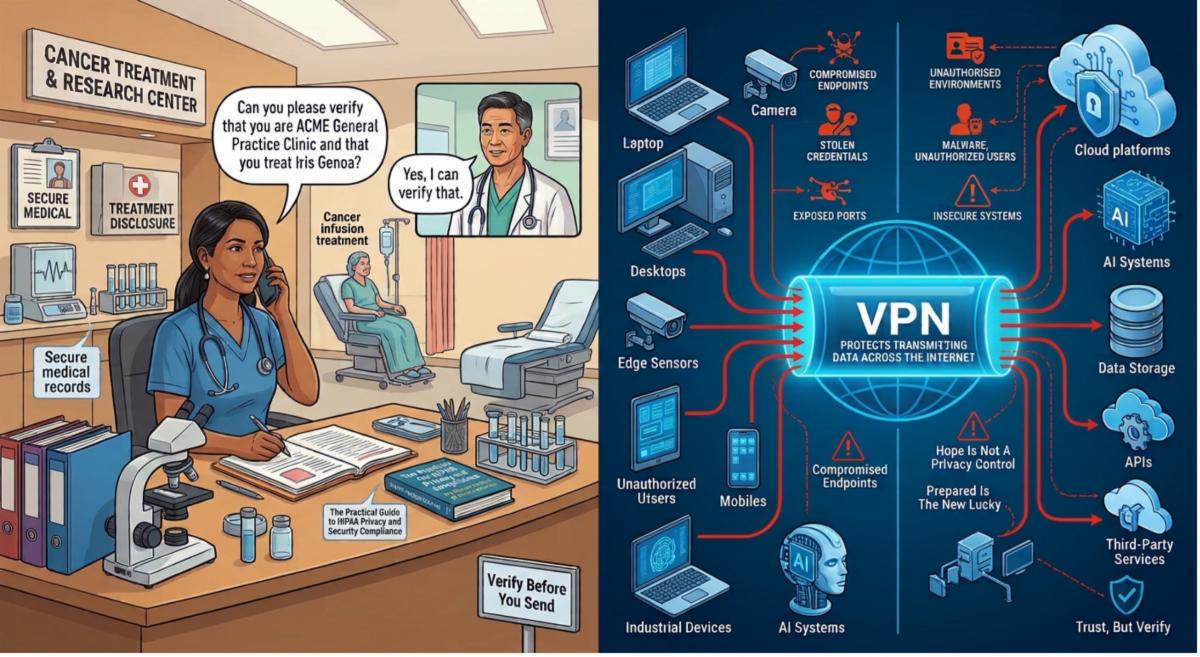
| | Image created by Rebecca Herold using Gemini Nano Banana. All rights reserved. Images representative of the first two questions below. | Q1: I am from a healthcare provider that has our own cancer patients, also performs cancer research, and also supports other healthcare providers as a business associate under HIPAA. If a medical research participant's lab values indicate a need for follow-up with their primary care provider (PCP) that our organization currently does not have a relationship with, does this fall under continuation of care healthcare treatment, or do we need additional paperwork from the patient in order to send the lab values to their PCP to be in compliance with HIPAA? | | |
A1:
I recommend confirming the particulars with your organization’s privacy officer and legal counsel, especially because your organization provides healthcare, conducts research, and acts as a business associate for other providers.
For general HIPAA purposes, however, you ordinarily do not need a separate patient authorization to send lab values to the participant’s PCP for that individual’s treatment, including evaluation and follow-up care. This assumes your organization holds the information in its covered entity (CE) capacity and no applicable restriction or other legal requirement changes that conclusion. HIPAA permits a CE to disclose protected health information “PHI” for the treatment activities of another healthcare provider treating the same patient.
The PCP does not need to have referred the individual to your clinic, and your organization does not need a prior relationship or business associate agreement (BAA) with the PCP for this treatment disclosure. The receiving PCP does not even have to be a HIPAA covered entity. The purpose of the disclosure, supporting that individual’s treatment, is what matters; you do not need to establish a separate category called “continuation of care.”
Your organization’s separate business associate (BA) work for other providers does not automatically change this answer. Nevertheless, confirm the capacity within which you hold these particular records. If you hold them solely as another provider’s BA, the disclosure must be consistent with the applicable BAA and the associated CE’s instructions. That may require coordination with that provider, but not necessarily a new patient authorization.
Because the results you referenced came from research, review the study’s arrangements for returning clinically significant findings, including the protocol and informed consent documents. Consult the research team and, as appropriate, the Institutional Review Board (IRB). Confirm whether the lab results are suitable for clinical use and whether applicable Clinical Laboratory Improvement Amendments (CLIA) requirements affect their reporting. Permission under HIPAA does not, by itself, answer those separate questions.
Before transmitting information, confirm the intended PCP and destination. If an unfamiliar provider requests the records, follow your verification procedures for the requester’s identity and authority. Make sure you use effective and appropriate privacy and security safeguards, such as encrypting the data, a confirmed fax number, or an approved secure electronic exchange. Verifying the recipient is not the same as obtaining a patient release.
Finally, check for applicable additional protections, such as federal substance use disorder (SUD) confidentiality requirements, the special HIPAA rules for psychotherapy notes, more protective state laws, or a restriction your organization has agreed to honor. These requirements can change the analysis for particular records.
In short, the absence of an existing relationship with the PCP is not, by itself, a reason HIPAA would require additional patient paperwork for a treatment disclosure. The important checks I described concern your role for these records, the research context, the recipient, and any additional applicable restrictions.
| | |
(Somewhat) Quick Hits:
Here are three more questions, most of which we are answering at a comparatively high level. We provide more in-depth information and associated details about these topics in separate blog posts, videos on our YouTube channel, in infographics and e-books, LinkedIn posts to our business page, and within our online training and awareness courses.
| | |
Q2: Are all data access, and associated integrity, risks for sending data through the internet mitigated by sending it via a VPN? If not, what solutions can be used?
A2:
No. While a virtual private network (VPN) creates an encrypted tunnel for data in transit across the internet, it does not mitigate all data access and integrity risks. A VPN generally only protects the network path. It does not secure the originating or destination endpoints, nor does it control the security posture of the digital ecosystems feeding into those endpoints.
If an attacker compromises an endpoint, misconfigures firewall ports, or gains unauthorized access, they can still intercept, manipulate, or inject malicious payload into the data before transmission or after decryption.
Here is a real-world example. An organization streaming real-time edge telemetry and visual feeds into a cloud-based AI model could rely upon a traditional VPN for transmission security. However, stronger protections may be needed to verify the authenticity and integrity of the originating data itself. One organization addressed this challenge using the open-source Atsign NoPorts solution. Each edge device and AI ingestion agent was assigned a unique cryptographic identity. Data was encrypted locally on the device before transmission and sent using outbound-only NoPorts connections rather than exposing inbound internet facing ports. The data was also cryptographically signed to help verify its authenticity and integrity throughout the transmission process. This approach provided strong assurance that the AI model received authentic, untampered data while reducing exposure associated with internet facing inbound ports.
If you want to discuss the details in more depth, let us know. We’d be happy to help you.
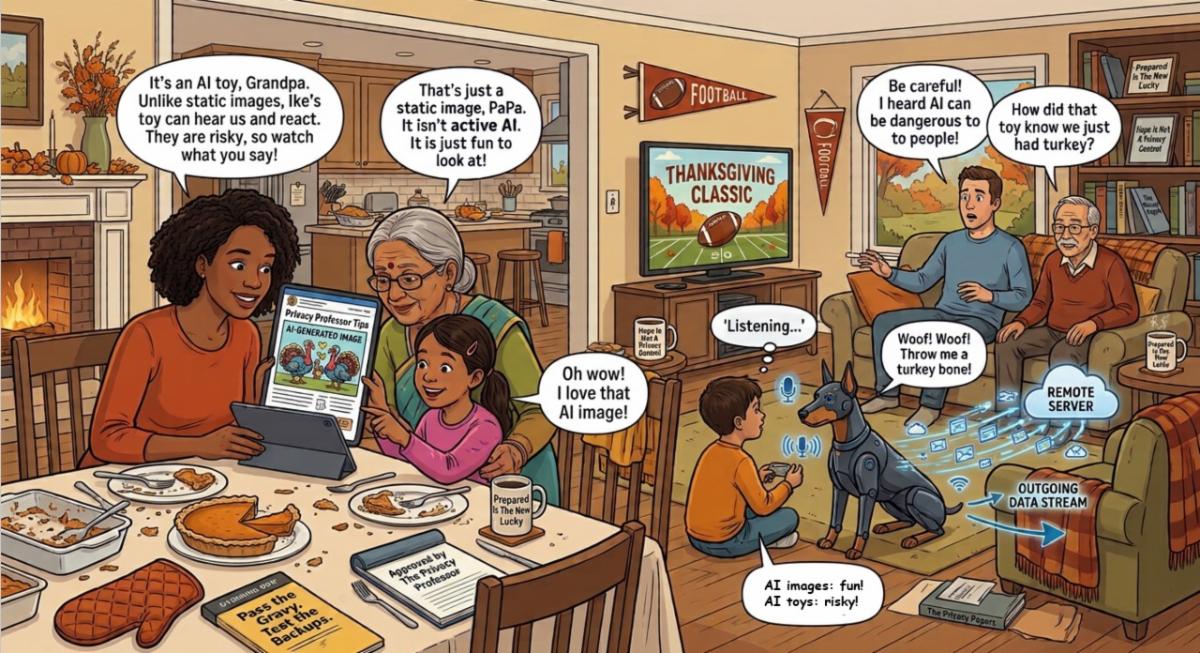
| | Image created by Rebecca Herold using Gemini Nano Banana 2. All rights reserved. This scene relates to both of the questions and answers below. | | Q3: Most of the AI toys I’m looking at for holiday gifts aren’t running AI on the toy/device itself. Instead, they’re sending a child’s voice through the internet to a server and sending a response back to the toy/device through the internet. What does that architecture mean for families, in plain terms? | | |
A3:
In plain terms, this means your child is not simply talking to the toy. The toy is acting as a microphone and communications device that sends your child’s voice, and potentially other information from the surrounding environment, through the internet to remote computer systems for processing. A response is then sent back to the toy.
As a result, information may be collected, transmitted, processed, stored, and shared outside of your home. Depending upon how the product is designed, the processing may be performed by the toy manufacturer, one or more cloud service providers, AI providers, or other third parties supporting the service. The hidden risks of cloud-reliant AI toys include at a high level:
- Third party data flow: Voice and environment audio rarely stays with the toy vendor. It is often routed through third party cloud hosts, AI API providers, and data analytics firms.
- Data persistence and model training: Raw voice recordings, transcripts, and environmental ambient noise may be stored indefinitely to train future AI models or monetized across partner networks.
- Conflicting policies: Terms of Service, Privacy Notices, and End User License Agreements often contain contradictory statements regarding data retention, sharing practices, and parental consent options. The privacy and security practices for these products also vary widely. Some providers may retain recordings, transcripts, or derived data for a period of time. Some may use collected information to improve their products and services. Others may offer parents greater control over data collection, retention, and deletion. The details are often found in the product's Privacy Notice, Terms of Use, and related data security documentation.
Before purchasing an AI-powered toy or device for others (or yourself), look for answers to these questions:
- What information is collected?
- Is voice and environment data stored?
- Who receives or processes the data?
- How long is it retained?
- Can parents review, download, or delete the data?
- Is the data used to improve AI systems?
- What security measures protect the data?
- What privacy rights are provided to the users of the products?
My personal preference is to choose products that perform as much processing as possible on the device itself, and/or within the end-user’s own computing device, reducing the amount of personal information that leaves the home, and the end-user’s control.
To put it simply: the less data that leaves the toy, the fewer privacy and security risks families generally face.
| | |
Q4: I've really enjoyed all your AI art you've been creating this year for The Privacy Professor Monthly Tips! Thank you for the permission you gave for us to use some of them within our company's privacy and security education materials. Related to this, some of our workers, including one of our VPs, has expressed a concern that the AI art is bringing risks into our network. They read that "AI could kill all humans." Does your AI generated artwork bring threats into our business by reading your Tips?
A4:
Great question! The short answer is no. The AI-generated artwork appearing within The Privacy Professor Monthly Tips does not introduce AI-related threats into your organization's network simply because you view the newsletter.
Here is why your IT team and VP can rest easy:
- The images are created separately from the newsletter using AI image-generation tools. Once created, the images are saved as standard image files, such as JPG or PNG files, and then inserted into the newsletter in the same way as photographs, illustrations, charts, or other static graphics. Static image files contain image pixels, not executable computer code, scripts, or active macros.
- There is no active AI running within the newsletter itself. The images do not contain AI agents, autonomous software, executables, or other AI functionality. Viewing the images does not cause AI models to run within your organization's systems.
- Similarly, whether viewing the newsletter by email or through its online version, the images themselves remain static image files. They are not continuously connected to, or interacting with, the AI systems that originally created them. Once an image is created and rendered into a standard graphic file, it is completely severed from any AI model or generation environment.
The concern that "AI could kill all humans" generally relates to how AI systems are designed, deployed, connected to other systems, or used by people. It refers to broad, existential philosophical debates surrounding future artificial general intelligence (AGI), autonomous weapon systems, or automated algorithmic decision making. The greater concern that motivates such statements are with the autonomous capabilities of some types of AI, since they act without human intervention. It does not apply to viewing a finished image that was previously created using AI and then saved as a standard graphic file. Those static graphic files do not possess the technical ability to act maliciously, infect a network, or "wake up" inside a newsletter. You can safely continue to enjoy and share the artwork in your privacy and security awareness communications and training!
In practical terms, reading a newsletter that contains AI-generated artwork is generally no different from viewing a newsletter that contains traditional digital artwork, stock photography, or manually created illustrations.
| | We hope you found the previous news items and questions/answers interesting and/or useful! Please send us any other security, privacy and/or compliance questions you have. We thank you for reading the monthly Privacy Professor Tips! | | |
Rebecca participated in a panel discussion, “The Great Data Clean Up: How to Reduce Risk Without Losing Business Value” at the InformationWeek virtual event, “The High Stakes Dilemma: Data Protection Strategies for 2026-27” from 2:45 PM - 3:30 PM EDT on Thursday, November 22. Rebecca greatly enjoyed discussing with Jenny Louise and Steven Hill the importance of data integrity for business and AI use. Watch the recording here: https://tinyurl.com/3n67b4fz
| | We are excited to provide ways for MSPs, law firms, and other professional services organizations to offer our monthly tips to their clients! It is already working well for some such organizations. Get in touch with us for the details! | | If you are a HIPAA business associate (BA) have you and the others in your organization taken your HIPAA security and privacy training for the year yet? If you are a HIPAA covered entity (CE), have you checked to ensure your BAs have taken their training? HIPAA requires security and privacy training, and the HHS OCR has indicated in all their HIPAA non-compliance settlements that such training needs to occur at least once a year. We can help you! Take our “HIPAA Basics for Business Associates: 2026 Edition”, which includes many supplemental materials you can use during the course of your business activities. Click here for more information. | |
This ½ hour “Secure Coding” lecture by Dr. M.E. Kabay focuses on the importance of secure coding: designing and writing programs that avoid common errors that can interfere with the intended functions of the software with possible harm to users and legal consequences for the software producers. Ensuring sound, secure programming requires both human factors and technical issues, with necessary coordination of systems analysts, designers, coders, and testers. Learners completing the course and passing the quiz will get a certificate documenting this achievement and can apply the associated 0.5 hours of time to most security and privacy certification ongoing learning requirements. Click here for more information.
| |
What topics would you like to see us create videos, and more formal online courses, for? Let us know!
Have questions about our education offerings? Contact us!
| | |
Permission to Share
If you would like to share, please forward the Tips message in its entirety. You can share excerpts as well, with the following attribution:
Source: Rebecca Herold. November 2026 Privacy Professor Tips
www.privacysecuritybrainiacs.com.
NOTE: Permission for excerpts does not extend to images.
Privacy Notice & Communication Information
You are receiving this Privacy Professor Tips message as a result of:
1) subscribing through PrivacySecurityBrainiacs.com/Tips or
2) making a request directly to Rebecca Herold or
3) connecting with Rebecca Herold on LinkedIn.
When LinkedIn users invite Rebecca Herold to connect with them, she sends a direct message when accepting their invitation. That message states that in the spirit of networking and in support of the communications that are encouraged by LinkedIn, she will send those asking her to link with them her monthly Tips messages. If they do not want to receive the Tips messages, the new LinkedIn connections are invited to let Rebecca know by responding to that LinkedIn message or contacting her at rebeccaherold@rebeccaherold.com.
If you wish to unsubscribe, just click the SafeUnsubscribe link below.
| | | | |