|
November 27th
CCDS's Socialist Education Project presents
How important is the United Nations today in curbing war and promoting peace?
9pm ET, 8pm CT, 6pm PT
Can the peace movement and other progressive forces make use of it?
At the time of its founding in 1945, The United Nations set out with
lofty goals: “To maintain international peace and security, and to
that end: to take effective collective measures for the prevention and
removal of threats to the peace, and for the suppression of acts of
aggression or other breaches of the peace, and to bring about by
peaceful means, and in conformity with the principles of justice and
international law, adjustment or settlement of international disputes
or situations which might lead to a breach of the peace.”
For our upcoming 4th Monday webinar, Carl Davidson will explore and
summarize the growth and changes in the United Nations over the years.
His key point will be that the UN is more important than ever in its
ability to fight for its founding principles stated above. Both the
socialist left and the broader peace movement would do well to make
more use of its founding charter and its recent declarations as a
pivot point to press demands against war and hegemonism on our
government.
The webinar will open with a 45 minute powerpoint presentation, follow
by 45 minutes of Q&A discussion.
| |
Register in advance for this meeting:
https://us02web.zoom.us/meeting/register/tZAqde-pqjgjG93rnOC1ytK7IdAsqP8tgHsE
After registering, you will receive a confirmation email containing information about joining the meeting.
| |
|
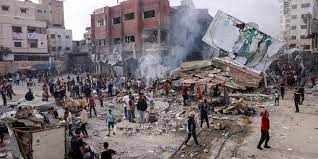
CCDS Condemns Israel’s Genocidal Policy: Calls On The United States To Demand That Israel Stop Its Bombing Of Gaza
The Committees of Correspondence for Democracy and Socialism (CCDS) joins peace and solidarity organizations in the United States and around the world in deploring the attacks on Israeli citizens on October 7 as well as the subsequent violence against the Palestinian people. Further, CCDS joins the worldwide call of peace and justice organizations demanding that Israel stop its genocidal war on the Palestinian people. Particularly we urge the Biden Administration to stop encouraging and arming the murderous Israeli government.
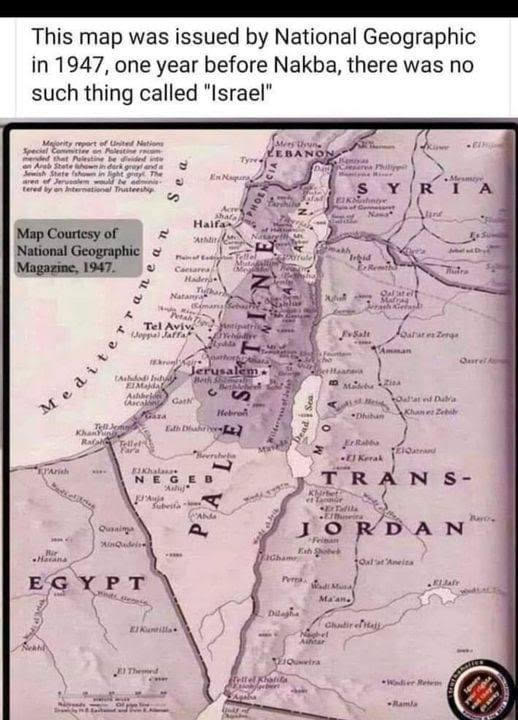
We recognize the fundamental role the United States has played in the Israel/Palestine conflict and the long-standing Israeli vision of a “Greater Israel” empire in the Middle East. And we recognize the need for a movement of progressives to mobilize to end US complicity with Israel’s violent policies. For 75 years, the United States has supported the victimization of the Palestinian people. And we recognize that Israel’s policies continue to expose its citizens to terrorist retribution and have fueled the rise of antisemitism and Islamophobia everywhere.
As Dr. Martin Luther King said long ago still holds true: "The chain reaction of evil--wars producing more wars -- must be broken, or we shall be plunged into the dark abyss of annihilation."
For now we say that peace and justice movements must expand their educating, organizing, pressuring politicians, and hitting the streets demanding that the Biden administration end its support of Israeli militarism and promote the liberation of the Palestinian people. Further, we ask all peace and justice-loving people and organizations to urge President Biden and the UN to take bold and immediate steps to discuss and implement plans for the self-determination of the Palestinian people.
| |
Friday, November 3, 2023
Harry Targ
This commentary was prepared during the Israeli war on Lebanon in the summer, 2006 and updated in 2009. Its portrait of the main actors in the tragic circumstances of Middle East peoples remains unchanged today in 2023.
The commentary hints at the fundamental role the United States has played in the Israel/Palestine conflict, the Israeli vision of a “Greater Israel” empire, and the need for a movement of progressives to mobilize to end US complicity with Israel’s violent policies which victimize the Palestinians while continuing to expose Israeli citizens to terrorist retribution. Unfortunately, none of these core features of the Middle East catastrophe have changed for many years.
This time the peace movement must expand its militancy demanding that the Biden administration end its support of Israeli militarism and promote the liberation of the Palestinian people.
***************************************************************
ASSESSING THE CURRENT MIDDLE EAST CRISIS:
CONSEQUENCES FOR EFFORTS TO REDUCE VIOLENCE
The Crisis is Upon UsThe current Middle East crisis has emerged with rapidity. We have seen a seemingly unending escalation of violence against expanding civilian targets in Gaza, Lebanon, the West Bank and Israel. Also Muslims and Jews have been increasingly threatened within the United States. However, spokespersons of both parties proclaim that the United States needs to exert military power regionally and globally.
Key Actors in the Middle East Drama
To better understand the immediate causes of this Middle East crisis and its relationship to United States foreign policy the major actors in the tense drama must be examined.
First, the Israeli government is driven by a vision of regional hegemony and the elimination of the Palestinian people as a political force. As Noam Chomsky has argued, Israeli governments (and the United States) have always envisioned a region based on a “Greater Israel,” that is Israeli control of the politics and economics of Southern Lebanon, Western Syria, and Palestine. Crushing the growing popularity of Hamas and Hezbollah is a necessity from the vantage point of this vision and ultimately as well destroying their base of support in Syria and Iran. The brutal assault on Israelis on October 7, 2023 provided an excuse to indiscriminately target Palestinians living in Gaza.
https://www.democracynow.org/2023/11/3/israel_leak_gaza_expulsion_egypt
Second, the Middle East crisis has profound consequences for the United States and the Biden administration. President Biden by word and deed has given the green light to Israel to expand its violence in Gaza and Lebanon. He has forestalled diplomatic activity to bring a halt to the violence despite cosmetic visits by Secretary of State Blinken and others to the region. He even has been slow to remove US citizens trapped in the war zones of Gaza. Further, the continued tension between the United States and Iran suggests that the former would not oppose an Israeli strike on the latter. The US would get its war on Iran without having to carry out the war itself. In the end, this Middle East crisis could give renewed intellectual justification for the neoconservative vision of a globalization of American power.
Third, this administration seems to be increasing support for militarism in the face of growing danger of war in virtually every region of the world: the Korean Peninsula, East and South Asia, Central Europe, and Latin America and the Caribbean. The Biden administration, as with most administrations since World War II, seems wedded to the unlimited use of military force as opposed to diplomacy.
Fourth, “Political Islam” refers to those movements, primarily in the Middle East, the Gulf, North Africa, and Asia that fuse the drive for political power with religious fundamentalism. Paradoxically, Political Islam drew much of its initial support from US global policy. For example, the United States provided massive aid and training to rebels fighting against the pro-Soviet government of Afghanistan in the 1980s, including the 9/11 enemy icon, Osama Bin Laden. In fact, President Carter began funding the creation of Political Islam in Afghanistan before the Soviet Union sent troops to that country.
Hamas and Hezbollah, allied with outside actors Syria and Iran, formed in the 1980s. They sought to capture the support of Palestinians and their allies in response to growing Israeli brutality against the Palestinian people and the corruption of the Palestine Liberation Organization. There is much evidence that Israel gave financial support to Hamas to weaken the secular Palestine Liberation Organization. While these two formations have supported what is called terrorism and religious fundamentalism they at the same time have provided significant social services and a political voice for the repressed Palestinian population.
Finally, we need to reflect more systematically on Syria and Iran as regional political actors sympathetic to the Palestinian people and opposed by the state of Israel. It is clear that both Syria and Iran are targets of the US. Israel receives huge military support from the United States in part to “balance” the influence of other state actors in the region. The US wants to control the flow of oil, and Israel wants to control territory and people.
It remains to be seen whether the growing worldwide protest against the Israeli war on Gaza and US acquiescence to it will bring a desperately needed ceasefire soon, and in the future, and whether anti-war candidates can win victories in 2024 US elections. The enormous increase in anti-war and free Palestine movements in the United States and growing opposition to the United States and Israel in the Global South suggest the emergence of a “second global power,” the power of the people against militaristic governments.
| |
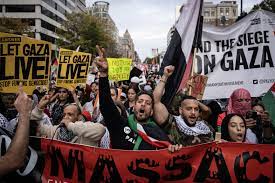
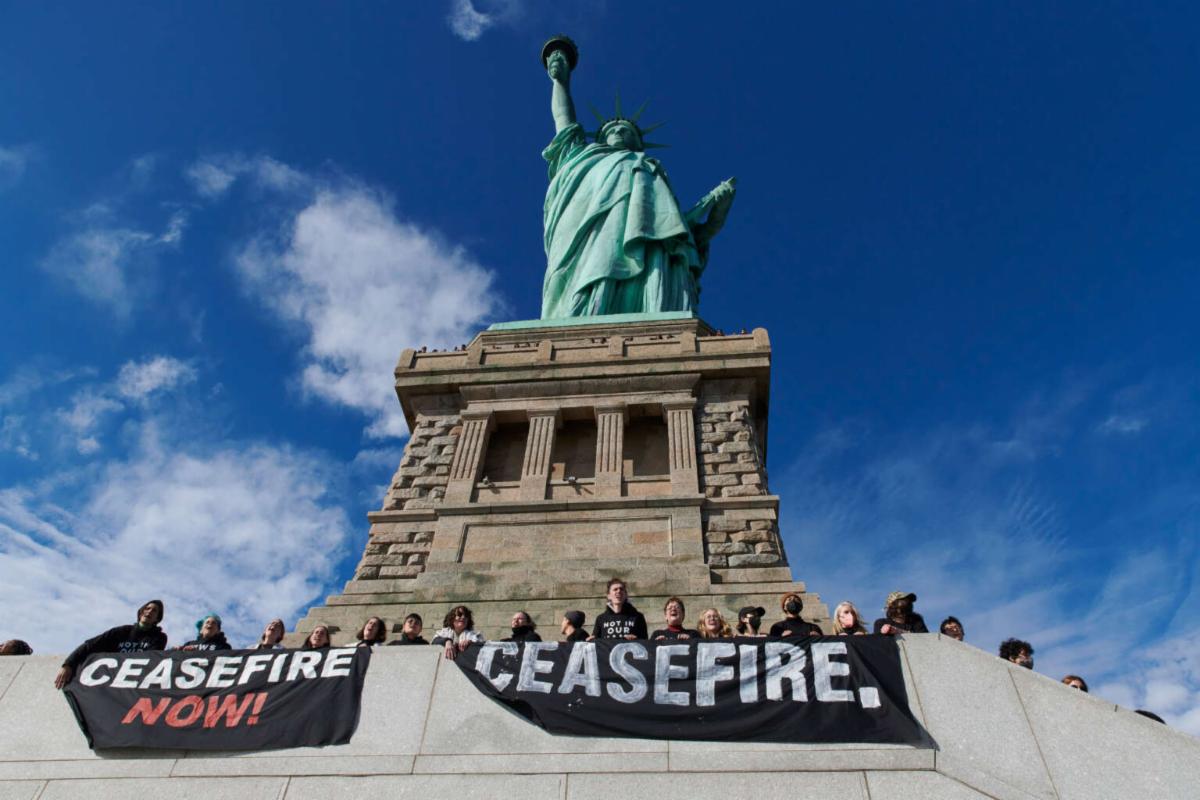
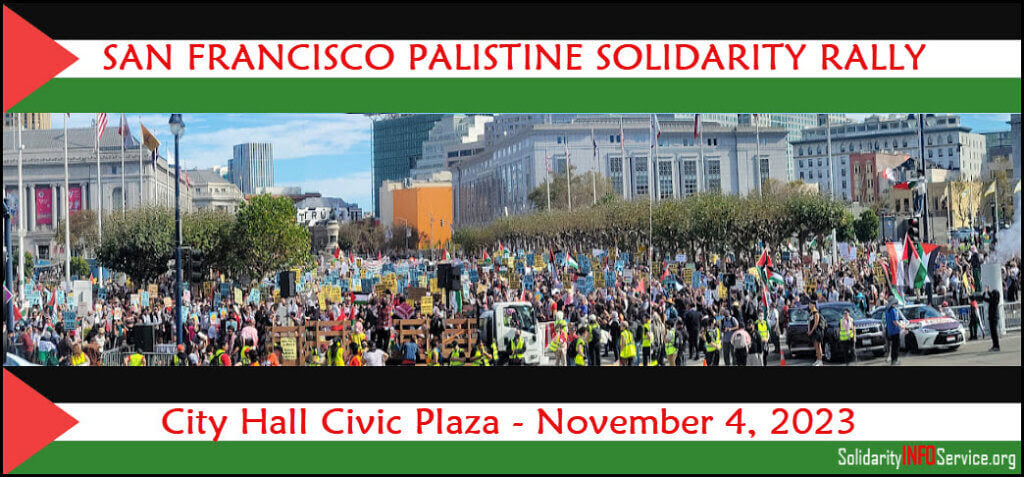
People demand Cease Fire Now across the US
and around the World
| 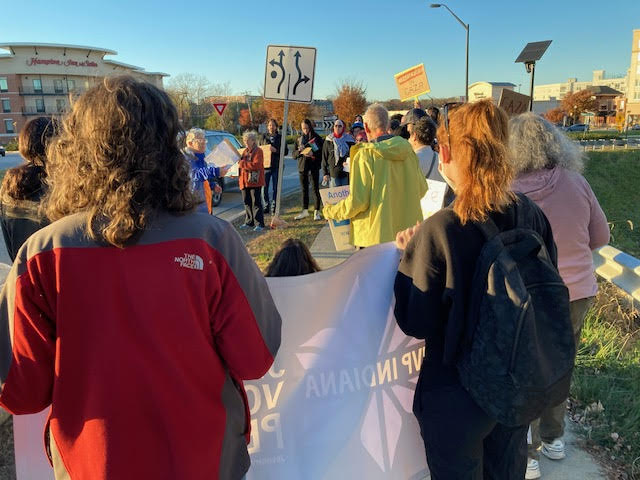 |
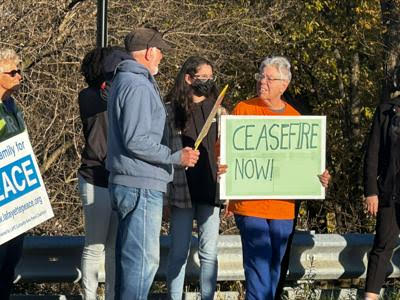
Retired Purdue professor, other West Lafayette residents call for ceasefire in Gaza Strip
By Star City News staff
As fighting escalates in Gaza, residents in West Lafayette are calling for a ceasefire.
Protesters from the newly formed Greater Lafayette chapter of Jewish Voice for Peace lined the streets entering West Lafayette Monday evening to call for a ceasefire in the Gaza Strip.
Retired Purdue political science professor Harry Targ was one of the protesters calling for an end to the bombings in Gaza. He says it's a point of caring for humanity.
"Words like genocide are not inappropriate. And I think we have to speak out, particularly to try and pressure the Biden administration to use his influence to get Israel to stop the bombing of Gaza," Targ said.
Targ was not alone in his criticism of the Biden administration's current handling of the Israel-Hamas War. Organizer Sheila Rosenthal says she was protesting the large amounts of aid the US sends to Israeli defense. Monday's demonstration joins the growing wave of protests happening around the world centered around the war in Israel.
WLFI, the local television outlet carried the story at:
at: https://www.wlfi.com/news/local/people-across-greater-lafayette-protesting-the-violence-in-gaza/article_583b675c-828b-11ee-a534-a7f687e4f8f4.html
|
PDA with Homemade Pear Pie
Nov 13, 2023 | PDA Blog
by Randy Shannon
Progressive Democrats of America, National Board Secretary
This past Sunday 11/12/23 was a busy day for us.
We have a pear tree on our property that annually produces 60-100 edible fruit. Now that we’re living on social security Tina was determined to process and consume that huge pile of fruit. So, she found a recipe; and with a few changes made a delicious pie/cake. The crust is hand crushed graham crackers, the filling is mostly diced pears, with soaked tapioca, a little water with lemon juice, and real maple syrup. She baked six pie/cakes and still has enough pears to bake six more. I like to eat it with sliced sharp cheddar cheese.
This past Sunday we drove to Pittsburgh to leave pear pie/cakes along with some frozen lentils with our three family households. Our last stop in Pittsburgh was the neighborhood called Polish Hill. It’s a steep undulating hill below Bigelow Blvd. that’s cut into the mountain that sits just east of downtown Pittsburgh. Polish Hill overlooks the Allegheny River and the Strip District, the oldest business district in early 19th century Pittsburgh where skiffs and other watercraft were able to dock and unload goods.
My son Ben was busy at the Polish Hill Civic Association. We parked and walked up to a young woman who was standing on the hill just above the sidewalk next to the Civic Association building. Standing anywhere in Polish Hill requires standing on a hill! She had a podium on the grass and was tallying the votes for best soup. I asked the cost of the soup and she said the contest was closed so no charge. I asked her who would benefit from the donations. She said the collection would be split between the Polish Hill Civic Association and support for the Palestinians. I gave her a double donation.
Ben was using a propane burner and an iron skillet to make fresh flat bread for the soup cook-off. Most of the community chefs were standing around on the sidewalk waiting for the vote tally, chatting, and smoking cigarettes. The Iranian soup won the contest; I didn’t get to taste that, all gone.
Tina gave Ben her pear creation and a container of frozen lentils. He then asked us if we wanted to try the soups. We wanted to try the soups but not inside the building, so Ben went in and out with various soups that were all delicious.
I asked Ben who had organized this fundraiser for Palestinians. He told me that some members of two teams of the Dock Ellis Baseball League had organized the soup contest and fundraiser for Palestinians. The League was founded in Pittsburgh by people whose cultural roots were in the Pittsburgh punk rock scene. The League has several inter-racial co-ed baseball teams around PA including 3 in Pittsburgh, 3 in Philadelphia, as well as Richmond, Baltimore, Raleigh, Asheville, and Wilmington. It has a World Series in West Virginia every year.
I had the fortune to watch a Dock Ellis League game at a field up on Troy Hill, another steep mountain on the north side of the Allegheny River. The rules are relaxed. There are no balls but three swinging strikes. The teams agree whether a base runner is safe or out. Most people sat around in camp chairs, snacked, and chatted. Up on that hilltop the sun sets later so there’s time to socialize under the setting sun.
As we drove home from Pittsburgh in the setting sun, we listened to an audiobook “Freedom’s Dominion: A Saga of White Resistance to Federal Power” by Jefferson Cowie. We are at the beginning where he details Pres. Andrew Jackson’s use of a Federal Marshall backed by the US Army to enforce the 1832 US treaty with the Creek Indians in south eastern Alabama along the Chattahoochee River.
We got home in an hour; sat down to a snack; and watched the PDA Town Hall on YouTube with Social Security Works organizer and brilliant political strategist Alex Lawson. Call your Representatives and Senators: “No commission in the continuing resolution!”
| 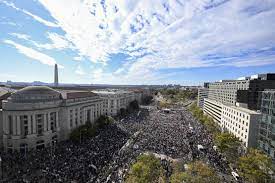 | |
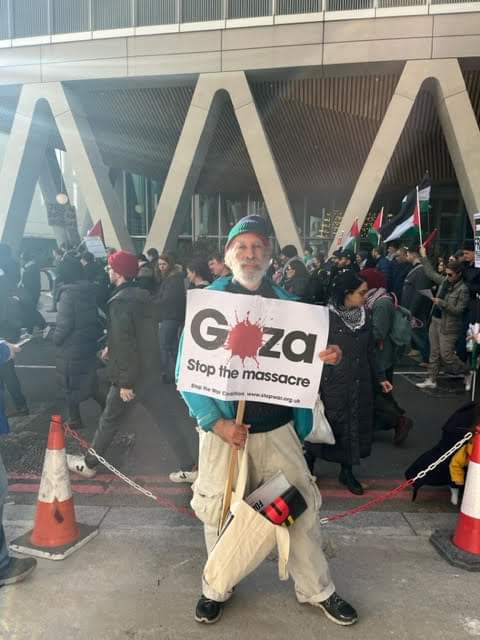
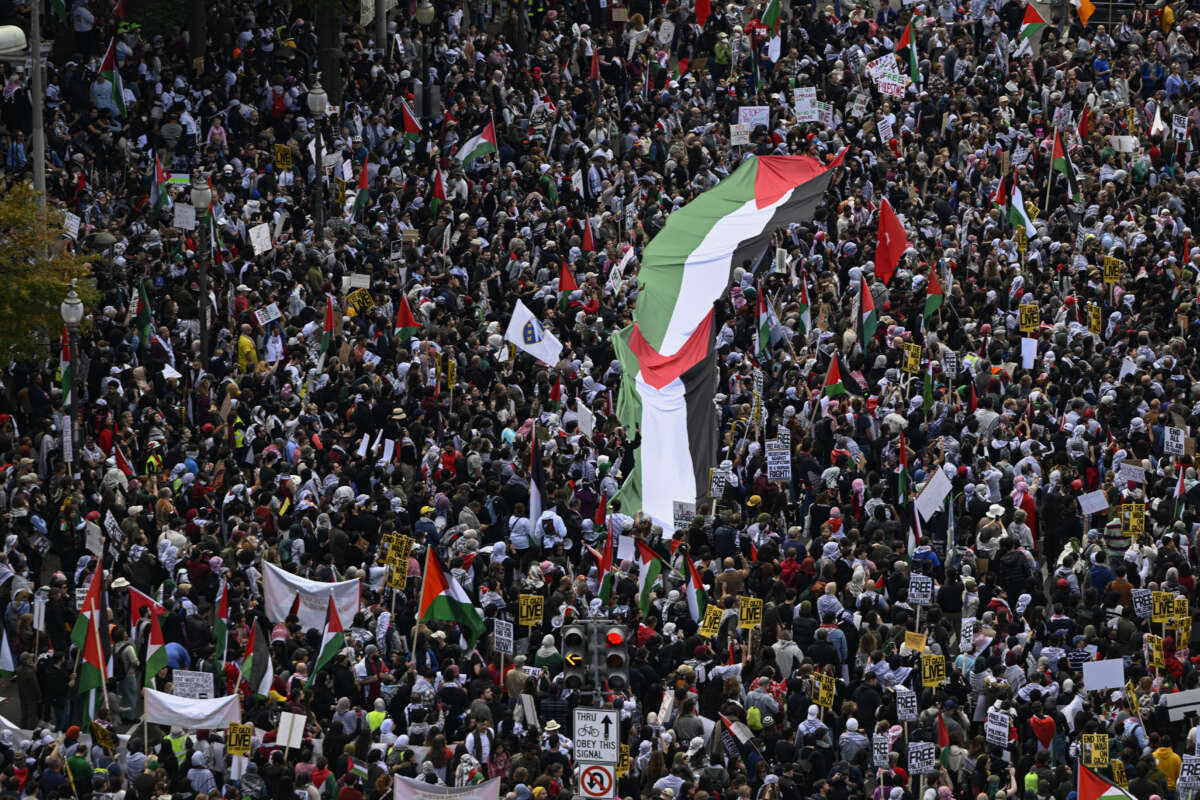
David Schwartzman: "We returned from London last night. I marched from Hyde Park to the US Embassy with hundreds of thousasnds (some ssy 1 million) to demand a Ceasefire and to end Israeli Genocide of the Palestinian people on November 11."
|  |  | |
For Immediate Release
Contact: Move the Money–NYC Coalition
Tom Gogan, 347-254-2505
info@mtmnyc.org
NEW YORK, Nov 15, 2023
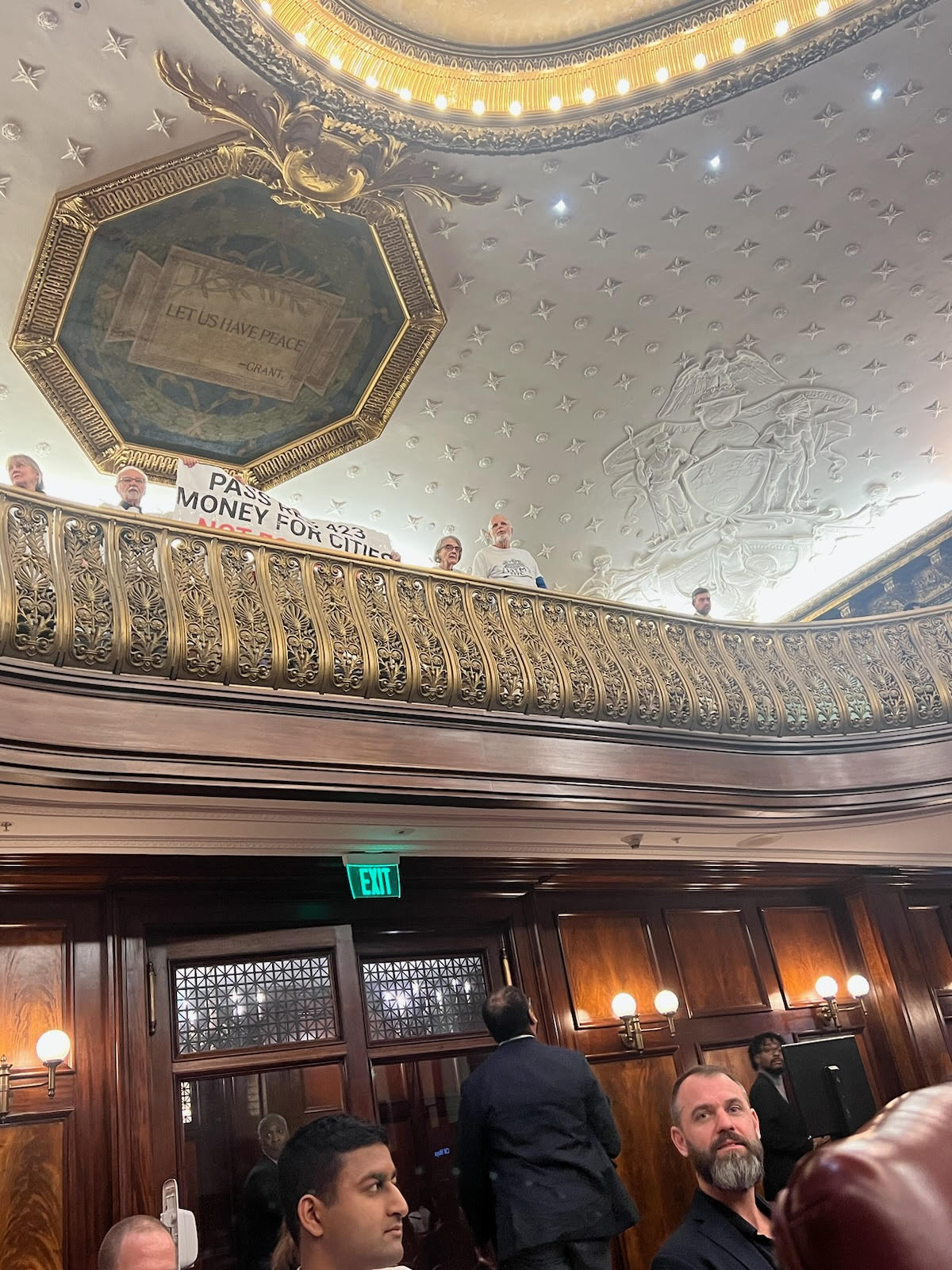
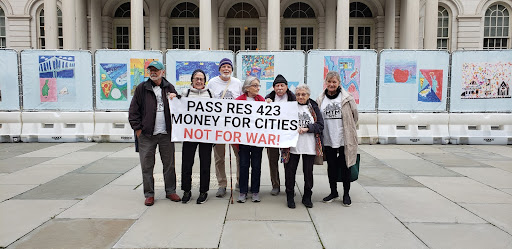
Protestors Escorted from City Council Chanting Move the Money
MtM activists were escorted out of City Council Chambers by security after chanting loudly and unfurling a large banner demanding a vote on Resolution 423 which would put NYC on official record in favor of moving money from the bloated Pentagon budget to the needs of our community and other across the nation
The non-binding resolution was introduced by Carlina Rivera and has twenty-seven cosponsors, including a majority of the City Council and Jumaane Williams, the city’s Public Advocate. Despite this support, MtM members are asking why it hasn’t been brought to a vote by the Council. No hearing has been scheduled by the Committee on Cultural Affairs, Libraries, and International Intergroup Relation to which it has been assigned. The hearing must be held in order to give the Council a chance to vote on the resolution before the Council’s term expires at year’s end.
The Pentagon budget for 2024 is $886 billion or nearly 60 percent of the annual Federal discretionary budget. In the view of the activists, the Federal government is prioritizing military expenditures and wars over the needs for vital human services, such as better healthcare, much more affordable housing, improved education and expanded mass transit. As MtM member Matt Weinstein put it, “We need to end hunger and homelessness and aid migrants. Just think what if the cost of a couple of F-16s were re-budgeted for deeply affordable housing, housing that includes a veterans' preference weighted into the selection process. How about new
|  |  |
Hundreds call for Gaza ceasefire, divestment from
Israeli military at Saturday rally
Beatrice Villaflor/The Daily Northwestern
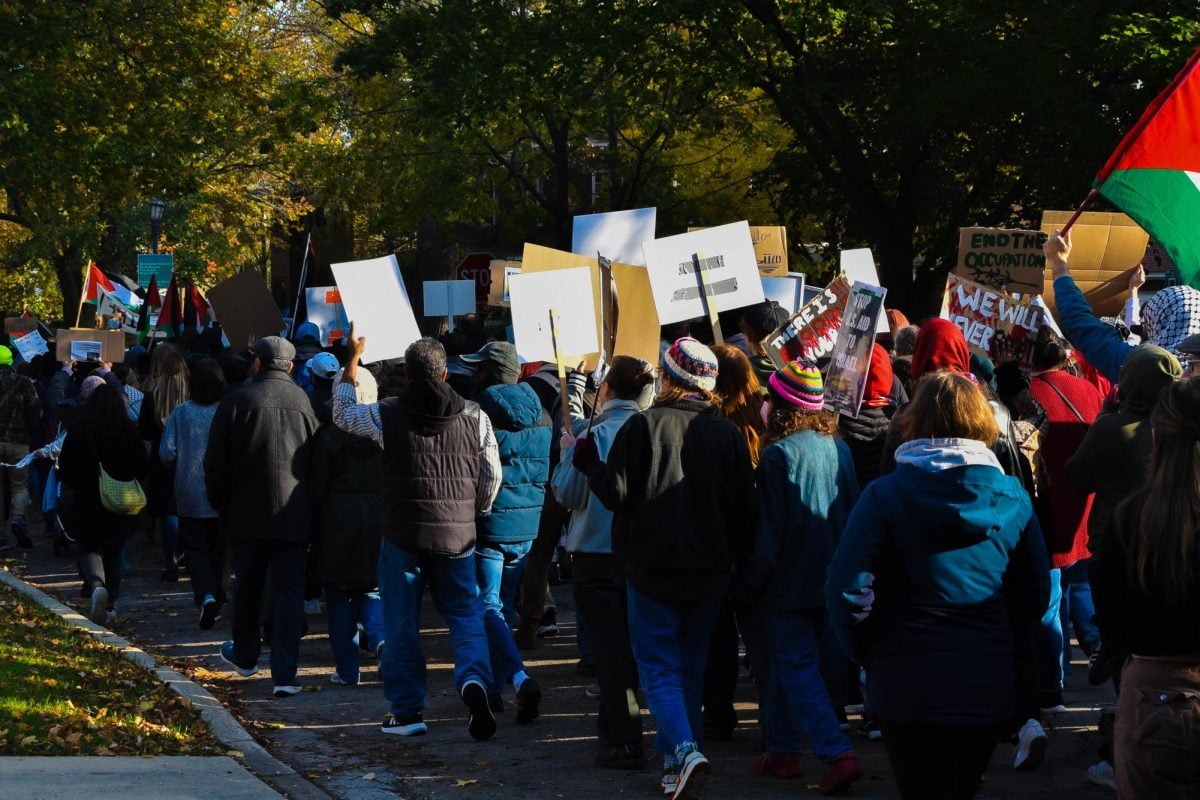
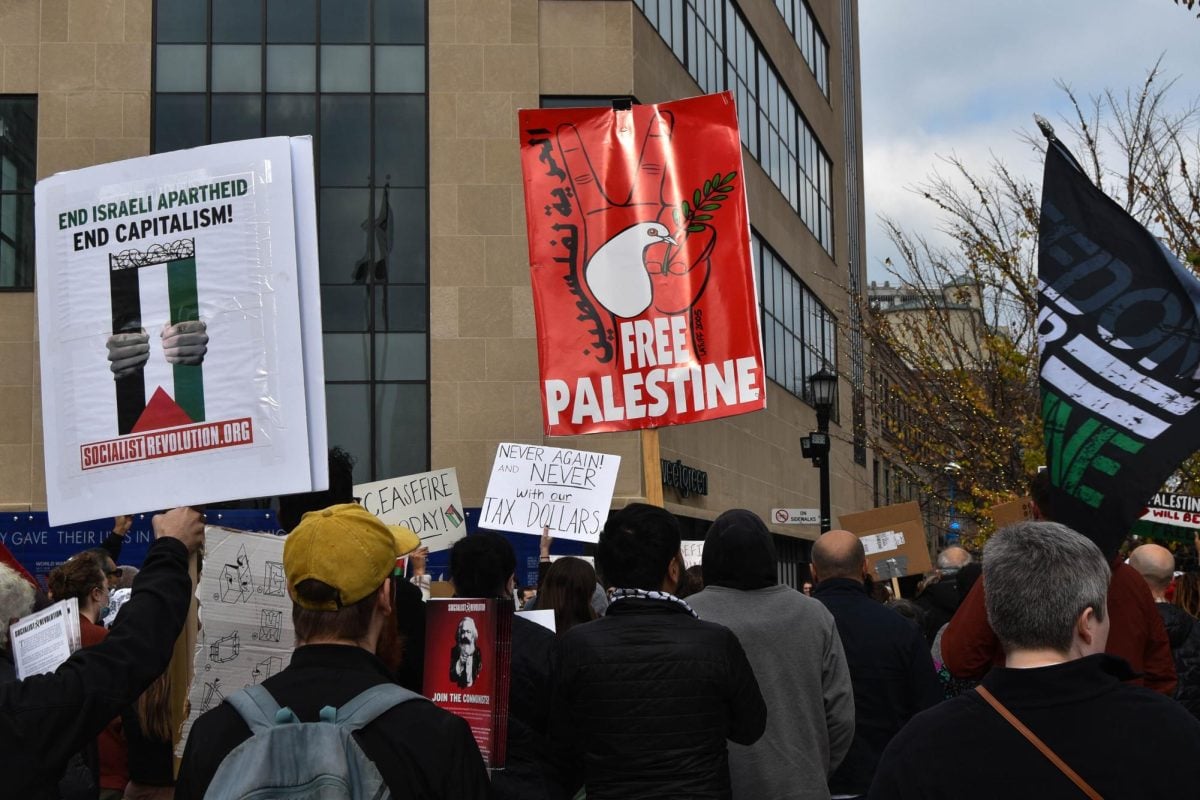
Hundreds of protesters marched to Northwestern President Michael Schill’s residence Saturday afternoon, demanding the University divest from arms producers. Demonstrators rallied in Fountain square before marching, calling for a ceasefire in Gaza.
William Tong, Copy Chief
November 5, 2023
As a line of protesters spanning a quarter mile marched along Sheridan Road toward Wieboldt House — Northwestern President Michael Schill’s residence — Saturday afternoon, they chanted “Free, free, Palestine.”
The march was part of a pro-Palestine rally held Saturday. Over 500 NU students, Evanston residents and protesters from around the Chicago area gathered at Fountain Square to call for a ceasefire in Gaza.
Waving Palestinian flags and holding signs reading “end Israel apartheid” and “resistance is justified,” protesters listened to 10 speakers who provided context for the Israel-Hamas conflict, shared personal experiences and called for action.
Saturday’s rally came amid the Israeli military’s continuous bombardment, blockade and ground offensive in the Gaza Strip after Hamas — a militant group the U.S. government labels a terrorist organization — launched a surprise attack on Israel Oct. 7. Over 10,000 Palestinians have been killed since, and over 1,400 Israelis were killed in the initial attack on Israel, according to Palestinian and Israeli authorities.
On Saturday, thousands of protesters held rallies around the world, including in the U.S., demanding a ceasefire.
An immediate ceasefire in Gaza is the “bare minimum,” said Karla Thomas, an NU Ph.D. candidate in human development and social policy. She called for an end to Israeli occupation in Palestine, granting Palestinian statehood and reparations to Palestinians.
She also said Israel is committing genocide against Palestinians in Gaza, pointing to the Genocide Convention’s definition for the term.
“Today cannot be the only day you speak out loud,” said Thomas, who helped organize the event and is a member of Every Single Person Committed to Anti-Racism.
Thomas and other speakers urged attendees to ask their elected representatives to support a ceasefire and stop supporting the Israeli government and military. U.S. Sen. Dick Durbin (D-Ill.) was the first senator to call for a conditional ceasefire in Gaza on Thursday.
Gallery • 10 Photos
Protesters from around the Chicago area gathered at Fountain Square Saturday afternoon.
Two other NU students, both members of Students for Justice in Palestine’s NU chapter, also spoke to the crowd. Thomas did not say their names while introducing them.
One student said this was the most support for Palestine they had ever seen at NU or experienced across the nation.
“As a Palestinian, I am filled with gratitude to see the amount of people here today, particularly the non-Palestinian allies,” they said. “Justice for this cause absolutely cannot be achieved without you and your solidarity.”
Participants from other advocacy groups, including Jewish Voice for Peace and Chicago Area Peace Action, also attended the rally.
Seph Mozes, a member of Jewish Voice for Peace, said while growing up in a Jewish family with relatives who were killed in the Holocaust, he was taught to not stay silent about genocide so people can prevent it from happening again.
“I could not imagine a worse insult — a worse betrayal of my ancestors who were killed in a genocide — than committing another genocide in their name,” Mozes said.
Other Jewish protesters also said they oppose Israel’s actions in Gaza.
Hamas’ surprise attack on Israel was “horrible,” but it doesn’t justify punishing all the Palestinians in Gaza, said Simon Piller, a Jewish Chicago area resident.
“I’m hoping that people will see it and get involved with the struggle,” Piller said. “And ultimately, it gets to the Israelis and they realize the world is not for bombing the hell out of Palestinians.”
Chicago area resident Aby Karottu read a statement from Evanston/Skokie School District 65 board member and Palestinian American Omar Salem, who was unable to attend the rally. At several points during the reading, Karottu seemed to tear up.
Growing up, Salem was taught to hide his Palestinian identity, he wrote. But that shame was “no match for the pride my father instilled in me,” he added.
“I want my children to see me be an active part of this movement so that they, unlike me when I was their age, can safely and publicly be their full, beautiful, celebrated, authentic selves,” Salem wrote.
After two hours of speeches and chants, most of the crowd marched north toward Schill’s residence. At times, the protesters formed a line that spanned several blocks. As they marched, they chanted “From the River to the Sea, Palestine will be free,” and other slogans.
Many protesters called out President Joe Biden and the U.S. government for financially supporting the Israeli military. Attendees also chanted slogans directed at Schill, who sent a statement asking NU community members to be “passionate about our beliefs while also being compassionate to those with whom we disagree,” Saturday morning.
“The response from President Schill to the Northwestern community lacked any sort of empathy or humanity for the Palestinian people,” Thomas said as the crowd gathered in front of Schill’s residence. “Northwestern intertwines its financial security and uplift with many companies who are profiting from this military engagement.”
Several members of NU’s Board of Trustees have served as executives at companies that supply arms to Israel, including Boeing and General Dynamics.
A small group of protesters not affiliated with the event’s organizers carried two flags featuring Hamas symbols. Thomas said after she asked them to move away from the main site of the demonstration multiple times, they walked away from the crowd to face Orrington Avenue. Thomas said none of the event organizers support Hamas “in any way.”
This event was the first protest Elgin resident Jennifer Vega has attended, she told The Daily after the event. Coming to the protest helped release some of the anger that had built up as she learned about what was occurring in Gaza, she added.
“I brought the wrong shoes — my ankles are bleeding, probably,” she said after the march. “(But) I think the people in Gaza are going through a lot worse, so I have nothing to complain about … People should be grateful for the things they have right now and just speak up for the people that can’t.”
Beatrice Villaflor contributed reporting.
Clarification: This story has been updated to clarify the sources of the death tolls in the ongoing war.
Email: williamtong2026@u.northwestern.edu
Twitter: @william2tong
|  |  |
Thursday, November 9, 2023
SOME OF THE HISTORICAL CONTEXT OF U.S. POLICY TOWARD THE MIDDLE EAST: FIGHTING COMMUNISM,
ACCESS TO OIL, GEOPOLITICS
Harry Targ
Eisenhower Fights Communism in the Middle East
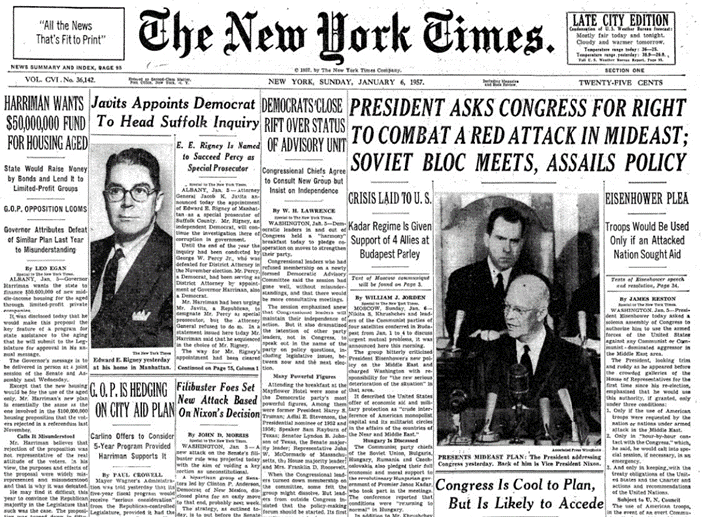
During the 1950s in the Middle East, the United States tried to court Arab nationalism to wean the area away from French and British influence. When the Soviet Union established economic and political relations with President Nasser of Egypt, the Eisenhower Administration began to define such nationalism as pro-Communist. The United States turned against Nasser by withdrawing financial support from the Aswan Dam project, whereupon the Soviet Union provided funding. When the British, French, and Israelis invaded Egypt after Nasser nationalized the Suez Canal in 1956, the United States, along with the Soviets, condemned the invasion. Then, the United States sought to ingratiate itself with the Arab world against traditional European colonialism.
But Eisenhower declared one year later, however, that the United States would be willing to use armed force to defend Middle Eastern nations being attacked by “international communism.” This became known as the Eisenhower Doctrine. After a coup in Iraq and domestic political instability in Lebanon, a right-wing leader in the latter country requested U.S. military support to retain power. Under the aegis of the Eisenhower Doctrine, the marines invaded Lebanon in 1959 and after a short time withdrew. While hinting at the root causes of interventionism, Melvin Gurtov, The United States against the Third World: Antinationalism and Intervention (1974) provides a useful description of U.S. actions in the Middle East:
s
“ The Lebanon intervention reflected an underlying antinationalism in American policy that continues to the present. Like Mossadegh and Kassem (Iraq), Nasser was treated as a front man for Moscow whose aspirations for Arab unity were inseparable from presumed Soviet ambitions to 'dominate' the Middle East. Chamoun (Lebanon), was a patriot, meaning he supported American objectives and would cooperate with Washington against Nasser and his friends. In the American perspective, Nasser and Chamoun had one thing in common: they were important not for what they represented in their national settings but for their degree of cooperativeness with U.S. political, economic, and strategic interests regionwide.” (38—39).
U.S. Imperial Policies in the Middle East, the 1960s and 1970s
The preoccupation with Vietnam did not preclude major U.S. involvement in the Middle East, Africa, and Latin America as well. In the Middle East, the United States had consistently supported the government of Israel as an extension of U.S. power in the area. The Arab-Israeli wars of 1948, 1956, 1967, and 1973 focused on the quest of the Palestinian Arabs to reclaim their homeland from Western colonialism and the Israeli government. This issue had been the source of Palestinian guerrilla actions within Israel, Israeli racist practices against Israeli Arabs, Israeli aggression throughout the Middle East against the Palestinians and their allies, and wars between Israel and its neighboring states that were drawn into or exploited the Palestinian issue for regional political purposes.
After the 1967 war, the Israeli government occupied the Sinai Peninsula, the Golan Heights, the West Bank, Gaza, and Jerusalem. The defeat of the Arabs kindled a desire for revenge on their part and arrogance in Israel. The United States provided armaments to the Israelis in ever-increasing quantities (and to the reactionary regimes in Jordan and Saudi Arabia as well), while the USSR armed Syria and Egypt.
In October 6, 1973, Egypt and Syria attacked Israel. After many setbacks early in the war, the Israelis began to recoup their losses. By October 22, 1973, the United States and the Soviet Union secured a cease-fire agreement within the ambit of the United Nations. The Soviets were angered by Israel's continuation of military operations after a cease-fire call and suggested that the USSR and the United States create a military force to save the Egyptian army, which was encircled on the Sinai Peninsula.
The Soviets proclaimed that they would act alone if no action were taken to save the Egyptians. The United States consequently called a worldwide nuclear alert, threatening an escalation of hostilities into a confrontation between the United States and the USSR. Shortly thereafter, the Israeli army ended its advance, and a cease-fire was secured. Kissinger then began a process of "shuttle diplomacy" to secure a peaceful settlement of the Middle East conflicts, but ignoring the influence of the Soviet Union in the process. He was able to arrange an interim truce in 1975 but was unsuccessful in securing a permanent peace that would end the thirty years of hostilities.
The 1973 Middle East war highlighted a seemingly new dimension in international politics—oil. In existence since 1960, the Organization of Petroleum Exporting Countries (OPEC) in the early 1970s assumed control of the price at which it sold its oil. During the October war, OPEC embargoed the sale of oil to nations that supported Israeli policy. In 1974 and 1975, OPEC quintupled its oil prices, which exacerbated an already-endemic inflation in those economies based on monopoly and huge defense expenditures. Europe and Japan were particularly hard hit by the OPEC move to control the pricing and distribution of its oil. The oil companies were by no means losers as a result of OPEC's seizing the power to price oil. Their profits began to soar, as they still controlled all downstream phases of oil production, from transport to processing to marketing.
Among the foreign-policy effects of the October war and the new surge of independence by OPEC's Middle East members was an attempt by the United States to enhance cordial relations with selected reactionary regimes in the Middle East and Persian Gulf areas, particularly Saudi Arabia and the puppet Shah of Iran. This was to be coupled in the years ahead with some measure of pressure on the Israelis to institute cosmetic policy changes relative to the Palestinian people to satisfy reactionary Arab elites, such as the Saudis.
The oil crisis of the mid-1970s stimulated heightened concern in Washington for controlling the direction of change in the Middle East. During the last phase of the Ford administration, officials in Washington and some academics began to write and talk about the need to intervene militarily in the Middle East to protect Western oil supplies.
Kissinger's bilateral shuttle diplomacy, designed to create an overall Middle East settlement between the U.S.'s ally, Israel, and conservative Arab states, was never successful. The Carter administration entertained the counterstrategy of the all-Middle East Conference to be held in Geneva. The Soviet Union and the United States even went so far as issuing a joint declaration on October l, 1977, endorsing the Geneva Conference and recognizing the "legitimate rights" of the Palestinian people in any final settlement of the Arab-Israeli conflict.
The comprehensive approach was superseded in November, 1977, however, when President Sadat of Egypt made a dramatic trip to Israel in pursuit of peace between the two countries. In response the Carter administration reversed itself and sought a Middle East peace that precluded the participation of the Soviet Union and the Palestinian people. Since real peace required Soviet and Palestinian involvement, the meaning of the new approach was that the Carter administration had decided to pursue an anti-Soviet, antiradical coalition in the Middle East.
In September,1978, Sadat and Prime Minister Begin of Israel met under the auspices of Carter at Camp David and agreed to an Egyptian-Israeli peace treaty that returned the occupied Sinai peninsula to Egypt in exchange for guaranteed sales of Egyptian oil from the peninsula to Israel. The accords called for some kind of Palestinian autonomy on the West Bank and the Gaza strip. While Carter hailed the accords as a major accomplishment in foreign policy, the accords left to future negotiation the rights of the Palestinians under Israeli control. Also the accords significantly left out of the negotiating process other Arab states as well as the Palestinians themselves. In protest, seventeen Arab states severed relations with Egypt after the treaty had been signed.
The U.S. strategy in the Camp David negotiations was to secure an agreement that would freeze the Soviet Union out of the area at a time when access to Middle East oil was becoming problematic. U.S. policy makers saw an opportunity to create in Egypt another powerful state in the Middle East that could act regionally to maintain the structure of imperialism in the area. With this in mind, the United States agreed to provide $1.8 billion in economic assistance to Egypt as well as $3.8 billion to Israel in return for signing the accords.
After the fall of the Shah of Iran and the growing Soviet support for Afghanistan, the Carter administration began a five-year program to arm Egypt with $4 billion worth of weapons. Egypt, which had been a recipient of economic and military assistance from the Soviet Union during the days of President Nasser in the 1960s, had become a bastion of anti-Communism in the Middle East by the 1970s,
In an attempt to soften opposition from reactionary Arab states to the accords and to maintain access to oil, the United States increased arms aid by fifty percent to Morocco and Saudi Arabia. Saudi Arabia alone contracted for $4.8 billion worth of U.S. weapons in 1978. In fact, in 1978, Israel, Iran, and Saudi Arabia received seventy percent of U.S. arms shipments in the Third World.
It is important to remember that the revolution in 1979 that would finally oust the brutal Shah of Iran, who had imprisoned and tortured thousands of political opponents, had begun in 1978. Since Iran had been the recipient of more U.S. military equipment than any other country in the world and had been defined by several U.S. administrations as the U.S. bulwark for influence in the Middle East, attempts to defuse Arab-Israeli hostilities took on renewed importance as the Shah was on the verge of being overthrown. New anti-communist regional gendarmes, such as Egypt and Saudi Arabia, were needed in case the pliant Shah was overthrown.
Seeking Anti-Soviet Clients in the Middle East: The Reagan Administration
The Reagan administration defined instability in the Middle East as Soviet-inspired. Middle Eastern countries, however, even profoundly anti-Soviet countries, were resistant to such a formulation of regional problems, given the historic Arab-Israeli conflict. To convince the so-called moderate Arab states of the preeminence of the Soviet threat, military assistance was provided, and sales of high-technology military equipment offered to Saudi Arabia, one of the world's leading oil producers. The sale of sophisticated AWACS surveillance aircraft generated opposition from members of Congress who saw such a transfer as endangering the security of Israel.
Meanwhile, a Syrian peacekeeping force in strife-torn Lebanon had been fired upon by right-wing Christian Lebanese forces, which were supplied by Israel. The Syrians moved antiaircraft missiles into Lebanon to counter indiscriminate Israeli air attacks. The Israelis threatened to attack and destroy the Syrian missiles. A U.S. diplomatic mission was sent to defuse the crisis, and the Reagan administration found itself in the difficult position of trying to maintain the pro-Israeli stance of the United States without offending local Arab states that were needed in an anti-Soviet alliance. The administration had to mute its hostility to the Syrians, who had close ties with the Soviet Union, because of the general Arab hostility to Israel.
Middle East conflicts were compounded in June,1981, when the Israelis precipitously bombed a nuclear reactor under construction in Iraq. The Israelis claimed that the nuclear reactor would at some time in the future produce nuclear weapons which would be used against Israel. The aggressive government of Menachem Begin reserved the right to attack preemptively any state that was constructing facilities for weapons that might be used against Israel in the future. The United States was put in a position in the UN where it was forced to condemn the Israeli action, although the US. ambassador to the UN refused to endorse any declaration tied to sanctions against Israel.
Reports began to appear in June, 1981, that the Israeli government was collaborating with other "pariah" regimes in the construction of nuclear weapons. Israeli scientists were reported to be working with the governments of Taiwan and South Africa to develop nuclear weapons. Taiwanese scientists were advising the South Africans. Finally, the South Africans were supplying uranium to both Israel and Taiwan. All three governments, of course, remained close allies of the United States at the same time that they were being broadly condemned by the international community for aggression and racism.
In June, 1982, after several months of threats, the Israeli army invaded Lebanon, claiming their mission was to extricate Palestinian guerrillas from the twenty-five mile strip of land adjacent to the Israeli border. Despite this stated objective, the army proceeded all the way to Beirut, the capital of Lebanon. In the process thousands of Lebanese, Palestinians, and Syrians were killed and hundreds of thousands of Lebanese were left homeless in the aftermath of the destruction.
The Reagan administration, while leveling some criticism at the Israeli aggression, did not seriously challenge the Israeli invasion or the occupation, With Palestine Liberation Organization (PLO) guerrillas in West Beirut under siege by the Israeli army, the United States secured a cease-fire, allowing them to leave the country. In the Reagan view the PLO was yet another surrogate of the Soviet Union.
Libya was also defined as a Soviet surrogate. When President Sadat of Egypt was assassinated on October 6, 1981, the United States warned Libya against any attacks on Egypt or the Sudan, both Libyan adversaries. Two AWACS planes were assigned to the Middle East to monitor Libyan activities. Two months earlier, U.S. aircraft fired on Libyan planes over the Mediterranean. As 1981 ended the Reagan administration made the fantastic charge that Muammar Qaddafi of Libya had sent an assassination team to kill the president. As with most foreign policy pronouncements of this administration, no evidence to support the charge was presented. In 1982, Reagan ordered U.S. citizens working in Libya to leave that country because they were in potential danger. The administration was basically doing its best to hinder the oil-based economy of Libya by coercing U.S. oil companies to reduce operations.
As was the case with every other region of the world, much was at stake in the Middle East. The United States needed oil, Countries like Israel, Egypt, and Saudi Arabia were large markets for U.S. exports, especially arms and high-technology aircraft. In geopolitical terms the Middle East was also astride the great Soviet land mass. Consequently, the Reagan administration saw the necessity of currying favor with the so-called moderate Arab states, especially Egypt, Saudi Arabia, and Jordan, together with Israel. Spreading Soviet influence, Arab socialism, and Islamic nationalism endangered U.S. access to oil, to foreign investments, and to export markets. The complexities and contradictions of Middle East politics were immense, however. Israel remained the most powerful regional regime. By the summer of 1982 it was close to annihilating Palestinians in Lebanon. It escalated its repression of Palestinian peoples living on the West Bank and had officially annexed the Golan Heights, taken from Syria in the June, 1967, war.
On September 1, 1982, President Reagan offered a Middle East peace plan that called for an association of Jordan, the West Bank and the Gaza Palestinians. In the interim, Palestinians would have some kind of self-government on the West Bank. Reagan opposed increased Israeli settlements in the occupied West Bank and at the same time refused to recognize the PLO because it did not recognize the state of Israel in advance of negotiations. (This refusal to recognize the PLO continued, and when Reagan tried to initiate talks based on his scheme in 1985, he indicated that any Palestinians in a future negotiating process could not be affiliated with the PLO. Ultimately, the PLO was part of Reagan's Soviet-terrorist cosmology. It was one of the Soviets' key surrogates in the world.)
On September 15, 1982, Israeli soldiers allowed Lebanese Christian military units to enter two main Palestinian refugee camps at Sabra and Shatila. These forces massacred hundreds of men, women, and children. World condemnation of the slaughter and its relationship to the Israeli invasion and occupation was broad-based, including massive protest demonstrations led by the Israeli peace movement.
read more
|  |
Portside Labor
Steven Greenhouse and Shawn Fain
November 7, 2023
In These Times
UAW President Shawn Fain talks with Steven Greenhouse about a unified working class, new organizing, battery plants, Biden and Trump.
When Shawn Fain won the presidency of the United Auto Workers last March as an insurgent candidate, promising to transform the union and take on Detroit’s automakers, he spoke with veteran labor journalist and Century Foundation senior fellow Steven Greenhouse for In These Times. Fain laid out a militant agenda.
“We need to run contract campaigns where we engage the membership and go after their demands,” he said. “We haven’t done this in my lifetime.”
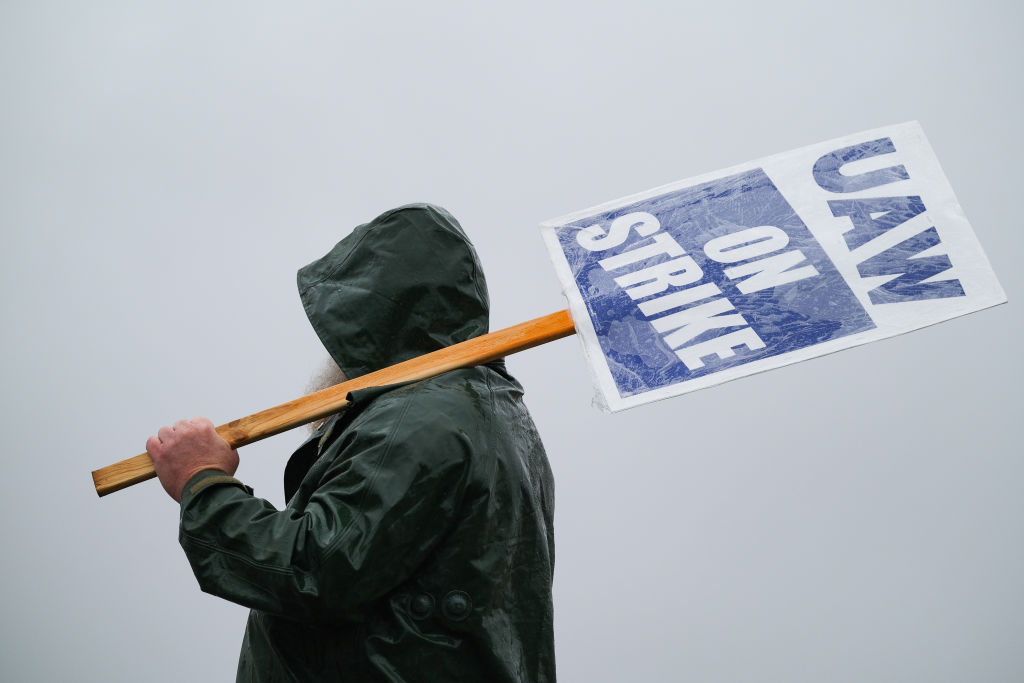
Six months later, Fain led targeted strikes against Ford, GM and Stellantis that have secured tentative agreements that include a 25% wage increase — more than all the raises that auto workers have received over the last 20 years combined. As UAW members began voting on the agreements, Greenhouse spoke with Fain again on November 5.
Exclusive: UAW President Shawn Fain on How the Auto Workers Won and What’s Next
Fain talks with Steven Greenhouse about a unified working class, new organizing, battery plants, Biden and Trump.
STEVEN GREENHOUSE AND SHAWN FAIN NOVEMBER 7, 2023
When Shawn Fain won the presidency of the United Auto Workers last March as an insurgent candidate, promising to transform the union and take on Detroit’s automakers, he spoke with veteran labor journalist and Century Foundation senior fellow Steven Greenhouse for In These Times. Fain laid out a militant agenda.
“We need to run contract campaigns where we engage the membership and go after their demands,” he said. “We haven’t done this in my lifetime.”
Six months later, Fain led targeted strikes against Ford, GM and Stellantis that have secured tentative agreements that include a 25% wage increase — more than all the raises that auto workers have received over the last 20 years combined. As UAW members began voting on the agreements, Greenhouse spoke with Fain again on November 5.
Steven Greenhouse: You’ve come a long way, as they say, since we last spoke. Congratulations on the tentative agreement the UAW won at Ford, General Motors and Stellantis. How did you and the union pull it off?
Shawn Fain: Basically, we exercised the power of the membership. When workers withhold their labor, nothing moves.
A lot of us have been within the system for years, so I thought it was important to bring in some new people to give us a fresh perspective on things. And we came up with a really good plan. This was our first-ever [simultaneous] contract campaign against the Big Three [automakers]. I think that was a very important piece. So was getting the membership rallied around our cause.
We had members and locals holding rallies to get energy behind the campaign and our issues and our stand-up strike strategy. And then there was the transparency with the membership, which was unprecedented in our union. Just the fact of being out there doing Facebook Lives with our members and doing messaging around our issues.
That didn’t just unify our members, it unified the public. Throughout this process, 75% of Americans were supporting our cause. I would have liked more time to plan for it. But with the short amount of time we did have, I think everyone involved just did a hell of a job.
SG: What do you think the contracts that the UAW won mean for the larger labor movement?
SF: To me, it’s a new day in the labor movement. These contracts are setting a new standard. I don’t think anyone should underestimate the power of the movement.
What organized labor has to offer is, we identify with working-class issues, union or not. I think our message resonates with working-class people everywhere.
There’s been a huge disconnect between the corporate class and the working class in this country. Most working-class people don’t have a union and are living paycheck to paycheck, working excessive hours, scraping to get by.
As I said over and over throughout the campaign, bargaining and organizing go hand in hand. I really believe, as we bargain good contracts, it’s going to lead to us organizing more workers and seeing a lot more success for working-class people, not just in America but all over this world.
SG: Can you talk about Toyota’s decision to raise its factory pay just days after the UAW announced its settlements?
SF: Obviously, Toyota isn’t doing this out of the kindness of their heart. They could have given this money a year ago, or six months ago. It’s not a coincidence that after we bargain these great contracts, all of a sudden they decided to reduce their progression to full pay from eight to four years and give [workers at the top rate] a 9% pay increase. We’re calling that the UAW bump.
We look at the workers there as future members. When they join the UAW, they’ll realize the full benefit of having a union — the full extent of the benefits we have and the wages we provide.
SG: You have said that you hope to use the victories at Ford, GM and Stellantis to help organize workers at Toyota, Tesla and elsewhere. Without asking you to tip your hand, can you tell us some about your strategy?
SF: Setting a standard leads to organizing workers. Throughout this whole bargaining process, with all of our messaging and Facebook Lives, we’ve had workers [from other companies] reaching out — hundreds and hundreds of workers daily — wanting to be a part of this. And now we’re seeing non-union companies giving raises. We’re affecting other areas just by bargaining a good contract for us, and those workers see that.
I found it interesting when Bill Ford stated that we need to focus on the real competition and take on the Toyotas and [other foreign automakers and Tesla]. As I’ve said before, Toyota and those companies may be Ford’s competition, but I believe the workers in those places deserve a good standard of living also. They deserve better. And I believe the UAW could bring that to them.
When the Big Three [were first] organized, people wanted to be a part of it — they saw a better way of life. I think people are seeing that now with what we’ve just done.
I’m not going to get in-depth on our strategy, but we have a plan. We’re working it out now. And we’re going to get busy bringing more people in.
SG: You have suggested that other unions seek to link up the expiration dates of their contracts so that they expire on the same date. Can you explain what that would do?
SF: If there was one good thing that came out of COVID, in my opinion — with all the loss of life and the bad things that went on — it was that working-class people realized that life shouldn’t revolve around working seven days a week, 12 or 16 hours a day, or working multiple jobs just to survive. There was not a better example than the fast food industry. Workers would [risk their lives to] go to fast food restaurants to work for $12 an hour. And people on social media were having a meltdown because they couldn’t get their French fries. It was a great example for working-class people everywhere that we have the power: When we withhold our labor, nothing moves.
If I could have a dream scenario, it would be that all of organized labor maps their expiration dates to May 1. May Day is a very significant day in labor history, going back to the Haymarket riots and the fight for the eight-hour workday.
When 26 billionaires have as much wealth as half of humanity, there’s a crisis. And the biggest way to stop that crisis is for working-class people to get unified. When we all stand together, the working class gets our fair share of equity and the fruits of our labor. It doesn’t matter if a corporate class builds 20 factories; if there aren’t workers to man it, they’re not going to make any product. We just have to get unified in this country and globally, and withhold that power if conditions aren’t how they should be for working class people everywhere.
SG: Can you explain what it means that the GM and Stellantis battery plants will be under the master contract? Will the workers be earning the same as the Big Three workers? Or will they be earning 75%? And where does Ford fit into all this?
SF: Getting this work under the Master Agreement was one of the key things we tried for. It’s a very delicate situation because these companies created these joint ventures [with foreign companies at what will initially be non-union plants]. Technically, we couldn’t make them bargain over it — it’s a “permissive” [non-mandatory] subject.
We got Stellantis and GM [battery] workers under the master agreement, and we got transfer rights for some of our members to go into those jobs as they ramp up. With an up-and-coming industry there’s concern about costs, so part of the tradeoff was that we did agree that anyone that’s hired off the street [rather than transferred] will start at 75% of the [master agreement] base rate. But each year, as we get guaranteed wage increases, that base rate goes up. By the end of the agreement, workers hired off the street will be at, ballpark, $31- $32 an hour. And because they’re under the master agreement, we can bargain for them in the next round of bargaining.
Ford is a different scenario. The battery plant in Marshall, Michigan, is a joint venture that Ford owns, and so that will be under the master agreement. The other two [Ford battery joint venture factories], we’re going to have to organize. We’re willing to do that. Ford didn’t want to come up to our standard of 75%, so we chose to fight that battle. As the [electric vehicle] plants ramp up, GM and Stellantis basically will have labor peace throughout that process. Ford chose not to have that.
Read More
| |
|
Portside Labor
Farah Siddiqi
November 10, 2023
Public News Service
A growing number of unions, labor leaders and union members are calling for a cease-fire in Gaza.
One of the nation's largest labor unions has become the latest organization to demand a ceasefire in Gaza as Israel's war with Hamas plays out.
The American Postal Workers Union announced on Wednesday that its members are "shocked and saddened by the tragic and ongoing violence in Israel and Palestine." The statement condemned the Hamas violence of Oct. 7 but also said Israel's response "has made the prospects for peace more remote."
APWU Detroit local president Keith Combs said an estimated 4,000 children are among more than 10,000 deaths in the conflict so far.
"Israel has shut off the flow of food, water, fuel and medical supplies to the Gaza Strip, a war crime," he said. "A humanitarian catastrophe is unfolding every day in Gaza. Thousands more innocent civilians stand to die - wholly preventable deaths."
The White House announced Thursday that Israel has agreed to a daily four-hour "humanitarian pause" from bombing Gaza to allow civilians to flee, but there's no word on whether those who leave will be allowed back in at a later date. The push for a longer pause came as part of President Joe Biden's renewed diplomatic push to free hostages taken by Hamas.
Combs said the union's position is that anything less than an immediate ceasefire, release of hostages and massive humanitarian aid to the people of Gaza will not be enough.
"We call on our government - which is the primary foreign benefactor of the Israeli government - to use all its power to protect innocent lives," he said, "and to help bring about peace in the region, and not use our tax dollars for more war."
Other unions have also made statements regarding the violence in Gaza, including Starbucks Workers United, which posted a message of solidarity with Palestine on X, formerly Twitter, on Oct. 9. Starbucks executives sued the union in federal court to stop using the company's name and logo, as trademark infringement. The union has filed its own countersuit.
|
UAW Strikers Have Scored a Historic,
Transformative Victory
BY NELSON LICHTENSTEIN
With its successful strike, the UAW has broken with decades of concessions, won on pay and workplace democracy, and launched a new national labor leader. There’s much more organizing to be done, but this is an unmitigated victory for the entire working class.
EDITORS
The UAW’s victory in its forty-five-day strike against the Big Three Detroit automakers is historic and transformative, ending a forty-three-year era of concession bargaining and labor movement defeat that began with Chrysler’s near bankruptcy in 1979 and Ronald Reagan’s destruction of the Professional Air Traffic Controllers Organization two years later.
Not only did the union win substantial wage increases for all members in its tentative agreements (TAs) — at least 25 percent over the four-and-a-half-year contract — but the wage structure is radically progressive, eliminating the second- and third-class status endured by thousands of temps and second-tier workers. With the regularization of their employment status, these workers will enjoy extraordinary pay increases, in some cases upward of 150 percent.
And the union clawed back the annual cost-of-living adjustment (COLA) that had been eliminated during the 2008 financial crisis. COLA had been a standard feature of UAW contracts since 1948, when General Motors first proposed it to the union to blunt the effort, forcefully pushed by then UAW president Walter Reuther, to limit auto and steel industry price hikes either through collective bargaining or government regulation. The labor movement at the time was fighting to limit inflation but secure a healthy wage increase — benefitting working class and middle class alike, union and nonunion, by advancing a program that shifted income and wealth from capital to labor.
That ambition failed during the increasingly conservative postwar years, making COLA increasingly coveted, and not just among industrial workers. During the major 2022 strike of graduate students and other academic workers at the University of California, winning COLA became the key demand of the most radical and activist segment of the student workers. Among the unionized workers of the Big Three, the restoration of COLA will probably add a 7 or 8 percent wage boost to the nominal wages workers earn over the life of the contract. (UAW members still need to ratify the tentative agreements, which they’re expected to do so in the coming weeks given the strength of the deals.)
UAW president Shawn Fain and other progressives, in the unions and out, have correctly denounced the vast pay inequalities that have given corporate CEOs three or four hundred times more income than the bulk of those employed in the same firms. But that income gap has always had an abstract quality. Few workers ever meet a top executive. Far more important, and divisive, have been the petty inequalities within the working class itself. When the person doing the same work on the line or behind the counter is making two dollars more an hour, solidarity decays and resentment festers. That is why Shawn Fain’s campaign for the UAW presidency last year declared, “No corruption, no concessions, no tiers.”
Indeed, this strike victory, spearheaded by Fain and a new slate of union leaders, resembles the dynamic that launched onto the national stage other tribunes of the US working class, from Eugene V. Debs in 1894 and William Z. Foster in 1919 to Walter Reuther in 1946 and Cesar Chavez in the late 1960s, armed with a progressive message and a mobilized membership backing that up. The UAW strike flowed organically from the movement to democratize the union, a multigenerational effort that culminated in the successful push, led by an opposition caucus, United All Workers for Democracy (UAWD), to elect top union leaders by a referendum vote of the entire membership. This would curb the insularity, corruption, and self-perpetuating leadership of a UAW executive board long dominated by a machine known as the Administration Caucus.
The Leader and the Strategy
Fain was not a leader of UAWD, but he made a name for himself inside the union, in 2009, when he vigorously opposed the concessions at his Kokomo, Indiana, Chrysler local that other UAW leaders accepted. He was chosen by UAWD to head an insurgent slate after a 2021 referendum, in which a majority of UAW members voted to henceforth elect top union officers by union-wide election.
Although most on the Fain slate easily defeated candidates of the ruling Administration Caucus, Fain was forced into a runoff against incumbent Ray Curry, who argued for the virtues of “experience” when the next round of collective bargaining began. The academic workers and graduate students, who now comprise nearly a quarter of the UAW membership, might well be credited with putting Fain over the top. They had not participated in large numbers, but when they did, university-employed people voted overwhelmingly for a changing of the guard.
Fain got off to a running start right after the election results were certified in March 2023. He put a new cohort of energetic labor militants on his staff, toured the country to mobilize support for a major confrontation with the corporations, and developed a rhetorical voice that grew in strength, radicalism, and self-confidence in the months leading up to the start of the strike on September 15 and during the conflict itself.
From Walter Reuther, the legendary UAW leader, Fain channeled the vision of the UAW as a vanguard institution setting the pace and purpose for a newly empowered working class; with Bernie Sanders, he openly denounced the billionaire class. In a highly symbolic rebuff, Fain absented himself at the formal start of negotiations when UAW leaders and company officials offer an across-the-table handshake for the press. Instead, Fain turned up at factory gates, pressing the flesh with the UAW membership in preparation for the struggle ahead.
And there is one more element that has made Fain a forceful spokesman, not only for his membership but for many thousands more. Fain deploys the social gospel in a very skillful fashion. Raised in a Protestant family, he declares that the UAW can “move mountains” when workers have faith in their power and righteousness. He denounces the greed and arrogance of corporate chieftains with the outrage of a prophet and declares that in the contemporary industrial world they have created a “hellish” underworld where men and women are forced to endure overtime, insecure jobs, and wages that fail to keep pace with either inflation or the never-ending growth of executive salaries. On occasion, Fain has also unleashed a sort of Midwestern populist condemnation of his cosmopolitan adversaries, as in one speech where he told UAW members that the CEOs at the big auto companies would never want to have dinner with their blue-collar employees or offer them a ride on their corporate jets. To such class contempt, Fain offered an even larger portion of disdain in return.
But rhetoric alone did not win the auto walkout. In a dramatic break from a seventy-seven-year bargaining tradition, the UAW did not choose just one company to strike and thereby set the “pattern” the others would follow. Instead, the union hit selected plants at all three companies, ratcheting up the number of factories and parts depots on strike according to the progress — or lack of progress — in negotiations.
Fain and his team called this the “stand-up strike,” in homage to the Flint sit-downs that founded the UAW and the modern US trade union movement in 1936–37. This strike and bargaining strategy had three advantages: it kept the conflict in a suspenseful news cycle as each new factory was shuttered; it preserved the UAW strike fund because only a minority of all workers would be out of work; and it applied a diverse set of pressures to all three corporations, in some instances generating last-minute concessions just before the UAW was scheduled to announce which new facility would be struck.
A Political Strike
The UAW strike was of a fundamentally political character, which is why it has often been compared to the UAW walkout against General Motors in 1945 and 1946. At stake in the recent strike was not just a wage hike big enough to compensate for the 20 percent drop in real wages during the previous two decades. Of equal importance was the entire auto industry’s transition to producing electrical vehicles. The Detroit Big Three, as well as all the nonunion companies, wanted the new generation of battery plants — the majority slated to be built in the South — to pay wages substantially lower than those mandated in the standard UAW contract. Virtually all the battery plants and some additional facilities were to be joint ventures between Korean or Chinese firms and US automakers, and thus excluded from contract coverage.
The UAW saw this as a union death sentence, and so did the most progressive parts of the Biden administration. The trillion-dollar Inflation Reduction Act (IRA) offered billions to the auto companies in loan guarantees and outright grants to advance the green transition. Although the legislative sausage-making stripped the IRA of its capacity to coerce or incentivize companies to unionize their new facilities, Biden clearly wanted the UAW to get a strong contract, and he became the first sitting president in US history to actually show up on a picket line (at a GM distribution center in Michigan). His presence was intended not only to curry favor among a strategic strata of Midwestern industrial workers but also to counter the argument put forward by Donald Trump and other Republicans: that a green industrial policy was a recipe for low wages and lost jobs.
“Industrial policy” means that corporate managers are no longer the sole arbitrators of new investment in plant product, location, and technology. It’s not quite government planning, let alone workers’ control, but it does help politicize and, to a degree, democratize the industrial future.
As a result of the strike, the UAW has taken an important step in this direction. First, it has forced the Big Three to include contract language guaranteeing that their new battery production facilities will be included in the master UAW agreement. And the union won important leverage to ensure that plant closures will no longer be at the sole discretion of management: UAW will now have the right to strike an entire company to prevent the shuttering of a production facility.
Indeed, the UAW did something unprecedented at the conclusion of its strike against Stellantis, the parent company of the old Chrysler corporation. The new contract guarantees that the Belvidere Assembly Plant, located in the small Illinois city of the same name, will reopen after management mothballed it last February. This is an absolute first in the auto industry, making clear that investment decisions are not those of management alone. Stellantis has also agreed to place a new battery plant in Belvidere, which will eventually add some five thousand additional jobs to the town.
The Next Fight
However, unless the rest of the auto industry is soon organized, the UAW victory in Detroit will turn Pyrrhic. Auto executives like Ford’s James Farley have complained that the labor cost differential between his unionized firm and nonunion Tesla will hamper Dearborn’s competitiveness and the employment levels the company can sustain. With Toyota, Nissan, Volkswagen, Mercedes-Benz, Honda, Tesla, and Hyundai all nonunion, the UAW represents workers producing less than half of all cars sold in the United States. Despite the signal success of this contract round, those companies keep a steady, downward pressure on the wages that the Big Three can profitably pay.
For more than forty years, UAW leaders, even the most stolid, have been well aware of this threat. And yet the union has repeatedly failed to organize these nonunion competitors. The reasons are manyfold, but the incapacity of the UAW to demonstrate what a powerful union can accomplish is certainly paramount.
Now that has all changed. “One of our biggest goals coming out of this historic contract victory is to organize like we’ve never organized before,” said Fain after the union won a tentative agreement with GM. “When we return to the bargaining table in 2028, it won’t just be with the Big Three. It will be with the Big Five or Big Six.”
Nelson Lichtenstein is research professor at the University of California, Santa Barbara. His newest book, which he wrote with the late Judith Stein, is A Fabulous Failure: The Clinton Presidency and the Transformation of American Capitalism.
| | |
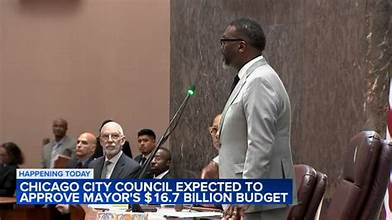
How Mayor Johnson’s $16.6 Billion ‘People’s Budget’
Benefits Black Chicagoans
Kouri Marshall
November 15, 2023
reprinted from CHICAGO DEFENDER
Mayor Brandon Johnson and the Office of Budget and Management held two virtual budget briefings for reporters and editorial board members to discuss his administration’s $16.6 billion budget pitch for the forthcoming year. His budget is set to go before the City Council on Wednesday (Nov. 15).
As a contributor to this publication, I had the honor of attending a session. I had the opportunity to ask the Mayor what this budget will do for the Black community here in Chicago — and how.
Keeping Black Chicagoans Home
The Mayor started by acknowledging the fact that Black flight and fin taxes — and societal divestment in the Black community — have resulted in too many Black Chicagoans not being able to afford the homes they have bought, even individuals who purchased those homes while working in lucrative professions such as engineering.
He said that holding the line on property taxes in this new budget was one solution to ensure that Chicagoans — and Black Chicagoans in particular — are not priced out of their homes over time from factors like rising costs, job loss or student loan debt.
The Mayor pivoted to note that 64% of the Chicagoans who got jobs this summer were Black people. He then pledged to increase that number by 4,000 by working with businesses around the city and general area. He then raised the point that 74% of unhoused Chicagoans are Black. The Mayor also vowed to increase our city’s investment into remedying homelessness in the new budget.
The Mayor’s “Bring Chicago Home” proposal to address homelessness crossed a significant hurdle at City Hall this week and will be headed to voters as a ballot measure during the March 19, 2024, primary election.
Prioritizing the Climate Crisis and Mental Health
He also mentioned that the recent storms and resulting flooding have impacted Chicagoans and Black Chicagoans disproportionately. He connected this event to the effects of climate change and how, due to factors like income inequality and disparity of generational wealth in the Black community, this phenomenon has had a significantly adverse effect on Black Chicagoans. He also pledged funding to help improve the city’s response to such disasters and to help bolster preventative measures in the new budget.
The conversation then turned to the mental health crisis in America and here in Chicago. Mayor Johnson is committed to the philosophy of “treatment, not trauma.” He highlighted the need for more mental health care centers and alternatives to simply calling the police or dialing 9-1-1. These points are also priorities in the new budget.
Amplifying Diversity, Representation and Access
Mayor Johnson is only the third elected Black Mayor in our city’s history. So diversity — and representation for Black Chicagoans, who have not always seen themselves in positions of power — was a natural turn for the conversation to take.
The Mayor mentioned the various current vacancies in our city’s government.
“I want Black people to apply to these jobs,” he said.
Mayor Johnson then highlighted the number of manufacturing jobs currently available in Chicago and the local area corporations who have stated that they are prepared to invest in Black Chicagoans and our interests.
In my view, he further underscored that resolve when he then pivoted to the subject of our neighborhoods and making them better and more livable for all.
He pledged that this new budget will include investments in home repair, particularly for low-income Chicagoans. It also provides for the replacement of 409,000 lead pipes around the city.
Our Mayor then highlighted the engagement in the Black community that he and his administration plan to do after the passage of this new budget.
“Black people have access to this mayor,” he proclaimed.
“This budget is centered around people — people who have been ignored for too long.”
The ‘People’s Budget’
Here are a few additional ways that this budget will impact the Black community:
- The budget lays aside $4.7 million to help establish the Office of Re-entry to help meet the needs of formerly incarcerated residents.
- Establishes a Commission on Restoration & Reparations by carving out $500,000 to support this commission’s work.
It seems clear that the Mayor wants this new budget to reflect the sentiment that this is the “people’s budget.”
As a Chicagoan — and a Black Chicagoan in particular — I am thankful and impressed that we have a mayor who is clearly and unapologetically committed to making our great city a more equitable place to live — and ensuring that Black Chicagoans have equal access to the American Dream.
About Post Author
Kouri Marshall
Kouri C. Marshall is a proven leader, mentor, and community activist, driven by his own personal motto: “Character and consistency.” Kouri has served as a political strategist, adviser and director for organizations, campaigns and projects ranging from the local to national level. This includes tenures serving as the Deputy Director of Agency Personnel and Executive Appointments in the Office of Illinois Governor JB Pritzker, Chief of Staff to the Cook County Commissioner for the 1st District and as the District of Columbia’s State Director for President Barack Obama’s re-election campaign, then as the Executive Director of Democratic GAIN, a national progressive political association with 42,000 members.
Kouri is the co-founder and Board Chairman of ChiGivesBack, Inc., a nonprofit committed to uplifting Chicagoans via a range of philanthropic programming. Kouri received his Masters in Public Administration at Southern Illinois University Carbondale and resides in Chicago, IL.
| |
|
CCDS National Coordinating Committee Meeting
Minutes, October 22, 2023
Time of day: Looking toward 2024 Carl, Paul, Harry, Janet
Carl and Paul spoke on the domestic side.
Carl said we have to first agree on what the principal contradiction is. He described the existence of a wide popular front – test for who is in it is, are they willing to fight fascism? The likely division of the electoral college (not popular vote) is 51-49. A cliffhanger. Need three sets of tactics:
Blue: mostly large cities, task is to unite the “Rainbow Working Class”.
Purple: like where Carl lives, in addition to uniting the base, need to find and reach out to and win back the “Obama to Trump flippers”.
Red: Build own base organization: Berniecrats and The Squad, and strengthen them, need to expand the size of the minority to win statewide offices.
Paul noted that a recent article said if Trump gets a second term it will be much worse than his first, because he’s used the last 7 years to identify people who are absolutely loyal to him. Solutions (he agrees with Carl’s description):
Need to mobilize unions. Doesn’t matter if we don’t like Biden, it’s necessary to fight fascism. The painter’s Union had a very slim majority for Biden in 2020. Many Trump voters. So they surveyed the voters about what were their key issues, and then showed which candidates had what record, showing in most areas the Democrats aligned with their needs. A subsequent poll showed 2-3% had shifted from Trump to Biden. You don’t have to be a union member to participate in union phone banks, call unions in your area, or the Democratic party.
INTERNATIONAL
Harry showed a slide show exploring the root causes of global violence. The War System is a system in which we are all victims and perpetrators. Direct violence (killing and maiming), Structural violence (class, racism, sexism), Cultural violence. NATO has been exploring (and developing) what they call “Clginitive Warfare” – not only what people think, but how they think and act. Influences individual and group beliefs to favor aggressor’s tactical or strategic objectives.
Conclusion: Say NO to the military /industrial/academic complex, no to virulent nationalism and racism, no to economic sanctions … This is in direct opposition to the Biden administration. Quote from Dave Zirin from The Nation on the huge demonstration in Washington DC organized by Jewish Voice for Peace (and IfNotNow).
Janet urged continuing to oppose Biden Admin decision to send more arms to Israel. We differ on Ukraine but that war continues; and there are wars throughout Africa. Colonialism was defeated but neo-colonialism continues, destabilizing countries so their mineral wealth can be robbed. With the recent events, it will make it harder for Biden to win in 2024.
COMMENTS:
Jay worries about referring to the “War System”, sounds like old fashioned communist rhetoric. How do we couch our new analysis in language more consistent with the 21st century. The fact that Israel is the single largest recipient of US Aid, including military – this is not receiving enough attention.
Barbara stressed that in the “Blue” areas in Carl’s analysis, necessary to unite among ourselves.
RESPONSES:
Carl said in referring to “our democracy”, he meant we have to defend it such as it is, and expand it more in the direction of popular democracy.
Paul said at one time he thought there were more important things to do at election time than phone calling, but now doesn’t think it’s an either-or. The phone calls, if enough people do it, it will make a difference.
We talked about the different requirements for voting in each state; in two states felons are allowed to vote even if in jail. Kathy asked if there would be conditions where citizens would lose the right to vote? Answer: not in Carl’s proposal (nor in Ellen’s mind).
Harry finds the peace movement to be the most vigorous social movement of our time in their reaction to the war against Palestine. Young people are getting animated in their antiwar work. The youngest two cohorts of voters – 18-29 – are voting in larger numbers. This can be bad for Biden.
Kathy warned about the growing efforts to draw the US and Iran into war.
Steve noted that the climate crisis is adding to the increased activism of youth. In respect to how to frame our analyses, the focus on the growing inequality of wealthy in this country and its relationship to the military industrial complex can tied these things together and show the structural problems. (i.e., capitalism.
Jay concurs that wealth inequality is the best way to approach this subject: one aspect is to point out how Israel has received the most US Aid; also the US has bought off Egypt, which is probably a reason why the Rafah Gate was closed. The only people benefiting from this are those selling the weaponry. And it’s a gift to Netanyahu. Posted in chat: We need (or at least I do) to better understand the relation between the Justice Democrats, PDA, the Congressional Progressive Caucus, and other left/progressive Democratic groups.
Meta spoke about the youth vote – we have to work on the things that matter to them. Youth are not interested in “cultural violence”, they are interested in “civil discourse” – anti-war, anti-capitalism, anti-uber-wealth. From chat: The right wing Christians like the Israeli theocracy. Perhaps we could consider ways to expose this idea???
Carl disagrees with this being good for Netanyahu: he has argued that he is the one that will make Israelis safe. And now that has exploding his face.
Ellen disagrees with Carl – the ground war against Gaza will eradicate the Palestinians. (also currently shelling the West Bank; will a Gaza war be followed by ground invasion of West Bank?)
We miss the important input from Ira Grupper.
Paul closed with stressing that we have to urge people to get out to vote. This isn’t about Biden, but about stopping fascism in this country.
Carl: we have to build campaigns, not movements. Carl worked with Bill Fletcher on this concept. https://convergencemag.com/articles/campaigns-and-movements-how-are-they-connected-how-do-they-differ/
Harry: would like to see more about Justice Democrats. Opposition to Biden’s foreign policy might bring more young people back to … being willing to vote Democrat.
CCDS Congress 2023 or 2024 45min
Convention will be June 1-2, 2024, virtual
NEC to serve as Convention Planning committee, with some additions from the NCC. NEC meetings start with the Convention planning then segue to NEC business, so NCC members can come to the one, and then escape if they wish.
We have urged people to submit papers with proposals on the future of the organization. One such has been submitted by Carl and Janet, Titled “Political center”. Submit proposals, resolutions to https://tinyurl.com/ccds-2024-docs./
Carl is going to set up a Google Doc where we can post our papers and comments on others.
Marilyn spoke on the points Carl made. One specific is we shouldn’t refer to the event being planned a “Convention”. People shouldn’t get the idea that this will be something like 1994. We should transition to the planned educational center that can relate to other (more vibrant) existing organizations. Viz, set up Educational Teams, and invite people to join them.
Paul asked what would be our relationship to work that some of our members are doing on the ground, like Move the Money in New York? Steve noted that CCDS as an organization is not active in Move the Money or System Change Not Climate Change – individuals are active and may identify themselves as members of CCDS.
Carl said the mass socialist organization we operate in should be DSA. Need to make sure we are not preaching to the young people.
Jay brought up the Mapping Project he is trying to get off the ground, where people would research what military-industrial complex centers are operating in their area.
Carl noted that our work in Medicare for All is primarily educational. E.g., important article in most recent LeftLinks. Why obstacles to Single Payer exist and what their roots are (in racism). See original article in The Hartmann Report, by Thom Hartmann:
https://hartmannreport.com/p/is-scientific-racism-why-america-784?publication_id=302288&post_id=138088103&isFreemail=true&r=10ww
Membership Report Steve Willett
Over last 10 years from 500 to under 200. Now somewhat stabilized but still dropping. New members, very thin on the ground. Tom asked if it is standard to send reminders to people when their dues come up for renewal. Jay says he doesn’t remember when he joined, getting anything saying “this is what you get as a member” – Steve says they get a new member packet.
Carl says 3100 people have signed up on our Facebook Group. Some from other countries, other organizations keeping an eye on us, and some from things like FBI. But … some may be potential members. Jay says some use false names.
Steve proposes we have a meeting of a social media committee (Steve, Janet, carl, Ellen, Jay, Randy, Courtney) … he will set up a meeting.
Finance Report Meta Van Sickle
$9134.36 in bank account. The Ed Fund is covering the whole cost of the Charlene books previously voted on by the NEC.
She thinks the transition better discuss whether the Treasurer will still have the same duties, will we still have dues? Members?
New Studies on the Left 2023 and other media (LeftLinks, OUL, Mobilizer)
Carl/Janet
Carl reported that this is the new name of “Dialogue and Initiative”, a title which doesn’t mean anything to people anymore. We can make more use of pictures and make it look much better – so it will draw more people on the socialist left who would want to look at it. Publish it as a printed publication AND as a website. Website can feature more current items, allow for comments. Once there are more visitors, we can try to get ads on it. Continue to publish the hardcopy through Lulu, which doesn’t cost us anything. We can use it to promote our projects like Fourth Monday. Increase the number of people who read it, by a factor of 10.
OUL: has been rescued from the former host, restored and rebuilt so it renders properly on mobile devices. Many people helped him.
Saturday Morning Coffee: range of people; most attendance is about 40 people. It’s posted on YouTube for those who can’t get up so early.
Mobilizer: Janet is overwhelmed with responsibilities, and proposes merging the Mobilizer into LeftLinks. Unless someone wants to take it over.
SEP Harry /Jay
Harry reported on the 4th Mondays.
Peace and Solidarity/Move the Money
Jay reported on the New Realities task force.
Reports on other projects. Karl reported on the Living Wage Coalition and Mexico Solidarity project
Move the Money: (Tom) – the resolution has a majority of the NY City Council supporting it, but the session ends in December and it is not certain by far that the Speaker will allow a hearing. But it has made history as there has never been a resolution like this that the majority of the City Council has supported.
Jay reminded us of the crushing sanctions that the US has imposed on Venezuela. Against the democratically elected president. As a political center, we can connect the dots between things like the domestic issue of immigration and the impetus caused by foreign policy against countries like Venezuela.
Medicare for All Update Group Marilyn Albert
Has been meeting for around 2 years; the last two haven’t been well attended, mostly because Sandy sent out two different Zoom links. She has doubts about keeping the group going for the quarterly meetings unless they can get the numbers back up to around 20 people.
Biggest thing to happen in the country .. .in California SB 770 was passed by the legislature and signed into law. This lays the basis for a Single Payer system in California. It came out of the two year process called the Healthy California for All Commission, which called it “Unified Financing” because legislators were squirrelly about “Single Payer.” Newsom wants to run for President, maybe 2028, be interesting to see how far right he will tack.
The movement against privatization of Medicare is growing, slowly, but starting to involve elected officials.
Jay is on the board of the Florida Medicare for All statewide organization. He is thinking of looking at the status of neonatal care and infant mortality.
Tom reported that in NYC there is a Temporary Restraining Order preventing city retirees from being pushed into a Medicare (Dis)advantage plan. There is a little interest in Medicare for All.
Medicare Advantage plans are fine as long as you’re not frail and sick, but once you need something the Advantage plans deny care.
Jay would like someone (Corinne Frugoni?) to write up the problems with medicare advantage plans.
Scheduling Next NCC Meeting February 11, 2024.
| |
|
ANDY CARTER, HELPING PRESERVE INDIGENOUS MAYA LANGUAGES
For thousands of years, the Maya people in Guatemala have spoken many indigenous languages, among them K’iche’ or Mam. When the Spanish conquered the region in the 16th century, they promoted Spanish as the national language and worked to suppress indigenous languages. That cultural oppression was but one arm of the campaign to oppress and weaken the Maya communities.
The oppression of indigenous Peoples in Guatemala continued into the 20th century in a civil war often referred to as the Dirty War. In a series of assaults between 1981 and 1982, the village of Saq Ja’ was completely destroyed by the Guatemalan military. Many villagers died in the attacks, while others joined the political resistance, fled into the mountains, or went to refugee camps in Central America. Among those who went into hiding was María Guadalupe and among those who fled Guatemala was Don Virgilio Vicente. In response to this humanitarian crisis, the Sanctuary Movement was formed in the 1980s to welcome Central American refugees into the United States. In 1986 Don Virgilio was taken into sanctuary at University Church in Chicago, Illinois.
In 1998 Andy Carter and his colleagues from the Sanctuary Movement at University Church in Chicago began sending yearly delegations to work in partnership with the people of Saq Ja’ to rebuild their village. On a delegation to Saq Ja’ in the spring 2007 Andy met Doña María Guadalupe, who told him of her father, Don Margarito Esteban Álvarez Velázquez, and his lifelong work of planting and nurturing a forest near his home in Saq Ja’.
Andy and his colleagues understood that one of the goals of the school in Saq Ja was to teach and preserve K’iche’, their native language. Working with Doña María Guadalupe, Andy crafted a children’s story about Margarito in K’iche’ for the village school.
He then contracted with the gifted artist Allison Havens to create illustrations for the book. To do this Allison asked children from the school in Saq Ja to draw images of local animals, plants and scenes after hearing the story of Margarito and his forest. Allison then used the children’s artwork along with her original drawings, paintings, and traditional and Mayan textiles to create the stunning illustrations for the book. With that done, El Bosque de Don Margarito, written in Spanish and K’iche’, was published in Guatemala in 2016.
Back in Chicago, Andy heard about Hard Ball & Little Heroes Press from a colleague in the Working Class Studies Association. He called the publisher and soon had a contract to publish El Bosque de Don Margarito in an English and Spanish version,. The text included side-bars of key phrases in K’iche, color coded for language exploration and appreciation.
After the publication of El Bosque de Don Margarito in 2016, with generous donations from friends and colleagues, the Maya Book Project (MBP) of University Church was founded in 2017. Since its beginning, the MBP has donated thousands of copies of El Bosque de Don Margarito to K’iche’ speaking communities in Guatemala. Andy then added a second version in Spanish and Mam, which along with the original Spanish K’iche' version, has been adopted for national distribution by the Guatemalan Ministry of Education.
Margarito’s Forest has done more than support the preservation of indigenous Mayan languages. The beautifully illustrated book also uses Maya numbering alongside the traditional Arabic numerals, providing an intriguing opportunity to explore different forms of numeration. The book includes an explanation of the Maya numeration, noting that the Maya discovered the concept of “zero” around the same time as the Muslim scholars in the Middle East.
More recently, the Maya Book Project partnered with Hard Ball Press in publishing two new editions of Margarito’s Forest. One is English-K’iche’ and the other is English-Mam. These new editions came about in response to requests from several K’iche’ and Mam speaking communities living in the US. The new editions are now in print and will be offered to schools and social justice organizations in North America at steep discounts.
Audio versions of the books, read in K’iche’, Mam, and Spanish are also available for free to any school. These audio books help Maya children learn to pronounce as well as read their native languages.
With great pride and humble gratitude, Hard Ball & Little Heroes Press and Andy Carter are publishing these two new editions of Margarito’s Forest in our continuing effort to help preserve the K’iche’ and Mam languages for children (and adults) in North America, Guatemala, and the world.
___________________________________________________________________________________
Timothy Sheard, editor, Hard Ball & Little Heroes Press
Timothy Sheard | 415 Argyle Rd., 6A, Brooklyn, NY 11218Unsubscribe jlynjenks@g
| |
|
The Man Who Changed Colors
By Bill Fletcher, Jr.
When a dockworker falls to his death under strange circumstances, investigative journalist David Gomes is on the case. His dogged pursuit of the truth puts his life in danger and upends the scrappy Cape Cod newspaper he works for.
Spend a season on the Cape with this gripping, provocative tale that delves into the
complicated relationships between Cape Verdean Americans and African Americans, Portuguese fascist gangs, and abusive shipyard working conditions. From the author of The Man Who Fell From The Sky.
“Bill Fletcher is a truth seeker and a truth teller – even when he’s writing fiction. Not unlike Bill, his character David Gomes is willing to put his life and career in peril to expose the truth. A thrilling read!” − Tavis Smiley, Broadcaster & NY TIMES Bestselling Author
Review by John Bachtell
Click HERE to purchase
| |  |
|
From Upton Sinclair's 'Goose Step' to the Neoliberal University
Essays on the Ongoing Transformation of Higher Education
By Daniel Morris
and Harry Targ
Paperback USD 17.00
This is a unique collection of 15 essays by two Purdue University professors who use their institution as a case-in-point study of the changing nature of the American 'multiversity.' They take a book from an earlier time, Upton Sinclair's 'The Goose-Step A Study of American Education' from 1923, which exposed the capitalist corruption of the ivory tower back then and brought it up to date with more far-reaching changes today. time. They also include, as an appendix, a 1967 essay by SDS leader Carl Davidson, who broke some of the original ground on the subject.
Click HERE to Purchase
| | |
From the CCDS Socialist Education Project... | |
A China Reader
Edited by Duncan McFarland
A project of the CCDS Socialist Education Project and Online University of the Left
244 pages, $20 (discounts available for quantity), order at :
The book is a selection of essays offering keen insight into the nature of China and its social system, its internal debates, and its history. It includes several articles on the US and China and the growing efforts of friendship between the Chinese and American peoples.
| | |
|
Taking Down White Supremacy
A Reader on Multiracial and Multinational Unity
Edited by the CCDS
Socialist Education Project
166 pages, $12.50 (discounts available for quantity), order at :
https://www.lulu.com/spotlight/changemaker
This collection of 20 essays brings together a variety of articles-theoretical, historical, and experiential-that address multi-racial, multi-national unity. The book provides examples theoretically and historically, of efforts to build multi-racial unity in the twentieth century.
Click here for the Table of contents
| | |
|
Vijay Prashad, “The Rise of ‘The Darker Nations’ in the 21st Century:
Responses to Crises of War, Poverty,
and Environmental Disaster
click here for the recording
| |
CHANGEMAKER PUBLICATIONS: Recent works on new paths to socialism and the solidarity economy
Remember Us for Gift Giving and Study Groups
We are a small publisher of books with big ideas. We specialize in works that show us how a better world is possible and needed. Click Gramsci below for our list.
| |
522 Valencia St.
San Francisco, CA 94110
415 863-6637
| | | | | |