|
Greetings!
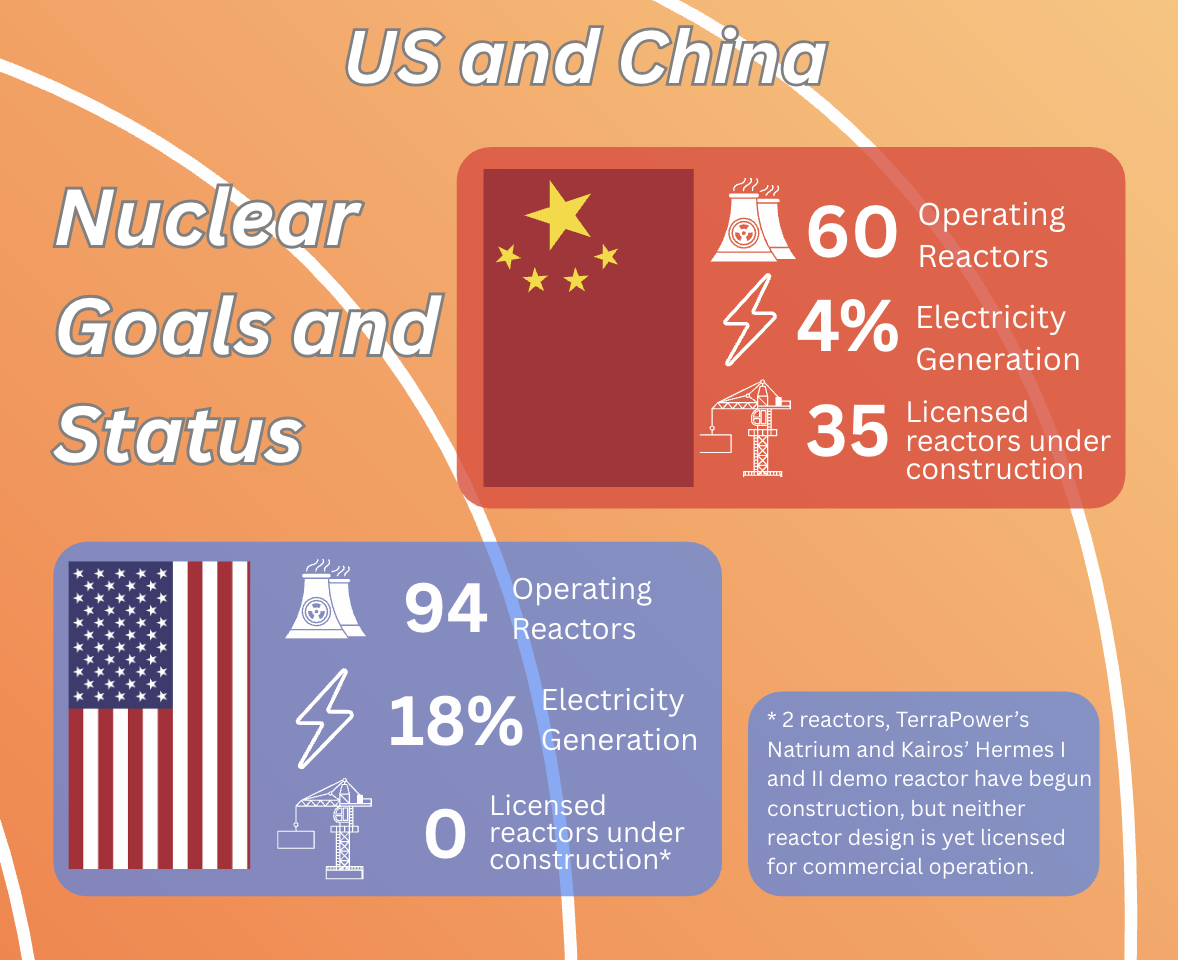
In this week’s issue, we provide an infographic highlighting the substantial contrast between the limited progress on the United States’ ambitious nuclear energy objectives and China’s significant expansion of its nuclear energy sector. We spotlight the introduction of the Nuclear Energy Innovation and Deployment Act (NEIDA) in Congress and examine its significance as the Department of Energy increases its role in nuclear energy regulation. Finally, we highlight key nuclear technology, security, and geopolitical developments, reports, and analyses.
This issue of Nuclear News and Views was produced by PGS Program Director, Patrick Kendall, and Della Ratta Energy and Global Security Fellows, Mackenzie Hansen, Gabriela Zanko, and Cate Donovan.
| | The Massachusetts Institute for Technology (MIT) is hosting a nuclear safety course to explore safety and regulatory issues of operating and maintaining nuclear reactors in the United States and other countries. Attendees will assess several aspects of nuclear plant safety such as extended life operations, spent fuel storage management, cybersecurity, and operating reactor safety and licensing. The course will also allow attendees to assess new developments in nuclear plant safety and examine advanced reactors and their safety characteristics. A flyer for the course can be found here. | | U.S. and China Nuclear Goals and Status | | |
Sources: IAEA Country Profiles (USA and China)
World Nuclear Association Outlook Report (USA and China)
| | |
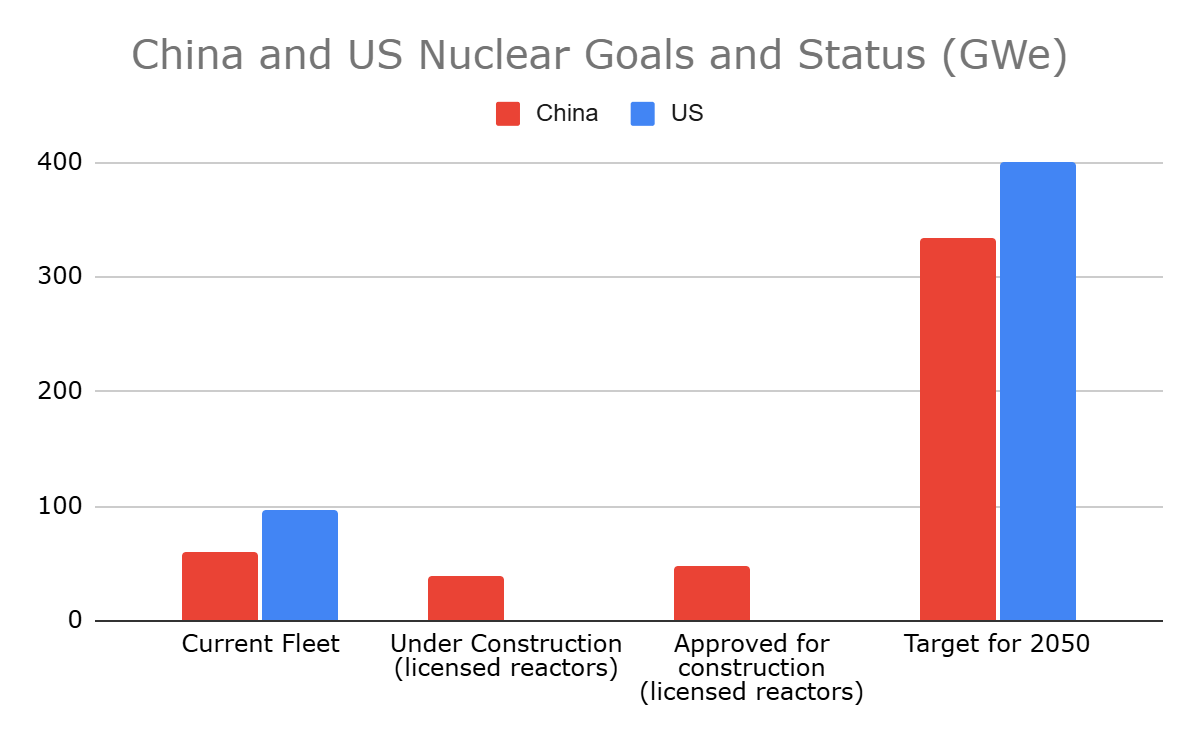
The United States, along with 38 other nations, pledged in November 2024 to triple nuclear energy by 2050. President Trump’s May 2025 Executive Order 14302, “Reinvigorating the Nuclear Industrial Base,” expanded that goal to quadrupling American nuclear energy generation to 400GW by 2050. According to Department of Energy estimates, this would require adding 35 GW of new nuclear capacity by 2035 alone. Then the country would need to add almost 25 GW of new nuclear power per year in each of the following fifteen years.
The United States currently has 94 operating reactors with a net capacity of 97 GW, constituting about 18% of total electricity generation. The U.S. also is working to facilitate 5GW of power uprates across the existing nuclear fleet and resurrecting mothballed reactors in Pennsylvania, Michigan, and Iowa that would add another 2.25 GW of nuclear energy this decade.
The Executive Order identified a goal of having 10 new large reactors under construction by 2030. At present, no new licensed power reactors are under construction in the U.S. However, construction licenses have been issued for TerraPower’s Natrium reactor in Wyoming and Kairos’ Hermes reactors I and II in Tennessee. Natrium is a 345 MW solium-cooled fast reactor. The Hermes II reactor is a 50 MW fluoride salt-cooled High Temperature Reactor. The Hermes I low-power demonstration reactor will precede it in development.
By contrast, China did not commit to the tripling of nuclear power by 2050 until March 2026. Its goal is to have 335 GW of nuclear power operational by 2050. It currently has 60 operating reactors, with a gross capacity of about 60 GW, constituting about 4% of total electricity generated. An additional 35 licensed reactors are currently under construction and are projected to add an additional 38 GW. China's 15th Five-Year Plan (2026-2030), published in March 2026, targets 110 GW of nuclear capacity by 2030. If this target is achieved, China would surpass the U.S., becoming the world’s largest generator of nuclear power.
This month, the Chairman of the China Nuclear Energy Association said that China’s installed nuclear power capacity is expected to reach 200GWe by 2040. Another study by the China Nuclear Power Development Center, a research institute under the National Energy Administration, stated that China’s nuclear capacity could reach 335 GW by 2050.
| | Cate Donovan, Della Ratta Fellow, Partnership for Global Security | | | | |
Spotlight
The need to define the regulatory jurisdiction of the Department of Energy and the Nuclear Regulatory Commission (NRC) has achieved a higher profile as the Trump administration seeks to accelerate the licensing and deployment of new nuclear reactors. A few weeks ago, Idaho National Laboratory Director, John Wagner, testified before Congress and advocated for more clearly defining the Department of Energy’s regulatory control over nuclear reactors on federal land. While the NRC has historically been the primary agency to regulate and license commercial nuclear reactors, the Trump administration conceives of reactors operating on federal land but also providing power to the electric grid. That has caused some tension and confusion over authorities.
To address these challenges, U.S. Senators Mike Lee and Dave McCormick have introduced the Nuclear Energy Innovation and Deployment Act (NEIDA) to accelerate the deployment of next-generation nuclear energy technologies and strengthen U.S. energy leadership. NEIDA establishes clear pathways to move innovative nuclear technologies from demonstration to deployment and clarifies the Department of Energy’s authority over nuclear facilities and materials. This bill seeks to support the government’s efforts to expand the United States’ nuclear energy sector.
| | Patrick Kendall, Program Director, Partnership for Global Security | | Issues of Special Interest | | Global AI and Data Center Energy | | |
Global nuclear industry leaders gathered in South Korea for the BEXCO annual conference with this year’s theme pertaining to nuclear energy and artificial intelligence. Participants emphasized that the rapid growth in AI technologies has reshaped global energy demand, and major technology companies have significantly increased investments in nuclear energy with total spending surpassing $30 billion over the past 18 months. The conference also included sessions focused on Southeast Asia where countries such as Singapore and Vietnam are exploring nuclear energy adoption.
Fermi co-founder and CEO Toby Neugebauer and CFO Miles Everson have departed the firm suddenly, sending the company’s shares down 25%. Although Neugebauer will remain on the company’s board, Fermi announced the departures, along with other plans, as part of Fermi 2.0. Fermi is currently developing an AI campus in Texas called Project Matador that will use nuclear reactors and other technologies to power data centers. However, the project has dealt with several setbacks in recent months, including friction with one of its primary customers.
Canadian engineering firm AtkinsRéalis announced a partnership with technology company Nvidia that will deliver nuclear-powered data center designs. Through the partnership, the firms said they will develop energy sources that can power the development of hyperscale centers that may cause strain on traditional power grids, and the centers will use Nvidia’s computing technologies for the streamlining of the planning process and integration into existing systems. Designs will likely range in capacity from 740 megawatts (MW) to 1 gigawatt (GW).
| | The Impact of Russia's Invasion of Ukraine on International Nuclear Affairs | | The IAEA reports that nuclear safety conditions in Ukraine remain unstable due to ongoing military activity, particularly around key facilities. Director General Rafael Mariano Grossi highlighted continued risks at the Zaporizhzhia Nuclear Power Plant, where external power supplies and overall security remain fragile. The most recent update from the agency notes that maintaining reliable off-site power is critical, as disruptions force reliance on backup systems needed to keep reactors safely cooled. IAEA teams are still present at Ukrainian nuclear sites, working to monitor conditions and help prevent an accident despite the challenging environment. | | Global Nuclear Developments, Geopolitics, & Governance | | |
The first VVER-TOI reactor at Russia’s Kursk II nuclear plant finished its testing phase and is prepared to begin commercial operation. During trial running, the unit was gradually brought up to full power after extensive safety and performance checks at different output levels. The new reactor is part of a next-generation design with enhanced safety features and longer equipment lifespan. Kursk II will ultimately replace older reactors at the existing plant, which are scheduled to be retired in the coming years.
In an interesting twist, Russian nuclear company Rosatom is exploring new energy projects in the Republic of Congo, focusing on small modular hydropower plants. The plan involves building two compact facilities with a combined capacity of about 2.6 megawatts to supply electricity to underserved regions. These modular plants are designed for quick installation, lower costs, and the ability to operate in remote areas with limited infrastructure. The initiative reflects expanding cooperation between Russia and Congo, following earlier agreements on energy and infrastructure development.
| | |
The China Nuclear Energy Association released a report stating that China is on track to achieve a total installed nuclear capacity of 125 GW, which would make China the largest nuclear operator in the world. Currently, China currently operates 60 commercial nuclear reactors and has 36 additional units under construction. This constitutes more than half of the nuclear construction projects currently active worldwide. The government expects to bring seven additional units online by the end of this year.
China General Nuclear Power announced that Unit 1 of the Taipingling nuclear power station project in Guangzhou has begun commercial operation. The 1,116-MW domestic Hualong One pressurized water reactor (PWR) unit was initially connected to the grid and produced its first electricity on 13 February. On April 19th, commissioning work on Unit 1was completed and met the conditions for commercial operation.
China National Nuclear Corporation (CNNC) announced that the outer steel dome has been installed at unit 4 of the Changjiang nuclear power plant in Hainan province. CNNC utilized 3D modeling technology in advance, allowing for precise simulation and collision detection of the hoisting path and connection points, thus mitigating potential risks. Construction on Changjiang units 3 and 4 (both Hualong One reactors) began in 2021. Both units are expected to be operational by 2027.
The reactor pressure vessel for Zhangzhou Nuclear Power Plant Unit 3 has been installed in China’s Fujian province. The vessel is the high strength steel cylinder that will house the reactor core and all of the associated components. China’s State Council approved the construction of two Hualong One reactor units at the Zhangzhou Plant in 2022, with construction on unit 3 beginning in 2024.
| | |
According to a draft document seen by Reuters, the European Union is set to caution its member states not to shut down their nuclear power plants early as part of a package of measures to offset surging energy prices and scale up clean technologies. The draft document says that nuclear power is a preferable option for clean power and provides flexibility facilitating the further roll-out of other clean technologies. Last month, European Commission President Ursula von der Leyen said that reducing Europe’s nuclear energy sector was a strategic mistake.
The European Commission has opened a consultation and a call for evidence on how the European Union bloc manages radioactive waste and spent nuclear fuel. The work will evaluate countries’ policies with the Shipment Directive and Radioactive Waste Directive, and it has already found that several countries have not defined national policies for the long-term management of all their radioactive waste. The report also identified targets in some national targets were not sufficiently ambitious, alongside weaknesses in how programs are controlled and funded.
Rolls-Royce SMR and Great British Energy-Nuclear (GBE-N) have signed a contract that enables work to immediately start on the delivery of three Rolls-Royce small modular reactors (SMR) at Wylfa. The agreement allows for work to start on the site, with Rolls-Royce SMR developing its site-specific design and ordering critical components from the supply chain. Rolls-Royce SMR was selected as the British government’s preferred technology for the Wylfa SMR project in June of last year, with £2.6 billion allocated to enable this contract and the wider program delivery.
Britain’s Tokamak Energy has been named the magnet systems partner for the United Kingdom’s STEP fusion program. Under the agreement, Tokamak Energy will act as a systems partner delivering eight work packages for magnets, working closely with United Kingdom Fusion Energy’s (UKFE) integrated program team across key areas such as magnets, tokamak systems, and plasma integration. In 2022, the West Burton coal-fired power plant site was selected to host the Spherical Tokamak for Energy Production (STEP), with operations scheduled by 2040.
Rosatom Director General Alexei Likhachev stated that his company is ready to discuss any questions that the incoming Hungarian government has about the Paks II Nuclear Power Plant. His comments follow the victory of Péter Magyar’s Tisza Party in the recent national elections, ending Viktor Orbán’s 16-year reign as prime minister. The current Paks II Nuclear Power Plant project is for two Russian-designed VVER-1200 reactors based on a 2014 intergovernmental agreement between Russia and Hungary.
Poland’s Synthos Green Energy (SGE) signed agreements with Spanish nuclear fuel manufacturers ENUSA Industrias Avanzadas and GNF ENUSA Nuclear Fuel to support the deployment of BWRX-300 small modular reactors (SMR) across Europe. SGE said the two agreements will allow the companies to develop a roadmap towards a fuel material procurement model and establish support related to the organizational and technical aspects of nuclear fuel supply. The BWRX-300 is an SMR developed by GE Vernova Hitachi.
Orlen Synthos Green Energy (OSGE) signed a preliminary agreement with Poland’s Industrial Development Agency to cooperate on a small modular reactor (SMR) project. This deal is an initial step toward a fuller investment arrangement for building and operating reactors at the Euro-Park Stalowa Wola industrial site. The planned plant would use GE Hitachi’s BWRX-300 reactor technology and could involve the development agency as a project investor. The site is part of a large economic zone with growing industrial energy demand, potentially reaching about 1,500 MW by 2030.
Korea Hydro & Nuclear Power (KHNP) President Kim Hoe-chun visited the Czech Republic to inspect the progress of the Dukovany Nuclear Power Plant and reinforce the company’s cooperation with local stakeholders. Kim reportedly met with Czech officials, project partners, and nuclear regulators in a series of discussions and also reviewed cooperation on licensing and infrastructure development. The Dukovany project entails the construction of two new APR1400 reactors, and the project is now entering its early implementation phase.
Czech energy group CEZ announced it has started a preparatory process to enable the long-term operation of the four reactors at the Dukovany Nuclear Power Plant, as well as considering extending the operation of the Temelín Power Plant’s two reactors. ČEZ signed a $19.6 billion contract with Korea Hydro & Nuclear Power (KHNP) last year for two additional APR1400 reactors to be built at Dukovany, with construction aimed to begin in 2029.
Canadian company ARC Clean Energy has signed a term sheet with IC Nuclear & Industry (ICN) to establish the commercial framework for deployment of its ARC-100 in Turkey and the wider Middle East region. The collaboration supports ICN’s active role in Turkey’s Domestic Nuclear Reactor Development Project and establishes a comprehensive framework for the deployment of advanced nuclear reactors. Turkey aims to finalize regulations and begin construction on prioritized small modular reactor (SMR) projects between 2030 and 2034.
The European Commission has opened an investigation to assess whether public support that Romania plans to grant for the refurbishment and lifetime extension of Cernavoda Nuclear Power Plant Unit 1 is in line with European Union state aid rules. Romania notified the Commission of its plan to support the refurbishment of Cernavoda 1 at an estimated nominal value of €3.2 billion ($3.8 billion). The Cernavoda Power Plant consists of two Candu-6 reactors, with the unit 1 refurbishment project beginning in 2017.
The Executive Director of the International Energy Agency (IEA), Fatih Birol, stated that Italy should reconsider its rejection of nuclear energy, stating that it will need stable and continuous energy production outside of renewables. Birol added that Italy should evaluate nuclear power carefully and that both traditional and modular reactors should be on the table. Nuclear power is currently prohibited in Italy following two referendums, but the current Italian government has been drafting rules to lift the ban.
Dutch nuclear company Thorizon has signed a memorandum of understanding with the province of Zeeland for the construction of a non-nuclear demonstrator Thorizon molten-salt reactor in the province before the deployment of the first commercial unit. The MoU sets out three milestones: construction of a non-nuclear molten salt test facility and the launch of the PILOT program, construction of the Thorizon Pioneer nuclear demonstrator, and construction of the Thorizon One in 2034.
Dutch heavy lifting and transport company Mammoet and nuclear company ULC-Energy signed a cooperation agreement to streamline the construction of new nuclear power facilities in the Netherlands. ULC-Energy is currently working to deliver multiple small modular reactors (SMR) both in the Netherlands and Belgium, and Rolls-Royce SMR signed an exclusive agreement with ULC-Energy in 2022 on the deployment of its SMRs in the Netherlands. In 2021, the Dutch coalition government prioritized nuclear power in its energy and climate policy.
The Swedish government announced it plans to take a majority stake in nuclear project development company Videberg Kraft and take a role in financing the future system for the disposal of radioactive waste and used nuclear fuel. The government said it is seeking authorization for the Riksdag to acquire shares of Videberg Kraft over the next two years and grant the state an ownership share of 60%. In May last year, Sweden’s parliament approved the government’s proposals for providing state aid to companies that want to invest in new nuclear reactors in the country.
The Swedish Radiation Safety Authority (SSM) has formally become a Party to the Nuclear Education, Skills, and Technology (NEST) Framework, joining a growing group of countries committed to strengthening nuclear education and training worldwide. Following the signing of the Act of Adhesion, institutions in Sweden are now eligible to participate in existing NEXT Projects that will expand Sweden’s engagement in international capacity building and knowledge transfer in the nuclear field.
| | |
Korea Hydro & Nuclear Power (KHNP) announced that Unit 3 of the Saeul Nuclear Power Plant has achieved a sustained chain reaction, making it the third of four APR-1400 reactors to achieve criticality at the site. Output from the unit will be gradually increased over the next six months and will begin commercial operation once its final performance and safety are verified. The Korean government authorized construction of two APR1400 units as Saeul units 3 and 4 back in 2014. Construction on unit 3 began in 2017, but progress has been suspended and delayed several times since.
Vietnam and South Korea’s leaders, To Lam and Lee Jae Myung, signed 12 non-binding documents that will expand bilateral cooperation in several areas, including nuclear energy development. The leaders have agreed to study the possibility of cooperation for nuclear power development and financing. Vietnam is currently looking for a new partner to develop a nuclear power plant by 2035 after Japan withdrew from the project.
Unit 6 of Japan’s Kashiwazaki-Kariwa Nuclear Power Plant has resumed commercial operations, becoming the first reactor owned by Tokyo Electric Power Corporation (Tepco) to do so since the Fukushima Daiichi nuclear meltdown in 2011. The reactor unit was originally restarted in February before being taken offline for inspections as part of procedures for its full-scale restart, and there was another delay in mid-March after a damaged electric conductor was discovered. The Kashiwazaki-Kariwa plant was already offline before the Fukushima Daiichi meltdown as work was being carried out to improve the plant’s earthquake resistance.
The HDFC Mutual Fund published a report arguing that India needs a coordinated push in uranium mining, fuel reprocessing, and long-term financing if the government is going to accelerate the expansion of its nuclear power sector. The report highlighted that while nuclear energy will play a large role in India’s energy transition, bridging existing gaps across the nuclear supply chain will be critical to meet the government’s capacity targets. The report adds that India will need to commission 3.5 to 4 gigawatts of nuclear capacity every year, which is nearly ten times the current pace.
Indian thermal power producer Adani has incorporated a new subsidiary to generate, transmit, and distribute power from nuclear energy. The Nuclear Power Corporation of India (NPCIL) previously announced that Adani has expressed interest in using the Bharat small reactors for its thermal power operations. Adani Power is the largest private thermal power producer in India, and the recent SHANTI Act of 2025 allows private companies to participate in India’s national nuclear sector.
The Kazakhstan Atomic Energy Agency published its strategy for the Development of the Nuclear Industry. The strategy sees Kazakhstan having at least operational three nuclear power plants by 2050 with a project for a fourth power plant possible. The agency added that options for constructing small modular reactor (SMR) power plants will also be considered. Kazakhstan is the world’s leading producer of uranium and is now preparing a nuclear power program.
Uzbek uranium company Navoiyuran announced the start of commercial in-situ uranium recovery at the Qizilkok deposit. After two years of pilot industrial operations and active work, the company has reached the stage of commercial production and will now contribute to the state’s program to expand uranium mining and processing volumes through 2030. Uzbekistan’s estimated uranium output is 4,000 tU as of 2024, making it the fifth largest uranium producer in the world.
| | U.S. Ambassador to Namibia John Giordano has indicated that the United States is considering increasing uranium imports from Namibia and supporting greater uranium output through mining companies and government financing. Namibia is the world’s third largest producer of uranium, which is the country’s largest commodity. The United States imported 633 metric tons of the fuel from Namibia in 2024, less than a tenth of the 8,413 tons China imported. China dominates Namibia’s mining industry, meaning the United States will have to develop new mines. | | The United Arab Emirates presented its Tenth National Report at the Review Meeting of the Contracting Parties to the Convention on Nuclear Safety (CNS). Its national report outlined the legislative, regulatory, and operational measures undertaken to fulfill its obligations under the CNS, highlighting significant progress since the previous review cycle. Some of the progress made includes the successful transition of all four units of the Barakah Nuclear Power Plant into full commercial operation and demonstrating the strength of the UAE’s regulatory framework. | | There are no new updates for this region. | | North America Nuclear Collaborations and Policy | | |
U.S. Energy Secretary Chris Wright told lawmakers that the first five new planned U.S. reactors will “almost certainly” receive loans from the Department of Energy’s Office of Energy Dominance Financing. The Office has nearly $290 billion to loan out to American nuclear energy developers, and Wright said last year that the biggest use of those dollars will be for nuclear power plants. These loans will support the Trump administration’s executive orders calling for 10 new large reactors to be under construction by 2030 and for the Nuclear Regulatory Commission (NRC) to speed up approvals for new reactors.
The U.S. Air Force selected three companies to install nuclear microreactors to power military sites. Radiant Industries, Antares Nuclear, and Westinghouse Electric will develop and operate the reactors at sites in Colorado, Texas, and Montana. Radiant expects to deliver the first systems by 2028, with Antares to follow by 2029. This is part of the United States’ greater push to deploy microreactors and small modular reactors (SMR) nationwide and follows the recent selections of the Buckley and Malmstrom Air Force Bases to host these small reactors.
The U.S. Air Force has selected the Buckley Air Force Base in Colorado and the Malmstrom Air Force Base in Montana as potential locations to site microreactors under the Advanced Nuclear Power for Installations (ANPI) program. In the coming months, the bases will be paired with an ANPI nuclear vendor technology that best fits the installation’s energy needs, with an anticipated deployment date of 2030 or earlier. The ANPI program was launched in 2024 by the Defense Innovation Unit aiming to deploy advanced microreactors on Air Force installations.
Advanced nuclear technology company TerraPower announced the official start of construction at its Natrium power plant in Kemmerer, Wyoming. TerraPower originally submitted its construction permit application to the Nuclear Regulatory Commission (NRC) in March 2024, and non-nuclear construction for the plant began in June of that year. The power plant is being developed through the Advanced Reactor Demonstration Program (ARDP), and it is expected to be completed in 2030.
Kairos Power has officially broken ground on the Hermes 2 demonstration reactor in Oak Ridge, Tennessee. The Hermes 2 will be Kairos Power’s first commercial-scale reactor and is also the first power-producing Generation-IV reactor to receive a construction permit from the Nuclear Regulatory Commission (NRC). Hermes 2 is being built and deployed as part of a 2024 agreement with Google to develop an advanced reactor fleet. It will supply up to 50 megawatts of electricity to the Tennessee Valley Authority grid.
The Nuclear Regulatory Commission (NRC) has approved Kairos Power’s request that the completion date specified in the construction permit for its Hermes 1 demonstration reactor be extended by 28 months. Kairos Power was granted a construction permit in 2023 for the Hermes 1 molten salt-cooled demonstration reactor in Oak Ridge, the first non-water-cooled reactor to be approved for construction in the United States in more than 50 years. Kairos Power broke ground for the scaled demonstration in 2024 with excavation works completed later this year.
South Carolina state-owned utility company Santee Cooper is expected to know by the first half of 2028 whether a $2.7 billion deal to revive the expansion of the VC Summer Nuclear Power Plant will officially go through. Santee Cooper reached an initial agreement with Brookfield Asset Management for the purchase of two partially built nuclear reactors at VC Summer, with Santee Cooper maintaining an ownership interest of up to 25% in the reactors. South Carolina originally sought to build additional reactors at VC Summer but abandoned the project in 2017 due to delays and cost overruns.
Gallup conducted a poll finding that American support for nuclear power is at an all-time high. Support for nuclear power has risen to 46%, which is the highest point to date since Gallup began conducting this poll 13 years ago. Still, over half of Americans (53%) oppose construction of a nuclear power plant in their area, with 34% of respondents strongly opposing such construction.
Advanced reactor company X-energy is targeting a valuation of up to $7.51 billion in its initial public offering, seeking up to $814.3 million through the sale of 42.9 million shares. The IPO roadhouse launch coincides with the S&P 500 reaching record closing highs and a nuclear energy resurgence for investors. X-energy is designing small modular reactors (SMR), and it previously planned to go public in 2023 before deciding against it due to tough market conditions.
New York expects to select a community this year to host at least 1 gigawatt of new nuclear energy, signaling a statewide push to accelerate nuclear reactor development. Eight upstate communities are vying for the project that could involve a single large reactor or multiple smaller units. New York Governor Kathy Hochul directed the New York Power Authority (NYPA) earlier this year to develop up to 5 gigawatts of new nuclear capacity, and the state also plans to issue a request for proposals to potential deployment partners later this year.
Inertia Enterprises announced a landmark partnership with Lawrence Livermore National Laboratory (LLNL) on fusion energy. The two sides signed two Strategic Partnership Projects and a new Cooperative Research and Development Agreement (CRADA) that allows Inertia to collaborate with Lawrence Livermore on research and development. To date, LLNL is home to the only facility in the world that has successfully demonstrated fusion energy gain.
The Trump administration is urging the Supreme Court to decline to hear a legal case on whether federal nuclear safety standards prevent courts from holding companies liable for alleged injuries from nuclear material under state tort law. Solicitor General John Sauer stated the fight over Cotter Corp’s liability for contamination of a stream isn’t ready for the justice’s review. Cotter Corp is facing legal action from two sisters who claim the company’s pollution of a creek in Missouri led to their cancer diagnosis.
First America Nuclear (FANCO) announced the submission of its regulatory engagement plan to the Nuclear Regulatory Commission (NRC) for its EAGL-1 small modular reactor (SMR) model. The filing formally opens the company’s pre-application engagement with the NRC and marks a significant milestone towards a construction permit. The EAGL-1 is a liquid metal fast reactor with a nuclear generation capacity of 240 megawatts electrical (MWe), and it is the first U.S. reactor design that will be cooled using lead-bismuth.
| | |
Nuclear fuel company Clean Core Thorium Energy signed an agreement with Canadian Nuclear Laboratories (CNL) for the manufacture of demonstration of its patented Advanced Nuclear Energy for Enriched Life (ANEEL) thorium fuel bundles. The company designed the thorium fuel for use in pressurized heavy water reactors, such as Candu reactors, saying it can be used to replace current uranium fuel bundles to reduce operating costs and waste volumes, increase safety and accident tolerance, and improve proliferation resistance. CNL will lead the development, qualification, and manufacturing of ANEEL fuel.
Bruce Power signed a memorandum of understanding with utility SaskPower to share its expertise in nuclear generation, project development, and long-term operations as Saskatchewan evaluates large nuclear technologies for potential use in the Canadian province. In October 2025, the Government of Saskatchewan released a First Energy Security Strategy and Supply Plan, under which the province will examine the feasibility of deploying SMRs. Then in January 2026, Saskatchewan and SaskPower announced plans to evaluate large nuclear reactor technologies.
Bruce Power also entered into a collaboration agreement with Energy Alberta, under which Bruce Power will share its nuclear energy experience, high‑level frameworks and lessons learned. Alberta does not currently have any nuclear power, but Energy Alberta has proposed construction of a plant featuring two to four Candu Monark reactors and separately signed a memorandum of understanding with Westinghouse to collaborate on exploring the deployment of an AP1000, while last year the province launched a public engagement initiative and public survey about nuclear energy's potential to meet future energy needs.
| | There are no new updates for this region. | | |
Nuclear Energy is Having a Global Revival 40 Years After Chernobyl
AP News, April 23
Reprocessing Gamble Could Drain Nuclear Waste Fund, Raise Electricity Prices
POWER Magazine, April 21
As America Accelerates Nuclear Ambitions, BWXT Delivers Necessary Speed and Scale
The Washington Times, April 21
Let’s Make Space Nuclear Again
The National Review, April 19
NRC Fee Reform Should Improve Performance, Not Impose Rigid Caps
The Breakthrough Institute, April 16
Modernizing California’s Nuclear Policy: Support for AB 2647
The Breakthrough Institute, April 15
Is America on the Verge of a Nuclear Renaissance?
Real Clear Energy, April 14
Can Germany Restart Is Nuclear Power Program? A Peek Inside a Decommissioned Reactor Suggests It Could
Politico, April 11
Need for Speed: The Regulatory Detour Slowing Grid Expansion
The Washington Examiner, April 10
Nuclear Fusion Power Approaches Critical Moment
Wood Mackenzie, April 10
Part 53: A Viable Licensing Pathway for New Reactors
The Breakthrough Institute, April 9
A Critical Moment for the Nuclear Safety Policeman
E&E News, April 9
| | |
News items and summaries compiled by:
Patrick Kendall, Program Director, Partnership for Global Security
Gabriela Zanko, Della Ratta Fellow, Partnership for Global Security
Cate Donovan, Della Ratta Fellow, Partnership for Global Security
| | For twenty-five years the Partnership for Global Security (PGS) has developed actionable responses to global security challenges by engaging international, private sector, and multidisciplinary expert partners to assess policy needs, identify effective strategies, and drive demonstrable results.
| | | | |