|
Greetings!
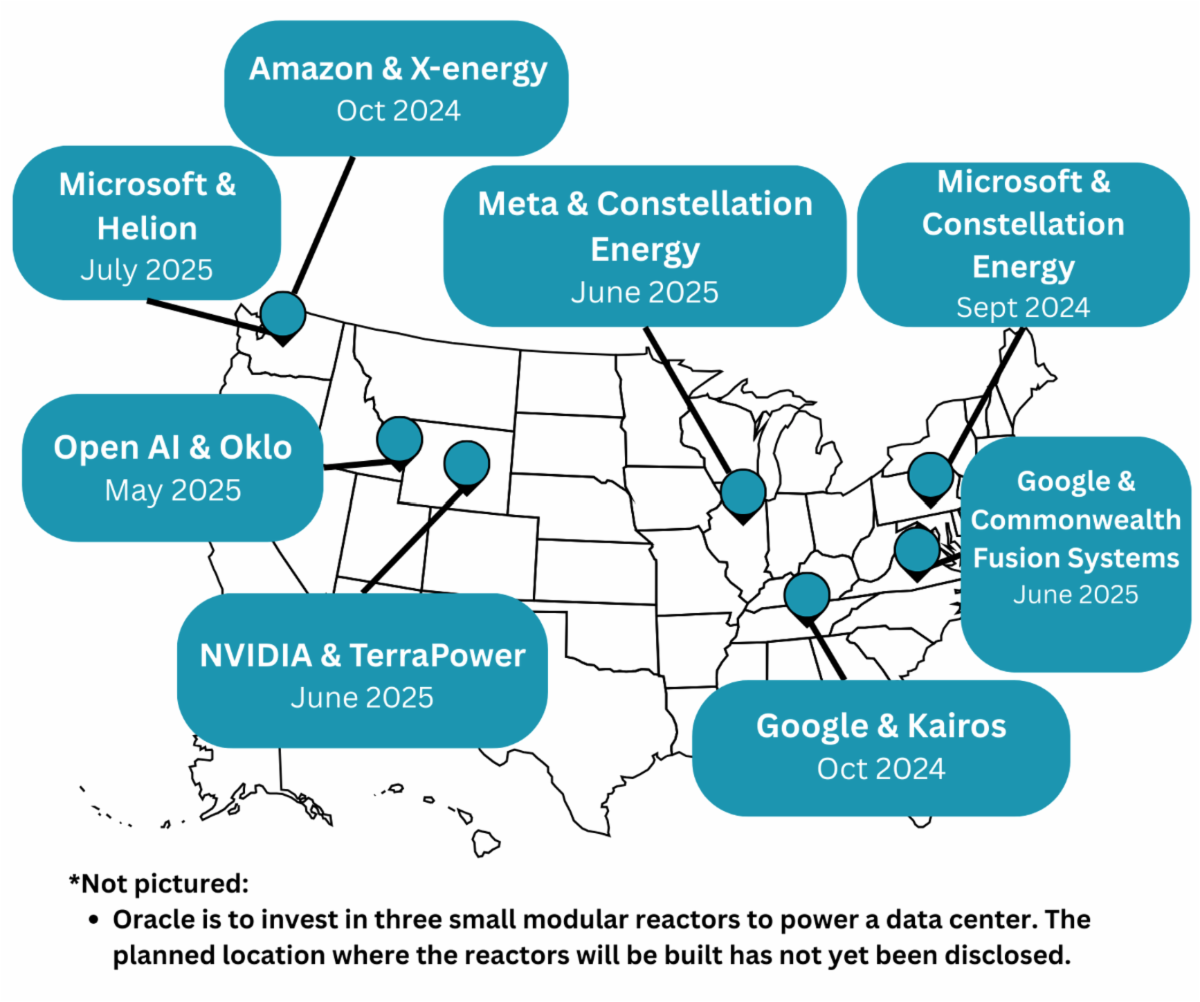
In this week’s newsletter, we provide an infographic that documents proposed tech company-nuclear energy partnerships designed to power U.S. artificial intelligence data centers. We spotlight the Trump administration’s launch of the Genesis Mission which seeks to expand U.S. use of artificial intelligence, including through nuclear fission and fusion power. Finally, we highlight key nuclear technology, security, and geopolitical developments, reports, and analyses.
This issue of Nuclear News and Views was produced by PGS Program Director, Patrick Kendall, and Della Ratta Energy and Global Security Fellows, Mackenzie Hansen and Gabriela Zanko.
| | AI’s Energy Challenge: Big Tech Is Betting on Nuclear | | |
To meet the rapidly rising energy demands required for AI to process massive volumes of data, tech companies are increasingly turning to nuclear power due to its sustainability, efficiency, and reliability. Their investments take several forms: restarting existing nuclear plants, funding the development of new reactors, and backing next-generation technologies that are not yet commercially proven, including small modular reactors (SMRs) and experimental fusion systems. Many of these nuclear projects are being developed alongside the data centers they are intended to support. The long-term success of these initiatives will depend on whether the industry can generate enough momentum to make these projects commercially viable.
Recent reported investments represented in the infographic above include:
● Microsoft and Constellation Energy agreed to restart Three Mile Island Unit 1, an 835-megawatt reactor.
● Meta plans to purchase 1.1 gigawatts of power from Constellation’s Clinton Clean Energy Center in Illinois beginning in June 2027.
● Google and NextEra have agreed to revive the 615 MW Duane Arnold nuclear plant in Iowa, and Google has partnered with Kairos Power, Elementl, and Commonwealth Fusion Systems.
● Amazon and X-energy are partnering on a 4 unit 320-megawatt SMR project with Energy Northwest in central Washington.
● Google and Kairos are investing in the 50 MW Hermes 2 Plant under development at Oak Ridge National Laboratory, Tennessee with the goal of ultimately deploying 500 MW of power.
● OpenAI and Oklo are collaborating to build an Aurora microreactor at the Idaho National Laboratory in Idaho Falls.
● NVIDIA and TerraPower are developing the first Natrium reactor plant in Wyoming, featuring a 345-MWe sodium-cooled fast reactor using HALEU fuel.
● Helion has begun construction on a nuclear fusion plant designed to supply power to Microsoft by 2028.
● Oracle intends to invest in three small modular reactors to power a data center, with the final site location yet to be announced.
| | Gabriela Zanko, Della Ratta Fellow, Partnership for Global Security | | | | |
Spotlight
U.S. President Donald Trump signed an executive order launching the Genesis Mission, a national effort to expand the use of artificial intelligence and bolster productivity. The Department of Energy will harness AI and advanced computing technology to double the productivity and impact of U.S. science and engineering within a decade, with nuclear fission and fusion energy being one of the priority domains to be included as part of the Genesis Mission. This announcement builds on a recent executive order passed by President Trump that directs the Department of Energy to co-locate data centers and new energy infrastructure on federal land.
| | Patrick Kendall, Program Director, Partnership for Global Security | | Issues of Special Interest | | Global AI and Data Center Energy | | |
Aalo Atomics has announced it will be collaborating with Microsoft on the use of the company’s generative AI for Aalo’s Energy Permitting Solution Accelerator. The primary goal of this deal is to streamline the regulatory and operational workflows to support Aalo’s nuclear manufacturing and deployment of its reactors. Aalo recently completed its Preliminary Design Review for its Aalo-X modular reactor that is planned to be built at the Idaho National Laboratory (INL) complex.
Westinghouse Electric is partnering with Google Cloud to develop a custom AI platform designed to optimize and accelerate the construction processes of nuclear reactors. The collaboration aims to address the logistical hurdles that have historically slowed down nuclear deployment, and early pilots of this platform are already demonstrating significant time and cost savings. This integration supports a recent Westinghouse initiative in which the company plans to have 10 of its AP1000 reactors under construction in the United States by 2030.
Terra Innovatum signed a Letter of Intent with U.S. technology firm Uvation to launch a 1 MWe pilot program that will support Uvation’s artificial intelligence and data center infrastructure needs. Using Terra Innovatum’s SOLO micro-modular reactor, this partnership seeks to fast-track the commercialization of Uvation’s AI by providing readily available power and sidestepping the delays and overruns inherent to traditional nuclear power projects. Terra Innovatum says it anticipates its SOLO reactor design to be available globally within the next 3 years, and it is also engaged in pre-application activities with the U.S. Nuclear Regulatory Commission (NRC).
| | The Impact of Russia's Invasion of Ukraine on International Nuclear Affairs | | |
Following a push by the Trump administration to bring about a peace deal in the Ukraine-Russia war, IAEA Director General Rafael Mariano Grossi stated that if an agreement is reached, a cooperation pact between Russia and Ukraine will need to be negotiated to ensure that the Zaporizhzhia Nuclear Power Plant can be operated safely. A draft of the 28-point peace plan included a proposal to have the plant restarted under IAEA supervision and electricity output equally split between Russia and Ukraine. Grossi stressed that no matter what the resolution may be on ownership of the plant, IAEA involvement will be necessary to ensure safe operation.
Ukraine’s government plans to appoint a new supervisory board for Energoatom by the end of the year amidst the company’s ongoing corruption scandal. The government dismissed Energoatom’s supervisory board in November after an investigation was launched into alleged corrupt activity. Energoatom is under fire over an alleged $100 million kickback scheme involving senior energy officials and a former business associate of President Volodymyr Zelenskyy.
| | Global Nuclear Developments, Geopolitics, & Governance | | |
Following regulatory approval, Russia’s Rosatom will begin 3D-printing equipment elements for its RITM-200 small modular reactors. Prototypes underwent various tests and Rosatom successfully received a certificate from the Russian Maritime Register of Shipping. Yuri Vytnov, Chief Technologist at Afrikantov OKBM, stated that obtaining regulatory approval for these 3D printed elements provides further possibilities for additive manufacturing to be utilized in other areas of the nuclear industry. 3D printing has already been explored in other nuclear industries such as Slovenia, the United States, and Sweden.
At an AI conference in Moscow, Russian President Vladimir Putin stated that Russia will be increasing nuclear energy capacity in order to ensure that its energy output can meet computing needs for artificial intelligence projects. Over the next two decades there are plans to build 38 nuclear power units. Putin highlighted the need for Russia to develop independent capabilities for artificial intelligence to eliminate the need for foreign support, and nuclear energy will be key in ensuring successful development of the sector.
Rosatom fuel division TVEL announced that the first new 9+ generation gas centrifuges have been launched at the Siberian Chemical Combine’s Isotope Separation Plant. Commissioning of the new centrifuges is scheduled to be completed in 2027. It is now the third of Rosatom’s four uranium enrichment sites to introduce the newest generation of centrifuges following upgrade projects launched in 2018 at the Urals Electrochemical Combine and the Electrochemical Plant in Siberia.
| | |
China’s State Power Investment Corporation completed factory acceptance testing of the full-scope operator training simulator for the first two CAP1000 units at the Lianjiang Nuclear Power Plant in Guangdong Province. The achievement marks the transition to on-site installation and supports workforce readiness ahead of reactor commissioning. The Lianjiang Phase I project, China’s first coastal CAP1000 development in Guangdong, is progressing toward initial operations in 2028 as part of a six-reactor buildout at the site.
China completed modular construction of the major safety systems for the second phase of the Xudabao Nuclear Power Plant in Liaoning Province, following installation of the final passive water tank module at Unit 4. The milestone concludes a four-year effort to apply large-scale modular assembly techniques to the Russian-supplied VVER-1200 reactor units. China National Nuclear Corporation (CNNC) said the approach has enhanced construction efficiency and safety performance and will support accelerated delivery of the two units, which are planned to enter service in 2027 and 2028 as part of a broader six-reactor buildout at the site.
Unit 2 of the Zhangzhou Nuclear Power Plant in Fujian Province has been connected to the grid, becoming the second Hualong One reactor at the site to begin electricity generation. China National Nuclear Corporation (CNNC) said all systems performed as designed following first power, with commercial operation expected later this year. The milestone completes Phase I of the six-unit project, supporting China’s clean-energy expansion and grid reliability in southern Fujian as additional units progress through construction.
The Shanghai Institute of Applied Physics (SINAP) announced it has achieved thorium-to-uranium fuel conversion inside the thermal experimental molten salt reactor (TMSR) in Wuwei. While the Institute did not release detailed technical data about the conversion process, the experimental TMSR confirms the technical feasibility of thorium utilization in a molten-salt reactor nuclear energy system. The TMSR is part of the Chinese Academy of Sciences’ (CAS) Strategic Priority Research Program launched back in 2011.
| | |
A British government review argues that the United Kingdom needs a “radical reset” of its nuclear power regulations after the country became the most expensive place in the world to build nuclear power plants. The review also recommended establishing a “one-stop shop” for nuclear decisions to reduce duplication and bureaucracy and argued that planning delays must be fixed. Prime Minister Keir Starmer commissioned this independent panel of experts earlier this year to review the country’s nuclear sector with the goal of speeding up new projects, reducing costs, and strengthening safety.
Framatome has completed the manufacturing of the reactor pressure vessel for the second of two EPR units being built at the Hinkley Point C Nuclear Power Plant in the United Kingdom. Électricité de France (EDF) added that the Hinkley Point C delegation also formally received the first two completed steam generators for Hinkley Point C Unit 2, which will be delivered to the power plant site in 2026. Construction of the Hinkley Point C Power Plant began back in 2018, with Unit 1 expected to become operational in 2030 after previous delays.
Électricité de France (EDF) CEO Bernard Fontana stated that the company is considering selling all of its U.S. renewable energy business in order to focus on building up its domestic nuclear energy operations. The company may sell 50 to 100% of its U.S. renewable business which could be valued at nearly $4.6 billion. EDF is prioritizing investments to strengthen its domestic nuclear energy fleet amid government frustration over delays in upgrading France’s nuclear reactors.
Türkiye Nükleer Enerji AS and Korea Electric Power Corporation (KEPCO) signed a memorandum of understanding on nuclear energy cooperation during a meeting between the two countries’ presidents. The MoU aims to facilitate the mutual sharing of technical data, information, and experience between the two countries in addition to developing joint nuclear power projects. Earlier this year, Turkish Energy Minister Alparslan Bayraktar stated that Turkey has engaged with South Korea on the prospect of collaborating on the construction of Turkey’s second planned nuclear power plant at Sinop.
The Czech Republic’s ÚJV Řež has signed a memorandum of understanding with Rolls-Royce SMR to deepen cooperation in the implementation of small modular reactor (SMR) technology in the Czech Republic and abroad. The memorandum will see the companies explore opportunities across areas such as nuclear safety analysis, design and engineering services, and licensing and regulatory requirements specific to the Czech Republic. The Czech government previously selected Rolls-Royce SMR’s technology to provide up to 3 gigawatts of nuclear power in the country.
A consortium of Laurentis Energy Partners, Canadian Nuclear Partners SA (CNPSA) and BWXT Canada signed an owner’s engineer contract to advance two new AP1000 units at Bulgaria’s Kozloduy Nuclear Power Plant. The contract will provide specialized technical advisory services and project management oversight for all of the major phases of the project. Bulgaria’s Kozloduy Nuclear Power Plant is its sole operational nuclear facility and consists of 2 reactors. The government aims to get the first of two proposed Westinghouse AP1000 units operational in 2035.
Molten salt reactor developer Thorizon announced it has secured support from Dutch companies and nuclear agencies for the construction of the molten-salt demonstration reactor Thorizon Pioneer. Horizon and a wide network of partners signed a joint Ambition Agreement to accelerate the project which brings together leading Dutch industrial companies, nuclear operator EPZ, and high-tech service providers. The Thorizon Pioneer project is part of Thorizon’s roadmap to industrialize molten salt reactors (MSRs) in the Netherlands and elsewhere in Europe.
Spanish group Grupo Dominguis Energy Services (GDES) and Korea Electric Power Corporation (KEPCO) Plant Service & Engineering signed a collaboration agreement to further the joint development of nuclear power projects in the Spanish and French markets, as well as expand cooperation in the field of nuclear power plant maintenance. GDES stated the alliance will enable both companies to share know-how, resources, and capabilities. KEPCO and GDES have decades of experience in the nuclear sector, with GDES participating in the construction of Spain’s nuclear power plants.
Several Danish organizations, universities, and companies have launched the Nuclear Power Alliance to advocate for the introduction of nuclear power in Denmark. The alliance is led by several Danish organizations such as the Confederation of Danish Industry, Dansk Metal, and the Novo Nordisk Foundation. Nuclear power has been banned in Denmark for the past 40 years, although two-thirds of Danish MPs supported the country launching an investigation into the possible use of nuclear power in May of this year.
Hungarian Foreign Affairs Minister Peter Szijjártó and Romanian Minister of Foreign Affairs Oana-Silva Țoiu met to discuss cooperation in the life extensions of their respective nuclear power plants. The talks covered general bilateral relations, including broader energy cooperation and wider bilateral links. Both countries are currently working on projects to extend the lifetimes of their nuclear power plants: Hungary’s Paks Nuclear Power Plant and Romania’s Cernavoda Nuclear Power Plant.
Unit 2 of Belgium’s Doel Nuclear Power Plant has been taken offline for the final time and disconnected from the national grid after 50 years of operation. Doel 2 has now entered the decommissioning phase in preparation for its dismantling, which will see fuel unloaded from the reactor and cooled in the storage pool. The reactor’s closure is in line with Belgium’s nuclear phase-out policy which has seen four reactors shut down. However, the government agreed to extend the operation of the Doel 4 and Tihange 3 reactors following the Russian invasion of Ukraine.
Norway’s Norsk Kjernekraft has proposed building a multi-reactor small modular reactor (SMR) plant producing about 12.5 TWh annually in the Taftøy industrial area between Aure and Heim. Norwegian ministries and regulatory agencies have prepared a draft Environmental Impact Assessment program for public consultation, and the Norwegian Environment Agency has invited neighboring countries to comment by 6 January 2026. Feedback will inform the Ministry of Energy’s final program, which will formally launch the full impact assessment and set a methodological model for the company’s nine other planned nuclear projects.
| | |
The Asian Development Bank has amended its energy policy in order to pave the way for financial support and cooperation for member countries that are looking to adopt and pursue nuclear power. The bank also signed a memorandum of understanding with the IAEA that will see the two organizations collaborate on identifying potential nuclear power projects such as those involving advanced reactor technology. The Asian Development Bank committed $3.8 billion to energy projects in 2024, with its pivot to nuclear following a similar move made by the World Bank earlier this year.
South Korean President Lee Jae-Myung stated that South Korea and the United States have agreed to form a joint venture to produce uranium fuel for Korean nuclear power plants. Lee also reaffirmed his country’s plans to build nuclear-powered submarines domestically despite U.S. President Donald Trump’s suggestion that they be built in the United States. South Korea has long wanted to enrich uranium as fuel for its nuclear reactor fleet and to reprocess spent fuel for waste management. But a bilateral nuclear treaty with the United States forbids South Korea from engaging in these activities. There are many details to be determined in all of these new areas of cooperation.
Indian Prime Minister Narendra Modi stated his government’s intention of opening India’s nuclear sector to private companies ahead of a legislative session that will see the Indian parliament consider new atomic energy legislation. Modi stated that this shift to private sector projects will create opportunities for small modular reactors and other advanced reactor technologies to be deployed. The Indian government has begun the process of amending the Atomic Energy Act and the Civil Liability for Nuclear Damage Act as part of its goal of deploying 100 gigawatts of nuclear power by 2047. Nuclear liability disagreements have prevented U.S. companies for participating in India’s reactor market despite a 2008 agreement to facilitate this cooperation.
The director of Japan’s Kashiwazaki-Kariwa Nuclear Power Plant stated that the power plant could be restarted as soon as January 2026 if the consent process is completed by the end of the year. A Japanese government official recently gave the green light for a partial restart of the plant, and the Niigata Prefecture is set to vote on his decision during its upcoming regular session. If approved, this restart would be the first for a Japanese nuclear reactor following the Fukushima Daiichi nuclear power plant meltdown in 2011.
Japan’s Starlight Engine and Kyoto Fusioneering announced that the Fusion by Advanced Superconducting Tokamak (FAST) project has reached its first key milestone with the publication of its Conceptual Design Report. The report has been put together by companies, researchers, and nuclear energy experts following the project’s launch in November of last year. The goal of this project is to demonstrate fusion energy power generation in Japan in the 2030s and for construction on the FAST facility to begin after 2028.
Russian President Vladimir Putin claimed that Kyrgyzstan is exploring the possibility of building its first nuclear power plant using Russian-designed small modular reactors (SMR). Following his meeting with Kyrgyz President Sadyr Japarov, Putin stated that Rosatom is already implementing a large-scale reclamation program in the country for uranium mining sites and that the possibility of building a nuclear power plant was also discussed. Kyrgyz Energy Minister Altynbek Rysbekov previously said that Kyrgyzstan was working with Rosatom to determine suitable areas for a nuclear power plant during the World Atomic Week forum held in Moscow.
Taiwan’s Ministry of Economic Affairs has approved Taipower’s report on the current condition of its decommissioned nuclear power plants. Taipower conducted a status assessment of the Chinshan, Kuosheng, and Maanshan Nuclear Power Plants in accordance with the Nuclear Regulation Act, and it determined that the Kuosheng and Maanshan plants would be feasible for reoperation. Taiwan previously sought to decommission its nuclear power plants by 2025, but the government recently passed an amendment allowing nuclear power plant operators to apply for a 20-year license extension past the existing 40-year limit.
Uzbek President Shavkat Mirziyoyev visited his country’s Jizzakh region to oversee the progress of Uzbekistan’s first nuclear power plant. Construction work is underway at the chosen site, with preparations taking place for the construction base and a temporary residential complex for the project’s workers. Excavation work began in October for the pit of the planned power plant, and it will feature two Russian RITM-200N small modular reactors (SMR) and two larger VVER-1000 reactors. The power plant is set to be the first export order for Russia’s RITM-200N SMR.
| | |
Rwanda and Senegal joined the Declaration to Triple Nuclear Energy by 2050 at the COP30 climate conference in Brazil. The two African nations join 31 other countries, 16 major financial institutions, and over 140 nuclear companies that have endorsed the declaration which was originally launched at COP28. Nuclear energy has become a more desirable option for countries in Africa looking to expand their energy generation, with the IAEA projecting Africa’s nuclear generating capacity tripling by 2030.
Niger’s government announced its plans to put uranium produced from the Arlit uranium mine on the international market just days after former operator Orano condemned a reported shipment of material from the site as illegal. The mine was previously majority owned by Orano until the Nigerien authorities appropriated and nationalized the Somaïr joint venture. Despite the opposition from Orano, the Nigerien government stated it has the legitimate right to dispose of its natural resources and sell them to whoever wants to buy them.
| | |
Korea Electric Power Corporation (KEPCO) and Emirates Nuclear Energy Company (ENEC) signed a memorandum of understanding to expand cooperation in advanced nuclear technologies, artificial intelligence, and digital transformation to support both countries’ nuclear fleets. The MoU will also see both countries collaborate on potential nuclear energy projects in third countries. KEPCO and ENEC have a long history of collaborating on nuclear energy projects, including the construction of the United Arab Emirates’ Barakah Nuclear Power Plant which began in 2012.
Framatome has manufactured the first lead fuel assemblies for the Emirates Nuclear Energy Company’s (ENEC) Barakah Nuclear Power Plant under a fuel supply agreement. The fuel assemblies were manufactured at Framatome’s U.S. facility in Kirkland, Washington, and will now be delivered for testing at the Barakah Power Plant. In July of this year, the two companies agreed that Framatome would supply complete nuclear fuel assemblies for use at Barakah, as well as providing engineering support services from its U.S. headquarters in Virginia.
| | |
China National Nuclear Corporation (CNNC) and Brazil’s National Nuclear Energy Commission (CNEN) signed a memorandum of understanding to strengthen their existing partnership in nuclear environmental protection and radioactive waste management. The agreement establishes their commitment to continuous cooperation in the areas of waste treatment, transportation and disposal, radiological protection, and personnel training. Brazil and China have recently bolstered their engagement in nuclear energy, including a separate MoU for the supply of Chinese radioisotopes to CNEN facilities.
Brazil’s National Nuclear Energy Commission (CNEN) announced it aims to start construction of the Centena radioactive waste repository in 2026. CNEN added that a preferred site has been selected in southeast Brazil and that the facilities will cost approximately $24.2 million. The ultimate aim is to complete construction of the repository in 2030, after which it would become the first radioactive waste repository in all of Latin America.
| | North America Nuclear Collaborations and Policy | | |
The Department of Energy announced an organizational realignment aimed at expanding America’s energy production and accelerating scientific and technological leadership. The Office of Security and the National Nuclear Security Administration (NNSA) will not see any of its offices cut. However, the Office of Nuclear Energy has been moved to the Office of Energy, and the new Office of Fusion is now under the Office of Science. While the creation of Office of Fusion is a notable step for executive support in the field, the dismantlement of the Office of Clean Energy Demonstrations (OCED) may have implications on how the Department of Energy supports advanced nuclear projects.
The Department of Defense’s Project Pele microreactor prototype received its tri-structural isotropic (TRISO) particle fuel at the Idaho National Laboratory. With 40,000 TRISO fuel compacts sent by BWX Technologies (BWXT) from its Virginia facility to INL’s Transient Reactor Test Facility (TREAT), the fuel represents the first TRISO microreactor fuel to be delivered to its final destination in the United States. Project Pele aims to build and demonstrate a high-temperature gas-cooled mobile microreactor that can be deployed at U.S. military bases, with formal system testing slated to begin as early as 2027.
The Department of Energy granted $400 million to the Tennessee Valley Authority (TVA) to continue the deployment of GE Hitachi’s BWRX-300 small modular reactor (SMR) at the Clinch River site in Tennessee. Commercial operation of the first BWRX-300 SMR at Clinch River is currently targeted for the early 2030s and would become the nation’s first commercial SMR if deployed on time. TVA led a coalition of partners in applying for funding through the DoE’s Generation III+ SMR program and submitted its construction permit application to the Nuclear Regulatory Commission (NRC) in May of this year.
Holtec International has received $400 million from the federal government to aid the construction of two small modular reactors at the Palisades Nuclear Power Plant in Michigan, with the money going towards licensing, pre-construction, and supply-chain mobilization. The $400 million was granted as part of the Department of Energy’s “First Mover Team Support” award under the government’s Generation III+ Small Modular Reactor Pathway to Development Program. The Palisades Nuclear Power Plant is undergoing the process of reactivation after being shut down in 2022.
The Nuclear Regulatory Commission (NRC) has completed its final construction safety evaluation for TerraPower’s application one month ahead of schedule to build the Kemmerer Power Station Unit 1 in Wyoming. The NRC staff began its formal review of TerraPower’s application in 2024 with an original target date of August 2026 to complete the review. However, it announced plans to accelerate the process earlier this year and is now aiming to complete it by the end of 2025. The Kemmerer Power Station is intended to demonstrate TerraPower’s Natrium sodium-cooled fast reactor technology.
Amazon announced its plans to invest in the Cascade Advanced Energy Facility in Washington state. The facility will be built by Energy Northwest and will consist of 12 X-energy small modular reactors (SMR), with Amazon granting an investment of $500 million for the project. Amazon added that the construction phase for the Cascade facility is set to begin by the end of 2030, with the current targeted completion date being sometime in the mid-2030s.
Idaho National Laboratory (INL) has launched the full-scale production of enriched fuel salt for the world’s first test of a molten chloride salt reactor. The first fuel salt production batch for the Molten Chloride Reactor Experiment (MCRE) was delivered in September, with four further batches to be produced by March 2026. The MCRE is planned to be the first reactor experiment hosted at the Laboratory for Operation and Testing in the United States (LOTUS) test bed being built at INL by the Department of Energy’s National Reactor Innovation Center.
The Department of Energy announced that General Atomics successfully completed the conceptual design of its new helium gas-cooled fast modular reactor (FMR). According to the DoE, General Atomics completed its design through various modeling and lab-scale tests to verify the performance of key safety systems, fuel, and operations. The FMR is one of three early-stage concept projects supported by the DoE’s Advanced Reactor Concepts 2020 (ARC-20), which is part of the broader Advanced Reactor Demonstration Program (ARDP).
Nuclear energy startup Deep Fission revealed the name of its proposed underground small modular reactor (SMR): the Gravity Nuclear Reactor. The company says Gravity will operate a mile underground where natural pressure and surrounding rock will create a built-in containment system and reduce the need for massive surface structures. This is another step forward for Deep Fission’s underground reactor project that is part of the Department of Energy’s Reactor Pilot Program. The company is planning for the reactor to reach first criticality by 2026.
Advanced nuclear startup Antares announced the close of its $96 million Series B funding round, consisting of $71 million in new equity capital and $25 million in debt for equipment, factory build-out, and uranium procurement. The funding was led by Shine Capital with participation from Alt Capital, Industrious, and other investors. Antares is working to demonstrate a low-power test reactor before 2026, with production units planned to be deployed as early as 2028.
Four Nebraska public power utilities have signed a memorandum of understanding to form the Great Plains New Nuclear Consortium which will explore the feasibility and development of deploying new nuclear technology in the state. The Consortium will focus on feasibility studies, site evaluations, and technology assessments for between 1,000 and 2,000 megawatts of new nuclear capacity, including small modular reactors (SMR). Nebraska currently operates the single-unit Cooper Nuclear Power Plant.
The Senate Environment and Public Works Committee will question nominee Douglas Weaver to fill the last open commissioner slot of the Nuclear Regulatory Commission (NRC). The committee is also holding a confirmation hearing on Lee Beaman to serve on the Tennessee Valley Authority (TVA), which currently has six vacancies following numerous firings by the Trump administration. Weaver has worked at nuclear companies Holtec International and Westinghouse Electric and has experience working for the NRC in the past.
Nuclear company X-energy has raised $700 million in its Series D round, bringing the total raised thus far by the company to $1.8 billion. This new round comes less than a year after X-energy expanded its Series C funding from $500 million to $700 million, with the latest finances being used to help build the supply chain for its small modular reactors (SMR). Thus far, X-energy states it has orders for 144 SMRs worldwide, with its customers including Amazon, Dow, and Centrica.
| | |
The Ontario government authorized Ontario Power Generation to refurbish four CANDU reactors at the Pickering Nuclear Generating Station, enabling continued operation for up to 38 more years. The C$26.8 billion project is expected to support roughly 30,500 jobs during refurbishment, leverage lessons from the ongoing Darlington project, and replace major components including 48 steam generators. Work will continue through the project definition phase in 2026, with execution expected to begin in 2027 pending regulatory approvals.
Canada and India are finalizing a deal to supply India with uranium. The deal would be worth $2.8 billion and run for 10 years, with Cameco supplying the uranium for India’s nuclear power plants. This deal is part of a comprehensive economic partnership signed by Canadian Prime Minister Mark Carney and Indian Prime Minister Narendra Modi. This new agreement restarts trade talks that have been shelved for the past two years.
A federal-provincial memorandum of understanding signed by Prime Minister Mark Carney and Alberta Premier Danielle Smith includes a commitment to jointly develop a nuclear generation strategy by 2027 to support deployment of competitive nuclear power in Alberta by 2050. The agreement aims to strengthen Canada’s energy sector, decarbonize electricity, and grow export opportunities, with nuclear identified alongside CCUS and energy storage as key technologies. Alberta, currently without nuclear power, is already assessing potential CANDU and AP1000 projects and SMR applications for the oil sands sector.
Bruce Power signed an agreement with Siemens Energy Canada to replace the high-pressure steam turbines at Bruce A, adding about 125 MW of additional clean generation as part of its ongoing Project 2030 upgrade and life-extension program. The uprates will be installed between 2028 and 2031 and support the long-term operation of the station by extending reactor life and improving efficiency.
| | There are no new updates for this region. | | |
Risks of DOE’s Surplus Plutonium Program Assessed. It Won’t Be Easy to Do It.
Neutron Bytes, December 1
Delivering Nuclear Energy: Promise vs. Regulatory Reality
POWER Magazine, December 1
Unleashing Colorado’s Nuclear Potential
The Denver Gazette, November 28
Kilowatts or Connections? Trump’s Favored Nuclear Start-Ups Soar to Riches
The Washington Post, November 26
Give Nuclear Power Another Chance
The New York Times, November 26
A Sustainable Nuclear Future Requires Transparent Regulation
The Carnegie Endowment for International Peace, November 24
Environmental Regulations Are Killing Nuclear Power
The Spectator, November 24
This Startup Wants to Build a Fusion Reactor – On a Boat
Tech Crunch, November 24
Can the U.S. Make Big Nuclear Reactors?
The Wall Street Journal, November 24
How AI Is Ushering In a New Nuclear Age
Forbes, November 21
How to Separate Hype From Reality in Microreactors
The Washington Examiner, November 21
US Small Reactor Developers Face Challenges in Europe
Reuters, November 20
What the U.S.-Saudi Nuclear Deal Means for the American Nuclear Industry
The Breakthrough Institute, November 19
| | |
News items and summaries compiled by:
Patrick Kendall, Program Director, Partnership for Global Security
Mackenzie Hansen, Della Ratta Fellow, Partnership for Global Security
Gabriela Zanko, Della Ratta Fellow, Partnership for Global Security
| | For twenty-five years the Partnership for Global Security (PGS) has developed actionable responses to global security challenges by engaging international, private sector, and multidisciplinary expert partners to assess policy needs, identify effective strategies, and drive demonstrable results.
| | | | |