|
Greetings!
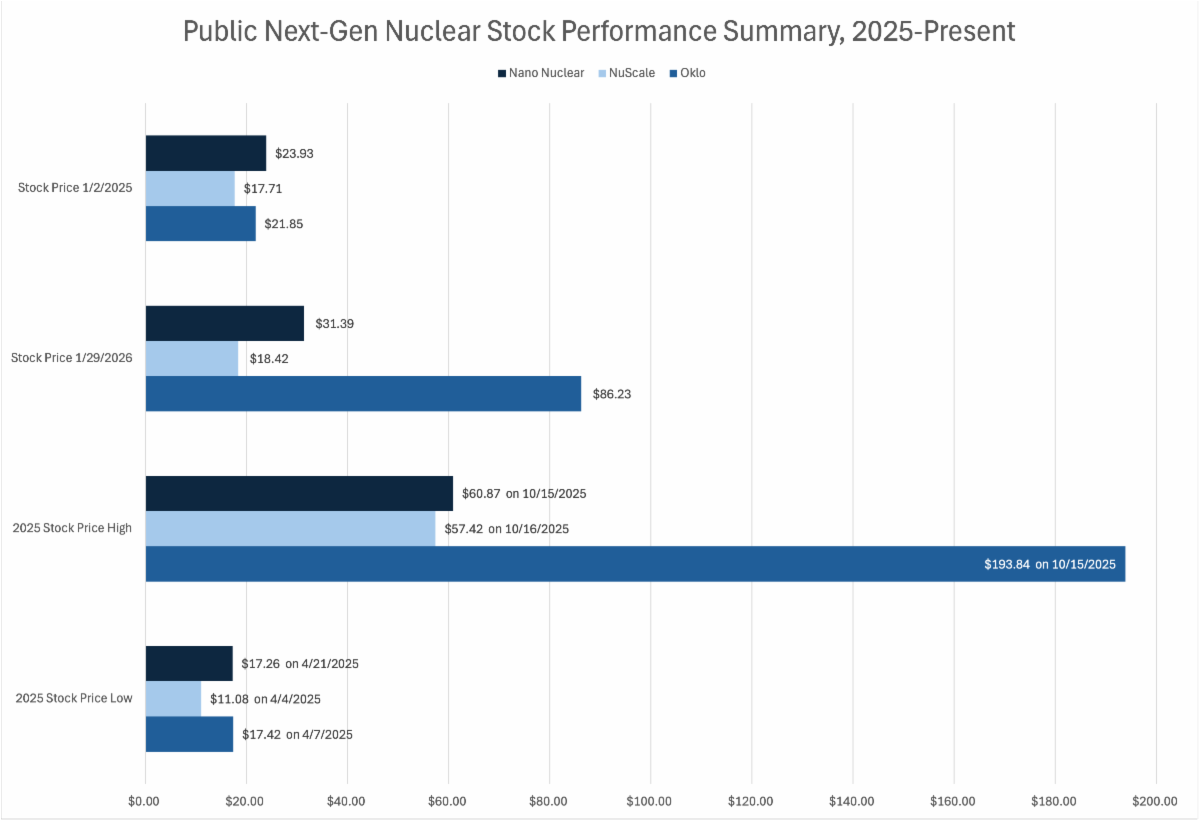
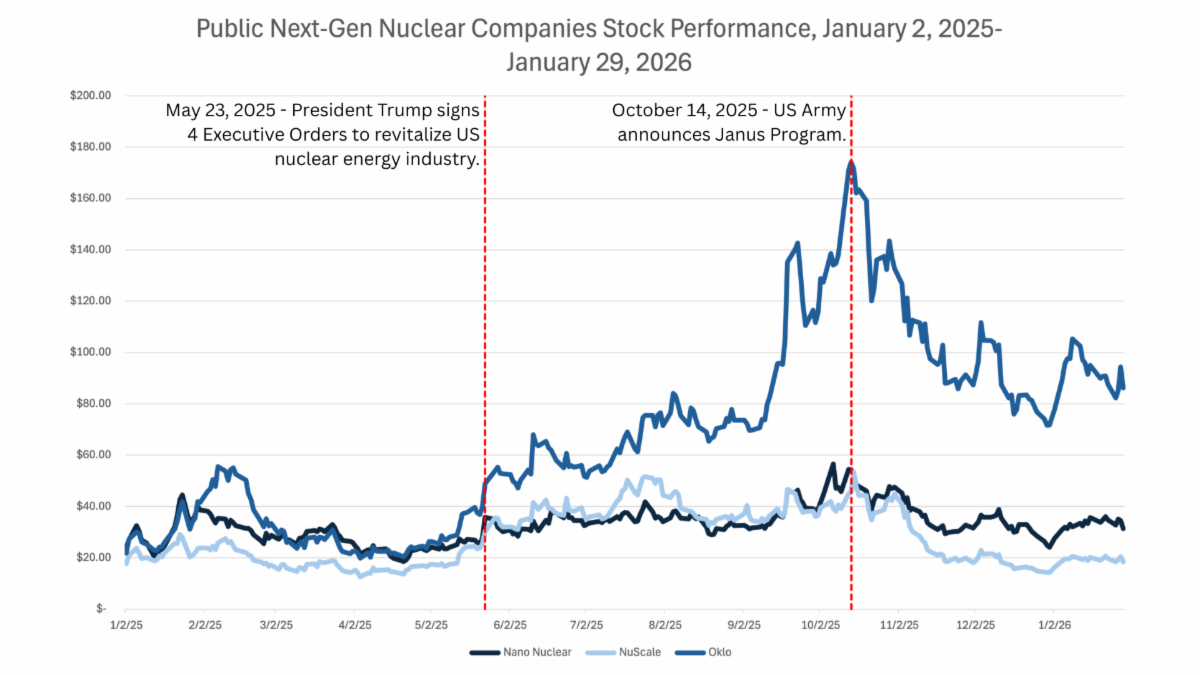
In this week’s issue, we provide infographics on how three key next-generation nuclear reactor company stock prices have fared in 2025. We spotlight an article from Utility Dive that argues for changes in the way that nuclear power plant projects are financed. Finally, we highlight key nuclear technology, security, and geopolitical developments, reports, and analyses.
This issue of Nuclear News and Views was produced by PGS Program Director, Patrick Kendall, and Della Ratta Energy and Global Security Fellows, Mackenzie Hansen, Gabriela Zanko, and Cate Donovan.
| | Public Next-Gen Nuclear Stock Performance Tracker | | |
When the Trump administration arrived in January 2025 it made expanding U.S. nuclear power a major item on its “energy dominance” agenda. It now has identified 8 Big Wins in its first year, including “Unleashing American-Made SMRs” and forging ahead with advanced reactors. There are a significant number of these types of next-generation reactors under development. Many are still in the design phase but a number of them have MOUs with the nation’s major technology companies to power data centers. Some of these new reactors may be tested on federal land and potentially operated on military bases. All require future licensing for commercial operation, and only NuScale’s Power Module has received design approval.
Many of the next-gen reactor companies are privately held, but a few are publicly traded. These graphs provide an overview of how three publicly traded SMR and advanced reactor companies, NANO Nuclear, Oklo, and NuScale, performed in the stock market in 2025. A significant climb in value occurred between the announcement of the Trump nuclear energy Executive Orders in late May 2025 and the announcement of the Department of Defense’s Janus program in mid-October. All three companies hit their lowest stock price for the year in April and their highest price on October 15 or 16. Since then, the values have significantly cooled. But ending this week, all remain above the January 2025 level.
| | |
Ken Luongo, President, Partnership for Global Security
Cate Donovan, Della Ratta Fellow, Partnership for Global Security
| | | | |
Spotlight
Bank of America Vice President of infrastructure and sustainable finance Ruhani Arya wrote an article for Utility Dive arguing that the next wave of U.S. nuclear expansion needs to be funded through project finance. Arya argues that the traditional financing model of using corporate balance sheets punishes shareholders and ratepayers when project costs rise like at the Vogtle Nuclear Power Plant. Project finance addresses this issue by involving a risk allocation that distributes project costs in a way that doesn’t negatively impact the deployment of nuclear power plant projects. Arya adds that an ideal financing approach for nuclear projects would mirror large-scale data center development projects with reactor designer companies, equity partners, and government incentives financing nuclear power plant deployment.
| | Patrick Kendall, Program Director, Partnership for Global Security | | Issues of Special Interest | | Global AI and Data Center Energy | | |
Advanced fission power company Oklo Inc. and technology company Meta Platforms are partnering to establish a 1.2 gigawatt power campus at the Portsmouth Gaseous Diffusion Plant in Ohio. The campus will be composed of a network of facilities producing nuclear power and will be built to support the region’s Meta data centers. The first phase of the project will build two powerhouses then power production will be incrementally increased until 1.2 GW is reached around 2034. The Portsmouth plant has been operating since the 1960s.
U.S. utility NextEra Energy announced it could add up to 6 gigawatts electrical (GWe) of small modular reactor (SMR) generating capacity at its existing power plant sites and potential new sites to meet the rising electricity demand from data centers. During a recent call with investors, CEO John Ketchum said the company will continue adding generating capacity to its nuclear fleet, including the recommissioning of the Duane Arnold Nuclear Power Plant in Iowa. NextEra has recently signed deals with Google, including a 25-year purchase power agreement from the Duane Arnold plant.
| | The Impact of Russia's Invasion of Ukraine on International Nuclear Affairs | | |
Ukraine’s Zaporizhzhia Nuclear Power Plant has been reconnected to its 330-kV backup power line after repairs were completed under a temporary ceasefire brokered by the IAEA. The line had been offline since early January, leaving the site dependent on a single 750-kV main line to power safety systems needed to cool six shut-down reactors and spent fuel pools. IAEA experts monitored frontline repair work and confirmed restored access to both external power lines, while warning that further damage could seriously undermine nuclear safety.
The Chernobyl Nuclear Power Plant temporarily lost all off-site power after a Russian strike damaged key electrical substations, though Ukraine has since restored supply and confirmed radiation levels remain safe, according to the IAEA and Ukraine’s energy ministry. The attack, part of wider strikes on Ukrainian infrastructure, involved 27 missiles and 315 drones intercepted, while five missiles and 24 drones hit 11 sites. Ukraine operates four nuclear plants with 15 reactors, supplying about 50% of the country’s electricity, and officials condemned the strike as a deliberate risk to nuclear safety.
| | Global Nuclear Developments, Geopolitics, & Governance | | The World Nuclear Association released a report finding that global nuclear generating capacity could reach 1,446 gigawatts electrical (GWe) by 2050 if governments hit their targets for deploying new nuclear reactors. The report compiled national government targets and goals for nuclear capacity for 2050 and assessed them alongside other nuclear deployment plans and their status. If realized, the output would exceed the COP28 conference pledge endorsed by more than 30 countries to at least triple nuclear capacity by 2050. There are currently about 440 nuclear power reactors worldwide with a combined capacity of almost 397 GWe. | | |
Uzbekistan and Russia have reaffirmed that construction of the country’s first small modular reactor remains on schedule, with first concrete expected before December 2026. Rosatom stated that preparatory work is progressing and that concrete pouring could begin as early as this spring, subject to licensing and regulatory approvals. The project includes SMRs based on the 55 Mwe RITM-200N marine reactor alongside plans for larger VVER-1000 reactors.
Russia’s nuclear regulator Rostekhnadzor approved a five-year life extension for Leningrad Nuclear Power Plant’s unit 4, allowing the RBMK-1000 reactor to operate for up to 50 years. The decision followed extensive safety reviews, inspections, and modernization work to ensure compliance with current reliability and safety standards. The regulator also renewed the plant’s license to handle radioactive materials for isotope production through 2030. Leningrad unit 4 plays a key role in supplying power to St Petersburg and northwest Russia as newer VVER-1200 units are phased in nearby.
Roscosmos has signed a contract with NPO Lavochkin for the creation of a Russian nuclear-powered lunar station by 2036. Roscosmos said the purpose of the lunar power station would be long-term supply of electricity to the Russian Lunar program, as well as infrastructure facilities of the International Lunar Research Station. Russia and China have recently signed agreements to cooperate on the creation of a lunar base powered by nuclear energy, with Roscosmos and China National Space Administration leading cooperation on the development of the International Lunar Research Station.
Rosatom expects up to four overseas nuclear units to reach start-up stages in 2026, including projects in Bangladesh, Turkey, and two sites in China, according to Director General Alexei Likhachev. He said units at Rooppur, Akkuyu, Tianwan, and Xudabao are nearing key milestones, despite delays caused by sanctions and financing challenges. Progress has also resumed on Hungary’s Paks II project, with first concrete now expected in early 2025. Likhachev emphasized that long reactor lifetimes require complex financing models and noted efforts to attract international debt and investors.
Rosatom delivered the first nuclear fuel for a VVER-1200 reactor to China, marking the initial fuel load for Tianwan Nuclear Power Plant’s unit 7. The fuel was produced in Russia and supplied under contracts covering units 7 and 8, both Russian-designed reactors in Jiangsu province. This is the first time VVER-1200 fuel has been shipped to China, building on earlier cooperation involving VVER-1000 fuel and increasing localization of fuel production within the country.
| | |
China has begun construction of the Xuwei Nuclear Power Plant in Jiangsu province, marking a significant addition to its expanding nuclear fleet. The project will feature two Hualong One (HPR1000) large reactors and one HTR-PM600 high-temperature gas-cooled reactor unit, with steam heat exchange technology providing both electricity and industrial heat for local users. The initiative reflects China’s dual focus on scaling traditional large-scale nuclear plants while integrating advanced reactor technologies into broader energy and industrial systems.
Reactor internals have been delivered to Xudabao Unit 1 in Liaoning Province, advancing construction of the first CAP1000 reactor at the site. China National Nuclear Corporation (CNNC) said the delivery followed detailed planning and process simulations to reduce risk and keep the project on schedule, clearing the way for the next phase of main equipment installation. Xudabao Units 1 and 2 are China’s domestically adapted AP1000 reactors and form the first phase of a larger multi-unit project that also includes Russian-designed VVER-1200 units already under construction.
China National Nuclear Corporation (CNNC) completed installation of all three steam generators at Zhangzhou Unit 3 in Fujian Province, marking another major construction milestone for the third Hualong One reactor at the site. CNNC said the work builds on lessons learned from the first phase of the project and clears the path for upcoming activities including containment dome installation and main pipeline welding. Zhangzhou Units 1 and 2 entered commercial operation in January 2025 and January 2026, respectively, while Units 3 and 4 are under construction as part of the plant’s second phase.
| | |
German Chancellor Friedrich Merz stated that Germany’s decision to shut down all of its nuclear power plants was a “huge mistake” and has come at a high cost of the economy. Merz added that the country does not have enough energy generation capacity to meet the national demand, and the energy system now relies on state intervention to keep prices at acceptable levels. Germany’s government decided to phase out its nuclear power facilities in 2000, speeding up the decommissioning of its power plants throughout the 2010s. Germany took its final three reactors offline in April 2023.
British nuclear project Sizewell C has selected American engineering company Jacobs for its Professional Services Framework which will provide key program management and project delivery services for Sizewell C. Under the framework, Jacobs will provide strategic leadership, program integration, and design and engineering support to meet Sizewell C’s technical and delivery requirements. Sizewell C is a new 3.2-gigawatt nuclear power station in England which began construction in 2024, and construction is expected to take place between 9 and 12 years.
The United Kingdom’s Nuclear Transport Solutions (NTS) has signed a strategic agreement with Westinghouse Electric to work together on the Pegasus cylindrical package design for high-assay low-enriched uranium (HALEU). The agreement formalizes the sharing of technical expertise, safety protocols, and design insights between the two sides in order to accelerate the Pegasus’ deployment. In 2024, the British government awarded NTS funding to spearhead the development of transport capabilities for the United Kingdom’s future use of HALEU.
Électricité de France (EDF) published a status report of its nuclear fleet in the United Kingdom over the course of 2025. EDF stated that its total output from the five operating power plants was 32.9 terawatt hours (TWh) last year, which was 12% lower than 2024 due to the extended outage at the Hartlepool Power Plant. EDF is planning to produce about 36 TWh of electricity from its British power plants in 2026, with plans to operate its last two advanced gas-cooled reactors until at least 2030 and seek a 20-year license extension for the Sizewell B pressurized water reactor.
Rolls-Royce SMR and Amentum have signed a collaborative agreement designating Amentum with the program delivery role for the first deployment of Rolls-Royce’s small modular reactors (SMR). As part of the agreement, Amentum will be responsible for integration, oversight and governance, construction management, and execution of SMR deployment, and Rolls-Royce SMR will deliver up to 1.5 gigawatts of nuclear energy to the British national grid. Additionally, Amentum will work on ensuring the successful delivery of Rolls-Royce SMRs in the Czech Republic.
Leading British companies have formed the Maritime Nuclear Consortium as part of the United Kingdom’s plans for a nuclear-powered naval fleet. The core membership of this consortium consists of companies such as Lloyd’s Register, Rolls-Royce, Babcock International Group, and Global Nuclear Security Partners. Lloyd’s Register said in a statement that the next generation of advanced modular reactors will allow ships to sail for years without refueling and with zero carbon emissions.
Slovakian Prime Minister Robert Fico and U.S. Energy Secretary Chris Wright signed an Intergovernmental Agreement to advance the European country’s nuclear power program, which includes plans for a new American reactor unit at the Bohunice Nuclear Power Plant. Under the agreement, the two countries will cooperate across a range of nuclear energy activities such as reactor technology, supply chains, and safety and security best practices. Slovakia currently operates five nuclear reactors at the Bohunice and Mochovce Nuclear Power Plants, and Fico previously indicated he would engage with the United States on nuclear energy.
U.S. power engineering company Sargent & Lundy carried out a feasibility study aimed at assessing Slovakia’s readiness and potential to host four small modular reactors (SMR) with a focus on four locations. The study backed the suitability of SMRs in Slovakia under the United States’ Project Phoenix initiative, with the next steps being the development of a regulatory framework, detailed site investigations, and public information and consultation. Project Phoenix was launched in 2022 with the aim of creating pathways for coal-to-SMR power plant conversions in countries worldwide.
French molten salt reactor developer Stellaria announced it is seeking the necessary authorizations to construct an experimental reactor, and its application is now under review by the French government. The company submitted its application for the creation authorization decree (DAC) for its Basic Nuclear Installation Alpha to the French ministry in charge of nuclear safety, with the application concerning the siting and construction of the reactor. The Stellarium is a compact experimental reactor that is scheduled to start up in 2030.
Turkish Energy Minister Alparslan Bayraktar stated that Turkey is making significant progress toward the commencement of operations at the Akkuyu Nuclear Power Plant, with the ongoing work and construction of the control room being 99% complete. The Akkuyu Nuclear Power Plant is set to be Turkey’s first nuclear power facility, and the 4.8-gigawatt plant is being built in collaboration with Russian nuclear agency Rosatom. Turkey also has plans to build additional nuclear power plants at the Sinop and Thrace sites, as well as the potential deployment of small modular reactors (SMR).
The Amentum-led NEXUS-NL consortium has secured a contract valued at up to $207 million to support the Netherlands’ nuclear power expansion plans. The consortium will leverage Amentum’s experience in managing nuclear infrastructure projects to ensure the successful planning and development of new Dutch nuclear power plants. The Netherlands currently operates just one nuclear reactor at the Borssele Nuclear Power Plant, but the current government is looking to expand the country’s nuclear fleet as part of its goal of achieving climate neutrality by 2040.
Dutch nuclear energy development and consultancy company ULC-Energy BV signed an agreement with French company Bureau Veritas to collaborate on the deployment of the Rolls-Royce small modular reactor (SMR) in the Netherlands on an industrial scale. Rolls-Royce SMR originally signed an agreement with ULC-Energy in 2022 to collaborate on the deployment of Rolls-Royce SMRs in the Netherlands, and around 90% of the SMR will be built in factory conditions. The Netherlands currently has preliminary plans to build two new reactors which are expected to be completed around 2035.
Denmark’s Ministry of Climate, Energy, and Utilities announced a framework is now in place to investigate the potential and risks of new nuclear technologies such as SMRs, as well as the possibility of lifting the country’s moratorium on nuclear power. The analysis aims to determine whether SMRs could be included in Denmark’s energy system and whether the country needs new national regulations, authority structure, and competencies. In 1985, Denmark’s parliament passed a resolution that prohibited nuclear power plants from being built in the country, but two-thirds of Danish MPs supported the country’s investigation into the possible use of nuclear power last year.
| | |
India’s Ministry of Power has released a draft energy strategy which aims to transform the country’s power sector to meet the goals of the Viksit Bharat development strategy. Once finalized, the Draft National Electricity Policy 2026 will replace India’s first National Electricity Policy (NEP) from 2005. As part of the new policy, nuclear projects will be eligible for Green Bond funding, and measures will be introduced to replace coal-based captive plants with nuclear power. This follows the recently passed SHANTI Act which opens India’s nuclear sector to participation from private companies.
South Korean Energy Minister Kim Sung-hwan said that South Korea plans to construct two new large nuclear power reactors by 2038 as part of its 11th Basic Plan for Electricity Supply and Demand. The plan contains domestic power generation facility plans for the next 15 years, including the two nuclear reactors with a capacity of 2.8 gigawatts electrical (GWe) as well as 700 megawatts of small modular reactor capacity. Under the current plan, Korea Hydro & Nuclear Power will launch a bidding process to select the host cities for the two new reactors by 2027.
South Korea’s top negotiator for nuclear cooperation with the United States visited Washington as the two sides are expected to initiate talks on allowing Seoul to obtain uranium enrichment and spent fuel reprocessing capabilities. This marks the first known meeting between the two countries since South Korea created a team responsible for negotiations on its pursuit of uranium enrichment and spent fuel reprocessing earlier this month. Under the existing 123 Agreement, South Korea may only enrich uranium to below 20% with written consent from the United States.
South Korean Defense Minister Ahn Gyu-back and U.S. Under Secretary of Defense Elbridge Colby agreed to deepen cooperation on Seoul’s pursuit of nuclear-powered submarines. The Korean Defense Ministry said that both sides viewed cooperation on a nuclear-powered submarine as a step that would strengthen the country’s ability to lead defense in the Korean Peninsula and East Asia. This agreement comes as the United States signaled that it expects South Korea to take a leading role in deterring North Korea.
Korea’s SK Innovation has transferred part of its stake in U.S. small modular reactor (SMR) developer TerraPower to Korea Hydro & Nuclear Power (KHNP). SK Group signed a memorandum of understanding (MoU) with TerraPower in 2022 to jointly develop next-generation technologies needed for SMRs, with SK Group investing $250 million in TerraPower later that year. TerraPower’s Natrium technology is a 345 megawatts electrical (MWe) sodium-cooled fast reactor, with the company expecting its first plant to be completed by 2030.
Vietnamese Deputy Prime Minister Bui Thanh Son announced the Ninh Thuan 1 nuclear power plant resettlement plan, aiming for a clean land handover in the first quarter of this year and the subsequent beginning of project construction. In 2024, the 13th Party Central Committee of Vietnam agreed to restart the two Ninh Thuan nuclear projects which were initially approved in 2009 but suspended in 2016. Both Ninh Thuan projects had previously completed feasibility studies, and collaboration on Ninh Thuan 1 will continue with Russia.
| | Gunfire and explosions were reported around the Nigerien capital of Niamey after export-bound uranium yellowcake was reported at the city’s airport, reportedly moved there from the Arlit mining area. However, the uranium remained secured amid the security tensions in Niger’s capital, and the stockpile was not struck. The yellowcake was being prepared for export following last year’s government takeover of the uranium mine from a French uranium company Orano. Niger regularly deals with terrorism threats from jihadist groups operating in the region. | | |
Amid heightened tensions between Iran, the United States, and Israel, Rosatom head Alexei Likhachev said that Russia is prepared to evacuate its personnel from the Bushehr Nuclear Power Plant in southern Iran if necessary, reflecting concern about regional escalation. The plant, Iran’s only operating nuclear power station and built with Russian assistance, was not struck in the previous U.S.-Israeli military actions, but Russian officials warned such an attack could have catastrophic consequences.
U.S. President Donald Trump issued a warning to Iran to agree to a nuclear deal that limits its nuclear activity or risk a “far worse” military strike than past confrontations. Trump cited the movement of U.S. naval forces toward the region as part of the pressure campaign. Iran responded with threats of retaliation against the U.S., Israel, and their allies while stating openness to a “fair, non-coercive” agreement that respects its right to peaceful nuclear technology.
Iranian Foreign Minister Abbas Araghchi is scheduled to visit Turkey for talks with Turkish officials aimed at reducing tensions with the U.S. and addressing nuclear issues. Turkey opposes foreign military intervention in Iran and has positioned itself as a mediator and urged step-by-step diplomacy starting with nuclear discussions, warning that regional instability could have broad repercussions. Turkish Foreign Minister Hakan Fidan added that Turkey supports finding a solution on Iran’s nuclear program as soon as possible.
| | |
Argentina’s National Atomic Energy Commission (CNEA) announced plans to carry out maintenance and launch a tender process to support the reactivation of the Neuquén Heavy Water Industrial Plant, which has been mothballed since 2017. The work will focus on modernization and refurbishment to preserve critical assets and enable a restart of production at what was once the world’s largest heavy water facility, with capacity of about 200 tons per year. The effort builds on a May 2025 MoU with Canada’s Candu Energy covering plant restart and long-term heavy water offtake, supporting Argentina’s domestic reactor needs while opening opportunities to supply other Candu and pressurized heavy water reactor markets globally.
Argentina’s CNEA has begun commissioning activities at the RA-10 multipurpose reactor, with the first primary cooling circuit pump brought online to enable initial coolant circulation and support upcoming cold testing. The milestone allows verification of hydraulic performance and safety parameters, with further system validation planned over the next two months. Once operational, the 30 MWt RA-10 reactor is expected to secure Argentina’s domestic supply of medical radioisotopes, support exports covering up to 20% of global demand, and provide capabilities for materials research, silicon production, and advanced nuclear training.
Argentina’s state-owned nuclear fuel producer Dioxitek reported a record 190 tons of uranium dioxide output in 2025, a milestone the company says enables Argentina to meet the full fuel needs of its Atucha I, Atucha II, and Embalse nuclear power plants domestically. The increase follows a restructuring of operations and process improvements at Dioxitek’s Córdoba facility, strengthening national self-sufficiency and reducing reliance on imported fuel. Dioxitek converts uranium concentrates and recycled materials into nuclear-grade UO₂ used for fuel pellets across Argentina’s reactor fleet, which supplies about 5% of the country’s electricity.
| | North America Nuclear Collaborations and Policy | | |
The U.S. Senate passed an Energy and Water Development appropriations bill with more than $49 billion for the Department of Energy in fiscal year 2026. The appropriated funds include $1.785 billion for the DoE’s Office of Nuclear Energy, $3.1 billion reprogrammed to the Office of Nuclear Energy for projects receiving cost-shared funding through the Advanced Reactor Demonstration Program (ARDP), and $150 million to the Loan Programs Office to support additional nuclear projects.
The Department of Energy announced a new initiative aimed at building the country’s nuclear fuel supply chain. The Department is asking states to express interest in hosting “Nuclear Lifecycle Innovation Campuses”, which would support activities across the entire nuclear fuel lifecycle. The request seeks to co-locate major elements of the full nuclear fuel cycle, including fuel fabrication, uranium enrichment, reprocessing of used nuclear fuel, and disposition of waste streams – including permanent disposal.
The Department of Energy published an overview of the Trump administration’s achievements in deploying and expanding nuclear power in the United States during 2025. The article highlighted 8 “big wins” for the Trump administration in nuclear energy, including the May executive order that laid out the plans to modernize nuclear regulations, streamline nuclear reactor testing, and deploy them nationwide. Among the other accomplishments were progress in building out domestic supply chains of enriched uranium, the development of American-made small modular reactors (SMR) and advanced reactors and taking steps toward restarting operations at power plants such as Palisades and Three Mile Island.
Kairos Power has finalized a contract with the Department of Energy to receive high-assay low-enriched uranium (HALEU) for the start-up and operation of the company’s Hermes Low-Power Demonstration Reactor currently under construction in Oak Ridge, Tennessee. Kairos Power was conditionally selected by the DoE to receive HALEU earlier this year under the agency’s HALEU Availability Program, with the company using the material to produce HALEU TRISO fuel pebbles for the Hermes 1 reactor. Kairos Power began the nuclear safety-related construction of the demonstration reactor in May of last year.
New York Governor Kathy Hochul unveiled the Nuclear Reliability Backbone initiative during her annual State of the State address. The initiative will direct state agencies to establish a clear pathway for additional advanced nuclear generation to support the state grid, including plans for 4 gigawatts electrical (GWe) of new nuclear capacity in addition to plans for 1 GWe announced last year. An additional initiative, NextGen Nuclear New York, will be launched to develop an in-state nuclear workforce through coordinated education and training pathways.
Nuclear energy startup General Fusion announced it will go public in the United States following a $1 billion deal with Spring Valley Acquisition Corp (SVAC). General Fusion said it expects the merger to close by mid-2026 and will list on NASDAQ under the ticker “GFUZ”. General Fusion is developing magnetized target fusion with the goal of building a first-of-a-kind power plant by the mid-2030s amidst the United States’ renewed interest in developing nuclear fusion technology.
Standard Nuclear announced it has secured $140 million in Series A funding from investors such as Chevron, StepStone Group, and Welara. This latest capital raise will support Standard Nuclear’s buildout of its fuel development and fabrication infrastructure, and the company will use the funding to expand its annual tri-structural isotropic (TRISO) production to over two metric tons across multiple sites by mid-2026. Standard Nuclear has recently achieved multiple milestones, most notably its selection as a supplier for the Office of Nuclear Energy’s Fuel Line Pilot Program.
BWX Technologies (BWXT) is opening its Centrifuge Manufacturing Development Facility in Oak Ridge, Tennessee. The facility marks a major milestone in the company’s efforts to re-establish a fully domestic uranium enrichment capability. In September of last year, the National Nuclear Security Administration (NNSA) awarded BWXT a $1.5 billion contract for a comprehensive program that supports the NNSA’s strategy to develop a secure and reliable supply of enriched uranium.
Westinghouse Electric, Nordin Inc., and PSEG Nuclear announced key milestones in their joint initiative to establish the first commercial-scale production of cobalt-60 for U.S. pressurized water reactors. The three companies have entered into long-term agreements to implement newly developed cobalt-60 production technology for units 1 and 2 of PSEG’s Salem Nuclear Power Plant in New Jersey, and the partners are targeting the implementation of the technology in 2026. Currently, most of the world’s cobalt-60 is produced by Candu’s reactors in Canada.
EnergySolutions has submitted a notice of intent to the Nuclear Regulatory Commission (NRC) confirming its plans to submit an application for new nuclear generation at the shuttered Kewaunee Nuclear Power Plant in Wisconsin. EnergySolutions announced last year that it was working with Milwaukee-based utilities company WEC Energy Group to explore new nuclear capacity at the Kewaunee site, and EnergySolutions plans to submit its application to the NRC by June 2028. EnergySolutions was previously decommissioning the Kewaunee Power Plant after acquiring the facility in 2022.
The Department of Energy formally approved Antares’ Preliminary Documented Safety Analysis (PDSA) for the Mark-0 demonstration reactor. The Mark-0 is meant to validate fueling operations, reactor controls, and core physics for Antares’ future reactor technologies, and the demonstration reactor is scheduled to go live before July of this year. The Mark-0 will be tested at the Idaho National Laboratory (INL), with the next reactor test set for 2027, and it is a critical step toward the deployment of the company’s advanced reactors.
| | |
Saskatchewan and its provincial utility, SaskPower, launched a formal evaluation of large nuclear reactor technologies, expanding the province’s nuclear strategy beyond its existing small modular reactor (SMR) plans. The move aligns with Saskatchewan’s Energy Security Strategy, which calls for assessing both SMRs and large reactors to meet long-term electricity and industrial heat demand using locally mined uranium. SaskPower will run the large-reactor review in parallel with its SMR program, which currently centers on GE Hitachi’s BWRX-300 near Estevan, while also exploring Westinghouse’s AP1000 and AP300 technologies through partnerships with Cameco and Westinghouse.
Canada’s Prodigy Clean Energy completed a two-year, government-supported R&D program to advance its Transportable Nuclear Power Plant (TNPP) concept, which aims to deliver fully assembled nuclear facilities to shoreline sites for rapid deployment, particularly in remote and northern regions. The project focused on integrating proven reactor technologies with marine fabrication and transport methods, including a TRISO-fueled microreactor design for remote applications. Prodigy is now targeting licensing and a Canadian pilot deployment between 2030 and 2032, with plans to validate the technology through a First Nation–proposed project before scaling TNPPs for broader use in clean power and high-heat applications.
Bruce Power has selected ABB to supply advanced excitation technology that will help extend the lifespans of the eight units at the Bruce Nuclear Generating Station in Ontario. ABB will modernize the existing systems at the Bruce A and Bruce B stations, replacing the infrastructure with UNITROL 6000 X-power technology over the next two years, with the first systems expected on-site by the end of 2027. As part of Bruce Power’s Major Component Replacement Project, units 3-8 are scheduled to be refurbished by 2033.
A new economic impact study commissioned by Bruce Power and the Nuclear Innovation Institute finds that the proposed 4,800 MW Bruce C nuclear project could contribute C$238 billion to Canada’s GDP over its lifetime, including more than CAD217 billion in Ontario alone. According to the Ontario Chamber of Commerce analysis, the project would support nearly 19,000 jobs nationally during construction and close to 6,700 jobs during operations. Bruce Power formally launched the federal impact assessment process in 2023, with pre-development work underway as Ontario plans for rising electricity demand and expanded nuclear capacity.
| | There are no new updates for this region. | | SPECIAL: The End of New START | | |
Who’s Going to Pay the Nuclear Bill?
Axios, January 28
Trump Plan to Engage States on Nuclear Waste Surfaces Old Hurdle
Bloomberg Law, January 28
The Trump Administration Has Secretly Rewritten Nuclear Safety Rules
NPR, January 28
Nuclear Industry Kicks Off 2026 with Major Public and Private Sector Announcements
Perkins Coie, January 27
A New Nuclear Materials Rush Is Underway and Wall Street Is Starting to Notice
Yahoo! Finance, January 27
Nuclear Being Considered to Address Rising Grid Demand in Washington
Tri-City Herald, January 25
How Small Modular Reactor Laws Are Reshaping State Nuclear Energy Policy
MultiState, January 23
Loosening Radiation Exposure Rules Won’t Speed Up Nuclear Energy Production
Scientific American, January 23
New-Wave Reactors Are the Face of An American Nuclear Renaissance. Some Experts Are Sounding Alarms
CNN, January 22
Why Reprocessing San Onofre Nuclear Waste Is Not a Short-Term Fix
The San Diego Union-Tribune, January 21
The Third Nuclear Age: Exploring Non-Traditional Security Challenges in Nuclear Policymaking
International Student/Young Pogwash, January 20
Power Reset: Is Nuclear the Missing Piece to Building Canada’s Clean Energy Future?
EY, January 19
7 Certainties About Energy for This Age of Uncertainty
International Energy Agency, January 19
Let’s Start Building Nuclear Plants Already
The Washington Times, January 19
Nuclear Fusion Seems Hot Right Now – But How Close Is Fusion Power?
CBC, January 18
4 Things to Watch at DOE in 2026
E&E News, January 16
The SHANTI Act: A Renaissance of India-US Nuclear Energy Cooperation
The Hill, January 16
After 3 Years Without Nuclear Power, Germany Is Changing Its Mind. Why?
Deseret News, January 15
| | |
News items and summaries compiled by:
Patrick Kendall, Program Director, Partnership for Global Security
Mackenzie Hansen, Della Ratta Fellow, Partnership for Global Security
Gabriela Zanko, Della Ratta Fellow, Partnership for Global Security
Cate Donovan, Della Ratta Fellow, Partnership for Global Security
| | For twenty-five years the Partnership for Global Security (PGS) has developed actionable responses to global security challenges by engaging international, private sector, and multidisciplinary expert partners to assess policy needs, identify effective strategies, and drive demonstrable results.
| | | | |