|
Greetings Patrick!
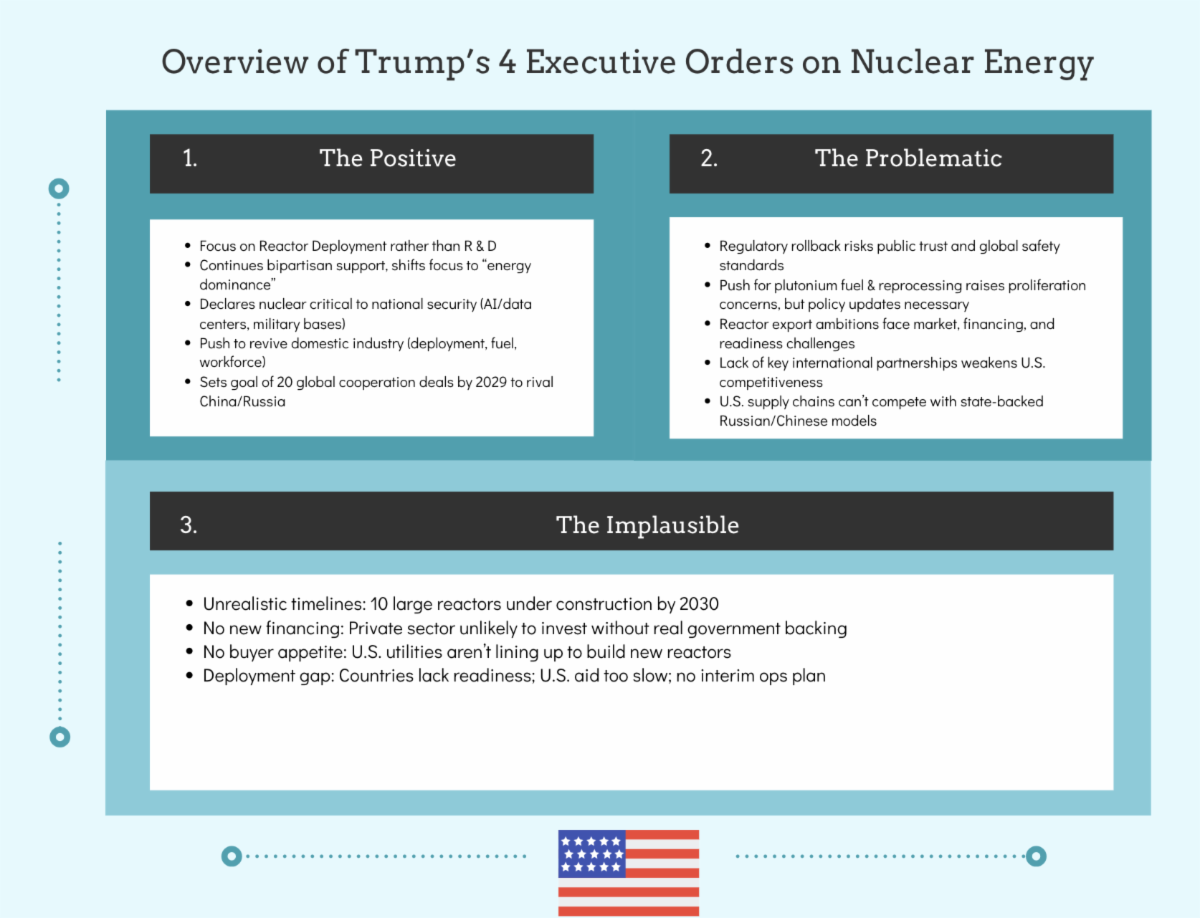
In this week’s newsletter, we provide an overview and an infographic breaking down the positives and negatives of the Trump Administration’s recent Executive Orders on nuclear energy. We spotlight the launch of the Nuclear Energy and National Security Coalition (NENSC) and its efforts to promote nuclear energy as a national security imperative. Finally, we highlight key nuclear technology, security, and geopolitical developments, reports, and analyses.
This issue of Nuclear News and Views was produced by PGS Program Director, Patrick Kendall, and Della Ratta Energy and Global Security Fellows, Emily Day and Jocelyn Livier.
The Nuclear News and Views newsletter will be taking a break for the Fourth of July holiday. The next edition of the newsletter will be published on July 18.
| | |
The Trump Nuclear Energy Executive Orders:
The Positive, the Problematic, and the Implausible
| | |
A longer version of this article was published by The Center for the National Interest
and it can be found here.
President Trump has issued four expansive Executive Orders on civil nuclear energy aimed at reestablishing the United States as a dominant developer, deployer, and exporter of large and small reactors. There are many positive and innovative aspects of the directives including declaring reactor development a national security priority, focusing on deployment over R&D, and strengthening America’s nuclear technology and fuel supply chain. But there also are some controversial issues in the administration’s directions. These include an over-reliance on the power of regulatory reform at the Nuclear Regulatory Commission to drive reactor deployment and a strong embrace of spent fuel reprocessing.
In addition, there are significant challenges related to nuclear exports. One is the volume of nuclear cooperation agreements with other nations that the president is demanding, and another is the lack of focus on the need to use new approaches to cultivate these overseas markets where nuclear power is desired, but the host nation is not well prepared to operate the technology. Finally, there are a few significant problems with the orders including unrealistic deadlines for reactor deployment and the absence of new funding from the government to support nuclear deployment at scale. The funding issue is the Achilles Heel of the president’s plan. It conflicts with the goal of reducing federal spending, but it is the essential ingredient to compete effectively with Russia and China for market share and provide assurance to private investors.
The infographic below provides an overview of the three categories for the Executive Orders that PGS has developed to help shape the policies that can assist in achieving the president’s nuclear renaissance goal. Read the original article for more details.
| | |
Ken Luongo, President, Partnership for Global Security
Jocelyn Livier, Della Ratta Fellow, Partnership for Global Security
| | | | |
Spotlight
The Nuclear Energy and National Security Coalition (NENSC) has been launched with an Expert Council that will support the role of nuclear energy in promoting U.S. and allied security. NENSC is led by Admiral Richard W. Mies and Former Deputy Secretary of Energy, Daniel B. Poneman. PGS President, Ken Luongo, will be a member of the council along with other prominent former national security leaders, military officials, and policy experts.
The NENSC emphasizes the important connection between a strong U.S. civil nuclear sector and national security and will advocate for policies and strategies that ensure the United States continues to provide the leadership necessary to advance nuclear technologies, international safety and security, and allied civil nuclear cooperation. The coalition aims to make sure that U.S. policymakers recognize the national security value of nuclear energy, as the well as its role as a contributor to global energy security, provider of reliable power, and major emissions-free energy source.
This perspective is especially important as the U.S. aims to compete with China and Russia’s expanding number of domestic reactors and international reactor exports. These countries offer state financing, fuel supply, and continued technical support and are engaged with countries in Asia, Africa, and the Middle East. In contrast, the United States has fallen behind in terms of domestic construction and international exports.
With rising domestic energy demand due to AI, and over 30 countries considering the adoption of nuclear energy there is a driving need for the U.S. to strengthen its role as a leader in global nuclear energy. President Trump’s recent nuclear Executive Orders identify a path forward to an American nuclear energy renaissance while acknowledging the challenges the United States needs to overcome.
By promoting the national security-nuclear energy nexus to U.S. policymakers, NENSC is working to position nuclear technology as a strategic asset that has positive impacts for global stability, the environment, the building of alliances, and long-term American technology competitiveness.
| | Emily Day, Della Ratta Fellow, Partnership for Global Security | | Issues of Special Interest | | Global AI and Data Center Energy | | |
Talen Energy Corporation has entered into a new agreement for the long-term supply of 1,920 megawatts electrical from its Susquehanna Nuclear Power Plant to support Amazon’s data centers, as well as looking into building small modular reactors and conducting capacity uprates. The new power purchase agreement will see Talen supply electricity to Amazon for operations that support AI and other cloud technologies at Amazon’s data center campus adjacent to Susquehanna. Talen previously announced the sale of its Cumulus data center campus to Amazon Web Services along with a long-term power purchase agreement, but the Federal Energy Regulatory Commission rejected this agreement earlier this year.
Nuclear technology company TerraPower announced the closing of a funding round that raised $650 million from a mix of backers including a joint venture led by Nvidia. The capital raised will be put towards the construction of TerraPower’s first Natrium plant, which would make it the first commercial advanced nuclear power facility in the United States. Nvidia’s participation comes as tech companies are increasingly turning to nuclear energy and technology to mitigate the growing emissions impact of data centers.
| | The Impact of Russia's Invasion of Ukraine on International Nuclear Affairs | | |
International Atomic Energy Agency (IAEA) Director General Grossi warned that Ukraine’s Zaporizhzhia Nuclear Power Plant cannot safely restart operations due to the ongoing military conflict and severe vulnerabilities at the site. He emphasized the plant’s continued reliance on a single power line and an interim groundwater system for cooling since the destruction of the Kakhovka dam. The IAEA remains engaged, supporting Ukraine with safety monitoring, infrastructure aid, and preparations for eventual reconstruction.
Russia asked the International Atomic Energy Agency (IAEA) to mediate with the United States over what to do with U.S.-supplied nuclear fuel stored at Ukraine’s Zaporizhzhia nuclear plant, which is under Russian control. Moscow wants to restart the plant but faces obstacles, including concerns over Westinghouse fuel and ongoing military threats. IAEA Director General Rafael Grossi said restarting the plant is currently impossible due to unstable power and cooling supplies, though the agency is willing to mediate.
Ukrainian President Volodymyr Zelenskyy held a high-level meeting with military, security, and government officials to address escalating Russian attacks on Ukraine’s critical infrastructure. He warned that despite diplomatic signals, Russia continues to target energy facilities and may intensify strikes, particularly on nuclear infrastructure, as global focus shifts to the Middle East. Ukraine has shared intelligence with the IAEA and U.S. officials and is working to strengthen its air defenses in response to Russia’s growing strike capabilities.
| | Global Nuclear Developments, Geopolitics, & Governance | | International Institutions | | The World Bank announced it will lift its longstanding ban on funding nuclear power projects. It has been in place since 2013, but the bank has not officially financed a nuclear power project since 1959. The move was welcomed by proponents of nuclear power as an alternative to fossil fuels. | | |
A Russian court postponed until March 2026 a $2.9 billion lawsuit filed by Rosatom against Finnish companies Fortum and Outokumpu over the cancelled Hanhikivi-1 nuclear power plant project. The dispute stems from Finland’s termination of the contract in 2022, shortly after Russia’s invasion of Ukraine, citing political and security risks. Rosatom claims the termination was unlawful, while the Finnish companies argue they were not liable under the project’s main contract.
Rosatom says that its fifth generation nuclear fuel assemblies have been loaded into the VVER-1200 reactor core of Novovoronezh unit 6 as part of developments to involve VVER reactors in closing the nuclear fuel cycle. The TVS-5 is designed to enable fully automated fabrication of VVER-1200 fuel bundles. The bundles will now undergo pilot operation with a regular fuel matrix based on enriched uranium oxide in compliance with the license issues by Rostechnadzor.
| | |
The China Nuclear Energy Association (CNEA) released a report laying out China’s plans to nearly double its nuclear power capacity by 2040. The CNEA added that the country is set to build dozens of new reactors to raise its installed capacity to 200 gigawatts by the end of the next decade. China currently has a nuclear energy capacity of 113 GW as of the end of 2024. China has embarked on one of the fastest buildouts of nuclear power facilities in history, with roughly half of the 61 nuclear reactors currently under construction worldwide being built in China.
The U.S. has suspended export licenses for companies supplying nuclear equipment to China, a move that could cost businesses hundreds of millions of dollars. This decision by the Department of Commerce reflects escalating trade tensions between the two countries, despite a temporary tariff ceasefire agreed on May 12. The U.S. cited China's alleged backtracking on commitments, especially regarding rare earth elements, while China criticized the U.S. for exploiting export controls.
The first safety-related concrete has been poured for the reactor building of unit 3 at the Taipingling Nuclear Power Plant, making it the third of six Hualong One units planned for the site. The construction of the first and second units began in 2019 and 2030, respectively, with unit 1 scheduled to start up in 2025 and unit 2 following in 2026. Construction of the second phase of the plant, which comprises of units 3 and 4, was approved by China’s State Council in 2023.
| | |
The European Commission announced that European Union countries’ plans to expand nuclear energy will require €241 billion ($278 billion) in investments and new funding instruments to make these huge costs less risky to private investors. This includes €205 billion to invest in building new nuclear power plants and an additional €36 billion to extend the lifespan of existing reactors. EU countries have set out plans to expand their nuclear power capacity to 109 gigawatts by 2050, and the European Investment Bank will launch a €500 million pilot program for power purchase agreements. Nuclear power generated around 24% of the EU’s electricity in 2024.
Four European nuclear technology organizations have launched the Eagles Consortium to develop and commercialize the EAGLES-300 next-generation lead-cooled small modular reactor (SMR) with the aim of delivering the first demonstration by 2035. The agreement was signed by Belgium’s SCK-CEN nuclear research center, Italian agency ENEA, Italian company Ansaldo Nucleare, and Romanian nuclear R&D coordination organization RATEN on the sidelines of the European Energy Council. Last year, the design was one of two lead-cooled fast reactor proposals selected by the European Industrial Alliance on Small Modular Reactors.
The United Kingdom will invest a further £14.2 billion ($19.25 billion) to build the Sizewell C Nuclear Power Plant as part of its wider spending review which will define its priorities over the next four years. This funding takes the total amount the British government has committed to the project to £17.8 billion, and the government is now seeking to bring new investors into the project. The Sizewell C Nuclear Power Plant is being developed by the United Kingdom and French electric company Électricité de France (EDF), and it is expected to produce enough electricity to power around 6 million homes when completed.
The UK government announced a £2.5 billion investment in fusion energy over the next five years as part of its latest Spending Review. The funding will support research and development in Oxfordshire, Nottinghamshire, and Yorkshire, including plans for a fusion power plant in West Burton. Officials said the investment will boost energy security, accelerate progress toward net zero, and position the UK as a global leader in fusion technology.
French innovative reactor developer Newcleo announced that its LFR-AS-200 small modular reactor design has been accepted to enter the United Kingdom’s Generic Design Assessment process. Newcleo added that the U.K. project team is currently investigating a number of potential sites for deployment of the LFR-AS-200 technology in the United Kingdom. Newcleo applied to the U.K. Department of Energy Security and Net Zero (DESNZ) in December of last year for approval to enter the Generic Design Assessment process.
According to a report from Politico, documents reveal that billions of pounds will be diverted from Great British Energy’s budget to fund the British government’s commitment to develop small modular reactors. In response to this report, two British government officials denied that the decision to fund SMRs amounted to a cut in Great British Energy’s budget. The incumbent Labor Party’s manifesto has committed to spending £8.3 billion over five years to develop clean power projects across the country, including a spending review that assigned £2.5 billion of its funding package to develop SMRs.
British company Rolls-Royce has received backing from the British government to build the country’s first small modular reactors (SMR) following a two-year selection process. The United Kingdom’s government said it intends to sign a contract with Rolls-Royce SMR and allocate a site later this year pending regulatory approval. The British government added that the plans could support up to 3,000 jobs and power the equivalent of 3 million homes once the SMRs are connected to the grid in the mid-2030s.
The French government, major French industrial companies, and trade unions signed a strategic contract aimed at coordinating France’s nuclear industry for the planned life extension of current reactors and the construction of new ones. The contract establishes a shared vision and commitment for the 2025-2028 period, centering around industrial performance, competencies, research and innovation, and transitioning to low-carbon energy sources. The French government has sought to initiate a nuclear renaissance since 2022 when it unveiled a proposed program for six new EPR2 reactors and potentially a further eight to follow.
European power prices jumped recently following concerns that a large French nuclear reactor might have possible stress corrosion. Testing highlighted possible defects in the Civaux 2 nuclear reactor but that there was no confirmation of corrosion at this stage and more testing was required. The last time defects were detected at French nuclear reactors was 3 years ago, which reduced French nuclear output to a 34-year low and sent prices skyrocketing during the European energy crisis.
French company Électricité de France (EDF) signed an Early Work Agreement with Finnish utility Fortum as the partners continue their collaboration toward the potential development of new nuclear projects in Finland and Sweden. The agreement paves the way for more in-depth cooperation and preparatory work, and for both parties to explore key technical and commercial aspects of deploying EDF’s EPR technology. This agreement follows a 2022 Framework Cooperation Agreement between the two companies which sought to study opportunities for cooperation for the development of nuclear projects.
Spanish energy companies Iberdrola and Endesa have proposed a review of Spain’s nuclear phase-out calendar after a major outage in April reignited the debate over nuclear power. The proposal ties the extension to a revision of the fiscal framework for nuclear energy as the industry has urged policymakers to lower taxes which they blame for hindering the plants’ ability to compete on the market. Spain currently has a plan to close all of its reactors by 2035, with the phase-out set to begin in 2027.
Finnish consulting company TVO Nuclear Services (TVONS) says it has expanded its service portfolio to include the advisory and expert services required for the preparatory and planning stages of small modular reactors (SMR) projects. TVONS added it will offer SMR developers services based on its extensive experience with safety standards and regulatory requirements. TVONs is a consulting company wholly owned by Finnish utility TVO and has already provided SMR-related consultancy services to companies such as Norsk Kjernekraft and Steady Energy.
Swedish firm Blykalla and Norwegian developer Norsk Kjernekraft announced plans to build a small modular reactor (SMR) power plant on Svalbard. The project aims to replace costly and unreliable diesel generators that were installed after the shutdown of Svalbard’s coal plant in 2023. The joint venture will begin with site-specific feasibility studies and is intended to be a model of broader SMR deployment across Norway and the Nordic region.
Halden Kjernekraft has submitted a proposal to Norway’s Ministry of Energy for an assessment of the construction of both a power plant based on multiple small modular reactors (SMR) as well as a radioactive waste storage facility. Halden Kjernekraft was set up in 2023 to investigate the construction of a nuclear power plant in the Halden municipality using SMRs. The proposed power plant will consist of up to 4 SMRs with a total installed capacity of 1,200 Mwe and an annual production of 10 TWh.
The Czech Republic received its first U.S.-made nuclear fuel assemblies at the Dukovany nuclear power plant. The delivery from Westinghouse follows similar moves at the Temelín power plant and reflects broader EU efforts to reduce reliance on Russian energy following the invasion of Ukraine. CEZ, the national energy company, is working on expanding its supplier base and building fuel reserves to strengthen the country’s energy security.
The Czech Republic signed an $18 billion deal with South Korea’s KHNP to build two new nuclear reactors at the Dukovany nuclear power plant, following a court decision to lift a legal injunction from France’s EDF, which had stalled the agreement. The contract markets the country’s largest ever procurement and is a significant step in its goal to replace aging coal and nuclear units. The project, which is expected to deliver its first unit by 2036, still requires additional EU approvals for financing and pricing.
Slovakia is nearing an agreement with the U.S. for Westinghouse to build a new 1,250 MW nuclear reactor at the Jaslovske Bohunice plant, Prime Minister Robert Fico announced. The project is part of Slovakia’s long-term plan to expand nuclear capacity to meet rising energy demand, following the government approval last year for a state-owned unit to be operational by 2040. If finalized, the deal would cost approximately $11.5 billion.
Belgium’s radioactive waste management agency, ONDRAF, has selected the NucleusSafe joint venture to undertake the civil works for the country’s first near-surface disposal facility for nuclear waste. According to JV partner BESIX, the project is a critical component of Belgium’s strategy for the long-term storage of low and intermediate-level radioactive waste. Construction on the facility is scheduled to start after the summer and will be executed in phases over the coming decades.
| | |
Korea Hydro & Nuclear Power (KHNP) signed a memorandum of understanding with the Electricity Generating Authority of Thailand (EGAT) for cooperation on small modular reactors (SMR) and exploring their feasibility for future projects. The agreement will see the two companies exchange SMR-related technical information, hold a joint review of options for introducing SMRs in Thailand, and cooperate on training personnel. Thailand and South Korea recently signed a Cooperation Agreement on the Peaceful Uses of Nuclear Energy this year that establishes a framework for collaboration and nuclear energy cooperation.
According to a report by the English news site Pulse, Korea Hydro & Nuclear Power (KHNP) is planning on entering the U.S. nuclear power plant deactivation and decommissioning (D&D) market sometime next year. KHNP plans to base its U.S. market entry on a research partnership with laboratories under the U.S. Department of Energy, and it is currently in the process of identifying joint research projects with these laboratories. KHNP has already jointly developed 96 decommissioning technologies with the Korea Atomic Energy Research Institute and has commercialized 58 of them.
Japanese utility Tokyo Electric Power Company (TEPCO) has begun loading fuel assemblies into the core of unit 6 at its Kashiwazaki-Kariwa Nuclear Power Plant ahead of its restart. A total of 872 fuel assemblies will be transported from the used fuel storage pool to the core of the Advanced Boiling Water Reactor, and it is expected to take about two weeks to complete the loading process. Additional regulatory inspections will still be required before Kashiwazaki-Kariwa units 6 and 7 can resume operation.
The Atomic Energy Agency of Kazakhstan has selected Rosatom as the leader of an international consortium to build Kazakhstan’s first planned nuclear power plant using Rosatom’s VVER-1200 reactor units. Discussions are now taking place on state export funding from Russia based on the proposals submitted by Rosatom. In another statement by the Atomic Energy Agency, Kazakhstan is planning to sign a separate agreement with China National Nuclear Corporation (CNNC) to build a second nuclear power plant.
Indian Minister of Power Manohar Lal Khattar stated that the first concrete for unit 1 at the Gorakhpur Nuclear Power Plant is scheduled to be poured in October. The Gorakhpur Power Plant is earmarked for the construction of four Indian-designed 700 MWe pressurized heavy water reactors to be built in two phases. The second phase at Gorakhpur will be for units 3 and 4 and are among ten units that the Indian government has sanctioned to be built under a “fleet” approach.
The Asian Development Bank (ADB) is reviewing whether to lift its ban on funding nuclear power projects in order to help meet a surge in demand for energy across the region. The talks between ADB officials reflect growing support for nuclear power among policymakers in the region such as Japan and South Korea as they search for solutions to meet rising electricity demands and climate commitments. This follows a recent decision by the board of the World Bank to remove its prohibition on funding nuclear energy.
| | There are no new updates for this region. | | |
The IAEA’s Director General, Rafael Grossi, expressed deep concern after Israeli strikes targeted Iran’s Natanz nuclear enrichment facility, damaging critical infrastructure and causing internal contamination. While no external radiological release was detected, the destruction of power systems may have compromised underground centrifuges, and attacks were also reported near other Iranian nuclear sites. Grossi called on all parties to exercise restraint and not take any action that would threaten nuclear safety. For the first time in nearly 20 years, the IAEA has formally declared Iran in non-compliance with its nuclear non-proliferation obligations. The resolution, backed by the U.S., U.K., France, and Germany, cites Iran’s failure to cooperate on undeclared nuclear materials and sites.
Iran signed a deal with Russia to build at least eight new nuclear power plants, including four at the existing Bushehr site in an effort to increase nuclear power capacity to 20,000 MW by 2041. The agreement builds on a broader 20-year strategic partnership between the two countries. While Iran insists its nuclear ambitions are peaceful and focused on energy needs, the expansion has raised concerns among international observers, especially amid limited IAEA oversight and heightened regional tensions.
| | |
Industrias Nucleares do Brasil has signed a contract with the Ministry of Science, Technology, and Innovation and the Financing Agency for Studies and Projects for the development and testing of critical technologies applicable to Brazil’s planned microreactor. The National Nuclear Energy Commission (CNEN) aims to demonstrate the feasibility of the development of a Brazilian 3-5 MW microreactor. The three-year $9.1 million project also brings together research centers, universities and other institutions such as the Brazilian Navy and the Institute of Nuclear Engineering.
Argentina’s National Atomic Energy Commission outlined numerous priorities during its 75th anniversary commemoration, including plans for the deployment of four ACR-300 small modular reactors (SMR) and restarting uranium mining and enrichment. President of the Argentine Nuclear Council Demian Reidel stated that the government plans to begin construction of four SMR modules at the Atucha Nuclear Power Plant that will nearly double the country’s installed nuclear capacity. Argentina currently has three operable nuclear power units that generate about 5% of the country’s electricity.
| | North America Nuclear Collaborations and Policy | | |
President Donald Trump abruptly fired Nuclear Regulatory Commissioner Christopher Hanson in another move by the White House to gain control of the independent agency. Numerous Democratic politicians condemned the move, stating that it violated the specific terms of the 1946 Atomic Energy Act and criticized the Trump Administration’s attempts to undermine the independence of the NRC. The Trump administration has been critical of the NRC and claimed it has obstructed the development of new reactor technologies with restrictive safety regulations and slow processing of permits.
The Senate Finance Committee released their version of the Republican budget bill that seeks to cut funding for numerous parts of the Inflation Reduction Act. The proposed bill would quickly end tax credits for solar power and also reduce funding for wind power and hydrogen. Other technologies such as nuclear, geothermal, and hydropower would receive a slight extension of the phase-out of tax credits. These moves are in line with GOP priorities to reduce spending on solar and wind power while preserving nuclear and geothermal power.
The Department of Energy Secretary Chris Wright said that the department’s Loan Programs Office (LPO) will continue supporting nuclear projects during his testimony before a House subcommittee about his proposed budget. However, renewable energy and electric vehicle-manufacturing projects may end up losing their funding from the LPO going forward. The White House budget request for the Department of Energy includes a budget cut of about $3.5 billion, although the proposal includes $750 million in credit subsidy for the LPO to support the development and deployment of commercial nuclear technologies.
Oklo announced the energy logistics agency of the Department of Defense has issued a notice of intent to award a power purchase agreement for a pilot reactor at the Eielson Air Force Base in Alaska. Although the agreement is not final, Oklo is currently set to design, contract, own, and operate the power plant that will deliver 5 MW of electricity and variable amounts of steam heating to the air force base. Oklo’s previous application for an operating license was denied by the Nuclear Regulatory Commission (NRC) in 2022, but Oklo plans to submit another application later this year.
Researchers at the Idaho National Laboratory (INL) are collaborating with Clean Core Thorium Energy to develop a new nuclear fuel design that could reduce nuclear waste, enhance safety, and lower costs for today’s pressurized heavy water reactors. The novel Advanced Nuclear Energy for Enriched Life (ANEEL) fuel combines thorium with high-assay low-enriched uranium (HALEU) which will hopefully be proliferation-resistant. Going forward, Clean Core Thorium will need to prove ANEEL’s performance and safety to industry and regulators before the novel fuel design can enter the marketplace.
The Department of Energy has awarded the second round of Gateway for Accelerated Innovation in Nuclear (GAIN) vouchers of the year to three companies. The three companies awarded are AimiLight Sensors & Intelligent Systems, Hayward Tyler, and Standard Nuclear. Hayward Tyler will collaborate with the Argonne National Laboratory to test several new materials for use in sodium-cooled fast reactor pumps to find cost-effective alternative for cobalt alloys, and Standard Nuclear will work with the Oak Ridge National Laboratory to calibrate their alternative approach to assess carbon and oxygen content in their TRISO fuel kernels.
The Department of Energy is inviting private-sector nuclear developers to submit proposals for experiments and demonstrations using its MARVEL project. The Idaho National Laboratory (INL) said in an expression of interest request that it is looking for cutting-edge concepts that can leverage MARVEL’s unique capabilities to accelerate the development, testing, and deployment of advanced reactors. The first-of-its-kind operational test bed for advanced microreactor technologies is now 90% through its final design phase, with key components already under fabrication.
The International Nuclear Energy Financing Act of 2025 has been introduced to the U.S. House of Representatives. The bill would require the U.S. representatives at the World Bank to advocate for increased funding for civilian nuclear energy projects and promote the creation of a Nuclear Energy Assistance Fund for global banks to finance such projects. The bill passed the House Financial Services Committee, with the bill’s authors noting that one-third of new nuclear power reactors in development are being built in China and that Russia has claimed as many as 70 nuclear projects in 29 countries.
Texas lawmakers have approved the creation of a $350 million program to attract the advanced nuclear energy industry to the state by giving companies taxpayer-funded grants to develop nuclear power projects. Under HB14, a Texas nuclear energy office would be established within the governor’s office that would oversee the nuclear funding program, as well as help companies interested in developing projects navigate Texas’ permitting and regulatory processes. Governor Greg Abbott said the money set aside in Texas’ budget this session for nuclear projects is the largest national commitment of its kind.
The U.S. Supreme Court ruled that the state of Texas and oil companies cannot challenge the Nuclear Regulatory Commission’s permit for a privately owned temporary nuclear storage site in the state. The court determined that because Texas and Fasken Land and Minerals weren’t parties to the NRC’s licensing proceeding, they are not entitled to obtain judicial review of the commission’s licensing decision of the Interim Storage Partners facility. The ruling is a big win for the NRC’s efforts to find a home for high-level spent fuel from commercial reactors.
The Nuclear Regulatory Commission has set an 18-month timeline to review Dow Chemical’s small modular reactor (SMR) nuclear plant application. Dow Chemical subsidiary Long Mott Energy is the developer that filed for a construction permit to build the SMR nuclear facility to eventually power Dow’s Seadrift manufacturing operations in Texas. Dow is working with reactor designer X-energy on the planned 320-MW carbon-free power project which would replace a gas-fired power plant currently powering the manufacturing operations.
The Nuclear Regulatory Commission (NRC) published a safety report that found Pacific Gas & Electric Company (PG&E) could safely operate the Diablo Canyon Nuclear Power Plant for another 20 years. The NRC reviewed inspections of Diablo Canyon units 1 and 2 to evaluate how aging would impact the power plant’s passive systems. PG&E originally applied for a 20-year license renewal in 2023 to continue operating units 1 and 2 at Diablo Canyon, with the NRC safety report conducted in response to this application.
| | |
Ontario unveiled its first integrated energy strategy, placing nuclear power at the center of its long-term plan to meet rising electricity demand while ensuring affordability, reliability, and clean energy. The “Energy for Generations” roadmap supports ongoing refurbishments, small modular reactor (SMR) deployment at Darlington, and planning for new large-scale nuclear projects at Bruce and Wesleyville. With nuclear power already supplying over 50% of Ontario’s power, the strategy aims to solidify the province’s energy security and economic resilience.
Canadian engineering firm AtkinsRéalis has signed an agreement with Électricité de France (EDF) to expand their existing global partnership to collaborate more closely and respond to new nuclear reactor opportunities around the world. Areas of potential collaboration will include engineering support, provisioning of equipment, sharing of operational excellence, installation and commissioning, and cooperation between the global technology centers of both organizations. AtkinsRéalis has taken a leading role in all Candu reactor life extension projects to data globally.
Canada’s Nuclear Waste Management Organization (NWMO) launched a two-year engagement process to begin planning a second deep geological repository for intermediate- and high-level radioactive waste. This new facility would supplement the first repository site selected in northwestern Ontario in 2024. The NWMO emphasized early engagement with Indigenous communities and public input as central to its site selection process, aiming to officially begin that search in 2028.
| | There are no new updates for this region. | | |
US Role in a Nuclear Energy Resurgence
Center on Global Energy Policy, June 17
Senate: Don’t Fumble the Energy Future
Utility Dive, June 17
What New Senate Megabill Text Means for Clean Energy Credits
E&E News, June 17
To Cut Nuclear Costs, Cut Concrete
The Breakthrough Institute, June 16
Inside the Effort to Reboot America’s Nuclear Energy Program
The Wall Street Journal, June 16
Is Nuclear Power Set for a Revival?
Goldman Sachs, June 12
The Global Nuclear Revival Has Officially Begun
Oil Price, June 12
America Can’t Afford to Hesitate on Nuclear Energy
Deseret News, June 11
The Audacious Reboot of America’s Nuclear Energy Program
The Wall Street Journal, June 11
What’s Behind Keir Starmer’s Decision to Back Nuclear Power?
The Guardian, June 10
Nuclear Power in 2025 – DOE Loan Programs Office (LPO) at the Forefront
The National Law Review, June 10
Is This 26-Year-Old America’s Nuclear Prometheus
The American Conservative, June 9
Uranium Is Hot: How New Nuclear Policies Could Spark a Market Revival
Forbes, June 9
The United States Needs a Nuclear Operation Warp Speed
Foreign Policy, June 9
Baseload Blind Spot? Senate Should Unleash 24/7 Clean-Energy Workhorses
Utility Dive, June 9
This Uranium Company Wants to Break the Grip that Foreign State Corporations Have on U.S. Nuclear Fuel
CNBC, June 6
Advancing a Nuclear Renaissance
The National Interest, June 6
Nebraska Needs a Nuclear Energy Strategy
The Nebraska Examiner, June 6
How Sweden Is Preparing for a Nuclear Power Comeback
Power Engineering International, June 6
Trump’s Nuclear Energy Revolution Promises Reliable and Affordable Energy
The National Interest, June 5
| | |
News items and summaries compiled by:
Patrick Kendall, Program Manager, Partnership for Global Security
Emily Day, Della Ratta Fellow, Partnership for Global Security
Jocelyn Livier, Della Ratta Fellow, Partnership for Global Security
| | For twenty-five years the Partnership for Global Security (PGS) has developed actionable responses to global security challenges by engaging international, private sector, and multidisciplinary expert partners to assess policy needs, identify effective strategies, and drive demonstrable results.
| | | | |