|
Greetings!
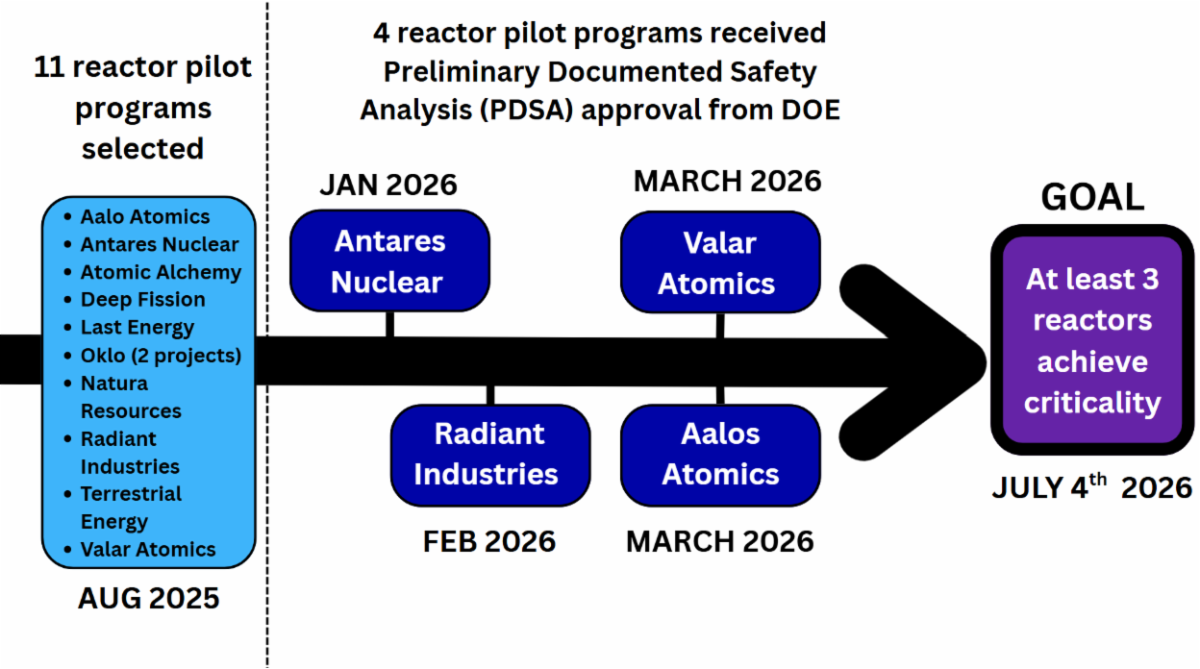
In this week’s issue, we provide an infographic documenting the status of Department of Energy’s Reactor Pilot Project and the technologies that have received Preliminary Documented Safety Analysis approval. We spotlight DoE Assistant Secretary for Nuclear Energy, Ted Garrish’s, testimony to the Senate Energy and Natural Resources committee on the status of the Department’s implementation of the Trump’s administration’s nuclear energy executive orders. Finally, we highlight key nuclear technology, security, and geopolitical developments, reports, and analyses.
This issue of Nuclear News and Views was produced by PGS Program Director, Patrick Kendall, and Della Ratta Energy and Global Security Fellows, Mackenzie Hansen, Gabriela Zanko, and Cate Donovan.
| | Status of the DoE Reactor Pilot Project | | |
The DoE Reactor Pilot Program was established in response to Executive Order 14301, which has as one goal: fast-tracking advanced reactor technologies toward commercial licensing. Announced in June 2025, the program’s objective is to have at least three reactors achieve criticality by July 4, 2026. The program does not specify if this needs to be cold criticality or full power. Radiant Industries has stated that it intends to operate the Kaleidos reactor for 60 effective full power days. Valar Atomics announced that it achieved zero-power criticality in November 2025.
The program requires the participating companies to fund the cost of the testing, but it allows them to bypass the Nuclear Regulatory Commission approval process in the initial testing phase. DoE is the authority responsible for the reactor approval. Of the 11 advanced reactor designs selected for the program in August 2025, four have now received DoE approval for their Preliminary Documented Safety Analysis (PDSA):
-
Antares Nuclear received PDSA approval in January 2026 for its Mark-0 reactor, a transportable, sodium heat pipe cooled R1 microreactor using HALEU TRISO fuel, with an output of 100 kWe to 1 MWe.
-
Radiant Industries received PDSA approval in February 2026 for Kaleidos, a 1 MW helium gas cooled nuclear microreactor utilizing HALEU TRISO fuel.
-
Valar Atomics received PDSA approval in March 2026 for a high-temperature, gas-cooled, graphite-moderated reactor employing HALEU TRISO fuel.
-
Aalo Atomics received PDSA approval in March 2026 for the 10 MW sodium-cooled Aalo-1 reactor using low-enriched uranium dioxide fuel for the Aalo-X experimental power plant.
Receiving PDSA approval allows the reactor companies to move from concept validation to execution including final design work, site preparation, and early construction activities, while advancing toward a Final Documented Safety Analysis (FDSA) required for reactor operation. The Reactor Pilot Program represents a significant effort to revitalize the U.S. nuclear industry and meet growing energy demand. It has drawn both praise and criticism for its aggressive schedule.
| | Gabriela Zanko, Della Ratta Fellow, Partnership for Global Security | | | | |
Spotlight
Department of Energy Assistant Secretary for Nuclear Energy, Ted Garrish, and Idaho National Laboratory Director, John Wagner, testified before the Senate Energy and Natural Resources committee regarding DoE’s implementation of President Donald Trump’s nuclear-related executive orders.
Garrish focused on the Energy Department’s reactor pilot program and noted that three to four demonstration reactors are expected achieve criticality by July 4 of this year. He identified the priorities for the administration including the need to significantly strengthen the U.S. uranium enrichment market and nuclear fuel production, the importance of expanding America’s nuclear exports to new markets, and the connection between nuclear expansion and American reindustrialization.
Wagner underscored that America stood at an “unprecedented inflection point” in the expansion of nuclear power. He provided an overview of the extensive nuclear energy activities at INL and highlighted the key challenge of nuclear fuel supply. He further advocated for providing DoE with greater authority to regulate reactors on federal land and noted that the “manufacturing, workforce, and supply chain challenges are substantial” if the country is to scale its nuclear output to 400 GW, a target President Trump has endorsed.
| | Patrick Kendall, Program Director, Partnership for Global Security | | Issues of Special Interest | | Global AI and Data Center Energy | | |
Palantir Technologies announced an agreement with Centrus that will apply Palantir’s AI-driven software tools in support of Centrus’ expansion of its uranium enrichment capacity. Through this partnership, Centrus is leveraging Palantir’s Foundry and AI Platform (AIP) to integrate disparate systems across numerous environments and utilize AI to optimize project controls, engineering, and supply chain management. Centrus is looking to expand production and operations at its Piketon uranium enrichment facility and aims to become the most efficient and cost-competitive enrichment company in the U.S. market.
Microsoft and Nvidia have announced an AI partnership designed to boost development and deployment of nuclear power, including to support data centers. Microsoft’s AI for Nuclear initiative combines its Azure-based permitting tools with Nvidia’s simulation stock to tackle licensing, plant design, construction planning, and ongoing operations. The pitch is that generative AI can draft paperwork and flag inconsistencies in the regulatory process, with companies such as Aalo Atomics and Southern Nuclear already using Microsoft AI tools for nuclear licensing and engineering.
AtkinsRéalis announced it is collaborating with Nvidia to explore the integration of Nvidia’s technologies for the development and deployment of nuclear powered AI factories. This initiative will assess how AtkinsRéalis can support developers by deploying AI infrastructure and selectively integrating Nvidia technologies into its delivery processes. AtkinsRéalis will examine how standardized nuclear power solutions within its CANDU portfolio could be integrated with large-scale AI data center requirements.
Renewable energy developer WBS Power announced plans for a 3.2 gigawatt data center campus in the Polish municipality of Choczewo, and the nuclear power plant being built at Lubiatowo-Kopalino will help provide a stable power supply. WBS Power is now moving to the next phase of the project, with preparatory work expected to be completed by the end of 2027 and the first data center planned to become operational around 2028 or 2029. The Polish government is building the country’s first nuclear power plant at Lubiatowo-Kopalino with the aim for the first reactor to enter commercial operation in 2033.
| | The Impact of Russia's Invasion of Ukraine on International Nuclear Affairs | | |
The International Atomic Energy Agency reported that the Zaporizhzhia Nuclear Power Plant temporarily depended entirely on a recently repaired backup power line during maintenance on its main connection, highlighting ongoing safety vulnerabilities. The backup line, restored just a day earlier under a negotiated ceasefire, successfully supplied power, but officials warned that limited and fragile off-site power options continue to pose risks. IAEA teams also monitored safety measures, including emergency diesel generator tests, organizational changes, and evacuation drills, noting that backup generators have been required multiple times since the conflict began.
An assessment of damage to the Chernobyl Nuclear Power Plant’s New Safe Confinement (NSC) has been completed following a 2025 drone strike that compromised its protective functions. The review found that while the structure’s main load-bearing components remain intact, key safety features, such as its ability to fully contain radioactive material, were significantly weakened. The IAEA and other experts stressed that temporary repairs have been made, but more extensive restoration is urgently needed to prevent further deterioration.
| | Global Nuclear Developments, Geopolitics, & Governance | | |
Uzbekistan and Russia marked progress on their small modular reactor (SMR) project by signing a new cooperation roadmap and beginning early construction activities, including the pouring of initial concrete. This milestone signals that preparations for Uzbekistan’s first nuclear power plant are advancing from planning into the early building phase. The project, led by Russian state nuclear company Rosatom, is part of a broader partnership to develop nuclear energy infrastructure in the country. Officials emphasized that the work is proceeding on schedule, with further construction steps dependent on regulatory approvals and technical readiness.
The World Nuclear Association reported that pilot testing of REMIX nuclear fuel has been successfully completed at Russia’s Balakovo Nuclear Power Plant after three full operating cycles. The experimental fuel assemblies, made from a mix of recycled uranium and plutonium, performed within normal parameters and showed no operational issues during testing. After removal from the reactor, the used fuel will undergo detailed post-irradiation analysis to support its future qualification for commercial use. REMIX fuel is designed to reuse spent nuclear material, helping enable a “closed” fuel cycle that reduces waste and extends fuel resources.
The first TVER-TOI unit at the Kursk II Nuclear Power Plant had its power increased to 100% as Russia continues with the commissioning process. The new unit is scheduled to begin commercial operation later this year, once nuclear regulator Rostechnadzor and the Rosenergoatom acceptance committee approve it. The Kursk II Nuclear Power Plant will feature four of the new VVER-TOI reactors, which are the latest version of Russia’s large light-water designs.
| | |
China has lifted the CA20 structural module of Bailong Nuclear Power Plant Unit 1 into place and also moved the first steam generator into position for Lufeng Nuclear Power Plant Unit 6. The construction of Phase 1 of the Bailong Power Plant was among approvals for 11 new reactors granted by China’s State Council in 2024, with State Power Investment Corporation (SPIC) planning to build two CAP1000 pressurized water reactors. Meanwhile, the two new units at the Lufeng Nuclear Power Plant will be Hualong One HPR1000 reactors.
The San’ao Nuclear Power Plant Unit 1 connected to the grid and began generating electricity after first achieving criticality in February of this year. Operators will gradually increase power and conduct load tests with the aim for Unit 1 to generate commercial electricity in the first half of 2026. The San'ao plant is the first nuclear power project in China's Yangtze River Delta region to adopt the Hualong One. A total of six Hualong One units are planned for the San'ao site.
| | |
The European Commission has adopted a 2026-2027 work program under the Euratom Research and Training Program, setting out €330 million in E.U. funding for fusion energy research and a range of nuclear technologies and skills. Most of the funding is earmarked for fusion as the European Union works towards connecting its first commercial fusion power plant to the grid, including plans to set up a new European public-private partnership for fusion energy. The funding also includes support for fusion-related projects under the European Innovation Council.
Nuclear trade body Nucleareurope published an action plan for nuclear power which outlines how key European Union policies can make a decisive contribution to its deployment across the E.U. This action plan aims to create the right policy environment to maximize the contribution of nuclear energy. The plan centers around five main policy groupings such as a long-term policy vision to stimulate net-zero emissions with nuclear energy, an accelerated regulatory framework to speed up nuclear deployment, and investing in the entire fuel cycle to ensure security.
The British government has outlined its plans to speed up nuclear delivery three months after the publication of the final report of the Nuclear Regulatory Taskforce. The plan is to advance reforms by the end of the year that will ensure smarter regulations and the cost-effective and rapid delivery across the entire civil and defense nuclear enterprise. The Nuclear Regulatory Taskforce was announced by Prime Minister Keir Starmer last year, with its final report in November stating that a “radical reset” was needed for U.K. nuclear regulations in order to speed up building new nuclear projects on time and at a lower cost.
U.K. Secretary of State for Environment, Food, and Rural Affairs Emma Reynolds will provide regulatory approval for the Rolls-Royce small modular reactor (SMR) design, the first SMR to receive this approval in the United Kingdom. The Nuclear Industry Alliance (NIA) applied to the Department of Energy, Food, and Rural Affairs in 2024 for a justification decision for the Rolls-Royce SMR which is required for the operation of a new nuclear technology. In June of last year, Rolls-Royce SMR was selected as the British government’s preferred technology for the country’s first SMR project at Wylfa.
Rolls-Royce SMR and Swedish nuclear technical services provider Studsvik have signed a memorandum of understanding to explore further collaboration and broaden their relationship across Studsvik’s range of services to support small modular reactor (SMR) deployment. The agreement enables the two companies to evaluate Studsvik’s capabilities in supporting the future deployment of Rolls-Royce SMR’s modular power plants. Areas covered include fuel qualification and testing, plant life management, and regulatory licensing support.
GE Hitachi’s BWRX-300 small modular reactor (SMR) completed Step 2 of the United Kingdom’s Generic Design Assessment (GDA) process, further progressing towards authorization and deployment in the country. Authorities reported no massive safety or environmental concerns that would prevent deployment, making it one of the fastest GDA progressions recorded. The BWRX-300 is GE-Hitachi’s 300-megawatt SMR that is designed to incorporate simplified systems and passive safety features.
The ILIOS consortium has been appointed as the construction partner for the United Kingdom’s STEP Fusion program to deliver the first three-year, $267 million tranche. This covers the design and build of a prototype fusion power plant, with ILIOS responsible for the design and construction of all buildings, infrastructure, and facilities on the STEP power plant site. Meanwhile, Kinectrics has been named as the design and fabrication partner for the UKAEA-Eni H3AT Tritium Loop Facility for future fusion facilities.
The European Commission is set to investigate a state aid package for Électricité de France (EDF) for building six nuclear power plants over concerns the support would reinforce the French utility’s market dominance. The package is central to France’s plans for renewing its nuclear fleet and expanding its fleet by 10 gigawatts of capacity. France put in its request to the European Union to approve the state support late last year, which would include a subsidized loan covering at least half of the construction costs.
France’s Nuclear Policy Council has reconfirmed the need to revitalize the country’s nuclear power industry to guarantee the country’s energy sovereignty, make energy accessible to the French people, and combat climate change. The council took note of the progress made in implementing the EPR2 program, which aims to build six new high-power reactors at the Penly, Gravelines, and Bugey power plant sites. Électricité de France (EDF) committed to meeting the construction cost target of $83.7 billion and the program schedule.
Électricité de France (EDF) and the Serbian government discussed a roadmap for the implementation of nuclear energy in Serbia regarding the studies necessary to allow the Serbian government to make an informed decision on implementing a nuclear power program. According to the proposed timeline, the aim would be for Serbia to be ready to enter the construction contracting process by 2032, with a nuclear power plant online in 2040. Serbia’s government recently passed amendments ending the country’s longstanding ban on nuclear power plant construction.
Turkish Energy Minister Alparslan Bayraktar stated that his country wants to build four nuclear reactors in the province of Sinop and four more in the Thrace region. Alparslan added that the government is in talks with South Korea, Canada, China, and Russia for these projects, although no agreements have been signed yet. Türkiye is currently building its first nuclear power plant at the Akkuyu site in collaboration with Russian nuclear agency Rosatom.
Dutch-French molten salt reactor developer Thorizon has signed a strategic memorandum of understanding with Hyundai Engineering & Construction to jointly advance the development and commercialization of molten salt reactor (MSR) technology. Under the MoU, the companies will explore areas of cooperation related to the development and commercialization of Thorizon MSRs. Horizon is developing a 100 MWe molten salt reactor design that is targeted for large industrial customers and utilities.
Kärnfull Next has submitted an application to build a power plant based on small modular reactors (SMR) in the municipality of Valdemarsvik in southeastern Sweden. The SMR campus is initially planned to host between four and six small light water reactors that will add between 10-15 terawatt hours (TWh) of electricity generation per year. This is the first application filed under the country’s new Act on Government Approval of Nuclear Facilities and will be part of the government’s plans to expand the country’s nuclear power capacity by 2035.
Swedish lead-cooled small modular reactor (SMR) technology developer Blykalla plans to proceed with the next phase of planning for a power plant in Norrsundet after initial assessments confirmed that the site offers suitable conditions. The proposed SMR plant is envisioned to consist of six of Blykalla’s SEALER reactors with a total generating capacity of about 300 megawatts. Blykalla said it aims to initiate the permitting process later this year and will now continue site investigations and detailed studies.
The Finnish government has submitted a proposal to parliament for a new Nuclear Energy Act that would streamline regulation and licensing of future nuclear power projects. Under the proposed reforms, the current Nuclear Energy Act would be repealed, and 14 other acts would be amended to strengthen Finland’s position as an attractive investment destination for nuclear energy production and as a location for the construction of new plants. Finland currently operates five nuclear reactors.
| | |
The U.S. Export-Import Bank has moved to solidify energy security ties in the Indo-Pacific region, advancing a $4.2 billion financing package to help Japanese nuclear operators decouple their supply chains from Russian-enriched fuel. The Ex-Im Bank issued formal letters of interest of $2.4 billion and $1.8 billion to Japanese and Korean nuclear utilities respectively, with the capital intended to fund the purchase of low-enriched uranium from uranium enrichment start-up General Matter. The bank’s goal is to mitigate the risk of supply disruptions that have plagued the nuclear sector in the wake of recent global conflicts.
Korea Electric Power Corporation (KEPCO) reported in its regulatory findings that its overseas nuclear power projects are posting losses of $1 billion from construction contracts as of the end of last year. These losses result from construction work at the El Dabaa nuclear plant in Egypt (being built by Russia), and the Barakah plant in the United Arab Emirates which has Korean reactors.
Kim Hoe-chun formally took office as Korea Hydro & Nuclear Power’s (KHNP) CEO for a three year term. Prior to this role, Kim held key positions at KEPCO, which he first joined in 1985. Between 2021 and 2024, he served as CEO of Korea South-East Power, a KEPCO affiliate. Kim succeeds Whang Joo-ho, who resigned in September 2025 following political pressure over the contract to construct the Dukovany new nuclear power plant project in the Czech Republic and the settlement of a divisive intellectual property dispute with Westinghouse.
South Korea announced that its limit on coal-fired power plants will cease entirely and the limit on nuclear power reactors will be loosened in response to the threat of an energy crisis from the United States’ war with Iran. The capacity utilization rate of South Korean nuclear power reactors will be raised from below 70% to 80%. Korean government official Ahn Do-geol said this can be achieved through the earlier-than-planned refurbishment of six nuclear power plants in South Korea by the end of May.
U.S. advanced nuclear technology developer X-energy and Japanese engineering firm IHI Corporation have designed a non-binding memorandum of understanding to explore and promote collaboration in high-temperature gas-cooled reactor technology. Under the MoU, the two companies will establish a cooperative framework to examine opportunities centered primarily on X-energy’s Xe-100 advanced reactor design. The Xe-100 is a Generation IV advanced reactor that is designed to operate as a standard 320 MWe four-pack power plant.
The United States and Japan have agreed on the roles in a potential joint nuclear project involving Westinghouse Electric and Japanese nuclear power equipment makers. Japan and the United States are working to include a nuclear power project in a second round of deals under Japan’s $550 billion investment package. According to a fact sheet released after U.S. President Donald Trump met with Japanese Prime Minister Sanae Takaichi in October. Westinghouse is looking at building pressurized water reactors and SMRs in Japan.
Vietnamese Head of the Office of the Government Tran Van Son and Rosatom director Alexey Likhachev signed an intergovernmental agreement for the construction of the Ninh Thuan 1 Nuclear Power Plant in Vietnam. Rosatom said the agreement regulates the conditions and key areas of cooperation between the parties in implementing the project, with Russia’s Leningrad VVER-1200 reactors being the reference point. A previous nuclear project in Ninh Thuan was approved by the Vietnamese government in 2009, but project work was halted in 2016 due to unfavorable economic conditions.
Energy companies GE Vernova and Hitachi entered into a memorandum of understanding (MoU) as part of a plan to deploy the groups’ BWRX-300 small modular reactor in Southeast Asia. The companies said they will collaborate through the GE Hitachi joint venture company to identify commercial opportunities for the BWRX-300 SMR and also explore opportunities to incorporate qualified Japanese suppliers in future power plant projects in the region. The first BWRX-300 SMR is currently under construction at the Darlington nuclear site in Canada.
Bangladesh announced it will likely commission the first reactor at the Rooppur Nuclear Power Plant in the next few months following numerous delays. Fuel loading in the first reactor is planned for April 7, and the reactor will then be linked to the grid and start running at 30% capacity by June of this year. The Rooppur Nuclear Power Plant will consist of two VVER reactors supplied by Rosatom, although the technical complexity of integrating atomic power into the national grid has caused delays.
Kazakhstan has presented its updates on nuclear energy and uranium production, with the top priority being its intergovernmental agreement with Russia on the construction of the Balkash Nuclear Power Plant. In an update outlining its first year of operation, the Kazakhstan Atomic Energy Agency highlighted its development of a strategy for the nuclear industry to 2026 and the selection of Rosatom as the leader of an international consortium to build the country’s planned new plant. Kazatomprom stated it is actively expanding its footprint across new markets and has secured uranium supply contracts with multiple European and Asian utilities.
Tokyo Electric Power Company (TEPCO) resumed power generation and transmission of Kashiwazaki-Kariwa Unit 6 on March 22 after replacing a cracked metal part found to have caused a fault signal that prompted its removal from the grid earlier this month. Commercial operation, scheduled for March 25, has been postponed until April following the incident. Unit 6 returned online in January of this year, making it the first reactor to be restarted by TEPCO since the Fukushima Daiichi nuclear power meltdown in 2011.
Earlier this month, Tokyo Electric Power Company (TEPCO) deployed small drones to gather data about conditions in Unit 3 of the Fukushima Daiichi Nuclear Power Plant in order to inform its cleanup strategy. Footage showed a large hole at the bottom of the pressure vessel, tubes with ruptures, and other damaged structures. The three reactors at Fukushima Daiichi contain at least 880 tons of highly radioactive melted fuel debris. TEPCO will continue to make use of drones to strategize on how to remove the radioactive debris.
| | South African nuclear energy company NESCA shared that it was advancing in its ambitions to build a 20-30 MW reactor for generating medical isotopes. NESCA would contract with an EPC vendor to deliver a turnkey product, and is considering vendors from Russia, China, South Korea, the U.S., and Argentina. The reactor would operate alongside Safari 1, one of the world's top producers of Molybdenum-99, or Mo-99, an isotope used in diagnostic tests for cancer, heart disease and other illnesses. The company is first prioritizing expanding its footprint in the global medical isotopes market but is also considering an SMR project in the future. | | |
The IAEA reported that entrances to Iran’s uranium-enrichment plant at Natanz have been struck as part of the U.S.-Israeli military attacks on the country. The agency’s findings fit with previously published satellite imagery from the Institute for Science and International Security that showed Natanz was hit by the strikes. The underground Fuel Enrichment Plant (FEP) is one of Iran’s three uranium enrichment plants that are known to be operational, including when the United States and Israel carried out strikes on Iranian nuclear facilities last year.
The IAEA reported that a projectile landed 350 meters from the Bushehr Nuclear Power Plant in Iran. Director General Rafael Mariano Grossi noted that there was no damage to the reactor itself nor injuries to staff but warned that any strike on a nuclear power plant would violate the IAEA’s “pillars of nuclear safety and security.” Bushehr is owned and operated by Russia’s Rosatom.
| | Brazil and Russia have agreed to establish a joint venture between NBEPar and Rosatom to develop mineral extraction projects in Brazil. The new company, Nadina Minerals, will focus on exploring and producing uranium and other critical materials used in advanced technologies. The partnership includes plans to secure permits, carry out geological exploration, and build modern facilities for mining and processing these resources. This initiative builds on existing cooperation between the two countries in the nuclear fuel cycle, including Russia’s supply of enriched uranium to Brazil’s nuclear power plants. | | North America Nuclear Collaborations and Policy | | |
The Nuclear Regulatory Commission (NRC) has issued a new licensing pathway, Part 53, that will accelerate innovative nuclear reactor deployment and aims to reinforce U.S. nuclear leadership. Part 53 is designed to provide optionality and make licensing advanced reactors faster and more cost-effective, with improvements meant to reduce unnecessary duplication in reviews, allow developers to complete licensing in stages, and reduce the time and cost required to bring new reactors online. Part 53 is the first new set of regulations to address initial reactor licensing since Part 53 was passed in 1989.
The United States and Japan announced a $40 billion project to build nuclear reactors in Tennessee and Alabama following talks between U.S. President Donald Trump and Japanese Prime Minister Sanae Takaichi. The joint statement, which aligns with the Tennessee Valley Authority’s (TVA) plan to deploy GE Hitachi’s BWRX-300 at its Clinch River Site (and may indicate an expansion of TVA’s Brown’s Ferry site in Alabama), touted GE Hitachi’s small modular reactors (SMR) as providing a stable power source as well as strengthening the U.S.-Japanese partnership in global energy technology. These talks came after Tokyo agreed to invest $550 billion through 2029 as part of a new trade pact with Washington.
A dozen Democratic lawmakers are calling on State Secretary Marco Rubio to push for “gold standard” nonproliferation standards in any nuclear cooperation agreement with Saudi Arabia. The letter urges Rubio to reconsider plans to exclude nonproliferation conditions from the proposed nuclear agreement and maintain the standards consistent with the bipartisan consensus on the issue. The Trump administration previously provided an overview to Congressional leaders on the non-proliferation and security elements of a pending civil nuclear pact with Saudi Arabia. At issue is whether or under what monitoring, the Kingdom would retain its right to uranium enrichment.
The Department of Energy has launched the Utility Power Reactor Incremental Scaling Effort (UPRISE) initiative to extend nuclear operating lifespans, power uprates, and restarting closed facilities. The UPRISE initiative aims to target the most cost-effective and immediate methods to increase nuclear capacity to 2.5 additional gigawatts by the end of this year, with the initial phase centered on a three-pronged approach to establish the business case for nuclear energy. U.S. President Donald Trump announced the goal of expanding the country’s nuclear energy capacity to 400 GW by 2050.
Aalo Atomics held a ceremony to unveil its completed Critical Test Reactor at the Idaho National Laboratory, and the company added that it expects the reactor to achieve criticality well before the July 4 deadline of the Nuclear Reactor Pilot Program. Aalo was selected by the Department of Energy last year as one of 11 advanced reactor projects for the pilot project. Two weeks after being selected, Aalo broke ground at INL on its Aalo-X experimental modular reactor.
U.S. advanced nuclear technology developer X-energy signed a Letter of Intent with Talen Energy Corporation to assess deploying X-energy’s Xe-100 small modular reactors (SMR) in Pennsylvania and across the PJM Interconnection Regional Transmission Organization market. The companies will explore opportunities to deploy three or more four-unit Xe-100 plants and will conduct early-stage project development activities. X-energy said it is currently developing more than 11 gigawatts of new nuclear capacity across partnerships in the United States and United Kingdom.
The Nuclear Regulatory Commission (NRC) is seeking public input on Fermi America’s Project Matador, marking the first use of a transformative new pilot program that modernizes how the agency conducts environmental reviews. This new approach allows applicants to develop a draft environmental impact statement and is expected to reduce in-house NRC review time by approximately 50% and deliver resource savings of about 30%. Comments will help identify the most relevant environmental issues after hearing community concerns.
Newcleo has initiated pre-application engagement with the Nuclear Regulatory Commission (NRC) to support the future licensing of its lead-cooled fast reactor (LFR) and an associated mixed-oxide (MOX) fuel fabrication facility in the United States. Newcleo will now begin early interactions with the NRC to familiarize staff with the proposed facility designs and associated safety approaches for the LFR. Newcleo will also plan to directly invest in a MOX plant to fuel its LFRs.
OpenAI is reportedly discussing buying electricity from fusion startup Helion Energy, with sources saying that a deal would enable OpenAI to be guaranteed part of Helion’s power generation. Helion announced that its Polaris prototype has set new industry benchmarks and becomes the first privately developed fusion energy machine to demonstrate measurable deuterium-tritium (DT) fusion. Helion could potentially provide as much as 5 gigawatts of power for OpenAI by 2030 and up to 50 GW by 2035.
NANO Nuclear Energy announced significant progress in its initiative to develop an optimized transportation solution for high-assay low-enriched uranium (HALEU) fuel. The project leverages NANO Nuclear’s licensed nuclear fuel transportation basket design as part of the company’s mission to develop capabilities from parts of the front-end fuel cycle to cutting edge microreactors like NANO Nuclear’s KRONOS MMR Energy System. The HALEU transportation package currently under development is designed to support the transportation of multiple advanced nuclear fuel types.
The Nuclear Regulatory Commission (NRC) is considering a policy proposal under which nuclear plants would no longer be required to keep radiation doses as low as reasonably achievable (ALARA). Under the new proposal, nuclear power operators and medical workers would need to keep radiation levels under maximum dose limits, some of which would be loosened under another draft rule. The ALARA principle has been the subject of debate for decades, with many in the nuclear industry arguing that it has made it more expensive to build and maintain nuclear power plants.
The Nuclear Regulatory Commission (NRC) is encouraging existing or potential applicants for new nuclear reactor-related activities to share planning information through fiscal-year 2028. NRC staff published the Regulatory Issue Summary (RIS) so the agency can best understand interest in order to most effectively set budgets for licensing reviews and inspections support needed to safely enable new technologies. The NRC is also reminding advanced reactor applicants and pre-applicants that they may qualify for reduced licensing fees under provisions of the ADVANCE Act.
| | Unit 4 at the Darlington Nuclear Power Plant has been reconnected to the grid at 100% power, bringing a major refurbishment project which began in 2016 to a close. According to Ontario Power Generation (OPG), the four-unit Darlington Refurbishment Project to extend the plant's operation by another 30 years came in at $9.4 billion, over $100 million under-budget and four months early. All four reactors at Darlington are Candu pressurized heavy water reactors, with Units 2 and 3 refurbished over the past few years as well. | | There are no new updates for this region. | | |
Trump Unleashes Nuclear Boom, Powering America Back to Energy Dominance
Fox News, March 24
With Moon Base and Nuclear Mars Mission, NASA Wants You to ‘Start Believing Again’
The New York Times, March 24
Saudi Arabia’s Nuclear Path Will Not Depend on Iran or the War’s Outcome
Stimson Center, March 23
Is Europe Going to Be Forced to Return to Nuclear Energy?
Euro News, March 21
America Needs Nuclear Power Fast. South Korea Can Deliver.
The National Interest, March 21
Can Florida Revolutionize the Nuclear Energy Sector?
The National Interest, March 21
AI Energy Demand Is Fueling a High-Stakes Bet on Nuclear Fusion
Oil Price, March 21
There’s a Nuclear Solution to Recharging American Industry
Fox News, March 20
Why the World Doesn’t Recycle More Nuclear Waste
MIT Technology Review, March 19
UK Bets Big on Homegrown Fusion and Quantum – Can It Lead the World?
Nature, March 19
Nuclear Sprint: DOE and Industry Race to Meet Trump’s Target
POWER Mag, March 19
What Do New Nuclear Reactors Mean for Waste?
MIT Technology Review, March 18
On Moving Fast and Breaking Things
American Nuclear Society, March 16
AI Power Demand Cracks Resistance to Nuclear Power
Axios, March 16
Turkey’s New Nuclear Calculus: Brilliant Strategy or Regulatory Nightmare?
Forbes, March 16
Crazy Or Genius? A Nuclear-Powered Solution to the West’s Water Crisis
USA Today, March 15
Nuclear Plans Hand Starmer a Way to Woo Trump
Politico, March 13
Don’t Hand China the Nuclear Future – Build It Here at Home
Fox News, March 12
| | |
News items and summaries compiled by:
Patrick Kendall, Program Director, Partnership for Global Security
Gabriela Zanko, Della Ratta Fellow, Partnership for Global Security
Cate Donovan, Della Ratta Fellow, Partnership for Global Security
| | For twenty-five years the Partnership for Global Security (PGS) has developed actionable responses to global security challenges by engaging international, private sector, and multidisciplinary expert partners to assess policy needs, identify effective strategies, and drive demonstrable results.
| | | | |