|
Greetings!
In this week’s issue, we provide an infographic and a narrative that examines the Department of Defense’s advanced reactor programs and their significance in the U.S. government’s overall plans for advanced nuclear deployment. We spotlight the proposed Nuclear Regulatory Commission (NRC) rule that would streamline the licensing of microreactors in the United States in line with the Trump administration’s plans to expedite the regulatory process for nuclear reactors. Finally, we highlight key nuclear technology, security, and geopolitical developments, reports, and analyses.
This issue of Nuclear News and Views was produced by PGS Program Director, Patrick Kendall, and Della Ratta Energy and Global Security Fellows, Mackenzie Hansen, Gabriela Zanko, and Cate Donovan.
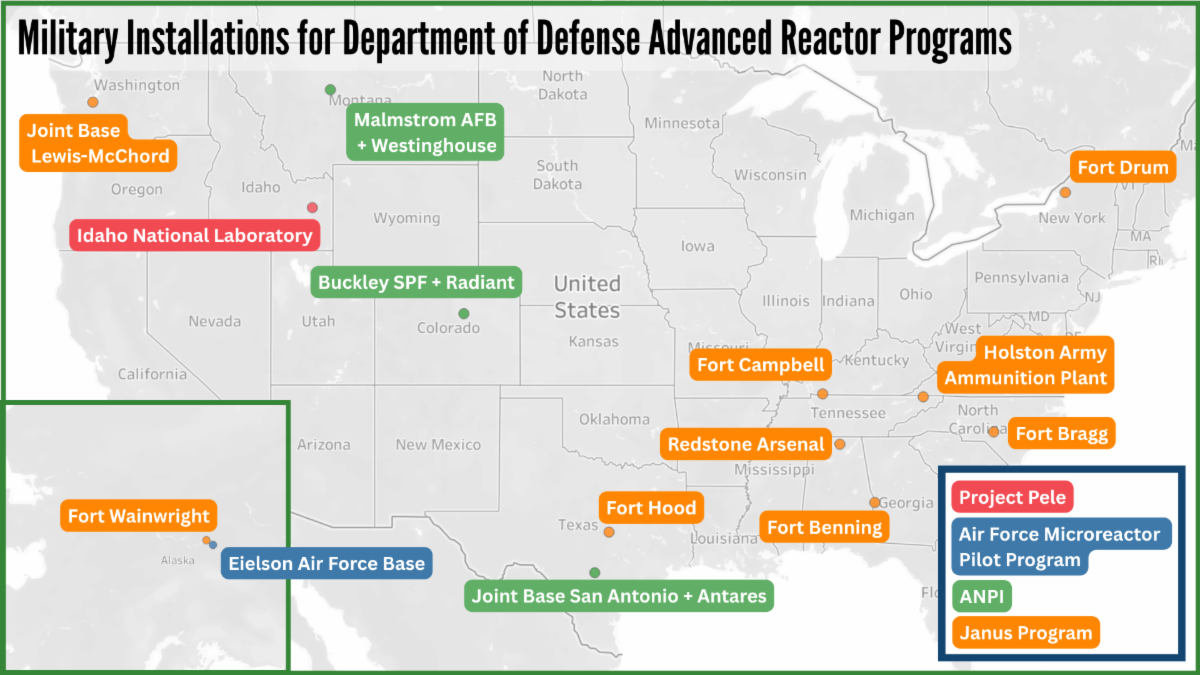
| | Military Installations for Department of Defense Advanced Reactor Programs | | |
The Department of Defense (DoD) has been pursuing advanced terrestrial nuclear power for military installation energy and mobile applications since it was recommended by the Defense Science Board a decade ago. These efforts have accelerated under the Trump Administration's push for American energy dominance and there are now four key DoD programs. The map identifies where demonstrations of these advanced nuclear technologies will occur.
Project Pele: Formally launched in 2020, Project Pele aims to design, build, and demonstrate a prototype for a portable microreactor (1-5 MWe) with long-duration operations without refueling, utilizing TRISO fuel, for deployment at remote military installations. The Pele demonstration will take place at Idaho National Laboratory (INL) and is targeted for 2028. In June 2022, Project Pele awarded BWXT a $300 million contract to construct its 1.5 MWe high-temperature gas-cooled reactor prototype. BWXT also received a $37 million contract from INL to fabricate TRISO fuel for Project Pele’s core. In September 2024, DOD and BWXT announced that they had broken ground at INL for the Project Pele microreactor. BWXT has begun construction on the reactor core and has completed fabrication of TRISO fuel using high-assay low-enriched uranium (HALEU) at its fuel fabrication facility in Lynchburg, Virginia. Fuel was successfully delivered to INL in December 2025.
Department of the Air Force Microreactor Pilot Program: In September 2022, the Department of the Air Force (DAF) launched its own microreactor pilot program in response to congressional direction in the FY2019 National Defense Authorization Act (NDAA). The DAF plans to execute a 30-year power purchase agreement (PPA) with a third-party vendor who will construct, own, operate, maintain, and decommission a commercial microreactor (less than 5 MWe) licensed by the Nuclear Regulatory Commission (NRC) to deliver electricity and thermal energy to an Air Force or Space Force installation. In 2023, DAF issued Oklo a Notice of Intent to award a contract to provide a stationary microreactor for Eielson Air Force Base in Alaska, pending commercial licensing from the NRC.
Advanced Nuclear Power for Installations (ANPI): Launched in June 2024, the Defense Innovation Unit, Army, and Air Force aim through ANPI to field fixed, on-site microreactor systems capable of supplying 100% of critical load requirements (target 3-10 MWe capacity), promote rapid prototyping through flexible, milestone-based Other Transaction Agreements (OTAs). Regulatory approval will proceed via civilian NRC pathways, with support from DoE national labs. ANPI proposes to shift to Power Purchase Agreements upon successful completion of the program, wherein the reactor would be Commercially Owned and Operated (COCO) on land leased from the military.
In April 2025, DoD announced eight companies as eligible to proceed under the ANPI program: Antares Nuclear, BWXT, General Atomics, Kairos, Oklo, Radiant, Westinghouse, and X-energy. On April 22, 2026, the Air Force announced that the following companies will develop and operate their reactor prototype projects, ideally transitioning to providing power to military installations:
-
Radiant Industries will be paired with Buckley Space Force Base in Colorado to develop its 1 MWe Kaleidos high-temperature gas-cooled (helium-cooled) reactor. As a participant in the DOE's Reactor Pilot Program, Radiant is targeting criticality by July 4th. It is slated to conduct testing at INL's Demonstration of Microreactor Experiments (DOME) facility this year. Standard Nuclear has signed an OTA through the DOE's Fuel Line Pilot Program to supply Radiant with TRISO fuel at INL.
-
Westinghouse will be paired with Malmstrom Air Force Base in Montana to develop its 5 MWe eVinci passive heat pipe, "nuclear battery" style reactor. The eVinci will also utilize TRISO fuel. Westinghouse will have the opportunity to test at DOME after Radiant.
-
Antares Nuclear will be paired with Joint Base San Antonio in Texas to develop its 0.5 MWe R1 graphite moderated, sodium heat-pipe cooled microreactor utilizing TRISO fuel.
The ANPI initiative seeks to have at least one advanced nuclear reactor operating on at least one DAF installation by 2030 or sooner. Next steps include siting and environmental analyses.
Janus Program: In May 2025, President Trump issued Executive Order 14299 on Deploying Advanced Nuclear Reactor Technologies for National Security, which directs DoD, through the Army, to commence operation of an Army-regulated nuclear reactor at a domestic military base or installation no later than September 30, 2028. In response, the Army announced it was launching the Janus Program on October 14, 2025, and in November opened a solicitation for microreactor proposals. Through the Janus Program, the Army seeks to prototype solutions for ‘Microreactor Power Plants (MPPs)’ that can be installed at military sites or deployed flexibly for mobile operations. Selected vendors will build two prototypes: a first-of-a-kind (FOAK) prototype and subsequently (drawing from lessons learned for FOAK efforts) a second-of-a-kind (SOAK) prototype. Upon successful completion of the prototyping activity, the Army plans to enter into follow-on agreements with vendors to purchase power and/or scale MPP production.
Dr. Jeff Waksman, Principal Deputy Assistant Secretary of the Army for Installations, Energy and Environment, who also led Project Pele, is currently overseeing the Janus program and in a recent interview, mentioned that the military is overwhelmingly pursuing gas-cooled or heat-pipe designs, which are far more conducive to rapid deployment and transportability than light water or molten salt reactors. The key challenge with these microreactors, he described, is wear and tear on the reactor materials. Waksman also discussed the preference for tri-structural isotropic (TRISO) fuel. Because TRISO fuel pellets are coated and resistant to meltdown, acting as a sort of containment, the theory is that a reactor would need less concrete shielding, reducing construction costs and making the reactor more transportable. Additionally, although TRISO is less efficient due to its lower uranium density, it minimizes volatile dispersion in case of a shutdown and is considered “walk away safe,” requiring fewer operators.
| | Cate Donovan, Della Ratta Fellow, Partnership for Global Security | | | | |
Spotlight
The Nuclear Regulatory Commission (NRC) has rolled out a proposed rule that aims to streamline the licensing of microreactors. The proposed rule could allow the commission to issue an operator license within six months to a year after accepting an application, and it would also allow for projects to be exempt from certain National Environmental Policy Act requirements if specific conditions are met. This proposal comes as the U.S. government and private companies are looking at advanced nuclear reactors to meet surging power demand.
The United States is seeking to accelerate the deployment of next-generation advanced reactors in the near future as an alternative to the costly and inefficient deployment of traditional larger nuclear reactors. In 2025, the Department of Energy reissued its tender for $900 million in federal funding to promote SMR development and announced the Energy Reactor Pilot Program later that year. Outside of the Department of Energy, numerous military agencies such as the Army and Air Force plan to deploy advanced reactors to power their bases across the United States.
| | Patrick Kendall, Program Director, Partnership for Global Security | | Issues of Special Interest | | Global AI and Data Center Energy | | |
Oklo announced a new partnership with the Los Alamos National Laboratory and Nvidia to perform AI-enabled research on nuclear infrastructure and fuel. The Pluto partnership is focused on exploring plutonium-bearing fuels, including the development of science-based AI models, to support fuel validation and materials science. Oklo currently has three projects in the U.S. Department of Energy’s Reactor Pilot Program, with the Pluto project being a sodium fast reactor platform that will use plutonium-bearing fuel.
Blue Energy will collaborate with GE Vernova in a partnership aimed at pairing nuclear and gas-fired generating capacity as a near-term approach to meeting AI-driven energy demand. The companies plan to design and develop a nuclear power plant using GE Vernova’s BWRX-300 small modular reactor (SMR) at Blue Energy’s planned site in Texas. Blue Energy said it could begin early site work on its first planned project later this year in order to support a final investment decision on a construction permit application and the first reactor coming online as early as 2032.
Terrestrial Energy and Riot Platforms are collaborating to deploy Terrestrial Energy’s Integral Molten Salt Reactor (IMSR) technology that will be co-located with data centers developed by Riot Platforms. As partners, Riot and Terrestrial Energy will consider project opportunities at multiple sites, including existing Riot facilities in Texas and Kentucky. Terrestrial Energy is developing IMSR Plant projects across multiple sites in the United States, and it has plans to build, license, and commission its first reactors in the early 2030s.
| | The Impact of Russia's Invasion of Ukraine on International Nuclear Affairs | | |
The IAEA reports that nuclear safety in Ukraine remains extremely fragile, especially at the Zaporizhzhia Nuclear Power Plant, where repeated disruptions to external electricity supply continue to threaten safe operation. On April 26, the plant lost its last off-site power connection, forcing it to rely on emergency diesel generators to keep essential cooling systems running. The agency also reported a recent drone attack near the site that struck a transport facility and resulted in the death of one worker, underscoring the ongoing human and operational risks.
The United States is giving $100 million towards repairs of the radiation containment dome at the Chernobyl plant after the dome was damaged by a Russian dome. Ukrainian energy minister Denys Shmyhal stated that funding was discussed with international partners at a recent conference about the Chernobyl plant where repairs of the dome are estimated to cost $584.95 million. The shuttered Chernobyl plant has seen its security compromised multiple times during Russia’s invasion of Ukraine, including a Russian drone hitting the containment dome last year.
| | Global Nuclear Developments, Geopolitics, & Governance | | |
Russian nuclear regulator Rostekhnadzor certified that the first reactor unit at the Kursk II nuclear power plant meets all technical and design requirements, clearing it for commissioning and commercial operation. The VVER-TOI unit had already been connected to the grid and underwent staged testing during pilot operation, eventually reaching full capacity and generating over one billion kilowatt-hours of electricity. Construction of the first unit began in 2018, with additional units underway and all four planned to be operational by 2034.
A pilot program testing nuclear fuel containing minor actinides has been successfully completed at Russia’s Beloyarsk BN-800 fast reactor after three operating cycles. The experimental fuel will now be cooled and examined to evaluate how it performed under irradiation. The project aims to demonstrate that fast reactors can “burn” these elements, converting them into shorter-lived or more stable materials and thereby reducing the volume and hazard of nuclear waste.
Russia confirmed it is holding detailed negotiations with Turkish companies over the potential sale of a stake in the Akkuyu Nuclear Power Plant project. The plant is being built and financed by Russian state nuclear corporation Rosatom under a build-own-operate model, but plans have long included selling up to 49% to outside investors. Officials say the current discussions are active and meaningful, signaling renewed momentum. Construction of the Akkuyu plant is ongoing, with the project seen as a key part of Turkey’s strategy to diversify its energy supply.
| | |
A research team from the Institute of Nuclear Energy Safety Technology at the Hefei Institute of Physical Science in China is developing a 10-megawatt prototype reactor designed to be transported by truck. The unit functions as a mobile power bank that is capable of operating for several decades without requiring a recharge. Potential applications for this technology include providing electricity for remote regions and islands, delivering emergency backup power, and propelling maritime vessels.
China National Nuclear Corporation (CNNC) began loading the first of 177 total fuel assemblies at the Changjiang Nuclear Power Plant’s Unit 3. Changjiang Units 3 and 4 are Hualong One reactors and are both expected to be operational by 2027. The Changjiang nuclear site also hosts two CNP-600 pressurized water reactors which entered commercial operation in 2015 and 2016. Construction of a demonstration ACP100 small modular reactor (SMR) has also been ongoing at the site since 2021.
China General Nuclear (CGN) announced that it had successfully completed cold functional testing of the Lufeng Nuclear Power Plant unit 5. Cold tests are conducted to verify the containment integrity of the primary circuit and components of both the nuclear and conventional islands, including pressure vessels, pipelines and valves, as well as to clean the main circulation pipes. The tests mark the first time the reactor systems are operated together with the auxiliary systems. CGN aims to connect Unit 5 to the grid in 2028.
China General Nuclear (CGN) announced that Unit 1 of the San'ao nuclear power plant has entered commercial operation, five years and four months after construction began. Unit 1 achieved first criticality on February 14 and was connected to the electricity grid on March 12. It is the first of six Hualong One reactors planned for the site in Zhejiang province. Additionally, CGN also completed hot functional tests at San’ao unit 2, which is scheduled to begin supplying electricity in 2027.
China Huaneng Group has installed the inner safety dome on the containment building of unit 1 of the Shidaowan nuclear power plant site. Shidaowan 1 is the first of four Hualong One units planned for the site in China's Shandong Province. China Huaneng said that the installation of the inner dome at Shidaowan 1 marks the transition from the civil construction phase, which began in July 2024, to the equipment installation phase.
| | |
A group of leading fusion industry CEOs has called on the European Commission to create a comprehensive E.U. Fusion Strategy to keep Europe competitive in developing commercial fusion energy. They argue that Europe must move away from short-term energy fixes and adopt a long-term plan that strengthens energy security, technological independence, and industrial leadership. The signatories urge the E.U. to treat fusion as a strategic priority, supported by targeted funding, clearer regulation, and policies that attract private investment.
U.S. fusion energy developer Type One Energy, Britain’s Tokamak Energy, and construction engineering firm AECOM have formed the U.K. Infinity Fusion Consortium to pursue development of the first private sector-led fusion power plant project in the United Kingdom. Through the consortium, the companies intend to develop a commercially viable fusion project that will combine Type One Energy’s Infinity Two stellarator fusion power plant design and Tokamak Energy’s superconducting magnet technology. Type One Energy has previously signed a Letter of Intent to build its Infinity Two reactor in Tennessee.
Urenco has completed its first trial production run for LEU+ fuel at its Capenhurst facility in the United Kingdom, with plans to make it commercially available in the near future. It added that LEU+ fuel could be transported to fabricators from early 2027 to complete the next stage of the fuel cycle. The project has received support from the United Kingdom’s Department of Energy Security and Net Zero’s Nuclear Fuel Fund, and the production trial demonstrates Urenco’s commitment to advancing the nuclear industry in the United Kingdom and globally.
Électricité de France (EDF) will invest $117.33 million in a new factory to develop component parts for nuclear reactor projects. The factory will produce heat exchangers for future reactors, with the first equipment manufacturing planned for 2030. EDF plans to deploy six new nuclear reactors over the coming decades and eight additional reactors to replace France’s aging fleet, with the first reactors expected to enter service in the late 2030s. However, the company’s recent projects have faced numerous delays and cost overruns.
French molten salt reactor developer Stellaria has signed a letter of intent with the Alternative Energies & Atomic Energy Commission for a feasibility study for constructing the Alvin experimental reactor at its Cadarache site. The letter of intent concerns the establishment of an “Alpha” Basic Nuclear Installation (INB) which will house a model, a fast-spectrum liquid-fueled demonstration reactor, and a salt production facility. The Alvin experimental reactor is scheduled to start up in 2030, and the first Stellaria reactor will be deployed in 2035.
The United States’ ITER organization has completed final deliveries for the central solenoid magnet for the International Thermonuclear Experimental Reactor (ITER) fusion project in France. This delivery includes busbars and leads for electrical connections between the modules following the delivery of the magnet modules, support structure, and tooling components. In 2024, the director-general of the ITER project announced a new schedule that aims for initial operation in 2035.
Czech nuclear operator ČEZ signed an early works contract with Rolls-Royce SMR for the proposed construction of a small modular reactor (SMR) at the Temelín Nuclear Power Plant. The contract allows preparation to start on site-specific documentation and materials such as the environmental impact assessment and nuclear and construction permitting procedures. ČEZ selected Rolls-Royce SMR in 2024 to deploy up to 3 gigawatts of nuclear-powered electricity in the Czech Republic, with the first SMR to be deployed at Temelín.
Swedish small modular reactor (SMR) Blykalla and global engineering company ABB have signed a Joint Development Agreement. With the agreement in place, their cooperation enters a new phase as they will jointly develop key elements of the electrical prototype reactor and commercial units. The two companies signed a memorandum of understanding in 2024 under which ABB is exploring how its solutions could support Blykalla’s SMR prototype SEALER-E.
The Belgian government has begun talks with French energy company Engie to take ownership of the country’s nuclear power reactors, and all decommissioning and dismantling works have been suspended until the acquisition is completed. Engie and the Belgian government said their agreement covers a transaction of Engie and Electrabel’s nuclear activities in Belgium, and the goal is to conclude terms by October. Belgium currently operates two reactors, Doel 4 and Tihange 3, and also has 5 additional reactors that are currently being decommissioned.
Several Norwegian principalities that submitted proposals to Norway’s Ministry of Energy for possible nuclear plants based on small modular reactors (SMR) have decided to initiate investigation work for these projects and prepare technical reports that will form the basis for future license applications. Nuclear project developer Norsk Kjernekraft submitted its proposal to the government in 2023 for an assessment of the construction of an SMR power plant in the municipalities of Aure and Heim.
Irish prime minister Micheál Martin said that Ireland should seriously examine the idea of developing nuclear power and cited advances in nuclear technology and an over-reliance on imported fossil fuels as contributing factors. The immediate focus of the Irish government was to speed up the development of offshore wind farms, but Martin stated that the government should explore “all avenues” in response to the global energy crisis. Ireland has never hosted a nuclear reactor, and the Electricity Regulation Act from 1999 prohibits electricity produced from nuclear fission.
| | |
The South Korean government and Korean shipbuilders have identified small modular reactor (SMR) powered ships as a key response to carbon neutrality goals and intensifying competition in the global shipbuilding market. Korean Deputy Prime Minister Bae Kyung-hoon visited the Korea Atomic Energy Research Institute (KAERI) and met with shipbuilders such as HD Korea Shipbuilding & Offshore Engineering. SMRs have become an increasingly necessary technology for global shipbuilders in order to achieve carbon neutrality, and countries such as China, Japan, and the United States have already moved to develop SMR-powered ships.
India’s Atomic Energy Regulatory Board (AERB) issued permission for the installation of major equipment, including the reactor pressure vessel and heat generators, at the Kudankulam Nuclear Power Plant units 5 and 6. The Nuclear Power Corporation of India Ltd. (NPCIL) issued the Major Equipment Erection after completing the safety review of the units’ design against the AERB’s safety requirements. The Kudankulam site is already home to two operating Russian VVER-1000 pressurized water reactors, and work on units 5 and 6 began in 2021.
Bangladesh held a ceremony to mark the loading of 163 nuclear fuel assemblies into the Rooppur Nuclear Power Plant unit 1. According to reports from the Bangladeshi press, this is the first stage of the unit’s key startup phase, and the next step will see the reactor being brought to a minimum controllable power level. Rosatom and Bangladesh are working together to build two reactors at the Rooppur Nuclear Power Plant, with construction of the first unit beginning in 2017 and the first batch of nuclear fuel delivered to the site in 2023.
| | South Africa’s government is launching a recruitment drive to lure back engineers working abroad as part of the country’s efforts to ramp up nuclear power capacity. The plan aims to attract skilled migrants and South African expatriates, especially those working in the United Arab Emirates and on the Barakah Nuclear Power Plant project. This will be part of South Africa’s nuclear energy roadmap which is targeting 5,200 MW of new nuclear generation capacity by 2039. | | IAEA Director General Rafael Mariano Grossi said that Russia remains open to removing highly enriched uranium from Iran as the ongoing U.S. and Israeli military strikes continue. Grossi stressed the importance of ensuring Iran loses its enriched uranium supply or that its enrichment is diluted in order to prevent Iran’s military use of nuclear weapons. The United States and Israel’s military strikes have already struck multiple nuclear sites in Iran such as the Isfahan complex and the Natanz nuclear site. | | There are no new updates for this region. | | North America Nuclear Collaborations and Policy | | |
The Department of Energy’s National Reactor Innovation Center (NRIC) issued a request for applications for its Nuclear Energy Launch Pad, opening the program to a broader pool of advanced nuclear developers and setting a deadline for initial submissions. The first four participants are Deployable Energy, General Matter, NuCube Energy, and Radiant Nuclear. The Nuclear Launch Pad invites private developers of nuclear reactors and other infrastructure to apply for one of two pathways and expand federal support for advanced nuclear deployment into siting, infrastructure, and regulatory pathways.
Global investment firm Brookfield and the Nuclear Company formed a joint venture to manage the completion of the two VC Summer AP1000 units in South Carolina. The partnership will specialize in the development of Westinghouse’s nuclear reactor technology, offering execution capabilities for deployment in addition to end-to-end management and licensing support. Construction of two AP1000 units began at the VC Summer site in 2013, but construction was abandoned in 2017 following Westinghouse’s filing for bankruptcy that year.
The Department of Energy’s Office of Nuclear Energy has begun a new initiative aimed at securing the nation’s nuclear fuel supply chain. The Nuclear Dominance - 3 by 33 campaign aims to create a secure fuel supply chain, accelerate advanced reactor deployment and close the nuclear fuel cycle, and explore how to align workforce, finance, and collaboration in support of the U.S. nuclear buildout. The initiative will enable all facets of the nuclear fuel supply chain and enable the Department of Energy to collaborate with private industry on technology development and deployment.
The Nuclear Regulatory Commission (NRC) has formally accepted Radiant’s CFR Part 70 license application for its R-50 Production Facility in Tennessee for review. This step initiates the NRC’s comprehensive evaluation of the R-50 facility’s design, safety basis, and operational programs. Once licensed and operational, the R-50 facility will support the assembly, production, and testing of Radiant’s Kaleidos reactors which use highly resilient tri-structural isotropic (TRISO) fuel.
The Department of Energy’s Idaho Operations Office has approved the Documented Safety Analysis (DSA) for the Aalo-X Critical Test Reactor and advancing Aalo into the Operational Readiness Review phase. The DSA demonstrates that a facility can be operated safely across its full range of normal, off-normal, and accident conditions. The Aalo-X Critical Test Reactor will test the full-scale nuclear core which will inform the eventual development and deployment of the 10 MWe Aalo-X power reactors.
Duke Energy’s Robinson Nuclear Power Plant has been cleared to operate for an additional 20 years after the Nuclear Regulatory Commission (NRC) completed the fastest license renewal review in the agency’s history. This is the first license renewal to be completed by the NRC under new federal timelines aimed at accelerating nuclear energy decisions, cutting six months from the regulator’s previous 18-month review schedule. The Robinson Nuclear Power Plant is now authorized to operate until 2050 and extends its operating lifetime to 80 years.
The Department of Transportation’s maritime agency is seeking input on small modular reactors (SMR) for shipyards, ports, and logistics works. Feedback on their approach will help the maritime agency gauge the system architecture, scalability, safety, and commercial viability of nuclear-powered commercial ships. This announcement comes as the Trump administration is simultaneously looking to make the United States a dominant player in the global maritime industry and the advanced nuclear technology sector.
BWX Technologies (BWXT) has lined up its first customer for the $500 million TRISO nuclear fuel plant that’s being built in Gillette, Wyoming. California-based Kairos Power is expected to become the first customer for the Gillette nuclear fuel facility once it comes online and will also be BWXT’s partner and collaboration in the production of tri-structural isotropic (TRISO) fuel. BWXT is seeking to expand its TRISO manufacturing capabilities in the United States and has been manufacturing TRISO fuel from its Lynchburg facility for more than 20 years.
Fusion nuclear power developer Commonwealth is seeking permission to connect what could be the world’s first commercial fusion power plant to the PJM Interconnection electric grid. Commonwealth filed a generation interconnection request with grid operator PJM Interconnection for the Fall Line Fusion Power Station in Virginia. The grid operator’s approval process aligns with Commonwealth Fusion’s plan to have its Fall Line project in service by the early 2030s.
The Government Accountability Office (GAO) released a report identifying more than $1.5 billion in needed repairs for nuclear waste facilities operated by the Department of Energy’s Office of Environmental Management. Two sites accounted for nearly two-thirds of the work needed: the Savannah River site in South Carolina and the Hanford site in Washington. According to the Environmental Management office, direct-funded maintenance and repair spending have climbed from $521 million in 2020 to a projected $950 million budget for 2026.
Florida’s St. Lucie Nuclear Power Plant units 1 and 2 have been approved to operate until 2056 and 2063 respectively after the Nuclear Regulatory Commission (NRC) issued subsequent license renewals. The St. Lucie Nuclear Power Plant units began operating in 1976 and 1983 respectively, with the most recent license renewal applications filed in 2021. St. Lucie joints several other reactor units in the United States that have been approved to operate for 80 years as of January 2026.
Iowa’s state legislature is considering a bill that would offer tax breaks for nuclear power plants in order to bolster nuclear energy in the state. Companies starting or restarting nuclear reactors could receive sales tax exemptions during the construction of nuclear facilities if they donate to nuclear energy workforce programs at the state’s utilities. The proposal would also impact NextEra Energy, which is restarting the Duane Arnold Nuclear Power Plant in eastern Iowa.
| | |
Canadian Minister of Energy and Natural Resources Tim Hodgson announced that Natural Resources Canada is developing a new Nuclear Energy Strategy to be released by the end of 2026. The Strategy will be structured around four pillars: enabling new builds across Canada; being a global supplier and exporter of choice; expanding uranium production and nuclear fuel opportunities; and developing new Canadian nuclear innovations (including fission and fusion). Canada’s federal government has committed $2.2 billion over ten years to the Chalk River Laboratories and $40 million in 2026–2027 to assess the potential of a Canadian‑controlled microreactor.
The Darlington New Nuclear Project has achieved a major milestone with the installation of a 2.1-million-pound basemat for Unit 1. Ontario Power Generation (OPG) is leading the project, with Aecon and Kiewit Nuclear Canada serving as the main construction contractors and GE Hitachi supplying the reactors with engineering support from AtkinsRéalis. Once complete, the site will host four BWRX-300 small modular reactors (SMR), and OPG is aiming to have Unit 1 operational by 2030.
| | There are no new updates for this region. | | |
Will Spain Rethink Nuclear Energy Phase-Out Plan?
World Nuclear News, May 6
America’s Nuclear Dry Spell Is Over
Canary Media, May 5
U.S. Nuclear Renaissance Enters Steel-in-Ground Phase
Industrial Info, May 5
New York Needs Nuclear. Just Look at Our Stretched Grid
USA Today, May 5
Understanding Domestic Nuclear Fuel Production Options in the United States
McKinsey & Company, May 4
Nuclear Power on a Faster Timeline Is Possible. Here Is How Utilities Can Make It Work
Utility Dive, May 4
Colorado’s Legislature Is Preparing to Jump-Start Nuclear Power. Green Advocates Want to Pull the Plug.
The Colorado Sun, April 30
Czechia: A Small Country with Big Nuclear Energy Ambitions
Euro News, April 30
Congress Should Fix the Nuclear Investment Tax Credit
Utility Dive, April 30
Times They Are-A-Changin’
Nuclear Engineering International, April 29
How to Build a Better Kind of Nuclear Power? This Side Hustle Might Help.
The New York Times, April 28
Will America Finally Let Itself Build Nuclear Plants?
The Free Press, April 28
The California Nuclear Moratorium Should Become a Thing of the Past
Independent Institute, April 28
A Trump-Branded Nuclear Power Project Thrilled Investors. Then Came the Cash.
The Washington Post, April 28
Five “Pro-Nuclear But” Myths: Why They Are Wrong and Why It Matters
The Breakthrough Institute, April 27
Solving the Problem of Fuel for Nuclear Reactors
POWER Magazine, April 27
Utah Wants a New Nuclear Sector to Rise in Brigham City. What Will It Take to Pull It Off?
The Salt Lake Tribune, April 27
How the Trump Administration Is Fast-Tracking Nuclear Microreactors
Forbes, April 26
Which Countries Lead the Way on Nuclear Energy?
Canary Media, April 24
| | |
News items and summaries compiled by:
Patrick Kendall, Program Director, Partnership for Global Security
Gabriela Zanko, Della Ratta Fellow, Partnership for Global Security
Cate Donovan, Della Ratta Fellow, Partnership for Global Security
| | For twenty-five years the Partnership for Global Security (PGS) has developed actionable responses to global security challenges by engaging international, private sector, and multidisciplinary expert partners to assess policy needs, identify effective strategies, and drive demonstrable results.
| | | | |