|
Greetings Patrick!
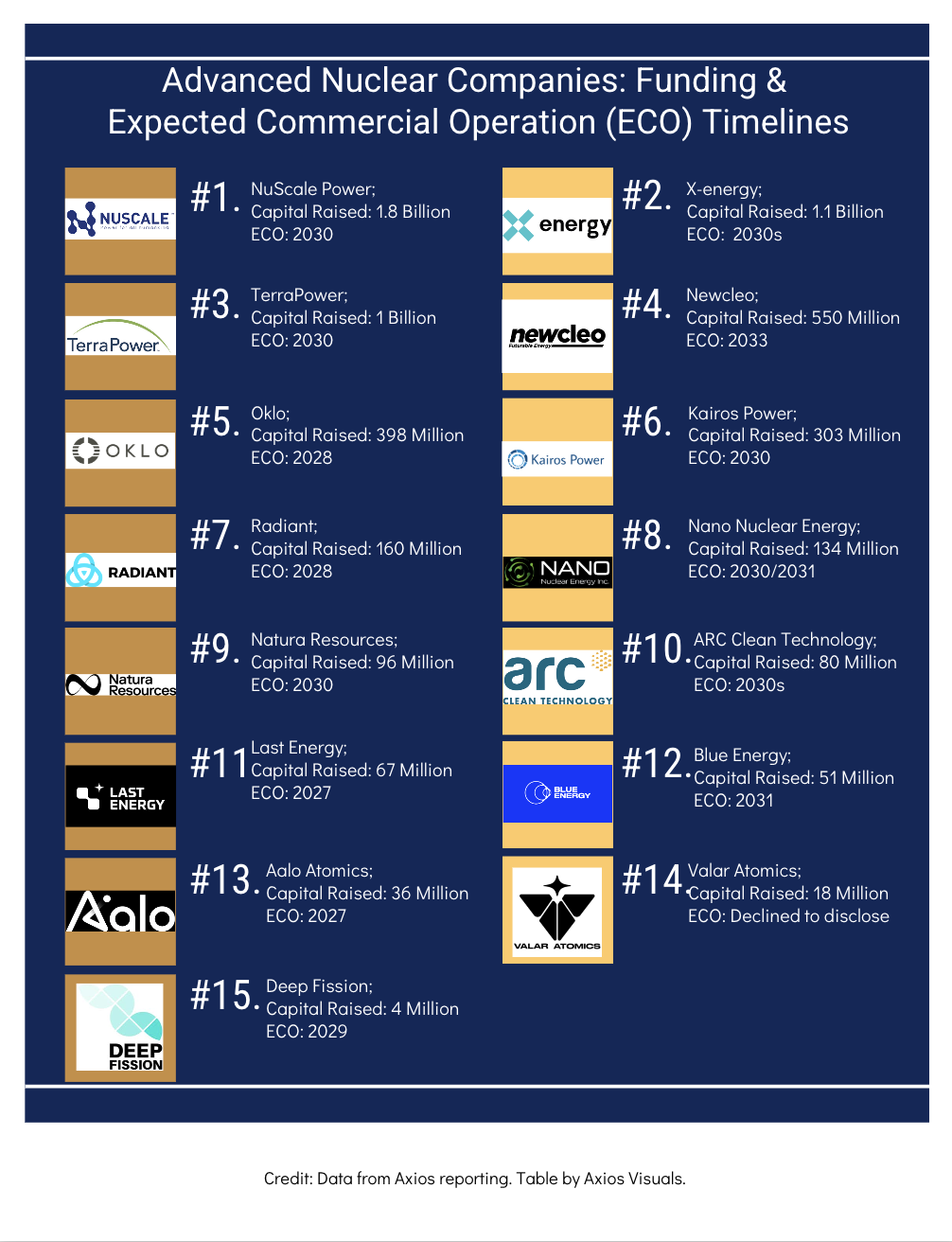
In this week’s issue, we provide an infographic that documents the amount of funding that advanced nuclear companies have collected and when these companies’ projects are expected to be deployed. We spotlight the Department of Energy’s publication of its nuclear energy accomplishments in the first 100 days under President Donald Trump. Finally, we highlight key nuclear technology, security, and geopolitical developments, reports, and analyses.
This issue of Nuclear News and Views was produced by PGS Program Director, Patrick Kendall, and Della Ratta Energy and Global Security Fellows, Emily Day and Jocelyn Livier.
| | Advanced Nuclear Companies: Funding & Expected Commercial Operation (ECO) Timelines | | |
Small Modular and advanced nuclear reactors have received significant attention over the last few years. The U.S. government has invested billions in these technologies and their fuel. Congress has instructed the Nuclear Regulatory Commission to streamline the evaluation of their safety, which is acting on this instruction. And Big Tech hyperscalers have looked to them as a solution for their high-intensity AI datacenter energy needs. However, as this infographic indicates, the capital that has been raised for these technologies to date pales in comparison with the scale of financing that will be needed to build even one, no less a fleet, of any of these reactors. With the exception
of NuScale Power’s VOYGR, none of the listed reactors has been approved by the NRC. So, any ECO date before the early-mid 2030’s is unlikely.
While smaller reactors are touted as being cheaper to build and operate, a first-of-its-kind of any of these reactors will cost at a minimum $5-10 billion and certainly much more for a small fleet. As the “Spotlight” of PGS’ News and Views indicates, the Trump administration is shifting the focus of the government from small reactor R&D to deployment. But to achieve that goal, the private financial markets, the U.S. government, allied nations, or likely all, will have to deliver billions more dollars for small reactor deployment. The list of the 11 Big Wins in the administration’s first 100 days is welcome and important. But as this infographic clearly underscores, it is insufficient to achieve the goal of nuclear energy dominance that the administration desires.
| | |
Ken Luongo, President, Partnership for Global Security
Jocelyn Livier, Della Ratta Fellow, Partnership for Global Security
| | | | |
Spotlight
In the first 100 days, the Trump administration has positioned nuclear energy as a cornerstone of its energy dominance agenda, announcing 11 Big Wins for Nuclear. These include the planned restart of the shuttered Palisades Nuclear Power Plant in Michigan, the first ever attempt to recommission a retired U.S. reactor, backed by a $1.52 billion federal loan guarantee to Holtec. Other headline initiatives include supporting small modular reactor (SMR) deployment and the development of advanced fuels like high-assay low-enriched uranium (HALEU). The administration has also accelerated public-private partnerships, including a Dow-X-energy advanced reactor project in Texas and a civil nuclear agreement with Poland to build AP-1000 reactors. In order to establish the United States as a leader in cutting-edge nuclear technologies, the national labs, specifically Idaho, Pacific Northwest, and Oak Ridge, have advanced work on developing molten salt fuel loops, testing new fast reactor fuels, and exploring space-based nuclear propulsion.
While the administration is touting all these steps as a long-overdue support for a nuclear renaissance, some of the marquee projects, including the Palisades restart, HALEU fuel development, and the Dow-X-energy partnership, predate the Trump administration. The real change in political direction is that the Trump administration is focused on deployment. There is no doubt that America must strengthen its position in nuclear energy to compete globally with Russia and China and to prepare for increased energy demand. But the success of this approach will ultimately depend on whether this federal support is sustained long-term and financially augmented to assure reactor deployment.
| | Emily Day, Della Ratta Fellow, Partnership for Global Security | | Issues of Special Interest | | Global AI and Data Center Energy | | |
Google is expanding its nuclear energy plans by providing early-stage capital for Elementl Power to prepare three potential sites in the United States for advanced nuclear power projects. The aim is that each of the three sites would have at least 600 megawatts of capacity, although the value of the investment has not yet been included in the two companies’ collaboration announcement. This agreement follows Google’s nuclear agreement with Kairos Power to purchase power from its small modular reactors (SMR) in 2024, and it is a part of a greater trend of tech companies looking to utilize nuclear technology to provide power for their growing data center needs.
Xcel CEO Bob Frenzel stated that it is crucial for the United States to break ground on new large-scale nuclear power plants to expand its nuclear energy capacity. In response to the rising energy demand coming from data centers, Frenzel said these types of projects will require partnerships across companies including power providers and customers along with government support. However, Frenzel added that Xcel isn’t currently considering building a new large nuclear reactor in its service territory.
China and the United States are driving 80% of the projected growth in electricity consumption from data centers by 2030, according to the International Energy Agency. U.S. data center power demand is expected to rise 130% to 425 TWh, surpassing electricity used for all domestic energy-intensive manufacturing, while China’s demand is set to increase 170% to 277 TWh. This surge is largely driven by the rapid expansion of AI technologies such as DeepSeek. Although data centers will account for less than 10% of global electricity demand growth, their geographic concentration may pose challenges for grid integration.
| | The Impact of Russia's Invasion of Ukraine on International Nuclear Affairs | | |
Ukrainian crews are conducting temporary repairs to the Chernobyl New Safe Confinement after a February drone strike caused damage, including a large hole in the roof. The structure, designed to contain radioactive materials from the 1986 disaster, suffered structural harm but has not released any radiation, according to the International Atomic Energy Agency. The European Bank for Reconstruction and Development has allocated €400,000 for damage assessment, following a joint inspection with Ukrainian authorities.
Ukraine’s Energy Ministry warned that the Zaporizhzhia Nuclear Power Plant faces renewed blackout risk after a Russian strike disabled one of its two remaining power lines. The plant now relies on a single external line for safe operation, raising concerns about radiation safety in the event of full disconnection. Energy Minister German Galushchenko stressed that only the de-occupation of the plant can guarantee its long-term security. Zaporizhzhia has had eight blackouts since the war began.
| | Global Nuclear Developments, Geopolitics, & Governance | | |
Russian state nuclear energy corporation Rosatom has initiated legal proceedings against Finnish energy company Fortum and steel manufacturer Outokumpu which demands compensation of 227.8 billion rubles ($2.83 billion) for the cancellation of the Hanhikivi-1 Nuclear Power Plant contract. The original contract for the Hanhikivi-1 project was signed back in 2013, but the Finnish consortium Fennovaima terminated it in 2022 citing significant delays and geopolitical risks following Russia’s invasion of Ukraine. Fennovaima has also sought international arbitration to recover €1.7 billion in advance payments from Russia.
Russia agreed to finance the construction of a new nuclear power plant in Iran as part of a broader energy and economic cooperation deal. The agreement also includes Russian support for completing phases two and three of the Bushehr plant and a major gas transfer deal, alongside a $4 billion investment in Iranian oil fields. These deepening energy ties come amid renewed U.S.-Iran nuclear negotiations and growing strategic alignment between Moscow and Tehran, both under Western sanctions.
Russian President Vladimir Putin ordered the development of key nuclear technologies, including a liquid-salt reactor and a nuclear used fuel reprocessing module, as part of the country’s national technology initiative. The directive also calls for the creation of a comprehensive digital database of high-tech materials and the establishment of an intersectoral additive manufacturing center. These efforts are intended to boost Russia’s leadership in next-generation energy technologies and high-tech industrial applications.
Russian nuclear regulator Rostekhnadzor has given the go-ahead for the Beloyarsk Nuclear Power Plant’s planned fifth unit, which will be a fast neutron BN-1200 reactor. The license was issued after the consideration of a package of documents covering the safety of the power unit and its compliance with technical regulations and federal rules. The sodium-cooled BN-series fast reactor plans are part of Rosatom’s project to develop fast reactors with a closed fuel cycle whose mixed-oxide (MOX) fuel will be reprocessed and recycled.
| | |
The first expert panel within the BRICS Nuclear Platform was held in China last week. The event on “Key Factors Impacting the Development of Nuclear Power” brought together representatives of government agencies and relevant organizations from BRICS countries, as well as representatives of the World Nuclear Association and the ASEAN Centre for Energy. The discussion centered on new approaches to the efficient allocation of nuclear energy resources, current trends in the industry, and prospects for cooperation among participating countries for balanced global development and energy security.
China has approved 10 new nuclear reactors, continuing a four-year streak of major expansion in atomic energy, with the latest projects expected to cost around 200 billion yuan (US$27 billion). With 30 reactors already under construction—nearly half the global total—China is on track to surpass the U.S. as the world’s largest nuclear energy producer by the end of the decade. The country’s nuclear capacity is projected to reach 65 GW by 2025 and 200 GW by 2040, accounting for about 10% of its total power output. China's centralized planning, low-interest financing, and streamlined construction processes give it a major advantage over Western countries facing cost overruns and delays.
China Huaneng announced the pouring of first concrete for the second Hualong One reactor of Phase 1 at the Shidaowan Nuclear Power Plant site. China Huaneng said that with the start of construction of Shidaowan unit 2, the Phase I expansion project has entered the full construction phase, and the construction of China’s first nuclear power base integrating third and fourth-generation nuclear power technologies was further accelerated. China’s State Council approved the construction of Shidaowan units 1 and 2 in 2023, with first concrete poured for unit 1 the following year.
| | |
Spain’s Nuclear Safety Council (CSN) is now preparing to reconnect the country’s nuclear reactors back to the power grid as they recover their external electricity supply after a power blackout hit Spain. The only exception is the Trillo Nuclear Power Plant, which was already shut down for refueling. CSN had said earlier that the country’s reactors were in safe condition following the blackout, and four reactors saw their emergency generators kick in after they had stopped operating automatically.
U.S. nuclear company Westinghouse has pulled out of Great British Nuclear’s small modular reactor (SMR) design competition, leaving Rolls-Royce, GE Hitachi, and Holtec as the remaining finalists. The Telegraph reported that Westinghouse did not submit a final bid following a negotiation process, with one industry source suggesting that the company balked at the commercial offer made by the British government. Westinghouse declined to give its reasons. Great British Nuclear is expected to announce two winners this year, with bidders told to prepare to build 3 to 4 mini reactors each.
In response to British Prime Minister Keir Starmer’s claims that investment in British companies has slumped because of overregulation, the Office for Nuclear Regulation (ONR) reportedly told the government that these claims about delays to nuclear power were not true. According to The Guardian, Starmer ignored warnings from the ONR that it was wrong to blame regulations for delays building new reactors when he launched his plan to revive the nuclear power industry earlier this year. ONR further suggested that a new task force should look at the issues facing the deployment of new reactor designs rather than the approval process if it wants to figure out why recent British nuclear reactors have been built so slowly.
Polskie Elektrownie Jadrowe (PEJ) and the Westinghouse-Bechtel consortium signed the recently agreed upon Engineering Development Agreement (EDA), which ensures the continuity of the implementation of Poland’s first nuclear power plant project. This agreement allows for the continuation of engineering work within the framework of the project and ensures the transition to the next phases of project implementation, including negotiations on the construction contract. The Polish government originally selected Westinghouse’s AP1000 reactor technology for construction at the Lubiatowo-Kopalino site back in 2022.
The Brno Regional Court has blocked Czech electric utility CEZ from signing its $18 billion contract with Korea Hydro & Nuclear Power to build new reactors at the Dukovany Nuclear Power Plant until the court has handled Électricité de France’s (EDF) complaint. EDF filed its complaint against Czech competition regulator UOHS last week after it rejected EDF’s appeal over the tender to pick KHNP for the two nuclear reactors. In response to this ruling, CEZ will appeal against the court injunction that is currently preventing it from signing its deal with KHNP.
The Czech government announced plans for a state loan to finance construction of two new units at the Dukovany Nuclear Power Plant, with a contract scheduled to be signed with Korea Hydro & Nuclear Power (KHNP) At a cabinet meeting, the government decided to purchase 80% of shares in the Elektrárna Dukovany II project, valued at around $163 million, and also approved a state loan to cover the construction costs, which will be repaid over a period of 30 years. The Czech government will require European Commission approval of the financing method and investor model, which is expected to happen around 2026.
Nine contracts and three memoranda of understanding (MoU) have been signed between Korean and Czech companies relating to the proposed new nuclear capacity planned at the Dukovany Power Plant. These agreements include a framework agreement on the supply of a turbine hall and a contract for a steam turbine between Škoda Power, Korea Hydro & Nuclear Power (KHNP, and Doosan. The signing of these agreements came despite a recent court injunction that has barred the signing of the contract for the new units between CEZ and KHNP until the court has handled Électricité de France’s (EDF) complaint.
Dutch small modular reactor (SMR) developer Thorizon has announced a partnership with French molten salt-based energy storage solutions specialist Storabelle. The two companies say that as part of the collaboration, they will develop a joint offering for industrial energy use and work together on designing conventional plant infrastructure. Thorizon is currently developing the Thorizon One SMR, with the company stating that it plans to conduct pre-feasibility studies at three nuclear-designated sites in France, Belgium, and the Netherlands.
Norsk Kjernekraft, energy company NEAS, and future Norwegian host municipalities Aure and Hein have founded a new company, Trondheimsleia Kjernekraft AS, to develop a power plant based on multiple small modular reactors (SMR). According to the preliminary plans, an SMR nuclear power plant will be located in a common industrial area in the border area between the Aure and Hein municipalities. Norsk Kjernekraft submitted its proposal for an assessment into the construction of the plant, aiming to consist of several SMRs with a total generating capacity of up to 1500 MWe.
Swedish company Blykalla and Norway’s Institute for Energy Technology formed a strategic partnership to accelerate the development of the SEALER small modular reactor (SMR). The collaboration will focus on engineering, safety systems, and operational environments to help advance the SEALER design from prototype to commercial readiness. Blykalla aims to deploy up to 1,000 SMRs by 2050.
Finnish utility Teollisuuden Voima Oyj (TVO) signed an $85 million loan agreement with the Nordic Investment Bank to finance safety upgrades at units 1 and 2 of the Olkiluoto Nuclear Power Plant in Finland. The loan will help finance key investments aimed at maintaining and improving safety measures and ensuring the possible extended operational lifetime of the two units. TVO is considering extending the operating licenses by a further 10-20 years and increasing the power output of each reactor from 890 MWe to approximately 970 MWe.
Finnish small modular reactor (SMR) developer Steady Energy will build a non-nuclear pilot facility at the decommissioned Salmisaari B coal power station in central Helsinki to demonstrate the maturity and safety of its LDR-50 reactor for district heating. Steady Energy and energy firm Helen previously signed an agreement to lease the decommissioned power plant building as a space for Steady Energy’s pilot plant, with construction scheduled to start later this year. The LDR-50 reactor has been under development at the VTT Technical Research Centre since 2020.
The International Thermonuclear Experimental Reactor (ITER) announced that the Central Solenoid, the magnet and beating heart of the tokamak, is finally complete and will begin assembly soon. The Solenoid was built and tested in the United States before being sent to France for assembly. The ITER is a decades-long multilateral project to develop the world’s first nuclear fusion facility, with the facility’s first plasma expected to be produced sometime in 2035.
| | |
India is considering a proposal to allow foreign companies to own up to 49% stakes in its nuclear power plants, a major shift aimed at expanding nuclear capacity and reducing reliance on coal. The changes would require amending the Civil Liability for Nuclear Damage Act and the Atomic Energy Act, potentially opening the door for both foreign and domestic private investment. These reforms could help India scale nuclear power to 100 GW by 2047, up from just over 8 GW today. Although foreign investment would still need government approval, major global and Indian companies have already expressed interest in participating.
India’s Ministry of Power has outlined a comprehensive strategy to expand the country's nuclear energy capacity more than tenfold—from 8.88 GW today to 100 GW by 2047—as part of its net-zero carbon emissions goal by 2070. Key steps include amending nuclear laws to enable private and state sector participation, accelerating regulatory approvals, and offering tax incentives and long-term financing. The plan also emphasizes public education on nuclear safety, repurposing retired thermal sites, and expanding domestic manufacturing and uranium sourcing. Members of Parliament supported the plan, calling for faster execution.
Japan plans to begin producing hydrogen using high-temperature heat from its experimental High Temperature Engineering Test Reactor (HTTR) by 2028, marking what would be the world’s first such use of a nuclear reactor. The Japan Atomic Energy Agency (JAEA) aims to connect the HTTR with a nearby hydrogen production facility and use the project to inform the design of a larger demonstration high-temperature gas-cooled reactor (HTGR) in the 2030s. While the initial process will still emit some CO₂, JAEA is researching emission-free hydrogen production methods.
Japan’s Nuclear Regulation Authority approved the restart of the Tomari No. 3 reactor in Hokkaido, marking the first such clearance since 2021 and a boost to the country's nuclear revival efforts. The reactor, shut since 2012, is expected to restart in 2027 pending formal approval after a public comment period. Despite a new government strategy to expand nuclear energy, progress has been slow due to strict safety checks and local resistance, with fewer than half of Japan's operable reactors back online.
Kazakhstan is exploring small modular reactors (SMRs) as a future component of its nuclear energy strategy, though its current focus is on building a large-scale nuclear plant. Officials have mentioned potential SMR deployments in Aktau and Kurchatov after 2030 and have held talks with U.S. companies like NuScale and GE-Hitachi, though neither was shortlisted for the country’s first plant due to lack of commercial experience. While SMRs offer benefits like lower upfront costs, flexible deployment, and reuse of coal plant infrastructure, they face challenges such as higher per-kilowatt costs and complex waste management.
The construction deadline for Korea’s Saeul Nuclear Power Plant units 3 and 4 has been extended once again following a revision to the Implementation Plan. The revision extends the construction period from 134 months to 147 months, consequently pushing back the deadline from October of this year to November 2026. Since construction began in 2016, the construction period for Saeul Units 3 and 4 has been extended several times. Although the construction itself is in its final stages, it is reported that more time is needed to develop accident management plans in line with strengthened security and safety standards.
A senior aide of Indonesian President Prabowo Subianto, Hashim Djojohadikusomo, said in an interview that the country plans a major expansion in renewable and zero-carbon energy by 2040, which includes the introduction of 10 gigawatts of nuclear power. Djojohadikusomo stated that the government expects to give out nuclear construction contracts in the next five years but added that no decisions have yet been made about the location of these nuclear power plants. He also claimed that Rosatom. China National Nuclear Corporation (CNNC), Électricité de France (EDF), and NuScale Power have shown interest in supporting Indonesia’s nuclear power ambitions.
| | Namibia is initiating discussions on the development of a nuclear power plant as part of efforts to diversify its energy mix, according to President Netumbo Nandi-Ndaitwah. As the world's third-largest uranium producer, Namibia aims to leverage its resources to strengthen energy security. While no timeline has been set, talks will begin in the current financial year. This announcement is part of the government’s larger plans to take advantage of Namibia’s natural resources, which also include stepping up efforts to ensure recent oil and gas discoveries are developed. | | Iran’s government stated that it remains committed to diplomacy with the United States after a fourth round of nuclear talks with Washington was postponed for “logistical reasons”. Government spokesperson Esmaeil Baghaei added that Tehran was flexible regarding the timing of talks and was waiting for details from mediator Oman regarding the next round of negotiations with the United States. While Iran insists that its nuclear program is purely for civilian purposes, U.S. President Donald Trump has threatened to bomb Iran if no agreement is reached to resolve the long-standing dispute over Iran’s program. | | There are no new updates for this region. | | North America Nuclear Collaborations and Policy | | |
President Donald Trump’s initial discretionary budget request from fiscal year 2026 cuts $4.7 billion from the Department of Energy’s federal funding, including a $408 million cut to the Office of Nuclear Energy and a $389 million cut to the Office of Environmental Management. According to the proposal, Office of Nuclear Energy funding for “non-essential research on nuclear energy” is being reduced to focus on “what is truly needed to achieve national dominance in nuclear technology.” This submission comes ahead of the submission of the comprehensive budget request which will outline the Trump Administration’s policy and funding priorities, which aims to cut more than $163 billion from non-defense federal funding.
26 House Republicans are calling for colleagues to spare certain clean energy tax credits from the chopping block. The letter to House Ways and Means Chair Jason Smith underscores the importance of preserving incentives for nuclear power, including the production tax credit for nuclear energy, and also argues that keeping these credits to bolster nuclear plants is essential to meeting the projected surge in electricity demand from the rapid growth of data centers. This letter comes as Republican leadership is closing in on a plan that could sunset many of the green subsidies codified by the Democratic Party’s 2022 climate law.
Kairos Power announced the start of installation of nuclear safety-related concrete marking the start of nuclear construction for the Hermes Low-Power Demonstration Reactor project in Oak Ridge, Tennessee. Kairos originally broke ground for the scaled demonstration of its KP-HFR fluoride salt-cooled high-temperature reactor technology last July, with the reactor being supported by risk reduction funding from the Advanced Reactor Demonstration Program (ARDP). While this facility won’t generate nuclear power, it serves as the prototype of the Hermes 2 reactor that will include a power generation system.
U.S. electric utility Entergy is looking to expand its nuclear power output by upgrading its existing plants across the southeast region of the United States while it considers advanced nuclear technologies. The power company is considering adding 275 megawatts of nuclear electric capacity through upgrades of its existing fleet and new sites such as a proposed power plant that would be located in Mississippi. Additionally, Entergy CEO Drew Marsh stated that companies and the U.S. government need to solve the construction risks and costs with any nuclear build in order to move forward with nuclear at a more rapid pace.
EnergySolutions announced it has signed a memorandum of understanding with the Intermountain Power Agency (IPA) and the state of Utah to explore the development of advanced nuclear power generation at the Intermountain Power Project (IPP) site in Utah. While the MoU does not identify a specific reactor technology to be built, the agreement has EnergySolutions helping IPA and Utah navigate the Nuclear Regulatory Commission’s (NRC) licensing process. The MoU follows EnergySolution’s signing of another agreement with Terrestrial Energy last year to collaborate on the siting and deployment of Terrestrial Energy’s integral molten salt reactor plants.
The Nuclear Regulatory Commission (NRC) has received the first portion of the construction permit application from the Tennessee Valley Authority (TVA) for a GE-Hitachi BWRX-300 small modular reactor at the Clinch River Nuclear Site in Oak Ridge, Tennessee. TVA submitted the environmental report portion of the application on April 28 and will need to submit an additional application in the future for permission to operate the facility. The NRC staff will now review the environmental report to determine if it is complete and acceptable for processing.
The State of Idaho and the Department of Energy have signed a targeted waiver of their original 1995 Settlement, allowing the Idaho National Laboratory (INL) to bring in a high-burnup nuclear fuel cask and limited amounts of used fuel from U.S. university research reactors. The waiver will enable critical research on a high-burnup nuclear fuel cask from a commercial nuclear power plant and enables INL to safely manage small amounts of used nuclear fuel. In 1995, the State of Idaho, the U.S. Navy, and the Department of Energy reached an agreement that settled a lawsuit filed by the state to limit the shipment of used nuclear fuel to INL for storage.
Utah signed two memoranda of understanding (MoU) with Idaho and Wyoming as part of a strategy to fire up innovation and collaboration in the region. Utah Governor Spencer Cox joined Idaho Governor Brad Little and Wyoming Governor Mark Gordon in signing the MoU. The MoU calls for the three states to work together on coordinating nuclear infrastructure, accelerating nuclear development, advocating for pro-nuclear federal policies, and expanding workforce development efforts to support the growing nuclear energy sector.
Illinois State Senator Sue Rezin is leading a bipartisan group of more than 20 cosponsors for Senate Bill 1527, which would remove regulations prohibiting the construction of new large nuclear power reactors with a nameplate capacity of more than 300 megawatts of electricity, with Rezin adding that the current ban needs to be lifted so that Illinois can compete with other states to provide electricity from nuclear reactors. Illinois currently has a ban on the construction of new large nuclear reactors.
The Nuclear Company has completed its Series A funding round as well as announcing the opening of its primary engineering and construction office in Columbia, South Carolina. The Series A funding was led by venture capital company Eclipse and included follow-on investments from all prior investors. The Nuclear Company is currently evaluating sites to support a 6-gigawatt fleet of nuclear reactors, aiming to leverage advanced construction and manufacturing methods alongside cutting-edge digital technologies.
The Department of Energy’s Office of Nuclear Energy has announced a significant upgrade to Argonne National Laboratory’s liquid test loop for sodium-cooled fast reactors. Argonne replaced an aging cold trap device, which is an upgrade that the Department of Energy stated is the first of its kind for the United States in more than 30 years. The Mechanisms Engineering Test Loop (METL) facility is an intermediate-scale liquid metal experimental facility that provides purified reactor-grade sodium to various experimental test vessels to test components that are required to operate in a prototypical advanced reactor environment.
| | South Korea's Doosan Enerbility has signed a preferred vendor agreement with Canada's Candu Energy, making Doosan the first non-Canadian firm to earn this designation. Doosan was the only non-Canadian company selected from over 2,000 vendors, giving it privileged access to design, manufacturing, and installation work on future Candu reactor projects. This partnership enables Doosan to participate in global nuclear projects involving the refurbishment of existing Candu reactors and the construction of new ones. There are currently 31 Candu reactors in operation around the world, including in Canada, South Korea, Romania, China, and Argentina. | | There are no new updates for this region. | | |
How France’s Dashed “Nuclear Renaissance” Complicates Korea’s Reactor Export Ambitions
Korea JoongAng Daily, May 7
A Nuclear Fusion Power Plant Prototype Is Already Being Built Outside Boston. How Long Until Unlimited Clean Energy Is Real?
CNN, May 6
Uranium Crunch: The Race to Fuel the West’s Nuclear Energy Revival
Mining Technology, May 6
Environmental Reviews Should Empower Nuclear Energy, Not Stall It
The Breakthrough Institute, May 5
Regulations Based on Vibes Don’t Work – Policy Must Come from Facts and Data
The Hill, May 3
U.S. Nuclear Capacity Factors: Stability and Energy Dominance
American Nuclear Society, May 2
Spain’s Big Blackout Shows the West Needs Nuclear
The American Conservative, May 2
Why Labor Won’t Stop Talking About Nuclear Power
Australian Financial Review, May 2
3 Issues to Watch as DoE "Energy Dominance" Agenda Takes Shape
E&E News, May 2
Will New Nuclear Arrive in the US in Time to Save Data Centers?
Fierce Network, May 2
States’ Nuclear Energy Growth Needs Federal Action to Follow Trump’s Vocal Support
News from the States, May 2
The Next Five Years Will Define U.S. Nuclear’s Fate
Power Mag, May 1
The New Nuclear: How TerraPower Is Powering the Future of Clean Energy
Columbia Business School, April 30
The Answer to Nuclear Finance
Nuclear Engineering International, April 30
Are Small Modular Reactors in Kazakhstan’s Nuclear Energy Future?
The Atlantic Council, April 29
11 Big Wins for Nuclear in Trump Administration’s First 100 Days
U.S. Department of Energy, April 29
Production of Hydrogen Via SMRS: A Promising Alternative for a Sustainable Energy Future in the Near and Long Term
Innovation News Network, April 29
The Other Nuclear Race
Foreign Affairs, April 28
How the U.S. and South Korea Can Power the Globe with Nuclear Energy
The Korea Economic Institute, April 28
How Astral Systems Plans to Turn Nuclear Waste into Clean Energy
Maddyness, April 28
Nuclear Will Help the United States Reclaim Energy Dominance
The Washington Times, April 28
Will Uranium Ever Gets Its Day in the Sun?
Australian Financial Review, April 27
Powering the Roll-Out of Advanced Nuclear Technologies Through Digital, Data, and AI
World Nuclear News, April 25
| | |
News items and summaries compiled by:
Patrick Kendall, Program Manager, Partnership for Global Security
Emily Day, Della Ratta Fellow, Partnership for Global Security
Jocelyn Livier, Della Ratta Fellow, Partnership for Global Security
| | For twenty-five years the Partnership for Global Security (PGS) has developed actionable responses to global security challenges by engaging international, private sector, and multidisciplinary expert partners to assess policy needs, identify effective strategies, and drive demonstrable results.
| | | | |