|
Greetings!
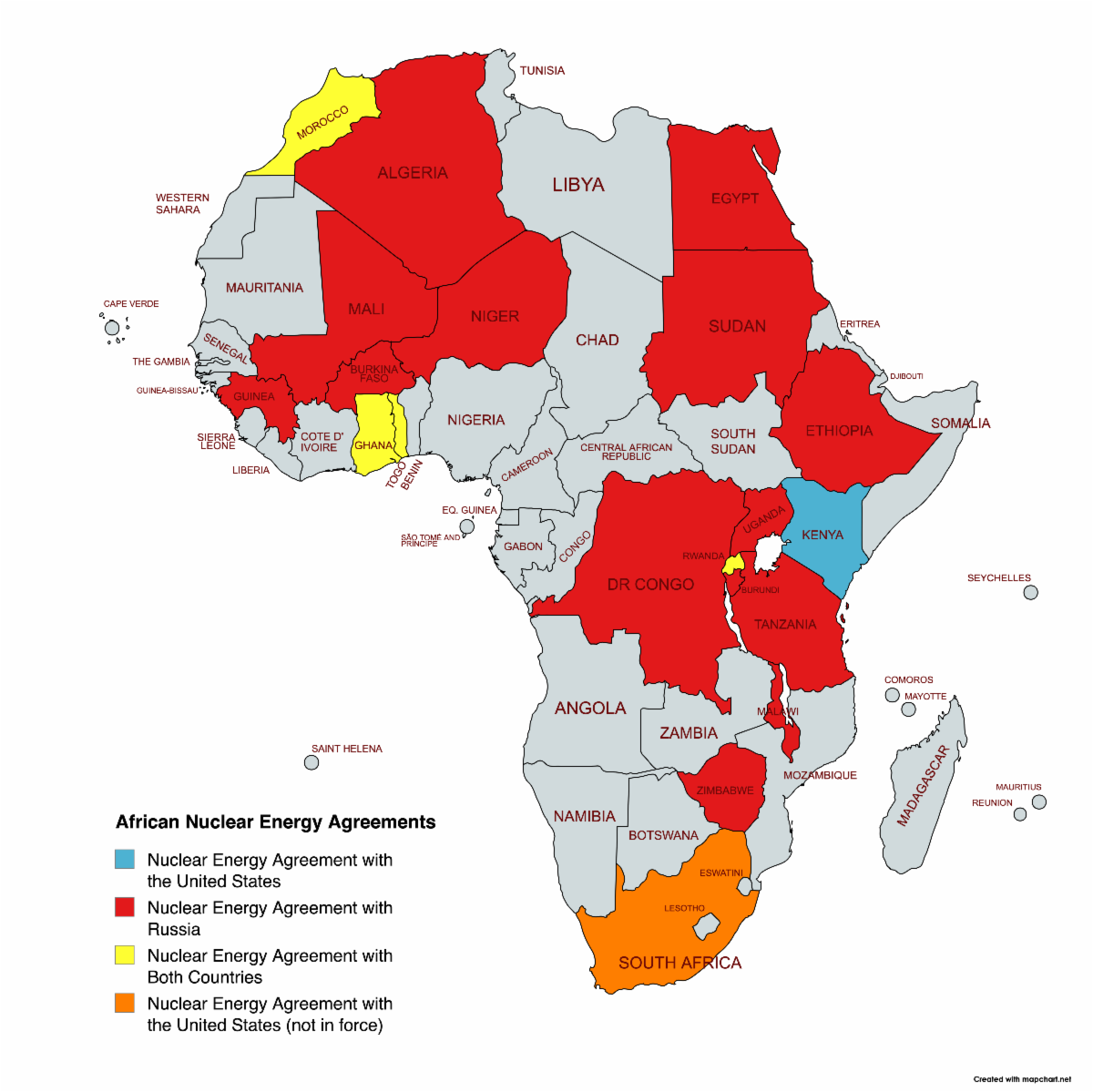
In this week’s issue, we provide an infographic and analysis of the United States and Russia’s nuclear energy diplomacy with countries in Africa and examine how Russia has achieved the upper hand in forging these agreements. We spotlight the schedule delay of the BWRX-300 small modular reactors being built at the Darlington New Nuclear Project in Canada, the first Small Modular Reactor technology set to be deployed in the Group of Seven (G7) countries. Finally, we highlight key nuclear technology, security, and geopolitical developments, reports, and analyses.
This issue of Nuclear News and Views was produced by PGS Program Director, Patrick Kendall, and our Della Ratta Energy and Global Security Fellow, Paul Tervo.
| | The United States and Russia’s Nuclear Diplomacy Competition in Africa | | Africa's population is expected to increase from 1.55 billion to 2.58 billion by 2050, and the continent's demand for electricity is projected to more than double to 2,291 TWh during that time frame. Subsequently, countries across the continent have increasingly expressed interest in nuclear power, and Russia and the United States have sought to sign nuclear energy agreements with new countries to expand their influence in the region. Both countries have established multilateral summits with African nations to discuss nuclear energy collaboration, including the U.S.-Africa Nuclear Energy Summit and the Russia-Africa Summit. However, Russia has gained the upper hand in terms of forging nuclear energy agreements with countries in Africa. These commitments range from declarations to cooperate on the development of nuclear power to nuclear reactor construction projects like the El Dabaa Nuclear Power Plant that Russia is constructing in Egypt. At the 2026 Russia-Africa Summit alone, Rosatom discussed expanding the El Dabaa project and advanced nuclear energy agreements with Ethiopia, Rwanda, and Uganda. The United States has made progress in planning nuclear power projects including the potential deployment of NuScale's VOYGR-12 small modular reactor in Ghana, the signing of a Nuclear Cooperation Memorandum of Understanding with Rwanda, and aiding Kenya's adoption of nuclear energy. The United States has a 123 nuclear cooperation agreement with Morocco that is in force. The U.S. also had a long-standing 123 agreement with South Africa, which was approved for renewal by the U.S. Congress, but it remains unratified by South Africa and has expired. Another agreement on nuclear R&D with South Africa remains active. Overall, Russia’s nuclear agreements on the continent are significantly outnumbering those of the United States'. | | |
Patrick Kendall, Program Director, Partnership for Global Security
Paul Tervo, Della Ratta Fellow, Partnership for Global Security
| | | | |
Spotlight
Ontario Power Generation (OPG) announced that the first of four BWRX-300 small modular reactors (SMR) under construction at the Darlington New Nuclear Project is no longer expected to be completed within the previously planned timeline of October 2030 or budget. OPG acknowledged in their third quarterly report that the project is subject to inherent risks and uncertainties that could affect the project’s cost and schedule. GE Hitachi’s BWRX-300 is a water-cooled SMR that leverages the design and licensing basis of the company’s boiling water reactor design and its licensed GNF2 fuel design.
The Darlington New Nuclear Project is the first small modular reactor facility expected to be deployed in a Group of Seven (G7) country. Although this setback will delay the project’s deployment, the BWRX-300 SMR is a first-of-its-kind nuclear technology and in that process schedule and cost are not unexpected. OPG now expects to complete the comprehensive assessment of the new project cost and schedule by mid-2027.
| | Patrick Kendall, Program Director, Partnership for Global Security | | Issues of Special Interest | | Global AI and Data Center Energy | | PSEG Power and Constellation Energy are planning a 200-megawatt uprate at their jointly owned Salem Nuclear Power Plant in New Jersey. This uprate will support the recent nuclear-focused power purchase agreement between Constellation and Google, and PSEG is also exploring potential deals with data center developers following the uprate of the Salem facility. | | The Impact of Russia's Invasion of Ukraine on International Nuclear Affairs | | |
The Zaporizhzhia Nuclear Power Plant regained its external electricity supply on November 8 after losing its power supply the previous night. Ukrainian nuclear agency Energoatom stressed that the situation at Zaporizhzhia remains extremely dangerous, especially as Russian military forces continue to occupy the facility. The Zaporizhzhia Nuclear Power Plant has experienced 16 blackouts since the beginning of Russia’s invasion of Ukraine, with one investigation by Greenpeace Ukraine finding that Russian forces have deliberately disabled power lines supplying electricity to the power plant.
The European Bank for Reconstruction and Development (EBRD) says it faces a €500 million shortfall for emergency repairs to the Chernobyl Nuclear Power Plant unit 4 in Ukraine. The EBRD is seeking money to restore the giant steel structure built over unit 4, which was damaged by a Russian drone strike in 2025. It warned that international funding is needed to avert a potential environmental disaster.
| | Global Nuclear Developments, Geopolitics, & Governance | | |
Russian state nuclear agency Rosatom has proposed an international methodology that would allow small modular reactors (SMR) to qualify for carbon credits under the terms of the Paris Agreement. Russia submitted its framework for recognizing the low-carbon benefits of SMRs, including the calculation of avoided greenhouse gas emissions. Under the Paris Agreement, carbon credits can be traded and used by states and organizations in signatory countries to hit their climate goals.
Russian nuclear corporation Rosatom announced a site has been selected for a uranium processing plant with a capacity of 11,000 tons of uranium oxide per year. The plant is to be established in Krasnokamensk and will process uranium from the Argunskoye and Zherlovoe deposits. Russia is currently the sixth largest producer of uranium globally, and the government is seeking to expand uranium mining and processing as part of the government’s plans to achieve a closed nuclear fuel cycle.
| | |
The first safety-related concrete has been poured for Haiyang unit 5 in Shandong province, marking the beginning of full-scale construction on the plant’s third phase of expansion. Units 5 and 6, both CAP1000s, are anticipated to be operational in 2027. Once all reactors are operational, the Haiyang power plant will be the world’s most productive plant to fully rely on passive pressurized water reactors.
China General Nuclear completed fuel loading at the newly constructed unit 2 reactor at the San’ao nuclear power plant in Zhejiang province. The reactor, a Hualong One, is scheduled to begin supplying electricity in 2027. At the same time, CGN began construction of unit 4. In total, there are six Hualong Ones planned for deployment at the San’ao plant, with the first already providing power to the grid.
China National Nuclear Corporation has begun pouring concrete for the high temperature gas reactor at the Xuwei nuclear power plant in Jiangsu province. The reactor, which is a Chilong HGTR, has a capacity of 660 MW and will provide both power and industrial-scale heating. Construction of the reactor was approved, along with the two conventional reactors planned for the Xuwei plant, by China’s State Council in August 2024.
| | |
Poland’s PEJ has submitted an application to the government of Pomerania for a permit to begin early site works for the country’s planned nuclear power plant at the Lubiatowo-Kopalina site. An approval would allow PEJ and Bechtel to perform basic work, like surveying and fencing, without needing to wait for further approvals, allowing them to keep to their schedule. The planned power plant, which would host three AP1000s, would be Poland’s first and is now planned for operation in 2036 after a series of delays in the past months.
Westinghouse Electric has submitted an order to Japanese engineering firm IHI Corporation covering engineering and procurement activities for long-lead items for one containment vessel and an associated large steel module for Poland’s first nuclear power plant. Last month, PEJ gave Westinghouse the go-ahead to start ordering long-lead items for the first AP1000 unit at the Lubiatowo-Kopalino site. Three Westinghouse AP1000 reactors are planned at the site, construction is scheduled to begin in 2028, and the first unit is expected to start commercial operation in 2036.
Turkey and South Korea have signed two MoUs to collaborate on nuclear energy topics. One agreement sees the two countries partner on energy transition technology, including nuclear power, while the other, specifically signed between Türkiye Nuclear Energy Company and the Export-Import Bank of Korea, establishes a framework for future financing partnerships. The agreements come as Turkey considers contractors for its planned reactor at Sinop and other sites in the country, with Korean companies among the candidates.
Canadian reactor developer AtkinsRéalis signed an MoU with TÜNAŞ, Turkey’s state-owned nuclear company, to explore deployment of a 4.5 GW nuclear power plant featuring six CANDU reactors at an unspecified site. Under the MoU, the two companies will conduct feasibility and front-end engineering studies, both of which are targeted for completion before the end of next year. Turkey is currently in the process of building its first nuclear power plant at Akkuyu with Rosatom and has in recent weeks asserted that it would soon solidify plans for another plant at Sinop; it is unclear whether the plant outlined in the MoU is intended for Sinop.
UK Fusion Energy is seeking tenders for five engineering contracts covering the design, testing, and control of key systems needed to operate the planned Spherical Tokamak for Energy Production (STEP) fusion power plant. The terms of the contracts will be two years with an option to extend for one year on two occasions. In 2022, the British government chose a site in West Burton to host the STEP power plant, with the primary objectives of the facility to deliver net electricity greater than 100 megawatts and utilize fusion energy beyond electricity production.
The European Commission’s Innovation Fund has awarded French small modular reactor developer Calogena €40 million to support construction of its first reactor. This is the first time that European Commission funding has been given to a commercial SMR facility. Calogena’s SMR is designed to provide heat for urban utilities, with its first deployment targeted for 2030 at the Pierrelatte nuclear site in southern France. The company is also pursuing projects across Europe, including in Central and Eastern Europe.
Estonia has narrowed down its choices for the country’s first nuclear power plant to three locations in the Viru-Nigula municipality. The Estonian government initiated the state spatial planning process for the nuclear power plant in May of 2025, and the first part of the phase planning process will continue up until next year. Estonia passed the Nuclear Energy and Safety Act earlier this year which sets out key steps required for the deployment of nuclear energy in the country.
Belgium’s government and multinational energy companies Engie and Electrabel have agreed to extend negotiations for the potential acquisition of Belgium’s seven nuclear reactors by the state. The three parties began negotiations in late April, and their Letter of Intent covered a proposed transaction that covers the full scope of nuclear activities owned and operated by Engie and Electrabel. Belgium’s government reversed its previous nuclear phase-out law in 2025 and is planning to operate its remaining two nuclear units for a further ten years.
The Danish Molten Salt Power Barge developer Saltfoss has notified the U.S. Nuclear Regulatory Commission (NRC) of its intent to begin pre-application engagement. The company says it is expanding its operations in the United States and plans to submit its Regulatory Engagement Plan to the NRC in the first quarter of next year. Saltfoss’ seaMSR-100 is a molten salt reactor that will operate with low-enriched uranium, and Saltfoss finished the conceptual design in 2025.
Copenhagen Atomics has signed an MoU with Urenco to open a deconversion facility in Denmark. The uranium processed by the facility will be used for Copenhagen Atomics’ own molten salt SMRs as well as sold to other reactor companies. The facility will be Denmark’s first fuel cycle facility and first nuclear power-related facility since its last research reactor closed in 2002.
Finland’s Helen Ydinvoima Oy launched an environmental impact assessment (EIA) on the construction of a small nuclear power plant at one of three potential sites in Helsinki. The EIA will examine the maximum capacities of the plants, resulting in a report that will be published in 2028. During the initial phase of its nuclear program, Helen will negotiate with potential partner stakeholders, evaluate plant suppliers, and determine potential plant sites. Helen is aiming to achieve carbon neutral energy production by 2040.
Greece’s Athlos Energy and consulting company Helixos conducted a study analyzing the economic impact of a nuclear power plant in Greece. The report found that the construction of a 1,600 nuclear power plant could contribute about €4.5 billion ($5 billion) to Greece’s gross domestic product (GDP) over the full construction facility, with a separate scenario of small modular reactor (SMR) construction contributing €590 million. Greece does not currently have any nuclear power facilities, but Prime Minister Kyriakos Mitsotakis announced that the country would examine the role of SMRs in its energy mix.
Slovakia has increased the power output to 35% for the fourth unit at the Mochovce Nuclear Power Plant as the reactor continues its commissioning process. The reactor was connected to the power grid when its power output was at about 20% and has now produced about 16.2 gigawatts of electricity. Slovakia currently operates five nuclear reactors at two sites, with Mochovce unit 4 beginning construction back in 1986 and reached criticality in August of this year after years of delays to its deployment.
Both units of Romania’s Cernavodǎ nuclear power plant were reconnected to the grid following an extended shutdown. This restart returns 1400 MW to the grid, roughly 20 percent of Romania’s total generation. Both of the plant’s reactors had been shut down for nearly three months following a summer drought that lowered the water levels of the Danube river, which typically provides cooling for the plant.
A bill has been introduced in the Dáil Éireann, Ireland’s parliament, to lift the country’s ban on nuclear power which has been in place since 1999. While the bill’s passage is not guaranteed, it was introduced by a member of the Fianna Fáil party, which is a part of the current government, and is supported by the party’s leader. Ireland has never had a nuclear reactor but in recent years has seen rising interest in building a nuclear industry.
| | |
South Korean Finance Minister Lee Hyoung-il stated that a planned $100 billion advance remittance for a U.S. nuclear power project would only proceed after a full review of its business feasibility. Lee told a parliamentary budgetary committee that the remittance plan remained at a preliminary stage and would be reviewed carefully before being approved. This announcement comes as the United States and South Korea continue negotiating a major investment deal in the U.S. nuclear energy sector, including potential joint nuclear power projects.
South Korea has approved a plan to develop a nuclear-powered submarine under its Jangbobo-N program. The Defense Acquisition Program Administration (DAPA) added that the Jangbogo-N project is intended to produce nuclear-powered boats through domestic research and development, with DAPA set to begin work on the project sometime next year. South Korea’s Ministry of National Defense unveiled the project in May of this year, planning to use low-enriched uranium fuel and design the submarines for long operating periods between refueling.
U.S. small modular reactor (SMR) developer First American Nuclear has signed a comprehensive master service agreement with Hyundai E&C. The master service agreement helps advance the companies’ framework agreement to the contract stage for the EAGL-1 project, and it will see Hyundai E&C performing constructability reviews, design and engineering consulting, and provision of technical feedback in the construction sector. The EAGL-1 is a lead-bismuth cooled SMR designed for factory fabrication and scalable deployment.
Kazakh Energy Minister Yerlan Akkenzhenov said during a government briefing that the Balkhash Nuclear Power Plant is in construction progress and that a second nuclear power plant is also in development in collaboration with the China National Nuclear Corporation (CNNC). In late October, Kazakh President Kassym-Jomart Tokayev stated that it was possible to begin construction of the Balkhash Nuclear Power Plant in 2027 and also sign a comprehensive cooperation agreement for the deployment of the Moyynkum Nuclear Power Plant project. Balkhash is set to be Kazakhstan’s first nuclear power plant and will consist of a pair of Russian-designed VVER-1200 reactors.
Pakistan has installed the containment building for unit 5 of the Chashma Nuclear Power Plant. Pakistan signed a $4.8 billion deal with China in 2023 for the construction of the new Hualong One unit that is set to produce electricity in 2030. Pakistan currently has six operating nuclear power reactors, including two Hualong One units at the Karachi Nuclear Power Plant.
Uzbekistan announced it plans to double its production of uranium from 7,500 tons this year to 15,000 tons by 2050. President Shavkat Mirziyoyev said that state mining company Navoiyuran must make the most of advanced production technologies to achieve this plan, as well as the expected rise in demand for uranium in the coming decades. Uzbekistan is the fifth largest producer of uranium in the world, with the the country’s uranium mining industry going back to the Soviet era.
The Singapore Nuclear Research and Safety Institute and Finland’s VTT Technical Research Centre signed a five-year memorandum of understanding to deepen cooperation in nuclear safety and jointly assess emerging nuclear technologies. Under the MoU, the two parties will cooperate in areas such as nuclear reactor technology assessment and safety analysis, radioactive waste and spent fuel management, and capability developments. Singapore is considering the deployment of nuclear power and recently appointed British firm Mott McDonald to conduct a technical feasibility study of advanced nuclear technologies.
| | |
Russia has agreed to partner with Ghana on deployment of a 2,000 megawatt nuclear power plant. The agreement was reached at the recently held Russia-Africa summit and follows continued Russian involvement in African countries’ nuclear power development. Ghana has long had ambitions to develop nuclear power and is one of the few countries on the continent to maintain a research reactor.
Uganda and Russia signed an agreement to cooperate on nuclear power deployment in the African country. The agreement specifically opens the door for the creation of a joint body to develop a contract for Russian partnership on the planned Nakasongola nuclear plant. Uganda has been seeking to develop nuclear power for decades and has set out a roadmap to deploy four nuclear power plants with international partnership.
Rosatom announced four target countries to potentially host floating nuclear power plants. The candidate countries, which are now in advanced discussions with the Russian company, are Egypt, Togo, Namibia, and Tanzania. Rosatom is framing the facilities as introductions to nuclear power for these countries, which, aside from Egypt, would be nuclear newcomers.
Eskom, South Africa’s state-owned power company, has submitted its feasibility program to the government for its planned buildout of 5200 MW of new nuclear capacity. The government plans to complete its review by 2027 and is aiming for construction to begin by 2036. Eskom manages the Koeberg plant, Africa’s only currently operating nuclear power plant.
| | |
Rosatom has completed the production of all key components of the first reactor at the planned El Dabaa nuclear plant in Egypt. The equipment will now be shipped to the plant site for installation, with the reactor targeted for operation by 2030. Rosatom originally signed the contract to build four reactors at the El Dabaa plant in 2017 and has since made progress installing the first components.
The IAEA conducted its Integrated Regulatory Review Service (IRRS) mission in Jordan, reviewing the government and regulatory body’s responsibilities and functions, the country’s regulatory framework, and inspection and enforcement. The IAEA found that Jordan has a well-established regulatory framework for nuclear and radiation safety while providing recommendations for further improvement. Jordan currently operates a nuclear research and training center, has significant uranium resources, and is considering the deployment of small modular reactors (SMR).
| | There are no new updates for this region. | | North America Nuclear Collaborations and Policy | | |
The Nuclear Regulatory Commission (NRC) has issued a construction permit for X-energy’s Xe-100 reactor at Dow’s Long Mott Generating Station in Texas. The NRC previously released its Final Safety Evaluation Report for Long Mott Energy’s construction permit application after a comprehensive review of the Xe-100’s principal design criteria, preliminary design, and safety analyses. The Long Mott Generating Station is being developed under the Department of Energy’s Advanced Reactor Demonstration Program (ARDP), and the company is expected to consider a preliminary investment decision in 2027.
Urenco USA announced its first commercial production of low-enriched uranium plus (LEU+) fuel at its National Enrichment Facility in New Mexico. Urenco USA received authorization from the Nuclear Regulatory Commission (NRC) to enrich uranium up to 10% U-235 at its facility in 2025, and all of the plant’s gas centrifuges are licensed to produce LEU+. This is the company’s first commercial production of the higher enriched fuel, and it plans to build 2.1 million separative work units (SWU) at the site with the first cascades expected to begin production in 2032.
The U.S. Senate is debating the Bipartisan American Affordability and Jobs Act (BAAJA) which would address numerous aspects of energy infrastructure permitting, including by amending the conditions under which the Federal Energy Regulatory Commission (FERC) may issue a construction permit for certain transmission lines. The legislation includes several bipartisan nuclear energy bills that seek to improve the efficiency of the nuclear licensing process and support the deployment of domestic nuclear fuel infrastructure.
The House of Representatives has passed the Nuclear Recycling Efficient Fuels Utilizing Expedited Licensing (REFUEL) Act. The REFUEL Act would amend the existing Atomic Energy Act by excluding advanced fuel recycling technologies from the definition of a “production facility” as long as the process does not separate plutonium from other transuranic elements, with the goal of streamlining the licensing for nuclear fuel recycling sites.
American advanced nuclear technology developer X-energy selected Fluor Corporation to provide engineering, design, and project management services for the Cascade Advanced Energy Facility near Richland, Washington. Under the agreement, Fluor will provide these services and leverage its knowledge from ongoing work with X-energy as the project aims to incorporate X-energy’s Xe-100 reactor technology. The Cascade Advanced Energy Facility is expected to deploy four Xe-100 reactors.
The Department of Energy’s ARPA-HONIG program has named eight awardees, companies, universities, and laboratories to turn transuranic elements from used nuclear fuel into fissile material for advanced reactors. These awards will focus on recycled fuels for fourth-generation reactors, with Westinghouse Electric developing its PowerBlock technology and Oklo receiving funding for its FORGE project. The ARPA-HONIG program falls under the Advanced Research Project’s Agency-Energy (ARPA-E).
| | |
The Canadian government released its budget for 2026 that provides funding for a strategy to double grid capacity by 2050 and investments in nuclear energy and critical minerals. The budget proposed providing C$518.5 million over five years to advance Canada’s nuclear research, supply chains, workforce, and regulatory capacity. This builds on the Nuclear Energy Strategy the government presented in June that seeks to strengthen Canada’s domestic supply chains, expand the country’s nuclear energy sector, and promote Canadian nuclear expertise abroad.
Refurbishment work on the Bruce Nuclear Power Plant unit 5 has begun, with the unit taken offline to begin its Major Component Replacement outage. The Major Component Replacement process involves replacing key reactor components such as steam generators, pressure tubes, and feeder tubes with the goal of adding 30 to 35 years to the reactor’s operating life. This is the fourth unit to be refurbished under Bruce Power’s plan to renew six of its units at the Bruce nuclear site.
| | There are no new updates for this region. | | |
Is America Headed Toward a New “Nuclear Golden Age”?
The Nation, November 12
Counting the Real Numbers in a Workforce Driving a Gigawatt Nuclear Plant
Neutron Bytes, November 11
Springtime for the Full Nuclear Fuel Cycle
American Nuclear Society, November 10
The Midterm Elections Opened a Bipartisan Path on Nuclear Waste
POWER Magazine, November 10
Russia’s Nuclear Offerings to Africa Are Attractive. That’s Why the US Needs to Step Up ASAP
Energy for Growth Hub, November 6
America’s Nuclear Revival Is Running into a Fuel Supply Wall
Oil Price, November 6
Budget 2026: Nuclear Ambition to Delivery
Burges Salmon, November 5
Building an Efficient European Nuclear Energy Supply Chain: Why We Need a Unified Nuclear Skills Passport
Clean Air Task Force, November 5
AI Data Centers Are Fueling a Nuclear Comeback
Data Center Knowledge, November 5
A Syzygy in Nuclear Energy
POWER Magazine, November 5
The Senate Permitting Bill Holds Promise but Needs Amendments
Utility Dive, November 3
America Is Running Finland’s Nuclear Experiment in Reverse
The Washington Post, November 3
Nuclear Regulatory Reform Beyond the Permitting Bill
Center on Global Energy Policy, November 2
The Rise of the Nuclear Hexagon and the Future of Asian Stability
Asia Times, October 30
How D.C. Cook Built a Culture of Excellence and Continuous Improvement
American Nuclear Society, October 30
Keeping America’s Nuclear Fleet Reliable as Electricity Demand Grows
POWER Magazine, October 29
| | |
News items and summaries compiled by:
Patrick Kendall, Program Director, Partnership for Global Security
Paul Tervo, Della Ratta Fellow, Partnership for Global Security
| | For twenty-five years the Partnership for Global Security (PGS) has developed actionable responses to global security challenges by engaging international, private sector, and multidisciplinary expert partners to assess policy needs, identify effective strategies, and drive demonstrable results.
| | | | |