|
Greetings!
In this week’s issue, we present a timeline of Italy’s nuclear power program that documents its origins, the country’s decision to abandon nuclear power following the Chernobyl disaster, and the government’s recent moves to reintroduce nuclear energy. We spotlight the Italian Senate’s passage of legislation that paves the way for Italy to reintroduce nuclear power and deploy new reactors. Finally, we highlight key nuclear technology, security, and geopolitical developments, reports, and analyses.
This issue of Nuclear News and Views was produced by PGS Program Director, Patrick Kendall, and our Della Ratta Energy and Global Security Fellow, Paul Tervo.
| | Italy Reverses Course on Nuclear Power | | |
Last week, Italy’s parliament passed a bill that will allow the reintroduction of nuclear power in the country. It is the culmination of Prime Minister Giorgia Meloni’s push to reverse a 1987 national referendum to abandon nuclear power in Italy after the Chernobyl nuclear reactor meltdown. Italy’s return to nuclear power aligns the country with most of its partners in the G7, leaving only Germany with a nuclear moratorium.
The decision was hastened by rapidly rising energy prices in Italy the wake of the war in Ukraine and Middle East instability. Italy’s energy system is heavily reliant on imported natural gas, which has spiked in price in Europe. The resurrection of Italy’s nuclear energy program is tied to energy security and economic competitiveness.
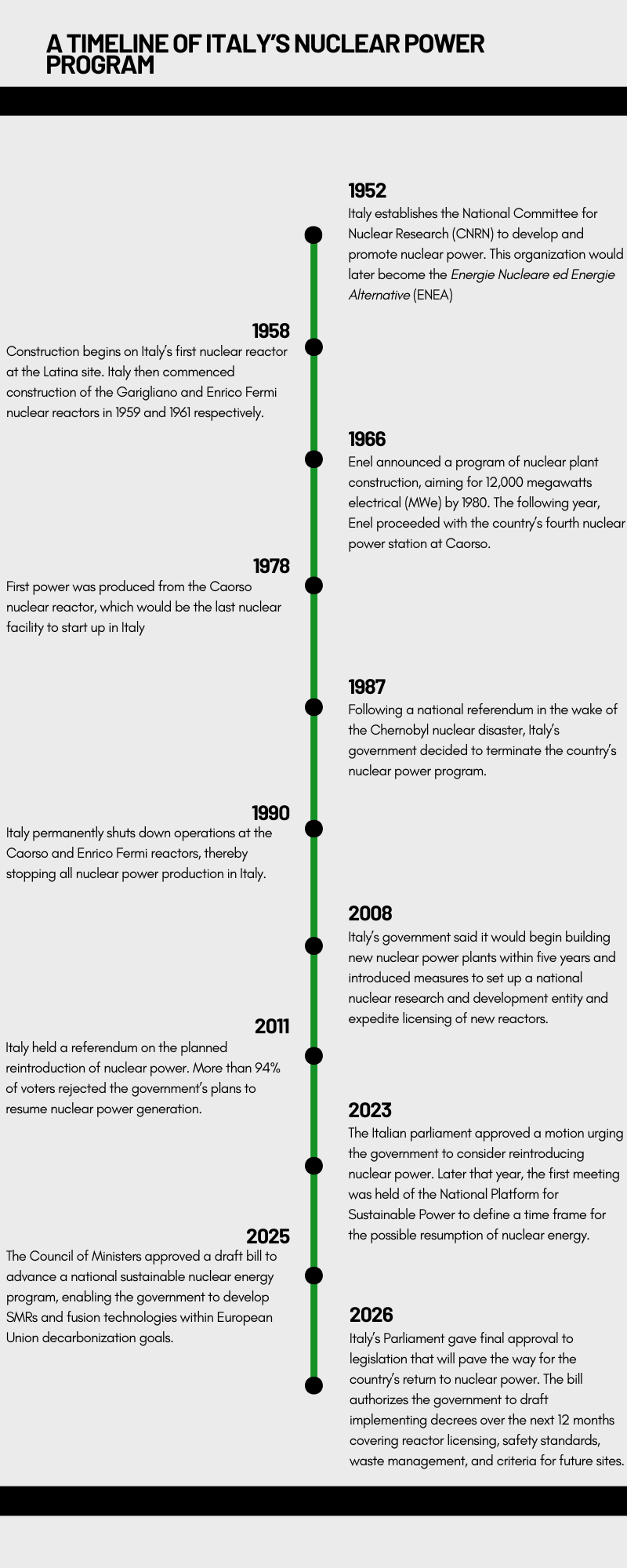
The infographic illustrates the timeline of nuclear power in Italy, highlighting that it was an early adopter, building four nuclear plants between 1958 and 1978. It then abandoned that commitment after the Chernobyl disaster. Italy sought to bring the program back in 2008, but these plans were dashed by the Fukushima-Daichii disaster in 2011 and another referendum that demonstrated strong opposition to a nuclear restart.
In 2023, the Italian government again sought to bring nuclear power back to the country, culminating in the approval of the current legislation that empowers it to pursue a variety of nuclear reactor types such as small modular reactors and develop an updated system for nuclear licensing and spent fuel management.
| | |
Patrick Kendall, Program Director, Partnership for Global Security
Paul Tervo, Della Ratta Fellow, Partnership for Global Security
| | | | |
Italy’s parliament has given its final approval for legislation that will pave the way for the country to reintroduce nuclear power nearly four decades after it shut down its nuclear energy program. The bill authorizes the government to draft implementing decrees over the next 12 months, establishes a framework for evaluating next-generation nuclear technologies, and covers reactor licensing, safety standards, waste management, and criteria for future sites. The bill also allows for the establishment of an Independent Nuclear Safety Authority, development of a National Programme for Sustainable Nuclear Power, and strengthening of domestic scientific and industrial research in nuclear power.
Italy previously operated a nuclear power program that began in the 1950s. The government ended the operation of its nuclear power facilities in 1990 in response to the Chernobyl nuclear disaster. While a second referendum in 2011 saw voters again reject the reintroduction of nuclear energy in Italy, the Russian invasion of Ukraine and the rising energy prices has influenced Italian Prime Minister Giorgia Meloni and lawmakers to reconsider this moratorium. Italy is one of many countries in Europe that are reconsidering nuclear power, as countries such as Spain, Belgium, and Switzerland have either moved toward resuming their nuclear energy programs or are considering lifting the moratorium on new reactors.
| | Patrick Kendall, Program Director, Partnership for Global Security | | Issues of Special Interest | | Global AI and Data Center Energy | | |
Global investment firm JP Morgan stated that the European Union’s goal of ramping up data center capacity has driven more investment into European nuclear energy projects. Companies such as Microsoft and Amazon are investing in nuclear power plant projects in the United Kingdom, France, and Finland. Global energy consumption from artificial intelligence is projected to more than double by 2030, and the European Union is aiming to triple data center capacity by 2035.
NANO Nuclear, IP3 Corporation, and Cybernetic Intelligence announced the signing of a Letter of Intent to jointly pursue nuclear-powered AI, national security nuclear-powered AI, national security and computing, and other infrastructure opportunities. The Letter of Intent names NANO Nuclear as the preferred provider of nuclear technology and services to IP3 and Cybernetic Intelligence for opportunities pursued through this collaboration. Areas under consideration include potential advanced reactor pilot programs for military application and high-performance computing infrastructure.
| | The Impact of Russia's Invasion of Ukraine on International Nuclear Affairs | | The IAEA reported that a drone hit a cooling tower at the Kursk nuclear power plant in Western Russia. Although the reactor was operating at the time, Rosatom asserted that there was only minor damage and no impact to operation. Drone incidents have occurred at the Kursk plant in the past, most notably in August 2025. Russia and Ukraine have each exchanged fire in recent months, with some strikes threatening the safety of power plants such as the Kursk power plant and the Zaporizhzhia power plant in Ukraine. | | Global Nuclear Developments, Geopolitics, & Governance | | Nine industry associations are calling on governments around the world to continue advancing the peaceful use of nuclear technology through several measures addressed at the Roadmaps to New Nuclear conference. The Nuclear Energy Association stated that delivering new nuclear capacity at scale faces significant challenges such as workforce development, supply chain readiness, and regulatory preparedness. Among the organizations who signed this declaration are the World Nuclear Association, the Korea Atomic Industrial Forum, the Nuclear Industry Association, and Nucleareurope. | | Russia has manufactured the second RITM-200C small modular reactor unit for the floating nuclear power plant which will supply electricity to a copper mining center in Chukotka. The floating nuclear power plant will feature two of the RITM-200C reactors, with the first being manufactured in May of this year at the ZiO-Podolsk plant. Russia has produced 16 RITM units already, eight of them are in operation on Russia’s nuclear icebreakers, and an additional 12 are in various stages of manufacturing. | | |
Tests have been completed at unit 5 of the Lufeng Nuclear Power Plant to check the integrity of the containment structure. The two-part tests confirm that the containment vessel meets design and construction quality requirements. China is currently building six nuclear reactor units at the Lufeng Nuclear Power Plant, with Lufeng unit 5 being the first of two Hualong One reactors under construction at the site. Once all six reactors are operational, the plant will generate about 52 terawatt hours (TWh) of electricity.
Unit 3 at the Changjiang Nuclear Power Plant has entered commercial operation after being connected to the grid in August. The unit is the first of two Hualong One reactors being constructed as part of Phase II of the power plant’s construction. The Changjiang Nuclear Power Plant is currently home to two operating CNP–600 pressurized water reactors which entered commercial operation in 2015 and 2016, respectively.
China’s State Power Investment Corporation has begun pouring concrete for the Bailong unit 2 CAP1000 reactor in the Guangxi region. The milestone officially marks the beginning of construction on the reactor, which is planned to take 56 months. Phase I of the Bailong plant, which is composed of units 1 and 2, was approved by the State Council in August 2024, with the first concrete for unit 1 being poured in December 2025.
Tianwan unit 7 in Jiangsu province has achieved a self-sustaining chain reaction at its minimum power level. This marks the beginning of a cycle of tests and checks that will eventually bring the new reactor up to full power. The Tianwan power plant is a collaboration between Russia and China, with Rosatom building the units and a China National Nuclear Corporation-led consortium owning and operating it.
| | |
Polish state-owned nuclear power company, PEJ, Bechtel, and Westinghouse agreed on the main commercial terms of a deal to build Poland’s first nuclear power plant. The groups said the engineering, procurement, and construction (EPC) contract stipulates the power station will use three Westinghouse AP1000 pressurized water reactors, and the two sides are aiming to finish EPC negotiations by the end of this year. Poland originally selected Westinghouse as the reactor supplier for Poland’s Lubiatowo-Kopalino nuclear power station in 2022.
GE Vernova, Hitachi, Synthos Green Energy (SGE), and Samsung C&T signed an agreement to identify and develop market opportunities for the deployment of BWRX-300 small modular reactors (SMR) in Europe. SGE is set to develop projects for a fleet of BWRX-300 reactors with GE Vernova-Hitachi across Europe, but with a focus on Poland and the United Kingdom. The BWRX-300 is a water-cooled SMR, and the first unit is under construction at Ontario Power Generation’s Darlington site in Canada.
Rosatom head Alexei Likhachev announced that the first unit at the Akkuyu Nuclear Power Plant is being prepared for the reactors’ next stage of pre-start up testing. Likhachev added that the aim is to obtain a license and begin launch operations by the end of the year. Akkuyu is Turkey’s first nuclear power plant that is being built by Rosatom, and the aim is for unit 1 to begin supplying energy to Turkey’s power grid sometime this year.
The U.S. Trade and Development Agency (USTDA) signed an agreement with Turkey’s state-owned nuclear development enterprise (TUNAS) to fund technical assistance to create the regulatory, institutional, and financial roadmap for Turkish private sector companies to deploy small modular reactor (SMR) technology. The USTDA’s assistance will identify the policy and investment steps needed to bring SMRs to market. Last November, Turkey’s energy minister set out a target for his country to deploy 5000 megawatts electrical (MWe) of SMR capacity by 2050.
Nuward CEO Julien Garrel stated that his company aims to start the construction of a small modular reactor (SMR) unit in 2030, which will be the first of ten units to be deployed. Nuward is the SMR unit wholly owned by Frances EDF. Garrel added that the goal is to produce the first electricity in 2035. This announcement comes as the European Industrial Alliance on SMRs is assessing a second round of applications, with the ultimate goal of SMRs being operational in the European Union by the early 2030s.
Framatome has signed a commercial contract to deliver the world’s first nuclear fuel reload with U-235 enrichment above the industry standard to an operational nuclear reactor in the United States. Under the agreement, Framatome will supply a series of higher enriched fuel reloads beginning with delivery in early 2028. The advanced fuel will be manufactured at Framatome’s facility in Richland, Washington, and the company is seeking permission for the plant to handle uranium enriched up to 10%.
Rosatom Director General Alexei Likhachev met with Armenia’s government to discuss further life extension options for the Armenian Nuclear Power Plant. Likhachev added that most of the work planned for the period up to 2031 has already been completed in relation to the life extension of the reactor until 2036. Armenia currently operates one Russian-designed VVER reactor at the Armenian Nuclear Power Plant and is also considering the prospect of new nuclear reactor construction.
Armenian Prime Minister Nikol Pashinyan asserted that the country will make a decision on proposals to build new nuclear power capacity in the country in the near future. The country has reportedly received such proposals from Russia, the United States, France, China, and South Korea. Armenia is already collaborating with a variety of nuclear power companies, having signed a 123 agreement with the United States in February while working with Rosatom to extend the lifetime of its lone operating reactor.
British nuclear site operator Sellafield has selected the Amentum joint venture as the preferred supplier for an asset care and creation program for Sellafield’s nuclear power facilities. Under the Projects and Asset Care Execution (PACE) contract, Amentum and its supply chain partners will support Sellafield’s spent fuel management and retrievals mission by providing full lifecycle services, as well as assisting with project management and commissioning. The initial contract duration will be nine years with an optional six-year extension.
Britain’s Rolls-Royce SMR has chosen Czech energy company Skoda JS as the sole supplier of control rod drive mechanisms for Rolls-Royce’s future SMRs. Earlier this year, Rolls-Royce SMR selected Skoda JS and Doosan Enerbility for pre-production work for key components. The first of Rolls-Royce SMR’s reactors is due to be built in North Wales, with an additional unit set to be built at the Temelín Nuclear Power Plant in the Czech Republic.
Slovakia’s Mochovce Nuclear Power Plant unit 4 began power generation on September 21, which Slovenské elektrárne describes as the last major step before the unit is put into operation. The reactor’s power output will now be gradually increased in stages, with checks and tests at each level before being increased. The Mochovce 4 unit has been under construction since 1986, but progress has been stalled numerous times. Slovakia currently generates about half of its electricity from the Mochovce and Bohunice nuclear power plants.
The Dutch Senate has approved an amendment to the country’s Nuclear Energy Act allowing the Borssele nuclear power plant to operate past 2033. At the same time, the Dutch national government announced that it had taken a 70 percent stake in the company managing the plant, allowing it to pursue its goal of keeping the plant operating until 2054. The Borssele plant is the only nuclear power plant operating in the Netherlands; however, the government has expressed interest in building new nuclear capacity.
Belgium has extended negotiations with French utility Engie to purchase the company’s energy assets in the country. The deadline has now been pushed to November 4 from October 1, giving the parties more time to agree to a deal. Engie’s assets in Belgium include two operating nuclear reactors as well as three more undergoing decommissioning.
Germany’s PreussenElektra announced the demolition of the decommissioned Stade nuclear power plant’s 80-meter exhaust stack in Lower Saxony. As phases I and II of the plant’s dismantling have continued, only the reactor containment vessel and administrative buildings remain. The plant has been in decommissioning since 2005 and is scheduled to be fully released from nuclear regulatory oversight in 2027.
| | |
Taiwan’s Nuclear Safety Commission (NSC) has completed its review of Taipower’s plans to restart the Maanshan Nuclear Power Plant. The two pressurized water reactors at the power plant were taken offline in 2024 and 2025 respectively following the expiry of their 40-year operating license and in accordance with Taiwan’s nuclear phase-out policy. In 2025, Taiwan’s Legislative Yuan passed an amendment to the Nuclear Reactor Facilities Regulation Act that allows nuclear plant operators to apply for a 20-year license renewal beyond the existing limit, and Taipower submitted its license renewal application for Maanshan earlier this year.
Japanese startup Helical Fusion announced it expects to begin preliminary power-on tests at its demonstration fusion reactor in 2027. The company is developing the Helix HARUKA, which is Japan’s first integrated pilot reactor using the helical approach to nuclear fusion, and will demonstrate the feasibility of continuous fusion reactions. Construction of the first spiral coil at the National Institute for Fusion Science (NIFS) site began early this year, and Helical Fusion plans to conduct power-on tests of the completed facility around 2030.
India has achieved multiple fuel loading milestones for its nuclear power fleet, including the fuel loading at Rajasthan Atomic Power Project unit 8 and at Kaiga Nuclear Power Plant unit 1. Rajasthan Unit 8 is expected to begin commercial operations during the current financial year, and Nuclear Power Corporation has also started geotechnical investigations for the next two units at the plant. India’s government has set a long-term objective of achieving 100 gigawatts electrical (GWe) of nuclear capacity by 2047.
| | |
The U.S. Development Finance Corp has approved up to $414 million in financing for Canadian company Global Atomic’s Dasa uranium extraction project in Niger. According to Global Atomic, opening the Dasa deposit would give the company access to some of the highest-grade uranium in Africa. The approval comes amid both rising Western interest in uranium and deal-focused rapprochement between the United States and Niger under the Trump administration.
Atomic Eagle and the Republic of Niger formalized an agreement to resume uranium mining for the former’s Madouela project. The agreement includes a framework for future operations at the project as well as the discontinuation of international arbitration. The Madouela project was one of many foreign uranium projects held by the Nigerien government following a coup d’etat in 2023.
| | There are no new updates for this region. | | The Inter-American Development Bank and the IAEA have signed a memorandum of understanding (MoU) to strengthen cooperation on the use of nuclear energy in Latin America and the Caribbean. The two organizations will explore cooperation on the technical, institutional, and economic aspects of nuclear technologies such as small modular reactors (SMR) and other emerging technologies, with the MoU providing a framework for dialogue, knowledge sharing, technical assistance, and capacity building. Currently, Brazil, Argentina, and Mexico are the only Latin American countries with nuclear power programs. | | North America Nuclear Collaborations and Policy | | |
President Donald Trump has unveiled plans for up to $200 billion in South Korean investment in U.S. energy infrastructure, including eight large nuclear reactors, a Texas power complex, and a planned Alaska LNG project. Project Power establishes a framework for up to $120 billion for eight reactors: six Westinghouse AP1000 units and two South Korean-designed APR1400 reactors. The reactors will be built in Ohio, Tennessee, South Carolina, and Kentucky. Construction is proposed in three stages, while about $100 billion would cover construction and another $20 billion would be held as contingency reserves.
A group of U.S. Senators led by Edward Markey published a letter to Secretary of State Marco Rubio expressing their disapproval of the U.S.-Saudi nuclear cooperation agreement, arguing that the deal fails the Gold Standard nonproliferation test. By abandoning the Gold Standard, the Senators state that the agreement would allow Saudi Arabia to acquire the means to potentially produce weapons-grade nuclear materials without proper nonproliferation safeguards. The letter also calls out Rubio for supporting the deal despite previously being an advocate against Saudi Arabia’s pursuit of nuclear weapons.
A group of nonproliferation experts submitted a letter to Congress expressing their concern about the proliferation risks posed by the U.S.-Saudi agreement for civil nuclear cooperation. The letter argues that the proposed Bilateral Safeguards Agreement is not a proper substitute for the IAEA’s Additional Protocol as it only requires Saudi Arabia to provide additional information about sites where the U.S. is engaged in nuclear fuel cycle cooperation. Additionally, the experts express concern that the agreement would likely lead to Saudi Arabia developing a uranium enrichment program using U.S. technologies.
The Nuclear Regulatory Commission (NRC) has issued a construction permit for the Tennessee Valley Authority’s planned BWRX-300 small modular reactor (SMR) at the Clinch River site. The TVA submitted its application to the NRC in May of last year, making it the first utility in the United States to submit a construction permit application for GE Hitachi’s BWRX-300 SMR technology. This decision paves the way for the United States’ first commercial SMR, with NRC Chairman Ho Nieh adding that the decision demonstrates how the NRC can make credible safety decisions that enable major American nuclear projects to move forward.
Kairos Power has picked engineering firm Samsung C&T to help build its 50-megawatt demonstration reactor for Google, with the nuclear startup aiming to complete construction by 2030. As part of the deal, Samsung C&T will make an equity investment in Kairos and provide engineering services. Google and Kairos first signed a deal to build Kairos’ reactors for Google’s AI data centers in 2024, and Kairos is also building the Hermes 2 reactor at Oak Ridge, Tennessee.
Georgia Power and Google signed an agreement under which Google will support power uprate at Georgia Power’s Vogtle and Hatch nuclear power plants. The utility says the power uprates increase the electrical output of nuclear power generating units through modifications to equipment such as turbines, pumps, and cooling systems. Georgia Power added that the Hatch and Vogtle plants provide about a quarter of the electricity used by the state.
Bechtel is stepping away as the design, procurement, and construction partner of the Natrium reactor project currently underway in Kemmerer, Wyoming. TerraPower said it intends to rebid the engineering, procurement, and construction contract for the project, and Bechtel will remain on site to complete the plant’s Sodium Test & Fill Facility and support an orderly transition to the new partner. TerraPower originally named Bechtel as its partner in a federal grant application in 2020 to build the Natrium plant in Wyoming.
On the margins of the United Nations General Assembly, the United States announced the establishment of an Implementation Plan in support of the small modular reactor (SMR) deployment agreement signed between the United States, Japan, and South Korea. The Implementation Plan will pursue SMR deployment worldwide to meet the growing global energy demand. This is in addition to a key industry initiative signed between GE Vernova, Hitachi, Synthos Green Energy, and Samsung C&T to advance the deployment of SMRs across Europe.
Constellation Energy and Amazon announced a 20-year power purchase agreement that will support the expansion of Constellation’s Calvert Cliffs nuclear plant in Maryland. The agreement will enable more than $3 billion in Maryland infrastructure investment, including 690 megawatts of power from the Calvert Cliffs plant and, and will support Constellation’s efforts to expand the Calvert Cliffs facility for another 20 years. Calvert Cliffs is Maryland’s sole nuclear power plant, but it produces about 80% of the state’s clean energy.
Members of the Senate Committee on the Environment and Public Works considered a $50 billion federal plan that would fund three future nuclear innovation campuses designed to attract heavy manufacturing industries. The Department of Energy’s Nuclear Lifecycle Innovation Campus (NLIC) initiative aims to build three regional hubs that will contain data centers, advanced reactors, and commercial nuclear fuel recycling facilities. The DoE has signed agreements with five states that will be considered as hosts for the campuses.
TRISO-X announced the completion of the building that will house its TX-1 advanced nuclear fuel facility in Oak Ridge, Tennessee. This first fuel facility will move onto the interior buildout, installation of fuel fabrication equipment, and continued construction of supporting facilities. The plan is for the completed TX-1 facility to produce about 700,000 TRISO-X fuel pebbles each year, which is enough capacity to fuel up to 11 Xe-100 reactors. Initially, it is expected to support X-energy’s proposed development of the Xe-100 advanced SMR in Texas.
The Nuclear Regulatory Commission (NRC) and the Department of Energy’s Office of Energy Dominance Financing have issued an environmental assessment and finding of no significant environmental impact for reauthorizing operations as the Crane Clean Energy Center in Pennsylvania. Constellation is seeking to restart operations at the Three Mile Island unit 1, which has been renamed as the Crane Clean Energy Center. Constellation submitted an exemption request and three license amendment requests in support of allowing the resumption of power operations for the reactor.
The Department of Energy is asking Congress for new legal authority to manage spent nuclear fuel and move past the longstanding impasse over the Yucca Mountain waste disposal site. The Department proposes establishing a series of Nuclear Lifecycle Innovation Campuses (NLIC) that consolidate interim dry storage, spent fuel reprocessing, fuel fabrication, and permanent disposal. There has been pushback from lawmakers over the prospect of spent fuel reprocessing, with the question of cost and nuclear safety concerns being the primary arguments against it.
Antares and Centrus have agreed to a multi-year high-assay low-enriched uranium (HALEU) contract to support Centrus’ ongoing expansion of its uranium enrichment capacity. The HALEU deliveries will also support Antares’ advanced reactor projects that are set to begin by the end of the decade, including for space and national security missions. Antares is developing the Antares-0 reactor which is transportable and will be fueled using TRISO HALEU. The Antares-0 was the first reactor under the Department of Energy’s Reactor Pilot Program to achieve criticality by the government’s July 4 deadline.
California Governor Gavin Newsom has signed new legislation to accelerate the deployment of nuclear fission and fusion industries in California. The legislation creates a strategic plan for the development of fusion energy, expands the number of opportunities for fusion research and development, and develops a commercial fusion strategy for California. California is already home to the Lawrence Livermore National Laboratory, where researchers achieved the first laboratory fusion ignition in 2022.
General Matter has submitted a license application to the Nuclear Regulatory Commission (NRC) for its proposed commercial uranium enrichment facility in Paducah, Kentucky. Pre-construction work at the site has already been taking place, with the application containing evaluations of the facility’s safety and impact. General Matter was one of four companies selected by the Department of Energy in 2024 to provide enrichment services to help establish a U.S. supply of high-assay low-enriched uranium (HALEU).
| | |
The Canadian government has published a notice for the country’s Deep Geologic Repository project, marking a step towards listing the repository as a project of national interest. Putting this label on the project would subject it to accelerated and consolidated government review, as opposed to a usual project which would have to go through multiple stages of review consecutively. The repository is currently undergoing a federal impact assessment, licensing by the Canadian Nuclear Safety Commission, and site selection.
Four reactors at the Pickering nuclear plant in Ontario went offline in preparation for a massive refurbishment project. The project, which includes partners like Candu Energy and Aecon Group, would extend the operational lifetime of the reactors by 30 or more years. The $26.8 billion refurbishment project is set to begin in January and continue for nearly a decade.
The government of Saskatchewan has released its plan to develop a provincial nuclear power program. The plan seeks to bring online at least 2.6 gigawatts of nuclear power by 2050. This plan builds on current efforts by state-owned utility SaskPower to deploy both large reactors and SMRs across the province.
| | There are no new updates for this region. | | |
Piecing Together the Pele Power Puzzle
Axios, September 30
Trump Wanted Faster Nuclear Reactor Permits. TVA Made Record Time.
Chattanooga Times Free Press, September 30
US Nuclear Exports Can Compete with Russia and China. Here’s Why.
The National Interest, September 29
Why America Is Losing the Nuclear Export Race to Russia and China
The National Interest, September 29
Can the SpaceX Playbook Work for Nuclear Power?
Politico, September 27
AI’s Nuclear Power Push Runs into Cost and Regulatory Hurdles
Bloomberg, September 25
Nuclear Plant Restarts Show What Government Can Do with a Clear Mandate
POWER Magazine, September 25
The US-Saudi Nuclear Cooperation Agreement Would Serve US Interests
Center on Global Energy Policy, September 24
How to Fix the US-Saudi Nuclear 123 Agreement
The National Interest, September 24
Why Nuclear Power Is Exciting Investors
The Washington Examiner, September 24
Iowa Is Leading America’s Nuclear Power Comeback
Des Moines Register, September 23
What Does Fleetwide AI Actually Mean for the U.S. Nuclear Industry?
POWER Magazine, September 23
A $50 Billion IPO Is Good News for America’s Nuclear Rebirth
Bloomberg, September 22
Nuclear Regulatory Policy and Presidential Power
The Regulatory Review, September 22
Nuclear Power Is Back on Southeast Asia’s Energy Agenda
DW, September 21
Nuclear Energy is the Kremlin’s Latest Leverage Over Washington
Foreign Policy, September 21
A Safer Way to Bet on Nuclear
The Wall Street Journal, September 21
We’ve Crossed the Nuclear Tipping Point
American Nuclear Society, September 16
| | |
News items and summaries compiled by:
Patrick Kendall, Program Director, Partnership for Global Security
| | For twenty-five years the Partnership for Global Security (PGS) has developed actionable responses to global security challenges by engaging international, private sector, and multidisciplinary expert partners to assess policy needs, identify effective strategies, and drive demonstrable results.
| | | | |