|
Greetings!
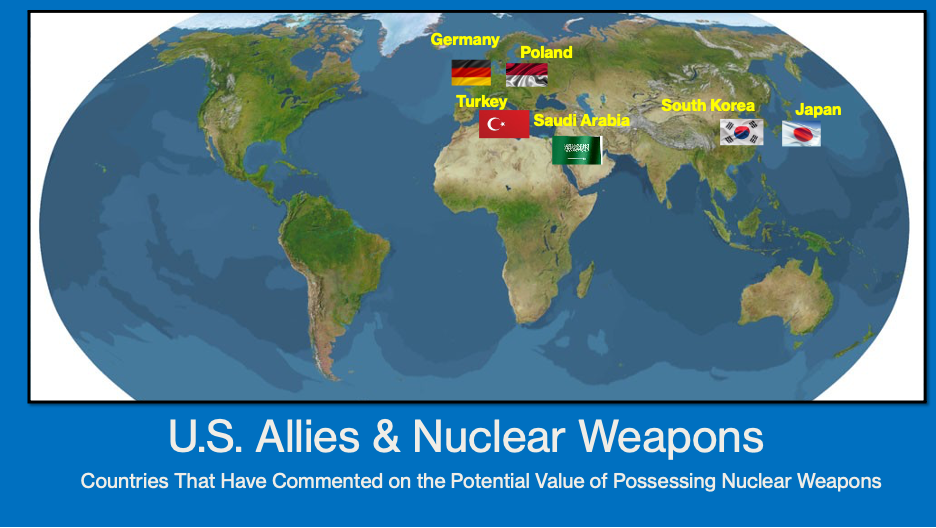
In this week’s newsletter, we feature an infographic and commentary that identifies U.S. allies that have discussed the possibility of possessing nuclear weapons and the implications this has for the global nonproliferation policy and the expansion of nuclear energy. We spotlight a new report from the Carnegie Endowment for International Peace, produced in collaboration with Harvard University’s Belfer Center and the Nuclear Threat initiative. It argues the United States needs to revise its global nonproliferation strategy and provides policy recommendations to prevent the further proliferation of nuclear weapons worldwide. Finally, we highlight key nuclear technology, security, and geopolitical developments, reports, and analyses.
This issue of Nuclear News and Views was produced by PGS Program Director, Patrick Kendall, and Della Ratta Energy and Global Security Fellows, Mackenzie Hansen and Gabriela Zanko.
| | Nuclear Power and Nuclear Proliferation | | |
As the Preventing Nuclear Anarchy report featured in our Spotlight makes clear, the unsettled state of global affairs, intensifying geopolitical tensions, technology advancements, and the erosion of the nuclear nonproliferation regime has increased interest in the potential value of possessing nuclear weapons in some countries, including some staunch U.S. allies in Europe, North East Asia, and the Middle East.
Poland: NATO infrastructure should shift east and “I think it’s not only that the time has come, but that it would be safer if [nuclear] weapons were already here.” Former President Andrzej Duda, March 2025
Germany: “That we in Europe …need to become more nuclear-independent is a question that has been discussed…for years.” Chancellor Friedrich Merz, February 2025
Turkey: Countries “have missiles with nuclear warheads…but (they tell us) we can’t have them. This I cannot accept.” President Recep Tayyip Erdogan, September 2019
South Korea: If the problem with North Korea gets worse, “our country will introduce tactical nuclear weapons or build them on our own.” Former President Yoon Suk Yeol, January 2023
Japan: Conservative politicians have raised the issue of possessing nuclear weapons, “I believe we should discuss the issue.” Former Prime Minister Shinzo Abe, February 2022
Saudi Arabia: If Iran possesses a nuclear weapon “we have to get one, for security reasons and the balance of power in the Middle East. But we don’t want to see that.” Crown Prince Mohammed bin Salman Al Saud, September 2023
Preventing the spread of nuclear weapons remains a bedrock international security objective but the defense and diplomatic doctrines that govern this area are under significant pressure. Regional tensions are increasingly a major driver of weapons interest. This is clear in the case of South Korea where the North Korean nuclear weapons program continues unabated. And in Eastern Europe where Russia’s invasion of Ukraine, now approaching its fourth year, has demonstrated an undeterred territorial ambition. An eye-opening recent example is the Saudi Arabia-Pakistan defense pact under which Pakistani nuclear weapons “will be made available” to Saudi Arabia.
This trend should alarm the governments, suppliers, and financiers that are supporting the global expansion of nuclear power. The core interest in nuclear power growth is its ability to address energy security, escalating energy demand, intensifying geopolitical competition, and clean energy expansion. But an international environment that can’t effectively control weapons proliferation will negatively impact the power sector and impose limits on its development.
The existing nuclear security red lines are clearly inadequate for new realities. What is needed is an evolved regime that can address the wide variety of new nuclear reactor designs, novel fuels, and renewed interest in fuel enrichment and reprocessing in a way that promotes nuclear energy expansion without producing the opportunities or pressures for nuclear weapons proliferation. Designing this new regime is easier said than done, but it should be the goal all parties support and work towards.
| | Ken Luongo, President, Partnership for Global Security | | | | |
Spotlight
The Carnegie Endowment for International Peace, the Nuclear Threat Initiative, and Harvard University’s Belfer Center released a joint report on the rising concerns of a world with more nuclear-armed states. The report states that emerging threats and changing technologies are increasing the risk that more countries will seek nuclear weapons in the future, and that the existing U.S. mechanisms to combat this weapons spread are becoming less effective. As a result, the organizations argue the United States must revise its non-proliferation strategy.
The Task Force recommends that a U.S. strategy be oriented towards preventing both adversaries and U.S. allies from acquiring nuclear weapons. Additionally, any efforts to prevent proliferation in specific areas are more likely to succeed if anchored in internationally recognized practices. The report also suggests the United States craft a new extended deterrence compact with its allies, pursue pragmatic diplomacy with rivals like Russia and China, and revitalize U.S. nuclear energy exports as a means of enhancing global nonproliferation.
| | Patrick Kendall, Program Director, Partnership for Global Security | | Issues of Special Interest | | Global AI and Data Center Energy | | OpenAI and Nvidia jointly announced a letter of intent for a strategic partnership to deploy at least 10 gigawatts of new energy to power data center infrastructure, with Nvidia planning to invest up to $100 billion. The companies said the first systems will come online in the second half of 2026 using Nvidia’s Vera Rubin chip platform. While the two companies did not specify which power sources would be utilized, the massive energy requirements of this partnership have driven other tech giants like Microsoft and Amazon to pursue nuclear power projects. | | The Impact of Russia's Invasion of Ukraine on International Nuclear Affairs | | |
IAEA personnel at the Zaporizhzhia Nuclear Power Plant continue to report incidents of shelling and gunfire heard near the plant. Shells that struck an area about 400 meters from the plant’s off-site diesel fuel storage facility are believed to have caused fires that are currently under control. Increased military activities have also been reported at the Chernobyl, Rivne, and Khmelnytskyi nuclear power plants. The IAEA’s Director General Rafael Mariano Grossi highlighted that these incidents yet again demonstrate the precarious nature of nuclear facilities in warzones and called for the exercise of maximum restraint to prevent the possibility of a nuclear accident.
A blackout was reported at the Zaporizhzhia Nuclear Power Plant, marking the 10th incident during which the plant has lost power since the beginning of Russia’s invasion of Ukraine. The Ukrainian Energy Ministry German Galushchenko reported that the plant lost connection from the power system and subsequently switched to diesel generators. Member states at the IAEA’s 69th General Conference also support the return of the plant to Ukraine in resolution GC(69)/RES/14 adopted on September 18th during the conference.
| | Global Nuclear Developments, Geopolitics, & Governance | | |
The IAEA has revised its forecast for new nuclear capacity in the 45th edition of its Energy, Electricity and Nuclear Power Estimates for the Period up to 2050 report. The agency’s high case scenario for nuclear capacity now suggests a 2.6-times increase from 377 gigawatts of capacity in 2024 to 992 GW by 2050, with the low case scenario estimate also increasing to 561 GW. The difference between the high case and low case scenarios is the role played by small modular reactors (SMR), with the high case forecasting 24% of 2050’s new capacity being provided by SMRs while the low case sees just 5%. This is the fifth successive year that the IAEA has revised the nuclear energy projections upward.
At the recent Roadmaps to New Nuclear conference in Paris, nine industry associations called on governments to bolster energy security and address the rising global demand for electricity. They issued a joint communiqué calling on all OECD members to support investment in nuclear fission projects such as from large-scale new builds, lifetime extensions of existing reactors, and deploying small modular reactors (SMR). It also called for the support of a collaborative nuclear supply chain within the OECD and in other countries.
| | |
Rosatom and China National Nuclear Corporation (CNNC) have signed a memorandum of understanding to expand cooperation in skills, training, and human resources in their respective nuclear sectors. The deal envisions a “human-centered approach” to workforce development, joint projects, and increased exchange between youth and women in the industries. It was formalized during a Chinese human resources delegation’s visit to Russia and included visits to Rosatom’s educational institutions, the Obninsk Technical Academy and the Rosatom Corporate Academy in Moscow.
Rosatom’s Fuel Division has manufactured an OS-5 fuel assembly based on mixed nitride uranium-plutonium nuclear fuel with a liquid metal sublayer. After being approved by Rostekhnadzor, the fuel will undergo pilot industrial operation in the BN-600 reactor at the Beloyarsk Nuclear Power Plant. Additionally, the Mining and Chemical Combine is set to be the location of a MOX fuel plant that will supply the BN-1200M fast reactor, a project that seeks to develop fast reactors with a closed fuel cycle.
| | |
The Chinese CAP1000 reactor CA01 “super module” was installed at Lufeng Unit 1 in Guangdong. This module, weighing nearly 990 tons, will house the reactor pressure vessel, steam generators, and other internal systems. The lift marks a shift from civil works to heavy equipment installation for the CAP1000 reactor, a derivative of the Westinghouse AP-1000. Two reactors were approved by China's National Development and Reform Commission at the site, while approval is pending for units 3 and 4.
In a milestone toward the completion of Lianjiang-1, a CAP1000 reactor scheduled for 2028, the mega cooling tower has been completed. This is the first ultra-large seawater cooling tower built for a nuclear plant. The design employs secondary circulation technology, reusing cooling water via air–water heat exchange, which cuts seawater intake and reduces thermal discharge to near-ambient levels, lowering water discharge significantly compared to traditional systems.
| | |
The European Industrial Alliance on Small Modular Reactors has adopted a Strategic Action Plan to facilitate the deployment of small modular reactors (SMR) in Europe by the 2030s. The action plan identifies 10 action items, each with a targeted deadline ranging from 2025 to 2028. These action items include developing a framework for SMR demonstration pilot projects, developing standardized fuel design specifications, and developing proposals for de-risking schemes for SMR deployment.
The United Kingdom and the United States announced a string of nuclear power deals to accelerate the build-out of advanced modular reactors in the U.K. British utility Centrica and X-energy signed an agreement to build up to 12 Xe-100 advanced reactors in northeast England, while Urenco and Radiant Logistics signed a deal to supply advanced nuclear fuels to the U.S. market. Additionally, Holtec International, Électricité de France (EDF), and Tritax Group unveiled plans to develop Holtec’s SMR-300 at a disused coal-fired power plant in Nottinghamshire.
Cambridge AtomWorks has signed a letter of intent with U.S. microreactor developer NANO Nuclear Energy to purchase its ODIN low-pressure coolant microreactor design. The letter details the total purchase price at $6.2 million, and the sale is expected to be closed by the end of 2025. NANO Nuclear has stated that the sale was a strategic move that was meant to allow the company to focus on and streamline its product line of microreactors, the KRONOS MMR Energy System, LOKI MMR, and ZEUS, which share underlying features.
The French Court of Auditors stated that Électricité de France (EDF) will need to invest around €460 billion ($542.39 billion) by 2040 in order to maintain its current nuclear fleet and deploy additional units. The court also urged EDF to continue to monitor the profitability of its nuclear and renewable investments in order to delineate a clear distribution of costs and risks between itself, the French state, and EDF’s customers. Nearly all of France’s 57 nuclear reactors are over 30 years old and will require extensive maintenance and funding of up to €6 billion a year to continue operating.
Canadian construction company Aecon has signed a teaming agreement with Estonian Fermi Energia to advance cooperation on the development and deployment of GE Hitachi’s BWRX-300 small modular reactor (SMR) in Estonia. The agreement establishes a cooperative framework for the two companies to work together during the SMR development phase, as well as plan and evaluate paths forward for the deployment of the BWRX-300. Estonia does not currently have a nuclear power program, but its government has begun assessing the feasibility of deploying nuclear reactors in the future.
Belgium’s SCK-CEN nuclear research center, Italian research agency ENEA, Ansaldo Nucleare, and Romanian nuclear organization RATEN launched a pre-licensing assessment of the EAGLES-300 lead-cooled small modular reactor (SMR) supported by this multi-nation consortium. The pre-licensing assessment aims to reduce duplication, clarify requirements, and accelerate the worldwide deployment of the EAGLES-300 SMR. The IAEA is also supporting the project within its Nuclear Harmonization and Standardization Initiative, and the parties hope to deliver the first demonstration by 2035.
Sweden’s budget bill for 2026 includes a framework for the provision of $23.5 billion to companies looking to develop nuclear energy projects. The approval of government loans by Sweden's parliament is meant to help lower the cost, and therefore risk, of projects for nuclear reactor developers. Loans will be limited to about 5,000 MWe of capacity, and reactors must be in the same location with an output of at least 300 MWe. Sweden’s current government is seeking to revive the country’s nuclear energy industry.
Swedish lead-cooled small modular reactor (SMR) developer Blykalla and global engineering company ABB signed a memorandum of understanding (MoU) to accelerate the deployment of reactors for the maritime market. The two parties signed a previous agreement in 2024 under which ABB would explore how its automation and electrification solutions could support Blykalla’s prototype SEALER-E SMR. The new MoU builds on the terms of a previous agreement and aligns the partnership with the growing momentum for nuclear energy as a marine power source.
Framatome has signed a contract for the maintenance and modernization of electrical systems at the Kozloduy Nuclear Power Plant’s two VVER-100 reactors in Bulgaria. The no-break power supply systems will be upgraded with new components that meet the highest international performance standards, and this is also part of the lifetime extension of both reactors. Kozloduy is Bulgaria’s sole nuclear power plant and produces more than a third of the country’s annual national electricity.
Cameco signed a long-term supply agreement with Slovenské elektrárne for uranium and conversion services to support operations at Slovakia’s nuclear power plants until 2036. Although details of the contract are commercially confidential, Cameco stated the material will support operations at the Bohunice and Mochovce Nuclear Power Plants starting in 2028. Slovenské elektrárne CEO Branslav Strýček added that the contract allows Slovakia to diversify its suppliers and reduce its dependence on Russian nuclear imports.
Czech nuclear utility ČEZ has awarded a contract to Doosan Skoda Power to supply generators for the Temelín Nuclear Power Plant. The contract value has not been disclosed to the public yet, but CEZ stated that it is the biggest contract for the country’s nuclear power plants and is valued at “several billion” Czech Koruna. There are currently two VVER-1000 reactor units in operation at the Temelín Nuclear Power Plant. The Czech Republic uses nuclear power for 34% of its total electricity supply.
Belgium has begun construction on its nuclear waste disposal facility. The start of construction was marked by the laying of a foundation stone by Prime Minister Bart De Wever. 28,831 vaults are planned for the facility to house short-lived low- and intermediate-level waste from nuclear power plants, hospitals, research institutes and the decommissioning of nuclear facilities. The NucleusSafe partnership and construction company Denys will be the contractors responsible for the project. After a 50-year storage phase the facility will be covered by natural and artificial layers and monitored for 300 years.
| | |
Japan’s Kansai Electric Power will resume surveys at its Mihama Nuclear Power Plant on the feasibility of building another unit. The surveys will start with geological studies to identify suitable areas, followed by an assessment of topography and ground conditions that will run through 2030. Mihama currently has one reactor unit operational and two more being decommissioned, and the renewed surveys mark the first work undertaken by Kansai Electric at Mihama since the Fukushima nuclear meltdown in 2011.
South Korean First Vice Science Minister Koo Hyuk-chae announced that South Korea aims to apply artificial intelligence technologies in its nuclear energy sector to bolster safety and expedite future expansion. Koo added that South Korea will use AI and robotics in all stages of the nuclear energy industry such as planning, operation, and safety management. South Korea is also in the process of establishing science-based regulations to utilize SMRs.
Nukem Technologies Engineering Services signed a memorandum of understanding with the Kazakh Atomic Energy Agency to provide consulting services on decommissioning and radioactive waste management. Under the MoU, Nukem will provide comprehensive consulting services to Kazakh operators, evaluate and optimize projects, and implement best available practices in remediation and safety. Kazakhstan is currently working to introduce nuclear power in the future, with the government’s current target being for nuclear power to produce 5% of the national generation mix by 2035.
Australia’s government announced it will spend $8 billion to establish defense facilities in Western Australia to help deliver submarines under the AUKUS nuclear submarine deal. Defense Minister Richard Marles said the planned precinct was critical to Australia’s shipbuilding and sustainment industry. The AUKUS pact between Australia, the United Kingdom, and the United States aims to provide Australia with U.S.-designed nuclear-powered submarines in the next decade to counteract China’s ambitions in the Indo-Pacific region.
Indian engineering conglomerate Larsen & Toubro has won an order from Nuclear Power Corporation of India Ltd. (NPCIL) worth up to $285 million for the project to build Russian-supplied pressurized water reactors at the Kudankulam Nuclear Power Plant. The order encompasses the mechanical package for the Kudankulam 5 and 6 project, including installation of the nuclear reactor and turbine systems and other equipment. The Kudankulam Nuclear Power Plant is currently home to two operating VVER-1000 pressurized water reactors, with four more currently under construction.
| | |
South Africa has announced ambitious plans to build self-sufficiency across its nuclear value chain, targeting 10 GWe of new nuclear capacity, resumption of a pebble bed modular reactor (PBMR) program, and revitalization of its fuel cycle operations. The strategy includes expanding manufacturing, engineering, and training, especially in small modular reactors and “greenfield” large projects. The move reflects South Africa’s view that future energy security and global competition in clean energy will depend on controlling all stages of the nuclear supply chain, from mining to decommissioning.
At a side event during the IAEA’s 69th General Conference, experts addressed the challenge of scaling the workforce needed to triple nuclear capacity by 2050. Necsa CEO Loyiso Tyabashe noted that although South Africa has built up significant nuclear expertise over past decades, many skilled professionals have migrated abroad for work. He said the country hopes to “bring those skills back” and attract more international talent to support new projects. Tyabashe argued that success by 2030 should be judged by whether the foundational workforce is in place, i.e. whether core construction, installation, regulatory, and operating capabilities have scaled up enough to support a tripling trajectory by mid-century.
Global uranium production is projected to fall by half after 2030, even as demand rises to around 150,000 tons by 2040. Going forward, Africa is poised to play a larger role: new and restarting mines in Malawi, Namibia, Niger, Mauritania, Zambia, Botswana and others are being developed to fill the gap. For example, Malawi’s Kayelekera has relaunched, Aura Energy’s Tiris mine in Mauritania plans production by 2027, and Global Atomic’s Dasa mine in Niger aims for 2026. However, challenges remain such as long lead times, financing gaps, and regulatory and permit uncertainty.
| | |
Saudi Arabia and Pakistan signed a bilateral defense agreement that stipulates an attack on one country would be considered an attack on the other. In addition to deterring an attack by regional rivals, Reuters reports that the Strategic Mutual Agreement also utilizes Saudi Arabia’s money to leverage Pakistan’s nuclear weapons as a protective shield. Pakistan has both a nuclear energy program and a nuclear weapons arsenal, while Saudi Arabia is currently looking to adopt nuclear energy and is also keen on pursuing the ability to enrich nuclear fuel.
Rosatom and Iran’s Atomic Energy Organization have signed a memorandum of understanding to cooperate in the development and construction of small modular reactors (SMRs) in Iran. The MoU paves the way for future contracts on design, construction, and component supply, and is meant to boost Iran’s nuclear technical capacity. The agreement was formalized during the visit of an Iranian delegation to Moscow and comes alongside ongoing collaboration on other Russian-designed VVER units at Bushehr (including one in operation and two under construction).
| | Brazil’s National Nuclear Energy Commission (CNEN) and Argentina’s INVAP signed a memorandum of understanding to guide negotiations for the Engineering, Procurement, and Construction (EPC) agreement for Brazil’s planned Multipurpose Reactor (RMB). The memorandum is centered on the technology complex that will support the reactor, including labs, operational infrastructure, and logistical facilities. Under the plan, construction is to begin in 2026 and be completed by 2030, with operations slated for 2031. | | North America Nuclear Collaborations and Policy | | |
The House of Representatives passed the fiscal 2026 National Defense Authorization Act, which includes broad support for advanced nuclear energy provisions. This is the House version of a Senate Bill that included Senator Jim Risch’s International Nuclear Energy Act, which would establish a nuclear export working group, promote international collaboration on safety and financing, and require high-level administration coordination on nuclear issues. Both bills identify nuclear energy as a strategic priority for U.S. defense and international competitiveness.
Oklo Inc. held the groundbreaking ceremony for its Aurora powerhouse reactor at the Idaho National Laboratory. The Aurora-INL is a sodium-cooled fast reactor, and Oklo has completed two of four steps for Department of Energy authorization to fabricate its initial core at the Aurora Fuel Fabrication Facility. Oklo is participating in the DoE’s Reactor Pilot Program, with the Aurora-INL being one of the three projects awarded to Oklo under this program.
Constellation Energy announced that its project to restart Unit 1 at the Three Mile Island Nuclear Power Plant remains ahead of schedule while licensing with the Nuclear Regulatory Commission (NRC) also remains on track. Over the course of this year, Constellation has signed long-term power agreements for data centers owned by tech companies such as Microsoft who will be involved in re-opening the plant. Three Mile Island Unit 1 closed in 2019 due to economic reasons but has been approved by the U.S. government to restart and is expected back online in 2027.
TerraPower, Evergy, and the Kansas Department of Commerce signed a memorandum of understanding (MoU) to explore siting TerraPower’s Natrium reactor and energy storage system within Evergy’s service territory in Kansas. The MoU will enable the three entities to evaluate site-specific characteristics for an advanced nuclear power plant and explore Natrium’s technical design and ability to serve Evergy’s customer. Evergy is the majority owner of Kansas’ Wolf Creek Nuclear Power Plant which produces around 17% of the state’s electricity.
The Tennessee Valley Authority (TVA) has unveiled its roadmap for its work with Type One Energy Group on deploying the world’s first commercial fusion power plant. Type One will use a TVA site to house a prototype reactor, with leaders stating that they hope to begin construction on the Infinity One stellarator in 2026. Type One was also the first recipient of Tennessee state nuclear funding intended to bolster the state’s nuclear future.
Deep Fission has identified three initial potential project sites for its borehole small modular reactors (SMR): Texas, Utah, and Kansas. Deep Fission added that Letters of Intent have now been signed in each of these states to pursue joint development projects. Deep Fission aims to build 15 MWe pressurized water reactors about one mile underground in a 30-inch borehole, and it is one of the 11 companies to be selected by the Department of Energy’s Reactor Pilot Program that aims to see at least three reactors achieve criticality by 2026.
The National Nuclear Security Administration (NNSA) awarded BWX Technologies (BWXT) a $1.5 billion contract to build a Domestic Uranium Enrichment Centrifuge Experiment (DUECE) pilot plant in Tennessee. The pilot plant will demonstrate low-enriched uranium (LEU) production for the NNSA’s defense missions before being repurposed to produce high-enriched uranium (HEU) for naval propulsion applications. This contract comes as the Trump Administration is also looking to build out a domestic supply of enriched uranium.
U.S. Energy Secretary Chris Wright commented that the United States needs to boost its strategic uranium reserves in order to buffer against Russian supplies and increase confidence in the long-term prospects of U.S. nuclear power generation. Wright said that the government hopes to see rapid growth in U.S. uranium consumption from both large reactors and small modular reactors (SMR). The United States currently has just two commercial enrichment facilities and imports a quarter of its enriched uranium from Russia.
Urenco’s startup of a new case of gas centrifuges at its uranium enrichment facility in New Mexico came ahead of schedule and on budget. This is the second new cascade to come online this year, and Urenco’s roadmap is to complete the expansion of its facility in 2027 when 700,000 separative work units (SWU) have been added. Additionally, Urenco is partnering with Aalo Atomics on a contract to supply uranium for the Aalo-X advanced reactor project by the first quarter of 2026.
Commonwealth Fusion Systems has agreed to sell more than $1 billion worth of power from its first fusion reactor to Italian energy company Eni. Commonwealth CEO Bob Mumgaard said that the demonstration-scale Sparc reactor in Virginia is 65% complete and previously stated the company plans to turn on the prototype in 2026. The 400-MW Arc fusion reactor is expected to open sometime in the early 2030s. Commonwealth’s agreement with Eni is the second such deal signed this year, having previously signed a similar agreement with Google.
Global Laser Enrichment (GLE) announced the completion of a large-scale uranium enrichment demonstration testing campaign to produce nuclear fuel at its Test Loop facility in Wilmington, North Carolina. The program will continue through the rest of 2025 and produce hundreds of pounds of low-enriched uranium, as well as help build a local manufacturing base and supply chain for homegrown enrichment facilities. GLE was formed in 2007 to develop and commercialize the United States’ laser-based uranium enrichment technology capability.
The Department of Energy has awarded $134 million in funding for two programs that are designed to secure U.S. leadership in emerging nuclear fusion technologies. The projects selected include research in material science, laser technology development, artificial intelligence learning for fusion modeling, and enabling technologies to move toward achieving economical fusion energy. The funding will also go towards supporting the next round of Fusion Innovative Research Engine (FIRE) collaboratives and the Innovation Network for Fusion Energy (INFUSE) awards.
Texas Governor Greg Abbott signed a bill creating the Texas Advanced Nuclear Office (TANO) which will oversee $350 million in state funding aimed at developing nuclear energy projects in Texas. TANO will provide financial incentives to nuclear developers choosing Texas to site their projects and will also work to streamline the regulatory processes in order to accelerate the deployment of new nuclear reactors. The creation of TANO comes as the state of Texas is seeking to attract more clients for nuclear power plant projects.
| | |
Canada’s Darlington New Nuclear SMR project has been shortlisted for federal “fast-track” approval under the new Major Projects Office (MPO) that aims to accelerate major infrastructure. The project is positioned as a milestone: Canada would become the first G7 country to operate an SMR, while also channeling C$500 million ($359 million) annually into the Ontario nuclear supply chain. Prime Minister Mark Carney announced the launch of the MPO in August in order to reduce the approval timeline for projects of national interest like nuclear power plants.
Senior regulators from the UK, USA and Canada say that multi-national regulatory cooperation can speed up technical assessments in nuclear licensing while preserving national decision authority. They noted that establishing mutual trust, particularly in how each regulator evaluates technical data, is vital, and that efficiencies build over time as agencies become comfortable with each other’s processes. The cooperation is backed by a new MoU between the UK’s Office for Nuclear Regulation and the U.S. Nuclear Regulatory Commission to reinforce “safe, efficient, and accelerated deployment of next-generation nuclear technologies.”
| | There are no new updates for this region. | | |
How AI Is Helping Al Gore Warm Up to Nuclear Power
Axios, September 23
Carbon Markets Are Incomplete Without Nuclear
Utility Dive, September 23
Trump’s Nuclear ‘Renaissance’ Rests on Risky Plan for Radioactive Waste
The Washington Post, September 22
The Next Nuclear Renaissance?
The Cato Institute, September 22
The Oak Ridge Corridor Is Powering America’s Clean Energy Future
The Knoxville News Sentinel, September 22
Forget Chips: The Next Battleground in the U.S.-China AI Race Is Nuclear Power
Market Watch, September 20
Building Nuclear Power in the U.S. Is Tough. NASA Wants to Do It on the Moon.
The Wall Street Journal, September 20
The Race for Nuclear Power Dominance Accelerates
Forbes, September 19
Keeping America’s Lights On: A Pragmatic Path Forward
Utility Dive, September 18
Nuclear Power Is Not Just About AI – It’s the Linchpin of American Geopolitical Strength
Power Mag, September 17
AI’s Energy Crisis: Why Nuclear Power Could Be the Missing Link
Forbes, September 17
Nuclear Energy Gives Illinois Economic Power, If It Will Allow New Plants
Illinois Policy, September 17
How Innovation in Nuclear Power Projects Is Rewriting the Business Energy Playbook
Power Mag, September 16
U.S. Nuclear Supply Chain: Ready for Liftoff
American Nuclear Society, September 11
| | |
News items and summaries compiled by:
Patrick Kendall, Program Director, Partnership for Global Security
Mackenzie Hansen, Della Ratta Fellow, Partnership for Global Security
Gabriela Zanko, Della Ratta Fellow, Partnership for Global Security
| | For twenty-five years the Partnership for Global Security (PGS) has developed actionable responses to global security challenges by engaging international, private sector, and multidisciplinary expert partners to assess policy needs, identify effective strategies, and drive demonstrable results.
| | | | |