Volume: 91   Date: April 23, 2020
6 WEEK NUTRITION AND EXERCISE CASE STUDY PART 3
Click here for the SPC Winter Schedule
Will I have to measure everything for the rest of my life?
I love data! Some of my favorite things to do are to collect and analyze data. Numbers don’t lie but they also don’t always tell the whole truth. If you don’t find this interesting, then this article might not have the same meaning for you as it did for me. But, being able to understand your own data(doesn’t have to be numbers) is hugely important to streamlining any process. 

Why is it even important in the first place? 
I have heard of people that don’t track anything and still get a result. This is very true!! But they actually are tracking something either consciously or unconsciously. Maybe it's their weight, pant size, how they feel, how much medication they are using or performance numbers, but there is always something that ends up helping them make a decision on what to do next. These are all things that give us feedback. Without it, we typically won't be motivated to continue or know how well something is working.
I can tell you that without the first 4 days of data, I most likely wouldn’t haven’t continued the next week of my experiment. 

So what the heck did I actually track and why?
Weight - the main metric to see if what I was doing was working
Habit consistency - how many days did I actually do the behavior that was supposed to lead me to success
Movement - did I do some type of activity and what type
Total exercise volume - recorded on a training app
Total exercise time - recorded on a training app
Body fat % - recorded 3x
Girth measurements - done 3x

Did I have to track all these?   
Nope. Here is why I did. 
I want to do the least amount of work. I really don’t like going into something and not knowing when it will end and what level of intensity is required. By tracking all these metrics, it allowed me to be pretty precise with what I had to do in order to achieve a change.

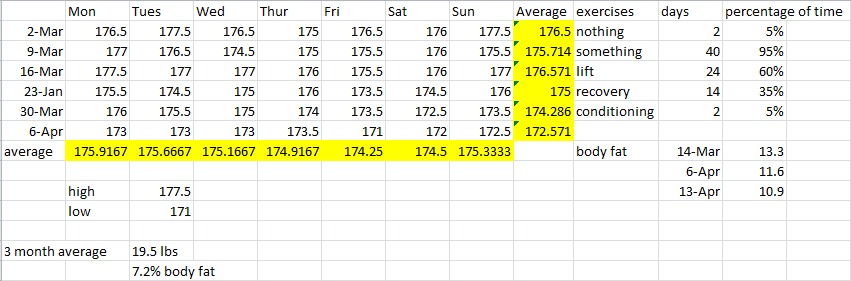
 
Week 1 and 2 went just the way I had planned. I was pretty much 90% compliant with my habit. In fact, I was very happy with seeing a 3lb drop in the first week and a half. But then I started to relax with my habit since I thought I had figured it out. That weekend I went back to eating a little more which you wouldn’t notice until you see the following week (3 rd ) when all my numbers were right back up to the starting point. I unconsciously was having a little more food here and there and not counting it as a meal. So, after 3 days of seeing that 177 number, I was mad. I knew I had let myself relax with my habit and was justifying adding more food thinking that I would still drop because I was so close to what I was doing the previous weeks that it was still going to work. This is important. Getting mad was what drove me to really buckle down the next 3 weeks. The success I saw was what kept me going each week, but being mad with myself was what started this whole project in the first place and what got me to get back on track after seeing my backslide.
I added to my habit, “I have to be a little hungry after dinner”. 
What I realized was that the two best markers of success the next day were:
  • Did I only eat what I planned in the morning for breakfast and lunch?
  • After dinner, did I still want something to eat? 
If I was able to say “Yes” to both of these at the end of the day then I knew there would be a change the next day in the direction I wanted. 

What became very apparent was that if I wanted this system to change, it needed to be stressed enough to change. 
Days that I felt pretty comfortable with food, I knew that my weight the next day would be the same or up. Now, that sounds like constantly being in a state of deprivation. No. Here is what I figured out. 
Every Thursday and Friday were my best days for results. So that means that I needed to be compliant at least 3 days in a row to see a motivating change. If I did 4 it was really motivating. As you can see Friday was typically my best day. That meant I could let my foot off the gas pedal a little on Saturday. Which meant I could have something that might not be as healthy but within reason. Like I wrote in the last newsletter, I had pizza, cookies and chips. What I was starting to understand was that my goal was more important, and I was beginning to be okay with some hunger.

The biggest benefit to the data was that it showed me the path of least resistance. 
I had a good gauge as to how much discomfort I had to be in in order to gain some pleasure in being successful toward my goal. The last 3 weeks were much easier than the first 3 because I was able to easily predict what was going to happen if I stayed with my plan. This made it motivating to stay on track and also curious to see what would happen if I strung 5 or 6 days of a little discomfort together. That is what happened at the end of March into April. Success begets success….except you most likely need to fail first to figure out how to move accordingly.

It also highlighted the fact that my exercise program really didn’t seem to have any impact on my weight loss. More on that in the next newsletter. 
Application
What gets measured gets managed, improved, done, focused on….etc. pick whichever saying you want
1)       Choose something you want to measure.
2)       Pick a frequency. Am I going to measure it every day, every other, once a week?  Try to choose what will allow you to make decisions in a timely manner you are comfortable with.
  • Keep in mind most people wait too long between measurements because they have a love-hate relationship with what they are measuring. This is the hard part. Data doesn’t have any emotional influence until we give it meaning. If we just look at it as a number on a spectrum of how close we are to where we want to go or how far away, it reminds us to do less or more of a behavior. If you have trouble with this, then until you get clear with what you want to do, it might be a yo-yo type of experiment. This happened to me in week 3.
  • Example- I am going to check my favorite pants that don’t fit the way I want right now every Mon/Wed/Fri.  What does this do? It allows you to see what happens if I string a few days together but also will give you an idea of how different your weekends are from weekdays. If they feel loose on Friday and tight again on Monday then you know that the weekend is bringing you right back to your start point.

Measurements aren't meant to make you feel bad. 
They are there to help you correct your course. Sometimes it gives you information to stop what you are pursuing. That’s okay. I’d rather find out that I'm not ready or I don’t have it in me to become the next fitness model, than to keep banging my head against the wall every 3 weeks just to find myself back at square one each time. Who am I kidding if Netflix had a magazine, I would be on the cover every month!
Chat soon!

Coach Tommy

Tel: 860.426.9536

P.S. If you think this type of nutrition application could help you, I would recommend precision nutrition online coaching. We offer this program at a huge discount and it has changed peoples lives. Let me know if you want to know more about it!
Sign up for our winter Session now.
Call 860-628-5597 to get started today!! Learn More
Better Athletes | Better Players | Better TEAM
By unsubscribing below you will no longer receive any Constant Contact emails from the Southington-Cheshire Community YMCAs. This includes newsletters, notices regarding weather and emergencies for either branch as well as Apple Harvest Road Races, Sports Performance and other program notices. At this time we are assessing our options for further specializing our email marketing practices. If you would like to provide feedback on these practices please contact our Marketing Director, Britt at btripp@sccymca.org.