OAA THIS WEEK | July 22, 2021
A news update and community connection for the Office of Academic Affairs of The City University of New York
|
|
Staggered hybrid schedules approved for Aug 2
The Office of the EVC has approved the proposed staggered, hybrid schedules that OAA supervisors most recently submitted for review. The schedules take effect August 2. Staff are encouraged to confirm their schedule with their supervisor prior to this date. The staggered schedules may be open to modifications per feedback from units throughout the return-to-office process.
Staff must use Everbridge app for building access
The Human Resources office reports that central Office staff must continue to use the Everbridge health-clearance app if they wish to enter a CUNY facility. After receiving testing clearance, staff will not be required to be screened for COVID-19 on a daily basis. Currently, Excelsior Pass is not required for CUNY building entry.
____The Blackboard COVID-19 safety course that staff had been required to complete before entering a facility is no longer required.
_____These building-entry protocols currently apply to both CUNY and Research Foundation staff.
HR hosts stress-management talk for return-to-office
In preparation for the August 2 return to the central office, CUNY’s HR department held an online seminar titled “Managing Stress as We Return to Work: Practicing Resiliency During Times of Transition” on July 15. The one-hour session, led by Corporate Counseling Associates (CCA), was part of a series of virtual events offered to Central Office staff to help prepare for the transition back to the office after nearly a year and a half of remote work. The event followed an online briefing that been held the previous day by Interim Executive Vice Chancellor Dan Lemons, in which he to discussed protocols and safety measures being put in place in order to ensure a safe return. Lemons also offered reflections on his own experiences as he had returned to work at the central office two weeks prior.
____CCA psychologist Jamie Peterson led the stress-management seminar. She sought to help participants deal with the anxiety that has become a common concern amongst people working from home during the pandemic as they prepare to return to workplaces. Continued concerns about the COVID-19 virus and more contagious new variants are commonly cited reasons, although some people have additional personal issues such as childcare. Peterson illuminated a variety of strategies for coping, including reflecting on the experiences of the past year to examine the broad range of impacts and feelings, from grief at the unfathomable losses to gratitude for such things as health, being able to work remotely and gain more time for family and personal pursuits such as exercise, hobbies or projects.
_____Peterson engaged participants in considering both the anxieties and positive feelings surrounding returning to the office, with people volunteering a range of emotions via the chat. While several people cited commuting as one of the causes of anxiety and someone described “a roller coaster of emotions,” others said they looked forward to seeing colleagues in person, participating in in-person meetings and being more active.
_____Peterson offered a series of suggestions for engaging in behaviors that build resiliency. For example, she urged participants to speak openly about their concerns and seek support from those around them. She also suggested using the anxiety individuals may be experiencing to “help prepare for reality” and move forward with hope, positivity and optimism. Peterson said that such a mindset can help people to see stress as helpful, and to reframe how we think about stress. “Focus on your zone of control,” Peterson advised.
|
|
CITY, STATE & NATIONAL NEWS
|
|
New bill supports community colleges, cites ASAP model
Amidst reports about the pandemic’s dire impact on community college students, ASAP is in the spotlight as a national model for supporting vulnerable students. An article titled “Help for College Students” in Inside Higher Ed pointed to ASAP (Accelerated Study in Associate Programs) as a model for a $10 billion bill called the Community College Student Success Act reintroduced last week by Democratic senators Brian Schatz of Hawaii and Sherrod Brown of Ohio.
_____The bill, which has been introduced in previous sessions, includes $10 billion in funding over a decade to support comprehensive wraparound services like free tutoring, textbooks and transportation for full-time community college students; another $5 billion would be authorized to provide the same services to part-time students.
_____Last spring President Joe Biden moved to address the escalating crisis by calling on Congress to fund a $109 billion program for tuition-free community college, as part of his American Families Plan. His plan proposes funding for college retention and completion programs that align with the Community College Student Success Act, according to the report.
_____Associate Vice Chancellor for Academic Affairs Donna Linderman told Inside Higher Ed that ASAP has been game changing for the 70,000 CUNY students who have participated since fall 2007. Recent data show that ASAP students are twice as likely to graduate in three years as those who aren’t in the program.
_____ “It’s changed what students think, see and realize is possible, and I think it's also changed what institutions and systems see is possible when following a very specific, evidence-based set of practices,” said Linderman. She noted that ASAP provides a clear model that can be adapted and replicated at other community colleges; so far, she noted, 10 colleges in five states have adapted the ASAP model.
|
|
In each edition, OAA This Week asks our colleagues about the work their unit is doing in the face of the COVID-19 crisis, and how they’re personally faring in the era of remote work. If you would like to be featured as a Colleague Connection, please contact Duffie Cohen at Duffie.Cohen@cuny.edu.
|
|
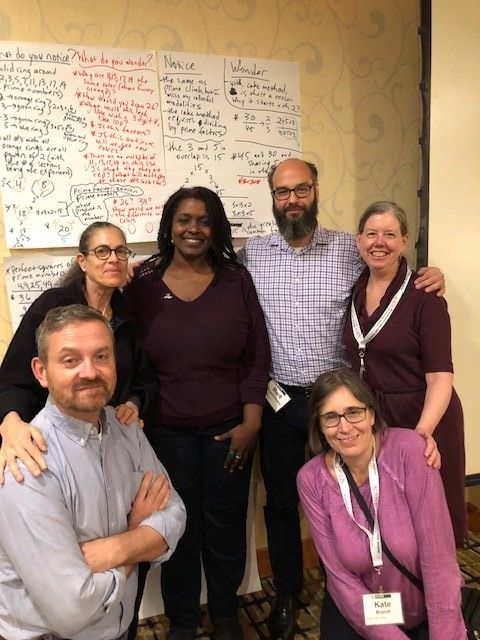
Kate Brandt and Mark Trushkowsky, Professional Developers, CUNY Adult Literacy Program
What does your role as professional developers for OAA’s Language and Literacy Program involve? Our team of professional developers, Eric Appleton, Ellen Baxt, Kate Brandt, Moira Taylor, and Mark Trushkowsky, work together along with Arnitta McKinley, Joan Stern, and Ramon Tercero under the direction of Stacie Evans, Language and Literacy director, to support the teachers and counselors of the CUNY Adult Literacy Program. The program provides English as a Second Language (ESOL), Basic Education (BE), and High School Equivalency (HSE) instruction to approximately 7,000 students per year.
_____As professional developers, we try to keep abreast of the problems facing our program staff, especially teachers, and work with them to improve teaching and learning. One of our main roles is developing innovative curricula and teaching tools. Through a grant from the New York State Education Department, we’ve also been the lead trainers for adult literacy and ESOL teachers across the City, State, and country.
How has your work adapted during the COVID-19 crisis? What are some of the challenges you and your team have had to address? The pivot from in-person to virtual classes was a big lift, as many students (and some teachers) initially lacked devices and internet access as well as the technical skills needed to benefit from online instruction. While Stacie worked with CUNY leadership to provide devices to those who needed them, the more tech-savvy members of our team led workshops on the basics of Zoom, the Google suite, and math-focused programs like Delta Math and Desmos, so that teachers could help students get the most out of their online learning experience. These workshops were extremely collaborative, with teachers who were quick learners sharing their methods and discoveries with the rest of us.
_____Another challenge was completing the high-stakes, labor-intensive WIOA proposal, which provides half of the funds for the entire program, while we were working virtually. It’s a measure of the collegiality in our team that we were able to pull this off.
What are some innovative programs, strategies, or initiatives that your team has developed while working remotely? The teachers, counselors and administrative staff of our campus programs were the real heroes here. So much of the work they (and we) do with students is hands-on. When programs went online, staff had to develop ways to intake and assess students remotely; teach students the tech skills they needed to participate in class; and find the best models for online instruction. The workload of teachers doubled, as they had to figure out not only how to adapt content for a remote environment, but also how to teach technical skills that some had just recently learned themselves...all this while bearing in mind that students were on their phones, often had spotty internet, and might have children participating in remote learning in the same room. Some of the innovations at our campus sites included tech workshops to prepare students before class began, and assigning a counselor to each Zoom classroom to troubleshoot technical issues, so teachers could focus on the class.
_____Counselors were pivotal, keeping in constant touch with students and connecting them with available resources in the areas of COVID information, housing, financial and food support, and parenting. Directors set up virtual workshops to provide homework help to students with children, resume writing for those who had lost jobs, and “Fun Days” for both students and staff, just to bring people together and alleviate the isolation and stress.
|
|
What are your remote workspaces like? What kind of challenges or disruptions are you dealing with while working remotely? In our team, we’ve all had different challenges related to working from home. These ranged from being on the job in close quarters with a partner who is also working; caring for a five-year-old with no other adults at home; being confined to a small space; or having to help homeschool children who are learning remotely by day, then work by night. Some of us just missed face-to-face interactions with colleagues and loved ones.
What’s your team’s daily routine? Does your team have self-care practices that have helped them deal with the past tumultuous year? We’re an innovative group who’ve coped with the challenges of the pandemic in a variety of ways: raising tomatoes, cucumbers and chickens in our backyards; biking to the far reaches of all the five boroughs; introducing a “pandemic puppy” named French Fry into the household; giving ourselves daily “dance parties” to get out of our seats and away from our computers; reminding ourselves daily that “it could have been worse.”
|
|
COVID-19 booster shots and a potential mass-vaccination re-rollout are now being discussed by the country’s top health authorities.
What are the factors that have led to the spike in Delta-variant cases across the U.S? CNN looks into it.
And Mayor de Blasio says that there is no need to reinstate indoor mask mandates in the City.
Finally, after a year of most of us living in isolation, it’s worth considering the plight of Arizona’s last remaining ocelot — who is now trapped all by himself on the wrong side of the Border wall. |
|
OAA This Week is published every Thursday. OAA This Week's editorial staff is comprised of Jason Brooks, Duffie Cohen, and Karen Rostron. For comments, questions, suggestions, or news and event tips, contact the professional communications writer for the Office of the Executive Vice Chancellor and University Provost, at Jason.Brooks@cuny.edu.
|
|
|
|
|
|
|