|
Director's Note
Dear Residents, Neighbors, and Friends:
In 1992, President George H.W. Bush designated the month of May as Asian American and Pacific Islander Heritage Month to officially recognize the historical and cultural contributions of the AAPI community. May was selected to commemorate the immigration of the first Japanese to the U.S. on May 7, 1843 and to mark the anniversary of the completion of the transcontinental railroad on May 10, 1869.
Asian Americans and Pacific Islanders are often lumped together under the umbrella term AAPI, though the latter has unique struggles related to sovereignty and decolonization. As a result, the U.S. Census Bureau split them into two separate racial categories. Collectively, the AAPI community make up 6.2 percent (20.6 million) of the nation’s population according to the 2020 census and represent approximately 4.7 percent 31, 575) of the District’s population.
Despite representing a small portion of the District’s population, Asian Americans and Pacific Islanders have a long and rich history within the District:
- In 1935, the Chinese Community Church was established and is currently the oldest, and last, church dedicated to serving the Chinese community. The CCC first began offering bilingual masses in English and Cantonese, and after the passage of the Hart-Cellar Act of 1965 it began offering masses in Mandarin.
- In 1957, Congressman Dalip Saund was sworn in as the first Asian American, first Indian American, and first Sikh representative in Congress.
- In 1965, Patsy Mink was sworn in as the first Asian American woman and first woman of color to serve in Congress.
- In 1982, the Vietnam War Memorial was dedicated and was designed by Maya Lin, an architect of Chinese descent.
- In 1998, the AALEAD was founded by Sandy Dang in Columbia Heights to empower low-income Asian American youth through education. Today, the organization serves a multi-ethnic Asian community in D.C., Maryland, and Virginia.
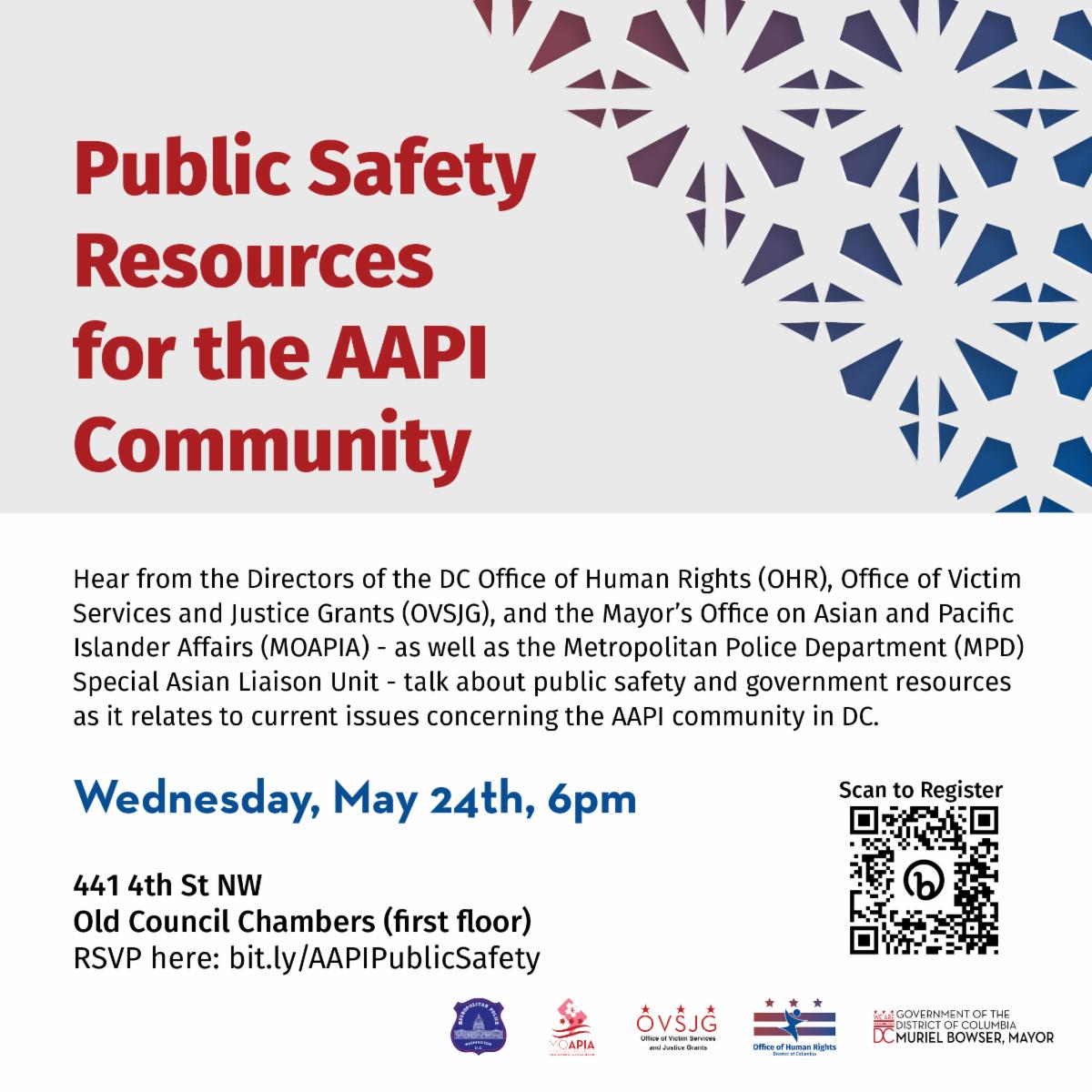
Celebrating Asian American and Pacific Islander heritage month means learning more about the rich diversity the within the community as well as their continued struggles. In the wake of the COVID-19 pandemic, Stop AAPI Hate was formed as a coalition to track and analyze incidents of hate. Unfortunately, to date, over 11,000 incidents have been tracked. Discrimination, prejudice, and violence against Asian Americans and Pacific Islanders has a long history in the U.S., dating as far back as early 19th century. It was rooted in nativism and xenophobia that began to rise as immigrants began arriving in the West to work on railroads, in mining, and other low skilled jobs.
We have a collective responsibility to end racial discrimination and prejudice. We have a responsibility to advocate for equity and safety of our employees, residents, and visitors, regardless of their racial or ethnic identity or country of origin. Here in the District of Columbia, the Human Rights Act ensures that we are free from race and national origin discrimination, whether at work, schools, in restaurants and bars, housing, or when seeking government services. To learn more, you can attend OHR’s next Human Rights training in July and look out for our protected trait Tuesdays! Additionally, we are proud to have published the first Inclusive Language Guide on race, and you can access that here!
Yours in service,
Hnin Khaing
Director
|