|
Funding Opportunities
|
Guidelines for Women's Preventive Services
HHS/HRSA
Deadline is January 4, 2016
Rural Health Network Development Planning Program
HHS/HRSA
Deadline is January 8, 2016
State Offices of Rural Health Grant Program (SORH)
HHS/HRSA
Deadline is January 15, 2016
Advanced Nursing Education Program
HHS/HRSA
Deadline is January 15, 2016
VHCF: Virginia Health Safety Net Grants
Deadline is March 2, 2016
HHS/National Institutes of Health (NIH): Understanding and Promoting Health Literacy (R01).
Deadline is May 7, 2016.
|
|
|
|
|
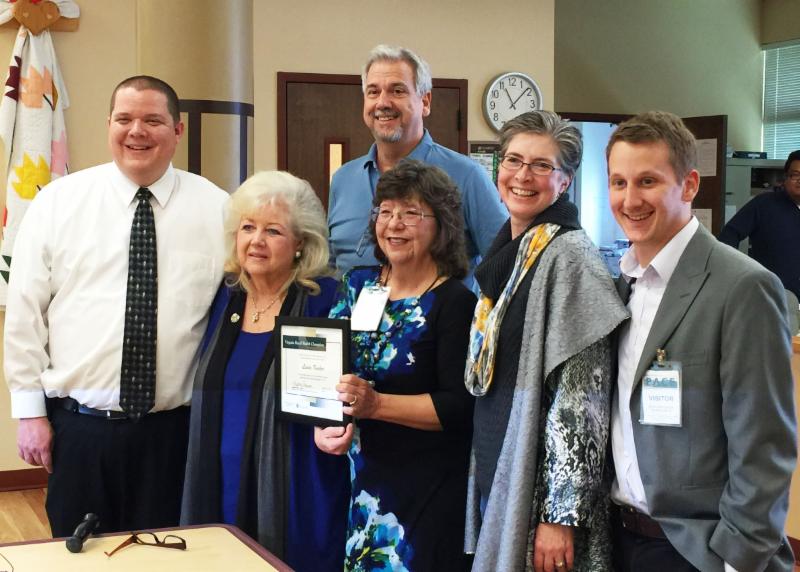
| Group photo (L-R): Michael Wampler (MEOC), Linda Kocher (Honoree, MEOC PACE), Tony Lawson (MEOC PACE), Heather Anderson (Va-SORH), Beth O'Connor (VRHA), Mike Mallon (Va-SORH). |
Va-SORH Celebrates National Rural Health Day in Big Stone Gap
On November 19, the Virginia State Office of Rural Health (Va-SORH) staff traveled to Big Stone Gap, Va., to honor a rural health champion as part of the celebration for National Rural Health Day. A ceremony took place at Mountain Empire Older Citizens (MEOC) Program of All-Inclusive Care for the Elderly (PACE) to recognize Linda Kocher, MEOC PACE's quality assurance coordinator, and her contributions to rural health. The ceremony was planned in partnership with the Virginia Rural Health Association (VRHA).
To celebrate in the Commonwealth, the Va-SORH, within the Office of Minority Health and Health Equity, asked its stakeholders for nominations of champions who do exceptional work to advance rural health. These champions work hard to help Virginia reach its goal of becoming the healthiest state in the nation.
Our Rural Health Champions:
- Amy Wagner, MRC
- Francisco Jusino, MRC
- Kathy Birdsong, MRC
- Linda Kocher, MEOC PACE
- Linda Wilkinson, Virginia Association of Free and Charitable Clinics
- Nancy J Stern, ESRH
- Reba Clayton, MRC
- Sarah Jane Stewart, VHCF
- Tamara S. Akin, Smith Mountain Lake Trinity Ecumenical Parish
- Western Tidewater MRC
We are grateful for their ongoing efforts and to all who work to advance rural health in Virginia. Thank you!
|
Rankings: More states improve than worsen on most health measures
USA Today, December 9, 2015
More states improved than worsened over time on most measures examined in new health rankings out Wednesday - the first since the
Affordable Care Act
's coverage expansions took effect.
The
Commonwealth Fund Scorecard on State Health System Performance looks at access to medical care, prevention and treatment of disease, avoidable hospital use and cost, healthy lives and health equity. Some of the 42 indicators on the scorecard are numbers of insured adults, people 50 and older who got recommended screenings, adults who went without care because of cost, breast cancer deaths and infant mortality.
Life expectancy not declining as rapidly as once thought but health inequality has worsened
University of Michigan News, December 7, 2015
While previous findings of dramatic decreases in life expectancy for some socioeconomically disadvantaged groups in the United States have been overstated, health inequalities persist and, in fact, have worsened, according to new research from the University of Michigan.
"Although the alarm generated by the dramatic findings of earlier studies was likely exaggerated, our more modest and relative findings are both more plausible and still disturbing," said Arline Geronimus, professor of health behavior and health education at the U-M School of Public Health and author of a paper appearing in the current issue of Health Affairs.
|
At UNLV, parents, doctors and mental health advocates talk pediatric challenges
Las Vegas Sun, December 2, 2015
Southern Nevada struggles to care for its children with mental health challenges - but in many ways the region is improving. That was the takeaway from a panel discussion at UNLV on Wednesday as part of the Sun's ongoing series examining pediatric mental health.
"This is an area in our state that needs change," said Helen Melendez, whose daughter killed herself at age 15. "You only hear about it when it's too late."
The universal language of health care
Asian American Press, November 30, 2015
It's difficult to ask a doctor for help when you both speak different languages. How do you tell your doctor what hurts? What about your medical history? How do you ask the pharmacist for your medication? How do you apply for health insurance? Where do you start?
This is a challenge facing millions of people in the United States when it comes to health care and insurance. These people who have a limited ability to understand or speak English, known as limited-English proficient (LEP), are some of the most uninsured and possibly some who receive the least amount of care in our communities.
|
|
Patients and providers satisfied with video-based health care, shows study
NewsMedical.net, December 9, 2015
More than 50 million Americans live in rural areas, and many have limited access to health care. For someone living far from an urban area, local specialty care for complex health issues is difficult, if not impossible, to obtain. For years, telemedicine programs across the country have connected rural patients to specialists in urban settings. Now, a study by University of Missouri School of Medicine researchers shows that patients and providers alike are satisfied with video-based health care.
AHRQ Announces Grant Opportunities To Address Opioid Abuse Disorder in Rural Areas
PRNewswire.com, December 8, 2015
In support of growing Federal efforts to reduce the abuse of opioid drugs, the Agency for Healthcare Research and Quality (AHRQ) announced today a call for research to expand access to evidence-based treatment for opioid abuse disorders in rural areas.
AHRQ is making available up to
$12 million to fund as many as four research demonstration projects to support implementation of medication-assisted treatment (MAT) for opioid use disorder in rural primary care practices. MAT is an evidence-based approach that uses FDA-approved medications combined with psychosocial treatments.
|
|
|