December 2020
Published by the Oregon Office of State Fire Marshal
|
|
A Year of Trials and Resilience
The year 2020 will forever be defined by the challenges it presented to the Oregon fire service, our people, and our state. Yet as we approach year's end, we continue to serve with resolve, compassion, and dedication.
Our ongoing efforts confronting these obstacles have shown our purpose, even as they have required the fire service to go far beyond what we are asked to do as public safety professionals.
A year ago, few in our response system could have predicted that a global pandemic would disrupt the lives of billions of people, not to mention our state and communities, and especially our most vulnerable residents.
Few could have foreseen that the country's worst public health crisis of the last 100 years would change practices in every firehouse, strain our resources for lifesaving personal protection equipment, and force the structural fire service to change ways we have engaged our residents and communities.
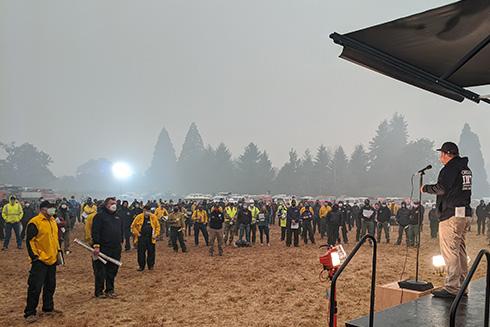
Then came fire season. Though forecasters drew up models for likely drought conditions, none foresaw a historic windstorm at the worst possible time. The ensuing historic September wildfires burned more than 1 million acres, claimed nine lives, burned more than 5,000 homes and businesses, and displaced thousands of Oregonians. No wildfire event like this in recorded history had been seen on the Oregon landscape.
These events touched every Oregonian and firefighter. We served and led through Oregon’s most difficult days. Throughout these challenging months, the fire service responded with calm resolve, keeping our communities and our own workforces safe:
- We supported Oregon's coordinated state and local response to COVID-19 by helping to lead the state's emergency system as we confronted the emergence of the novel coronavirus in our communities and workplaces.
- The Office of State Fire Marshal, with the Oregon Fire Chiefs Association and the Oregon State Fire Fighters Council, created the Oregon Fire Service Coronavirus Response Team (OFSCRT), which disseminated best practices to manage COVID-19, assisted in securing critical and appropriate PPE, and integrated the Oregon Fire Mutual Aid System into the state’s evolving shared response.
- Fire service personnel stepped in to serve on COVID modules, which controlled the spread of the virus to more than 9,000 wildland and structural firefighters fighting wildfires this summer.
- The fire service and all of our partners faced the worst fire season in our history that left great loss for Oregonians and our state with professionalism, never forgetting how these events impacted who we serve daily.
The challenges brought out our best. Throughout these months, we cared for each other, our partners, and the communities we serve.
To everyone out there, serving every day without fail, thank you for your ongoing efforts to support your teams and improve how you provide premier public safety services our communities expect, in the most trying of times. The people of Oregon could not be more proud of all you have done in 2020.
|
|
|
Have Yourself a
Safe Holiday Season
|
|
Crisp winter weather and holiday activities create many opportunities for wonderful memories. They also can create a greater risk for fires in our homes.
To ensure you have a festive and memorable holiday season, here are some ways to make it safe while still enjoying this special time of year:
- Take time to test the operation of your home's smoke alarms.
- If your plans involve a holiday tree, choose one with a fresh, deep-green color and flexible needles.
- Remember to water your tree daily — a tree may consume between a quart and a gallon of water per day.
- Be sure you have at least three feet between your holiday tree and any heating source.
- Ensure the tree is not blocking an exit, and that the decorations you use are flame resistant and flame retardant.
- Use only non‐combustible or flame-resistant materials when trimming your tree.
- Always unplug tree lights before leaving home or going to bed.
- Check your holiday lights before you display them; inspect them each year for frayed wires, bare spots, and broken or cracked sockets.
- Avoid overloading electrical sockets. Do not link more than three light strands, unless the manufacturer’s instructions indicate it is safe.
The Oregon Office of State Fire Marshal wishes you and your families a safe and happy holiday!
|
|
2020 Incident
Reporting Deadline
|
|
The Oregon fire service has responded to a vast variety of emergency and non-emergency calls this past year. Incident reporting assists the fire service to identify trends, quantify activities, determine causes, plan the deployment of limited resources, and help in the reduction of loss of life and property caused by fire.
We need your data for the Office of State Fire Marshal’s upcoming 2020 Annual Report. For your agency’s incident data to be included in the analysis for this report:
- The target deadline for agencies to submit their 2020 data to us is Jan. 1, 2021, with an absolute deadline of Jan. 15, 2021.
Please remember, all incident reports must be 100 percent valid with no errors or warnings in order to be accepted by the National Fire Incident Reporting System database.
If you have questions, please contact the Analytics and Intelligence Unit at 503-934-8250 or email us at osfm.data@osp.oregon.gov.
|
|
Gabliks Takes Reigns at NFA, Hallman Steps in at DPSST |
|
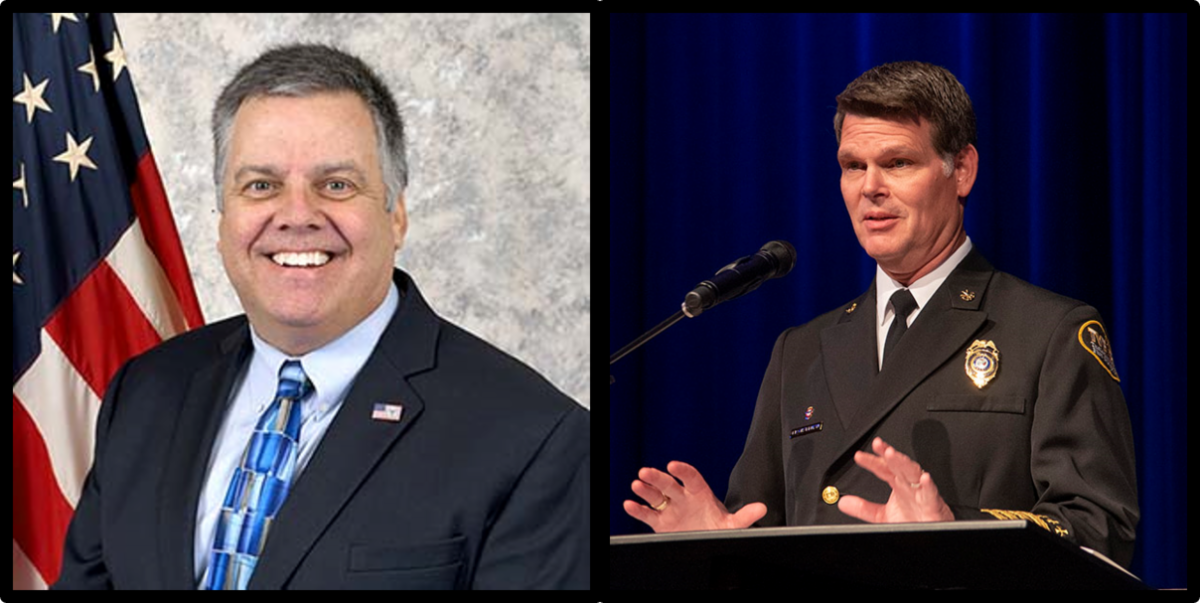
Eriks Gabliks (left), Superintendent of the National Fire Academy, and Les Hallman, Interim Director of the Oregon Department of Public Safety Standards and Training |
|
The Office of State Fire Marshal would like to congratulate Eriks Gabliks as he begins his new role as the Superintendent of the National Fire Academy. Gabliks began his tenure on Nov. 7 after serving as Director of the Oregon Department of Public Safety Standards and Training (DPSST) for 10 years.
Gov. Kate Brown appointed Les Hallman, Assistant Fire Chief with Tualatin Valley Fire & Rescue (TVF&R), as Interim Director of DPSST effective Nov. 2, until a permanent director is named, praising both leaders with her announcement early last month.
During his 19-year tenure at DPSST, Gabliks served numerous roles, including Fire Program Manager, Assistant Director, Division Director, and Deputy director. He served as Director from 2010 to 2020, overseeing a staff of more than 450 employees.
He is the first employee in DPSST’s history to have ascended to this position from the internal ranks. Gabliks also served as an ex-officio member for DPSST on the Governor’s Fire Service Policy Council from 2002-2020. During his 18 years of service to the council, Gabliks contributed advice and guidance on issues of common interest, policies, and affairs that affect the fire protection and life safety of the people of Oregon.
Gabliks entered the fire service in 1982, when he joined his neighborhood volunteer fire company in Adelphia, New Jersey. He served with four volunteer, combination, and career fire agencies, including the Howell Township Fire Company #1 and Howell Township Fire Bureau in New Jersey and in Oregon with TVF&R and the City of Dallas Fire and EMS Department (Oregon). His roles ranged from entry-level firefighter to deputy fire chief. He holds an MA in public policy and administration from the Mark O. Hatfield School of Government at Portland State University and has completed the Executive Fire Officer Program at the National Fire Academy.
Hallman has more than 30 years of experience in emergency services, serving for 12 years as a Fire Chief in South Walton, Florida prior to becoming the Florida State Fire Marshal. Hallman accepted a position as Fire Chief for the City of Newberg in 2009 and was selected for his current position as Assistant Chief when Newberg merged with TVF&R. Hallman has been active within the Oregon fire service, serving as President of the Oregon Fire Chiefs Association, as well as the Chair of the Mobilization Plan Committee and Governor’s Fire Service Policy Council. He joined the State Fire Marshal Incident Management Team program in 2012 and was appointed as the Green Team's Incident Commander prior to the 2015 season.
The OSFM and many in Oregon's public safety community will sorely miss Gabliks' leadership, promoting the highest possible standards for fire service and law enforcement in Oregon. We wish Superintendent Gabliks the very best in his newest endeavor and thank Chief Hallman for taking over leadership of the DPSST during this transition period. Both agencies will benefit from their capable leadership.
|
|
Coronavirus Bulletins Shared with the Oregon Fire Service |
|
In response to the increased spread of COVID-19 in Oregon and temporary rules for workplaces issued in mid-November by the Oregon Occupational Safety & Health Administration (OSHA), two new safety bulletins have been shared with the Oregon Fire Service.
The Oregon Fire Service Coronavirus Response Team (OFSCRT) issued the updates on Nov. 17 to the state’s more than 300 fire agencies and fire chiefs. They provide additional guidance for all firefighting personnel to ensure understanding and application of statewide COVID-19 workplace safety rules and to reinforce best practices that protect the health of firefighters and the public.
Oregon OSHA implemented a temporary rule and appendix to address COVID-19 in Oregon workplaces on Nov. 16, effective until May 4, 2021. The agency collaborated with experts and stakeholders before adopting the new requirement, including with members of the Oregon fire service and labor groups representing emergency medical services (EMS) and firefighting personnel. As a result, healthcare, law enforcement, 911 centers, and fire and EMS agencies now have additional rules and appendices applying to their work and workplaces.
The bulletins also follow Oregon’s statewide two-week "freeze" measures, in effect from Nov. 18 through Dec. 2, which were enacted to limit the spread of COVID-19, reduce risk to vulnerable Oregonians, and help to conserve hospital capacity that has been under strain with the sharp rise of positive cases in Oregon since late Oregon.
OFSCRT recommended the Oregon fire service implement a pause for a "safety stand down" the week of Nov. 17. "As Oregon entered into another 'freeze' on activities in anticipation of increasing infection rates, it was important to encourage Oregon fire service personnel to review the signs and symptoms of COVID-19, correct use of PPE, the importance of physical distancing, and procedures for sanitizing PPE, apparatus, fire stations, and workspaces," said Michael Heffner, assistant chief deputy for OSFM’s Emergency Services Division.
-
The Safety Stand Down update, Information Bulletin 2020-9, provided fire Chiefs, agency administrators, and firefighting personnel a review and references for best practice recommendations , and asked agencies to review the recommendations and resources between Nov. 17-19 or at their next drill, training, or meeting.
-
The OFSCRT interpretation of OSHA’s temporary rule, Information Bulletin 2020-10, clarifies these new requirements outlined in appendix 17 of the temporary rule.
The members of OFSCRT and OSFM want to thank all Oregon fire chiefs for their continued eye on safety and leadership and all firefighting personnel, who continue to serve their communities that are seeing rising infection rates of COVID-19 and who continue to see increased risks to firefighting, EMS, and emergency response service personnel.
A list of all OSFSCRT’s COVID-19 resources and service bulletins can be found on the COVID-19 resource page for the Oregon State Police and OSFM.
|
|
COVID-19 Continues to Challenge Oregon |
|
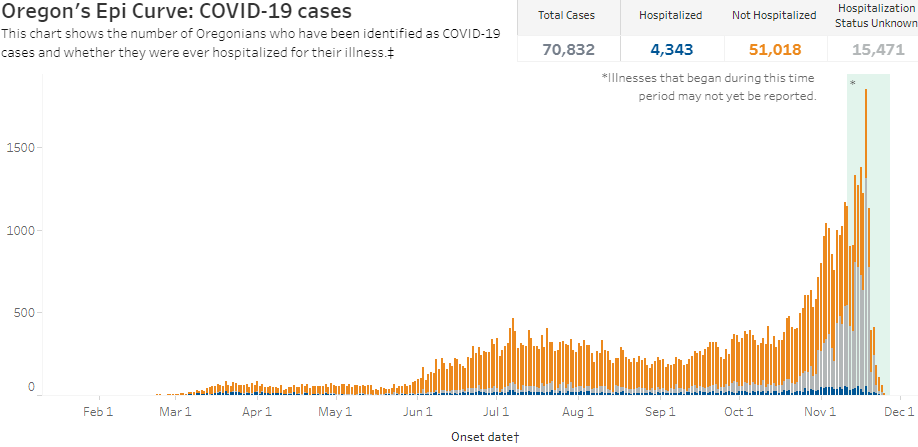
Source: Oregon Health Authority
|
|
As the Thanksgiving holiday arrived, Oregon’s public health and health experts were advising Oregonians to keep their gatherings small and limit travel to prevent the further spread of COVID-19 statewide.
Before the holiday weekend, daily confirmed cases in the United States were averaging more than 100,000 a day for nearly three weeks, with cases nationally topping 13 million.
When the normally busiest travel period of the year arrived, Oregon also was seeing a spike of positive cases, an increased number of deaths, and fewer available beds in hospitals for critical care patients.
More than 1,300 cases a day were reported in the weekend days before Thanksgiving, and the week of Thanksgiving saw the highest daily reported number of deaths. As of Nov. 30, the Oregon Health Authority (OHA) reported 75,431 positive cases and 912 deaths.
Evolving State Guidelines
The state implemented a two-week freeze from Nov. 18 through Dec. 2, to reduce the rising community spread of the virus, reduce risk to those more vulnerable to serious illness and death, and help to conserve hospital capacity.
Just before Oregonians headed into the long holiday weekend on Nov. 25, Gov. Kate Brown announced new metrics for all Oregon counties. "COVID 19 is rampant in our communities," said Brown.
Starting Dec. 3, and in each subsequent two-week period, the OHA will examine and publish county data weekly. In the first week, counties will be given warning week data to prepare for potential risk level changes. In the second week, county risk levels will be updated based on that week’s data. OHA’s latest update noted that until COVID-19 vaccines were widely available, health and safety precautions would remain in place so that schools, businesses, and communities could reopen and stay open.
OHA’s updated guidelines state for every risk level, to prevent COVID-19 outbreaks, Oregonians should continue to wear face coverings, watch their physical distance, wash hands, stay home when sick, and keep social get-togethers and gatherings small.
Planning Ahead
Cases of COVID-19 also continue to impact essential services, including firefighting and EMS, with sporadic cases reported among quarantined fire service crews and personnel.
The Office of State Fire Marshal (OSFM) remains engaged with the Oregon Fire Service through regular updates, Fire Defense Board Chief conference calls, and other communications. The OSFM has asked fire services to keep the OSFM and the Oregon Fire Service Coronavirus Response Team informed of their resource availability and critical needs, such as personal protection equipment.
As we head into December, the OHA also provided some good news with its Nov. 25 announcement that the first 30,000 batches of an expected FDA-approved and national COVID-19 vaccine will be sent to Oregon, to first be given to frontline COVID-19 healthcare workers. A national vaccination roll-out is expected in 2021, pending possible approval from the FDA of at least two vaccines.
Until that happens, OHA is asking all residents to practice safety measures to keep the virus from spreading.
In response to a request from the Centers for Disease Control and Prevention, Oregon has submitted its draft plan to distribute a proven COVID-19 vaccine. To learn more about the OHA’s statewide plan, download a copy from the OHA’s COVID-19 resource page.
|
|
Regulatory Services Division Adjusts Operations For COVID-19 |
|
Due to the steps taken to help mitigate the spread of COVID-19, the Regulatory Services Division (RSD) has adjusted its operations, working in consultation with our industry stakeholders.
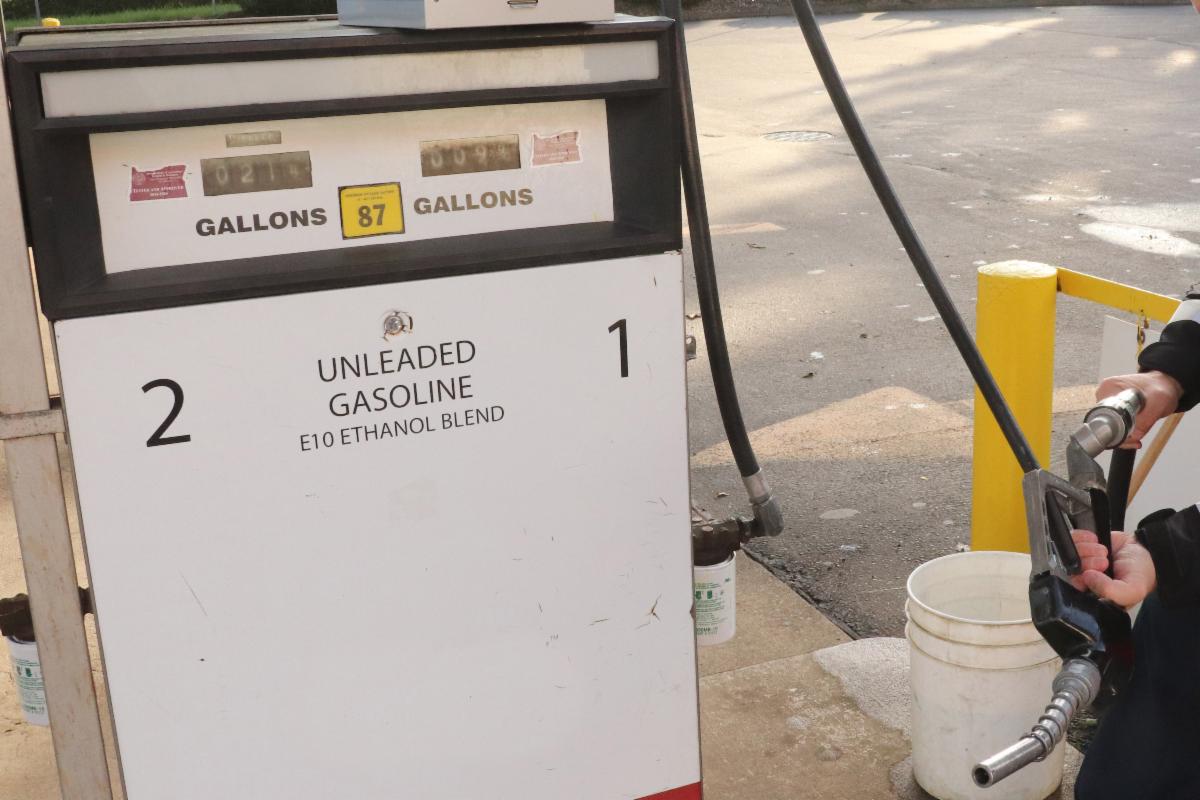
Under normal circumstances Office of State Fire Marshal (OSFM) Compliance Specialists conduct at a minimum an annual fire and life safety inspection of each cardlock facility in the state and each cardlock operator receives an annual audit of their customer records to ensure compliance with the requirements.
Because of social distancing guidance, compliance staff are assisting facility operators complete self-inspections of their cardlock facilities. OSFM is providing forms and technical assistance to assist them, and in turn, operators will be certifying their facility is in compliance. Partial audits will be conducted virtually, and customers will have options available to meet the 900-gallon minimum annual purchase requirement.
These measures are being taken to minimize the risk to both our staff and the staff of our stakeholders. Once OSFM staff can return to the field, we will conduct random facility inspections for verification and complete the rest of the audit tasks.
Also, as a result of the pandemic, some fireworks displays and retail sales are being cancelled. Certification requirements for display pyrotechnicians are also being impacted.
OSFM is providing refunds for fees collected for display permits to those who qualify and allowing additional time for operator certification renewal for those unable to meet the requirements due to the cancellations.
|
|
OSFM Revamps its
Mission and Values
|
|
The Office of State Fire Marshal (OSFM) has recently updated its mission statement and core values, which provide for more inclusive language and align the agency with its service to all Oregonians as well its activities that support neighboring states during emergencies such as conflagration response.
Starting in February, the OSFM created a Values and Vision Workgroup, with a diverse mix of employees and managers, who reviewed the OSFM’s core statements that defined its activities, aspirations, and principles for its staff and the public.
"Having more inclusive language that made clear our core activities served all Oregonians was central to our discussion," said Mark Johnston, assistant chief deputy for OSFM’s Regulatory Services Division. "That is reflected now in our revised mission statement as well as one of our five core values that OSFM believes serving others is central to what we do and is all inclusive."
The team worked for several months, often while practicing social distance measures, before it finalized its work and shared it with all staff in November.
The OSFM’s mission is: "To protect people, property, and the environment from fire and hazardous materials."
Our vision remains firmly fixed on providing premier public safety services.
The newly updated values represent the agency’s "moral compass." All OSFM staff are fully committed to live and embody them in their daily activities as public safety professionals:
Integrity: We believe in being honest, fair, and doing the right thing in everything we do.
Dedication: We are committed to performing our work the best we can in support of our mission, our customers, our stakeholders, the public, and each other.
Leadership: We are committed to be a leader in the Oregon fire service, to lead our organization, and lead ourselves as individuals in our day to day work.
Partnerships: We believe our success and the success of others depends on collaboration with our stakeholders.
Service to Others: We believe that serving others is a cornerstone of our mission, our day to day work and is all inclusive.
|
|
By OSFM Code Deputy David Mills
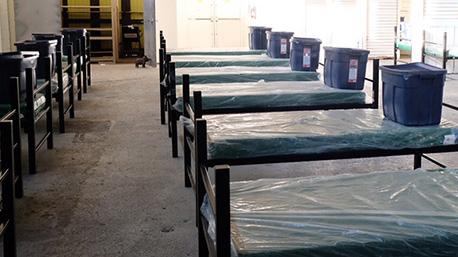
Temporary Warming Shelters
|
|
Communities across the country respond to homelessness with a variety of housing and services programs, including temporary shelters, transitional housing, rapid re-housing, and permanent supportive housing. In extreme weather conditions, temporary shelters are created that typically operate for short durations during inclement or adverse weather conditions.
The Office of State Fire Marshal reminds local and state fire professionals that Technical Advisory (TA) 11-14, entitled Temporary Shelters, can provide guidance to communities in providing clients and residents with safety and protection from exposure to the weather while simultaneously reducing the environmental impact on the community.
The intent of TA 11-14 was to assist communities in approving existing buildings or structures not necessarily designed for sleeping purposes to, on a limited basis, temporarily accommodate sleeping conditions safely. Provisionally, the time frame of 90 days within any 12-month period was to emphasize the idea that this condition must be temporary in nature. In the spirit of applying this time frame, the intent is to house occupants for sleeping purposes during inclement weather conditions.
The 90 days need not be an exact number, rather a number to forecast a limited period of time. If the weather conditions warranted say 99 days, due to inclement weather, that would meet the spirit and intent of the TA. Likewise, should there be less severe conditions, the shelter need not continue housing residents.
The TA also provides guidance in determining the number of people that may safely occupy the facility and in turn provide safe egress in the event of an emergency. A minimum of two exits are required along with maintaining the egress paths free of obstructions at all times. Though not mandated, a building that has automatic fire sprinklers may be granted flexibility for occupants sleeping on floors above the second floor and in basements. Smoke and carbon monoxide alarms are required and may be battery operated.
An emergency evacuation plan coupled with a fire watch during the sleeping hours provides an important level of safety for both occupants as well as emergency first responders.
We recognize this can be a sensitive issue in communities and appreciate everyone’s efforts to safely house occupants during inclement weather conditions.
(Photo: Courtesy of the City of Vancouver, BC, Canada)
|
|
To better serve our readers and stakeholders, the Office of State Fire Marshal (OSFM) seeks feedback from subscribers to the agency’s monthly Gated Wye newsletter.
We have created a reader survey that should take no more than five minutes to complete. Please submit your replies before Dec. 14.
We look forward to your replies and learning how we can keep all OSFM stakeholders and our Gated Wye readers informed about OSFM’s work providing premier public safety services for all Oregonians.
|
|
OSFM Incident
Management Teams
|
|
2021 Season Open Recruitment
All Applications Due by 5 p.m., Jan. 15, 2021
|
|
The Office of State Fire Marshal (OSFM) is seeking applications for the following positions:
- Incident Safety Officer
- Line Safety Officer Trainees
- Public Information Officer Trainee
- Division/Group Supervisor Trainees
- Geographic Information System Specialist Trainee
- Logistics Section Chief Trainees
- Communication Unit Leader Trainees
- Communication Unit Technician Trainees
Applications for all positions will be accepted and reviewed.
All applicants are asked to submit:
- Application signed by your Chief Officer
- Letter of Intent to include a summary of conflagration and incident management experience
- Two professional references
The recruitment process is selective. Applicants, their provided references, and/or others within the applicant’s agency may be contacted by OSFM staff, Incident Commanders, and/or IMT Section Chiefs during the selection process. Applicants should be expected to be interviewed.
Team members are expected to be available to respond during their team’s on-call rotations and remain at an incident for up to 14 days. Team members should be prepared to be logistically self-sufficient for 72 hours.
Team members should have the full support of their sponsoring agencies to participate in training, Section Working Groups, and the annual conference. Team members should have access to an agency command vehicle for deployments.
It is the expectation of OSFM and the Incident Commanders that all team members provide the highest level of customer service to all involved with or impacted by an incident. Team members represent both their home agency and the State of Oregon, and are expected to act professionally at all times.
|
|
See what's happening on our social sites: |
|
|
|
|
|
|