Transitions to Adulthood Center for Research October 2025 Newsletter | | |
In this Issue...
- National Disability Employment Month
- Popular Resources for YA Employment Success
- Juvenile Justice: The Youth Protective Factors Study
- The latest STAY Tuned podcast episodes
- HYPE - Career Development
- Webinars Reflecting on 30 Years of Research Are Available!
| | National Disability Employment Awareness Month | | |
This October is the 80th anniversary of National Disability Employment Awareness Month (NDEAM) an annual recognition of the positive impact of people with disabilities in the American workforce. This yearly event began in 1945 as a weeklong national observance of the contributions of people with physical disabilities. In 1988, Congress designated the commemoration as NDEAM, which then evolved to acknowledge the importance of increasing opportunities for people with disabilities, including those with mental health conditions and other nonobvious disabilities, in the workforce. In 2001, ODEP was created and entrusted to administer NDEAM, including the selection and promotion of its annual theme.
This year’s theme is “Celebrating Value and Talent.” NDEAM 2025 will recognize the value and talent American workers with disabilities add to our workplaces and economy and highlight their achievements both past and present.
Visit NDEAM’s website for ideas on how you can celebrate.
| | Resources for Young Adult Employment Success | | The Transitions to Adulthood Center for Research is committed to improving the supports available to youth and young adults with serious mental health conditions, helping them complete their education and ensuring they have fair access to training and job opportunities. Below are some resources to help. | | |
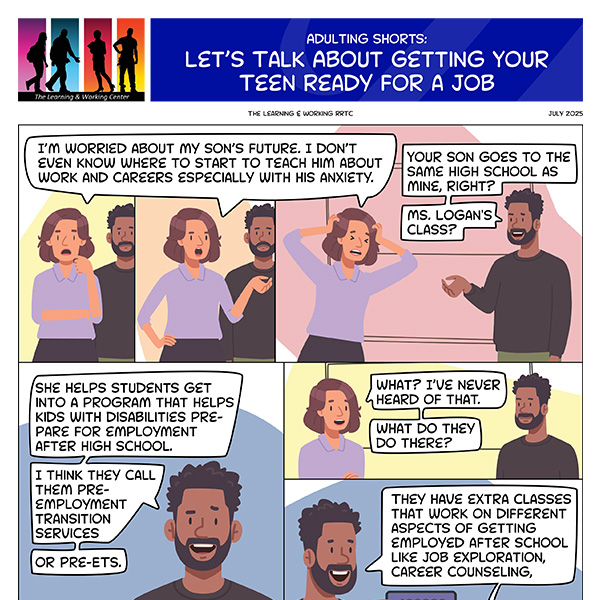
Adulting Shorts Comic: Let’s Talk About Getting Your Teen Ready for a Job
Pre-ETS, or Pre-Employment Transition Services, are a set of services designed to help students with disabilities, including those with mental health conditions, typically aged 14-22, prepare for post-secondary education or employment. These services offer an early start on career exploration and skill development, often preceding or supplementing traditional Vocational Rehabilitation (VR) services. This comic is used to increase the awareness of Pre-ETS.
| |
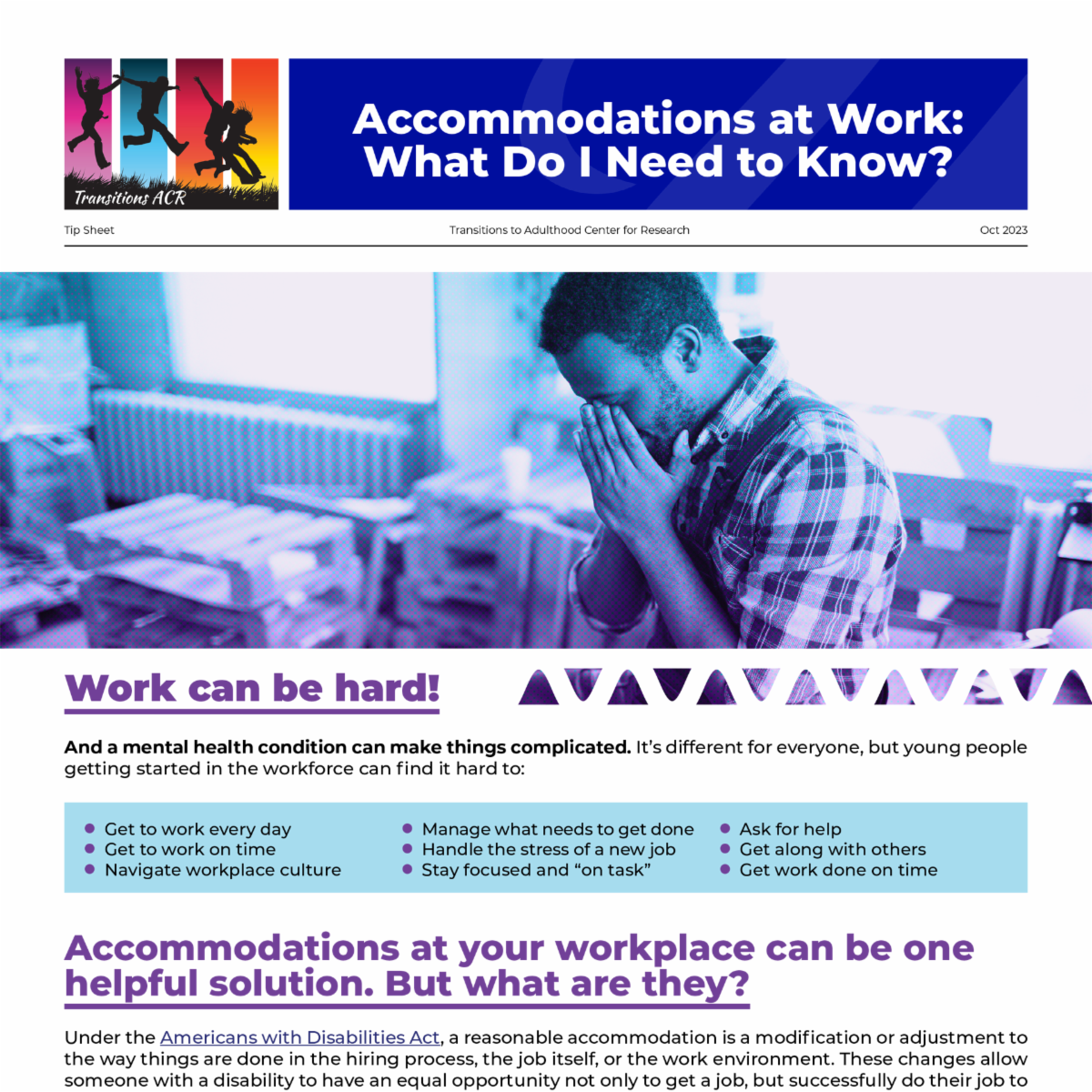
Tip Sheet: Accommodations at Work: What Do I Need to Know?
Working with a mental health conditions can be hard, and accommodations at your workplace can be one helpful solution. But what are they? This tip sheet can help young adults figure that out and figure out what to ask for to help them be successful at their job.
| | |
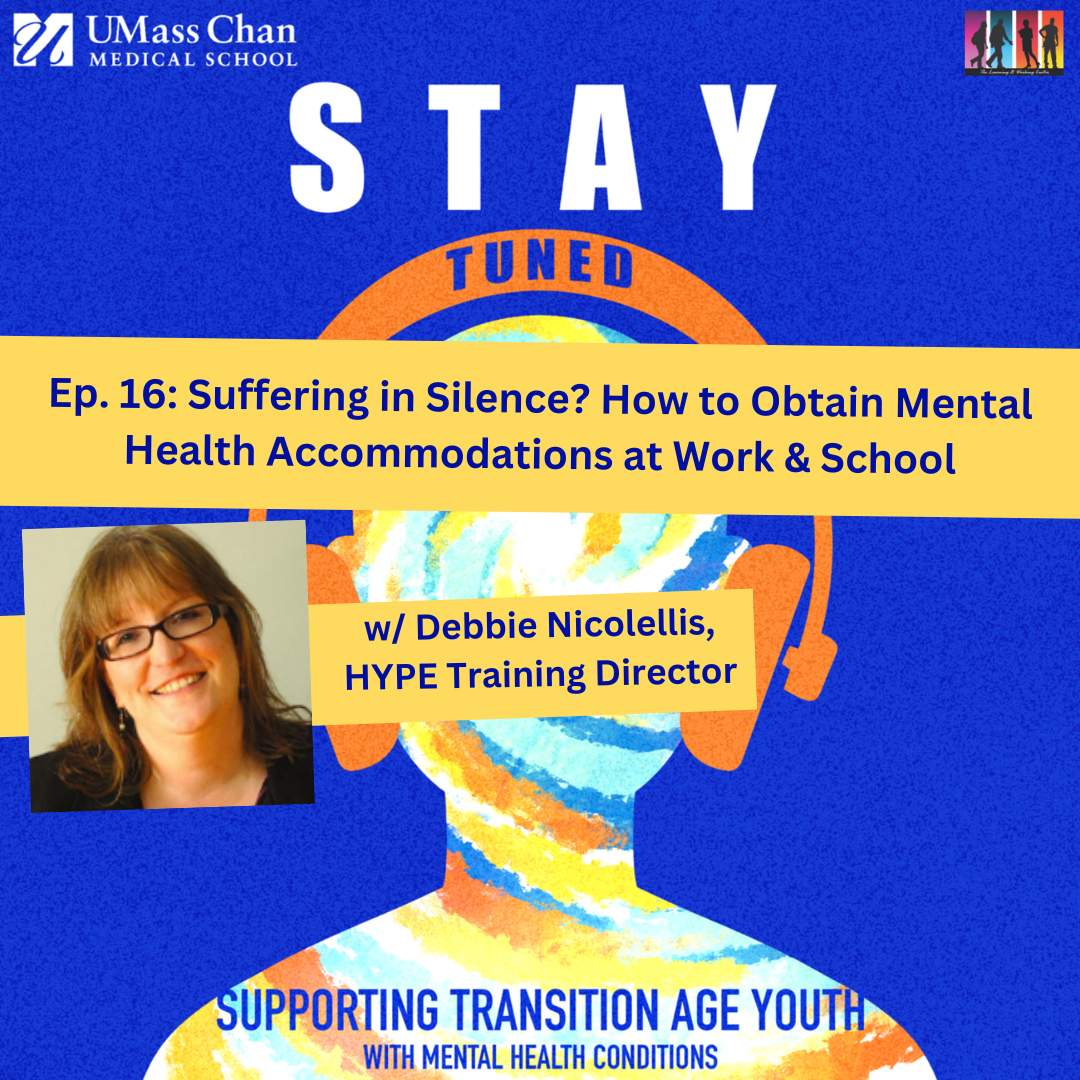
STAY Tuned Podcast: Suffering in Silence? How to Obtain Mental Health Accommodations at Work & School
Starting your first job after school? Join Debbie Nicolellis, our Director of Training for HYPE for an insightful dive into mental health accommodations. We explore what accommodations can look like at school and work in this engaging conversation.
| | |
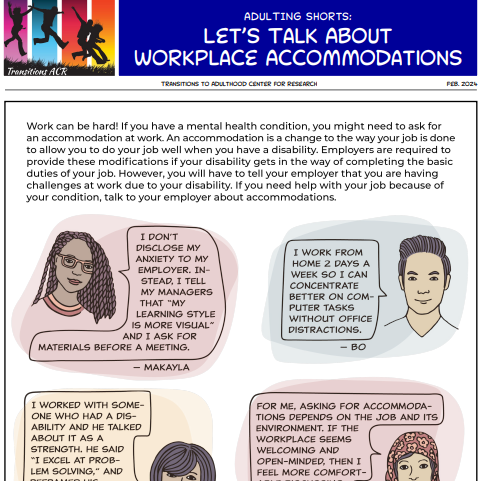
Adulting Shorts Comic: Let's Talk About Workplace Accommodations!
Work can be hard! If you have a mental health condition, you might want to ask for an accommodation at work (a change to the way your job is done) so that you can do your job well. This comic shares real-world experiences from 12 young adults living with mental health conditions as they navigate the working world.
| | |
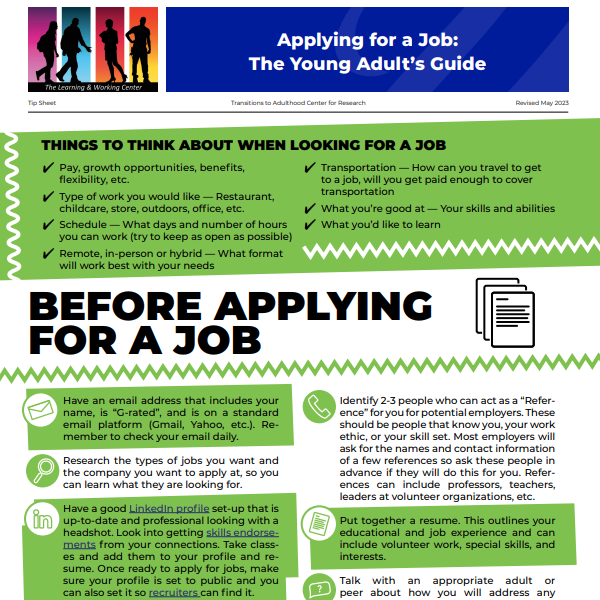
Tip Sheet: Applying for a Job - The Young Adult's Guide
This tip sheet is a good starting point for your young adult in their job search journey. It covers many topics and includes information on finding a job, applying for a job, and interviewing for a job. There's also a great list of networking resources.
| | New! Young Adults & Juvenile Justice | | |
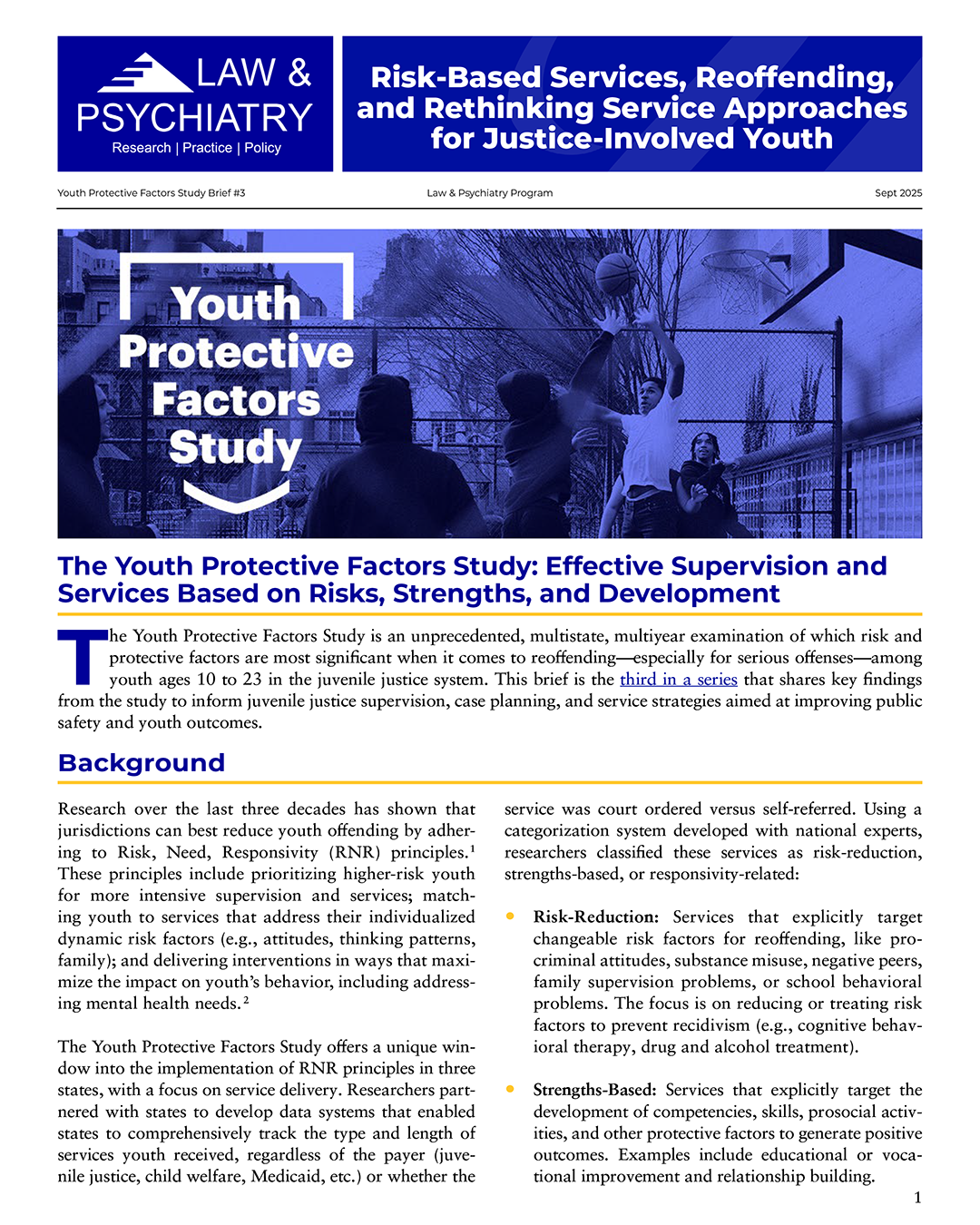
The Youth Protective Factors Study Effective Supervision and Services Based on Risks, Strengths, and Development is an unprecedented multistate, multiyear examination of what risk and protective factors matter most when it comes to reoffending - particularly for violent and other person offenses - for youth ages 10 to 23 who are involved in the juvenile justice system. The study provides policymakers and youth justice professionals with critical insights into how to maximize supervision, case planning, service, and funding strategies to preserve public safety and enhance positive youth outcomes.
Recently released findings are in the new brief, Risk-Based Services, Reoffending, and Rethinking Service Approaches for Justice-Involved Youth that shares key findings from the study to inform juvenile justice supervision, case planning, and service strategies aimed at improving public safety and youth outcomes.
| | New STAY Tuned Podcast Episodes | | |
Bridging the Gap in College Mental Health: Peer Academic Supports for Success
In this episode, we chat with Paul Cherchia, Assistant Director at the Center for Psychiatric Rehabilitation at Boston University, about PASS (Peer Academic Supports for Success) — a peer coaching program supporting college students with mental health challenges. Paul shares how PASS was developed, its evidence-based success, and its unique model that pairs trained student coaches with other students to foster academic and emotional well-being. We also dive into the current state of college mental health and why peer support can be a powerful complement to traditional counseling services. Listen to find out if PASS sounds like the right fit to disseminate this fully manualized and evidence-based support to your school.
| |  | |
Body Talk and Belonging: Eating Disorder Recovery in a Social World
In this inspiring episode, Jamie Yang, a graduate student and mental health advocate, shares her journey of resilience and growth in navigating recovery from an eating disorder. She highlights the powerful role of community in fostering healing through friendships and hobbies. Through her journey, Jamie explores how recovery involves unlearning toxic messages about food and bodies, setting boundaries, and intentionally choosing communities that nourish rather than deplete. With honesty and insight, Jamie shows how surrounding yourself with supportive, values-aligned people can build strength, shift focus toward wellness, and create space for lasting recovery.
| | | Find all our podcasts and transcripts HERE. | | Have You Heard about HYPE? | | |
Helping Youth on the Path to Employment (HYPE) is a research-based program that supports the career development of youth and young adults with mental health conditions. HYPE modernizes traditional employment and education supports by integrating Supported Employment and Supported Education—helping young adults succeed in both school and work.
Through individualized guidance, HYPE providers help participants build skills, stay on track academically, and prepare for meaningful careers. The program emphasizes education as a key step toward long-term economic independence and job satisfaction.
The Five Pillars of HYPE:
- Intentional Services
- Goal Development & Refinement
- Skill Development
- Resource Development
- Accommodations & Assistive Technology (AAT) Education & Advocacy
Our team works collaboratively with organizations, colleges, universities, and more to create and implement a training and implementation plan that is specific to each organization.
Contact us at hype@umassmed.edu to learn more.
| | Webinar Recording Available | | |
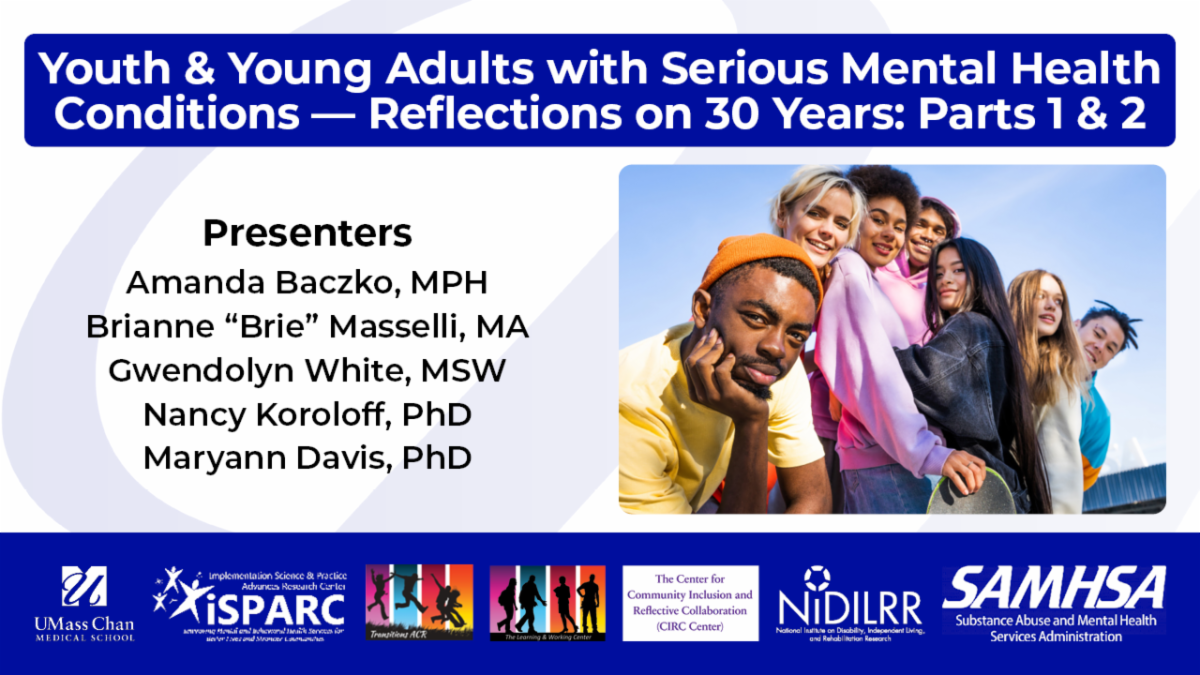
Youth & Young Adults with Serious Mental Health Conditions – Reflections on 30 Years: Parts 1 & 2
This two-part webinar series presented on the developments in services, policies, and research from 1995-2025 from the perspectives of five experts who have been keenly involved in the field for most of these years. The webinars highlighted the interrelationships of research, policy, and practices from the initial recognition of the need to both understand the strengths, needs, and circumstances of this population and to provide services that are tailored to them. They also highlighted the major milestones that have been achieved since the field’s infancy with an eye towards lessons learned and future implications.
| | Could You Use Assistance? | | |
Technical Assistance activities are an extension of the research and training activities of Transitions ACR. Our TA services can range from simple resource referrals to on-site development of a formal TA plan (including fact finding, goals, responsibilities, timelines and evaluation measures). We are ready to help you develop programs, policies and practices that support the community participation, educational and employment outcomes of youth with mental health conditions.
Please complete the form below for Technical Assistance from Transitions to Adulthood Center for Research. Please note that we do not provide clinical consultation, behavioral services, or referrals.
| | Some of the contents of this message are supported in part under grants with funding from the National Institute on Disability, Independent Living, and Rehabilitation Research, (NIDILRR), United States Departments of Health and Human Services (NIDILRR grant numbers 90RTEM0005, 90RTCP0010 and 90RTEM0012) and co-funded by the Substance Abuse and Mental Health Services Administration (SAMHSA). NIDILRR is a Center within the Administration for Community Living (ACL), Department of Health and Human Services. The contents of this message do not necessarily represent the policy of NIDILRR, ACL, SAMHSA, or HHS, and you should not assume endorsement by the Federal Government. | | | | |