Your Community Gardening Newsletter |
|
October 2022 Volume 10 Number 9 |
|
“I'm so glad I live in a world where there are Octobers. It would be terrible if we just skipped from September to November, wouldn't it?”
― L. M. Montgomery, Anne of Green Gables
|
|
Sunday, October 2, 2022 2:00 PM to 3:30 PM
Summit Metro Parks is hosting Back Yards Gone Wild: Seed Collecting; It’s never too early to plan next year’s garden! Learn how to start beautiful, beneficial native plants from seed, including collection, storage and propagation, and take home seeds to plant in your own yard! Please bring small bags from home for seed collecting. Twinsburg Ledges Area & Nature Center, 9999 Liberty Road, Twinsburg. See summitmetroparks.org for more information.
Thursday, October 6, 2022, 6:00 PM
Let’s Grow Akon: All are welcome for Garden Talks at the Summit Lake Nature Center on the first Thursday of each month at 411 Ira Avenue, Akron, OH 44301 http://letsgrowakron.org/
Wednesday, October 12th, and 26th 2022, 10AM – 11:30AM
Lil" Sprouts: This biweekly program is designed to engage 3- to 5-year-olds and an accompanying grown-up into the wonderful world of gardening. Each class will build upon knowledge from the last and will be centered on what’s growing and ready to harvest! ADVANCE REGISTRATION IS REQUIRED AND BEGINS 6/29: 330-865-8065.
Thursday, October 20, 2022, 6:00 PM to 7:30 PM
Join Summit Metro Parks for Good Gardens: Seed Swap Join us to swap some seeds! We will begin with a short program on seed saving followed by a seed swap. These can be seeds harvested from plants you grow, or extra seeds leftover from packets. Seeds should be labeled with variety name and packed in small quantities if possible. Vegetables and herbs are preferred, but all seeds are welcome! Anyone can attend, even if you don't have seeds to share. The program will be held at Goodyear Heights Lodge. See www.summitmetroparks.org for more information.
· Summit County Master Gardeners on Facebook
· Follow Summit County Master Gardeners on Instagram with our user name osusummitmgv
|
|
Join us for Design & Beyond 2022 |
The Summit County Master Gardeners will be hosting this day-long program on October 15, 2022.
Keynote Speaker: Kerry Ann Mendez, award-winning speaker, garden designer and author, will be presenting two programs for us:
"Budget-Wise Gardener"
"Hydrangeas Demystified"
In addition, Ken Huth, who has been involved with Bonsai for over 25 years, will be presenting
"The Art of Bonsai"
with a live demonstration of a Bonsai Forest.
Your ticket ($55) includes an Oatmeal Breakfast Bar and Buffet Lunch - Soup, Salad and Dessert Bar.
We will also have an Artisan Crafts Raffle, Door Prizes, and a 50/50 Raffle, as well as Book Sales and Signing.
Click HERE for more information and to register.
|
|
Challenge Grant Opportunity
from SeedMoney
|
These new grants range from $100 to $1000 and are challenge grants won through participating in our annual SeedMoney Challenge which runs from November 15 to December 15. Last year, 516 garden projects participated in the Challenge and raised over $430,000. To give you an idea of the range, the biggest check we cut was for $13,900, the smallest was $30 and the average was $833.
This funding opportunity is open to any nonprofit organization located anywhere that is looking either to start up a new public food garden or sustain an existing one. Past grantees include schools, community gardens, food banks, municipalities, homeless shelters, libraries, and tribal organizations to name just a few. No previous grant writing or crowdfunding experience is required to participate. They only run this program once per year, so we hope you'll take advantage of this opportunity or share it with someone else who can!
Click HERE for more information and to start an application.
|
|
Free Pollinator Habitat 101 webinars from the Ohio Bee Lab |
Register for this free weekly webinar series on Fridays at 10AM EASTERN
October 14th through November 11th.
Presenters will be
10/14: Doug Tallamy, University of Delaware
Pollinators’ Best Hope: A New Approach to Pollinator Habitat That Starts in Your Yard
10/21: Harland Patch, Penn State University
Creating Pollinator Gardens: the Role of Plant Choice and Design
10/28: Heather Holm, Author and Biologist
Creating and Managing Habitat for Native Bees
11/4: Matthew Shepherd, The Xerces Society for Invertebrate Conservation
Deciding To Create A Pollinator Garden Is The Easy Step -- What To Do Next?
11/11: Shana Byrd, The Dawes Arboretum
Getting Started with Wildflower Patches, Flower Strips, and Meadows
|
|
With such nice weather in September it might seem like the answer might be never. But frost is coming! The Midwest Regional Climate Center’s Vegetation Impact Program compiles tables on freeze dates based on historical information. These tables give probabilities that certain temperatures will occur after certain dates.
There is a
- 10% chance it will frost by October 1 - 10,
- a 50% chance it will frost by October 11 - 20, and
- a 90% chance it will frost by November 21 - 30.
Based on data from 1981-2010, The earliest first freeze was October 1-10 and the latest first freeze was November 1-10.
|
|
Were you looking for something to do? |
- Watch for first frost warnings (average date is 10/18)
- Complete final harvest of tender crops when cold temps become frequent. Partially ripe tomatoes can be picked and ripened indoors.
- Harvest gourds when stems begin to brown and dry. Cure at 70-80 degrees for 2-4 weeks in a dry well-ventilated location.
- Harvest pumpkins and winter squash when rind is hard and fully colored. Store in a cool place until ready to use.
- After the first frost, harvest parsnips and Brussel sprouts.
- After a killing frost, do a final garden clean-up, adding plant material to compost pile.
- Soil can be prepared for spring planting. Plant a cover crop, if planned.
- Before the ground freezes, plant rhubarb, garlic and shallots.
- Evaluate your garden and make notes to help plan next year's effort.
- Carve your Halloween Jack-O-Lantern!!
|
|
Many Fall vegetables will store for a surprisingly long time if kept in the proper conditions. Here are some examples:
Cold, moist storage
(32 to 40 degrees F, 90 to 95% relative humidity)
*Beets 2-3 months
*Carrots 2-3 months or overwintered in garden
*Parsnips 2-3 months or overwintered in garden
*Irish Potato 2-4 months. High humidity and good ventilation, avoid light
*Turnips 2-3 months or overwintered in garden
*Cabbage - 2 months
*Chinese cabbage - 2 months
Cool, dry storage
(32 to 55 degrees F, 50 to 60 % relative humidity)
*Onions and Garlic 6-7 months - cure before storage - needs good ventilation
Warm, dry storage
(55 to 60 degrees F, 60 to 70 % relative humidity)
*Pumpkins and winter squash 2-6 months depending on variety - needs good air circulation
The University of Minnesota notes that:
Basements are generally cool and dry. If storing vegetables in basements, provide your vegetables with some ventilation. Be sure they are protected from rodents.
Home refrigerators are generally cold and dry (40°F and 50-60% relative humidity). Putting vegetables in perforated plastic bags in the refrigerator will provide cold and moist conditions, but only for a moderate amount of time. (Unperforated plastic bags often create too humid conditions that lead to condensation and growth of mold or bacteria.)
Fruits and vegetables should always be stored separately. Fruits release ethylene, which speeds the ripening process of vegetables. Fruits can also easily pick up the taste of nearby vegetables.
|
|
Don't compost those green tomatoes |
Make salsa. Tomatillos are not the only thing you can use to make a green salsa, green tomatoes will work too. Roughly chop 2 large green tomatoes, one onion, and one seeded jalapeno, and roast them on a foil covered cookie sheet for one hour at 350. Let them cool, then dump them in a food processor with 2 tablespoons of chopped fresh cilantro, 2 tablespoons fresh lime juice, and salt and pepper to taste. Coarsely process everything, and enjoy. |
|
Freezing raw ripe tomatoes |
It is possible to quickly freeze raw tomatoes without blanching them first. Tomatoes may be frozen whole, sliced, chopped, or puréed. Frozen tomatoes are best used in cooked foods such as soups, sauces and stews as they become mushy when they're thawed.
Select firm, ripe tomatoes for freezing, discard any that are spoiled. Tomatoes should be washed before freezing. Wet each tomato with water, rub its surface, rinse it with running water, and dry it with a paper towel. Cut away the stem scar and surrounding area and discard it. Place the tomatoes on cookie sheets and freeze. (Tomatoes do not need to be blanched before freezing.) Once frozen, transfer the tomatoes into freezer bags or other containers. Seal tightly.
To use the frozen tomatoes, remove them from the freezer a few at a time or all at once. To peel, just run a frozen tomato under warm water in the kitchen sink. Its skin will slip off easily.
|
|
Be on the lookout for winter annual weeds |
As you and the garden start winding down for the year the last thing you probably want to think about is weeding. And it is easy to overlook those harmless little weeds that are showing up. But those may be winter annual weeds.
Winter annual weeds germinate in the fall and grow slowly throughout the winter. They begin rapid growth when temperatures rise in the late winter and can take over your spring garden if left to their own devices. They flower early in the spring, then set seeds and die, leaving the seeds for next fall.
Chickweed, hairy bittercress, henbit, purple deadnettle, and shepherd's purse are all winter annual weeds. Hairy Bittercress uses what botanists call balistic seed dispersal, meaning it shoot the seeds out. It shoots seed from 2-4 FEET! And touch can trigger the seed to shoot, so if you are weeding in the spring you might get a face full of seeds!
The trick for dealing with winter annual weeds is the same as with most other weeds, get 'em when they are small, and NEVER let them go to seed.
So do yourself, and your garden, a favor this fall, and pull those winter annual weeds.
|
|
Slicing an onion does not seem like rocket science, but how you do it can make a difference, according to Cooks's Illustrated. The layers of plant cells in an onion run from the root to the stem. So when you cut them cross-wise you separate those layers into small pieces that soften and break down when cooked. Just what you want to puree in smooth soups or sauces. When you cut your onions pole to pole, however, you preserve the cell's structure. That means that the pieces will maintain their shape when cooked. Perfect for onion soup or caramelized onions for hot dogs or sausages.
Now is the best time to add garden beds for several reasons. Not only to let them settle in over the winter and to do the work when the soil was not too wet and the weather not too hot. But also because if now, at the end of the season, when you are worn out, you think you need more beds, you probably do!
According to the University of Minnesota, research has shown that for the average consumer washing produce with tap water is just as effective as washing produce with any produce wash solutions that are on the market. (Not to mention cheaper, too.)
Leave winter squash on the vine until the stem shrivels. Pick after the vines have dried but before the first frost. The skins should be hard enough to resist the pressure of your thumbnail. Leave about 4" of stem on each squash.
Speaking of winter squash, large ones like Blue Hubbard can be hard to cut up. The skins are hard and the squash is hard to steady. Cooks Illustrated suggests a different approach. Put the squash in a clean kitchen trash bag and drop it from shoulder height onto a sidewalk or driveway. The squash should break into manageable pieces to get you started.
|
|
A little bit about growing Garlic |
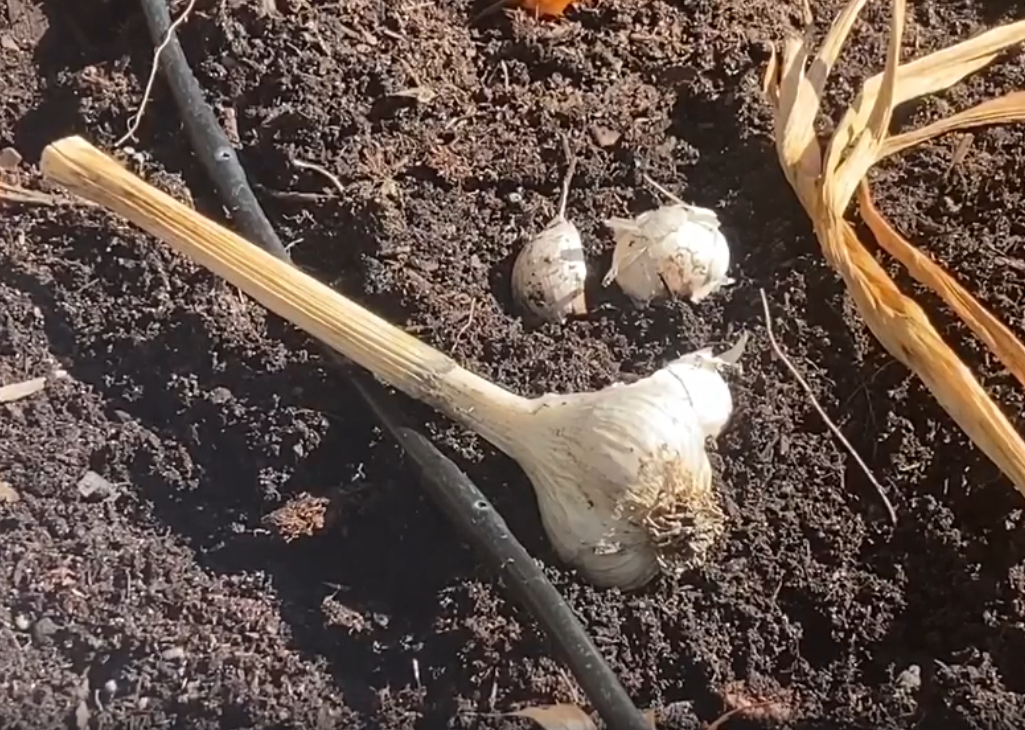
Fall is the time to plant garlic. Plant from about the time of first fall frost to early November. If your soil is loose and well-prepared, you can plant in very early spring, but fall plantings usually yield more. Garlic comes in 2 types, soft neck (which you can braid) and stiff neck. Stiff neck is more winter hardy and may be better for fall planting, which is recommended since spring planting yields small bulbs. Plant the individual cloves 1-2 inches deep, 4-6 inches apart, with the point up. Plant large cloves for larger bulbs. Smaller cloves may be planted closer together and harvested for garlic greens. Do not use supermarket garlic, since it may have diseases, may have been treated to prevent sprouting, and may not be suited to our climate. Garlic likes a good sandy-loam soil rich in organic matter with ample nutrients. Mulch well with straw or chopped leaves after planting. In spring be sure to keep your garlic well weeded and if it is dry, apply 1 inch of water per week. If flower stalks (scapes) appear in the spring, remove them for best bulb size.
Garlic is ready to harvest when the tops yellow and begin to droop-usually mid-July to August. Dig the bulbs carefully (rather than pulling out by the stems) and place them in a shady spot for a few days to dry. After the bulbs have dried, the tops and roots can be removed with shears to within an inch of the bulbs, but the bulbs should be spread out in a dry spot to fully cure. It is essential that the garlic be well cured before going into storage.
As a side note, OhioLine notes that "When garlic is used in canning pickles, a blue-purple pigment often develops under acidic conditions. This situation is often seen in canned products when the garlic is immature or overdried. This does not affect the taste or edibility of the product."
For a video on how to plant garlic, just click HERE.
|
|
Buckeye Yard and Garden onLine provides timely information about Ohio growing conditions, pest, disease, and cultural problems. BYGL is updated weekly between April and October.
|
|
|
|
|
|
|