October 2023 | Rooted in Community | |
Tsundoku
Tsundoku is Japanese for the act of acquiring reading materials and letting them pile up in one’s home. We thought it a perfect heading for this section, as we’ll feature books that are new or popular in the store. If you’re like us, tsundoku is a constant state of being.
How to Resist Amazon and Why, Danny Caine, $14.95
If you're looking for something spooky to read this Halloween season...maybe a true crime horror story...we recommend How to Resist Amazon and Why, because really, who is spookier than Jeff Bezos? (Elon Musk, maybe). This small book, recently updated and expanded, is packed to punch the behemoth of Amazon and all it's tentacled reaches straight in the teeth. Bonus: it's written by a bookstore owner from Kansas, and maybe we're biased, but we love a good Midwestern-bookstore-owner-fighting-giants story. Solid.
Ring Shout, P. Djeli Clark, $19.99
We'll stick with the scary-story theme; tis the season. Ring Shout is new to our horror section, a gory, action-packed monster tale that hits the ground running (no joke, a bat flew into the store as I was writing this, circled for 10 minutes, then flew out). What really gives depth and scope to this fantastical monster tale is its historical underpinnings--the monsters are Ku Kluxes, and the book is set in 1922, after the 1915 film Birth of a Nation captivated the country. This may be a novella, but it's bigger than it looks.
Haunted Japan, Catrien Ross, $12.99
Written in easy, simple prose, this is a gentle introduction to Japan's supernatural side. The book begins with the author's own introduction to Japan's ghostly lore (she's originally from Scotland) and then moves through various stories, places, and centuries. There are some fantastic images within the text, a solid collection of demon and ghost paintings; paired with the author's soft voice, there's certainly a sense of enchantment when reading this book. If you read it at night, alone, in a quiet room, who knows what you'll conjure.
Lone Women, Victor LaValle, $27.00
Gripping you from the outset, LaValle has written a novel that deftly juggles suspense, western expansion, and horror, all set in the year 1915. The story follows Adelaide, a black woman fleeing California after a terrible family tragedy. She arrives in Montana, alone, accompanied by only her heavy, mysterious trunk. What follows will surely keep you proverbially holding your breath and dying to know what happens.
| | |
|
Reading one book is like eating one potato chip.
--Diane Duane
| |
Ask a Booktender
Our goal for this section is to have a regular dialogue amongst our booksellers (booktenders, if you will) and our customers. Feel free to send us a message via email, Facebook, or Instagram asking about books, genres, plots, characters, anything (within reason).
This month, we're moving this section a little closer to it's original intent--to create a dialogue about books. We'll start with the most unfair and terrible question to ask a bunch of book lovers: what's your all-time favorite book?
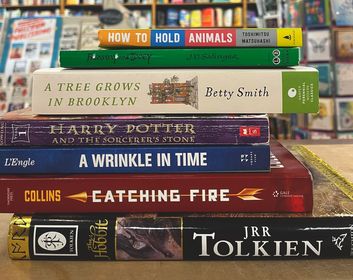
Beth: Blueberries for Sal Robert McCloskey
Rachel: Pilgrim at Tinker Creek by Annie Dillard
Sara: The Hobbit by J.R. Tolkien
Maya: How to Hold Animals by Toshimitsu Matsuhashi
Bella: Franny and Zooey by J.D. Salinger
Kazuya: Steppenwolf by Herman Hesse
Cindy: Reflections from the North Country by Sigurd F. Olson
Sophie: The Harry Potter series by J.K. Rowling
Amy: A Wrinkle in Time by Madeleine L'Engle
Margy: A Tree Grows in Brooklyn by Betty Smith
Ollie: Catching Fire (Hunger Games #2) by Suzanne Collins
Henry: The Phantom Tollbooth by Norton Juster
Fiona: Real Friends by Shannon Hale
| |
Small, Independent Publishing Matters
By Sam Scinta, Publisher at Fulcrum Publishing
| |
Many years ago, I read a quote in an essay collection (I believe it was from Charles Johnson’s Turning the Wheel: Essays on Buddhism and Writing, a volume that, unfortunately, I gave away to another reader in the years since) noting that small publishers are the “crucible” of the book industry. In essence, small, independent presses are the ones who take chances on new authors and introduce these voices to the world, who are willing to publish in fields that may not be popular for a mass audience, and who often build publishing programs that focus on mission first, ahead of profits.
After more than twenty-five years in the independent publishing industry, this assessment rings truer to me than ever before. Since I entered this industry in the early nineties, in addition to the major changes driven by Amazon, online bookselling, and e-books, there has also been significant consolidation in the industry. I recall as a young reader browsing at my local bookstores and libraries at the fascinating logos on the book spines representing a range of publishing houses (what can I say, I was a weird kid), struck by the sheer number of imprints and publishers. While many of the imprints survive, the independence of several of the publishers creating them has not.
We now live in a world dominated by the “Big Five publishers,” which almost became the “Big Four” until a private equity firm purchased Simon and Schuster in early August 2023 (and if history is any indicator, the mixing of private equity and a creative business does not have a great future). These large publishers are parts of larger conglomerate operations. Some of the small houses that I became acquainted with when I joined the industry are also gone, either closed or part of other conglomerates. This move to consolidation is not unique to the publishing industry, of course, but it has big impacts that perhaps readers may not identify, at least at first. Chief among these is the quality and breadth of books released by larger publishing houses. Don’t get me wrong; there are still terrific books published every year by the large publishers, and I read many of them. The books from the Big Five dominate both the bestseller lists and the book awards circuit and thus are the titles most familiar to the general public. But when consolidation occurs in any industry, the diversity of selections and quality of offerings often decline over time, and it happens too late for the customer to do anything about it. While books would continue to be published in a world without small, independent presses, the overall quality of books would suffer, and we would lose the platform that allows for the untested and unheard. In essence, consolidation removes the soul and spirit as the driving force for the industry.
Fortunately, against this background of dramatic change, new independent publishers have joined the field, and many small, independent presses continue to thrive. In this field of indies, I see the crucible metaphor playing out daily. New voices from all corners of our country continue to be introduced, providing a platform for those with something valuable to share. Small, independent publishers are taking financial risks in publishing those books that might otherwise get lost or go unreleased in a large corporate setting because they are not guaranteed blockbusters or don’t have a movie franchise tie-in. And these indies take intellectual risks as well, often willing to share voices that have been marginalized or canceled in one form or another.
| |  |
Customer Corner: Benjamin
Guest spotlight:
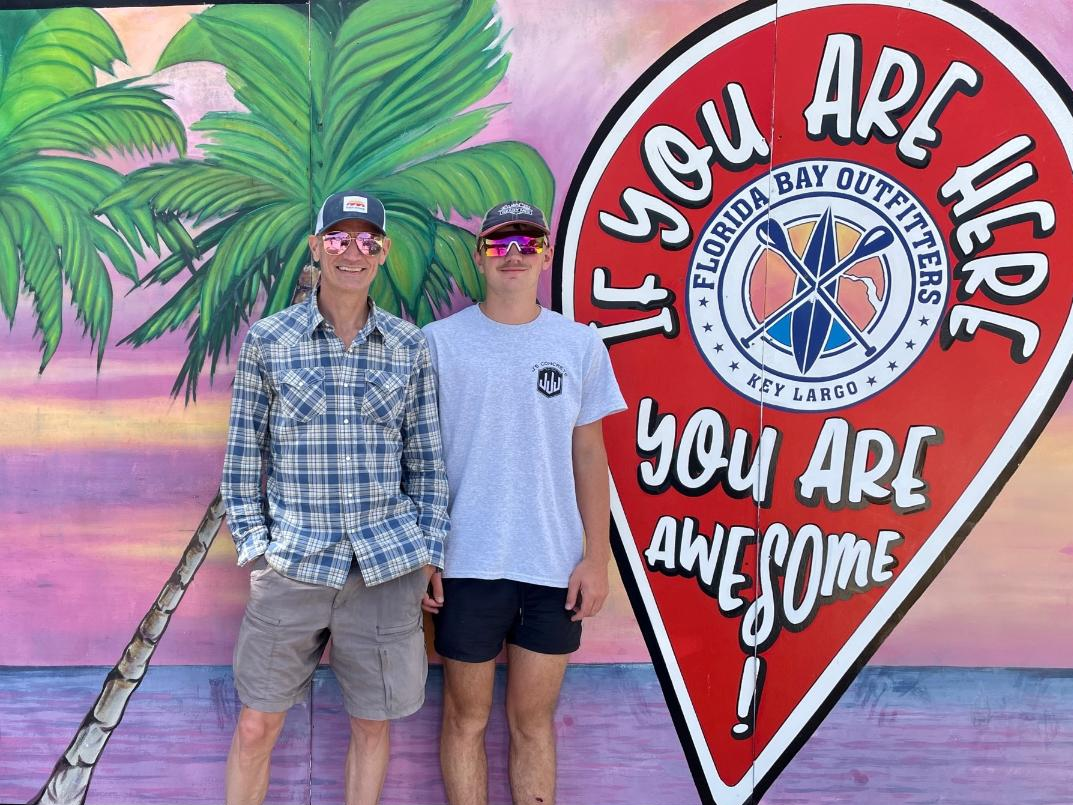
Benjamin Latham, Wisconsin-born
Favorite book: The Scarlet Pimpernel by Baroness Orczy
Currently reading: Howling Dark by Christopher Ruocchio (Book 2 in the Sun Eater series)
Just finished: Redshirts by John Scalzi
Favorite genre: Fantasy and Sci-Fi (subgenre: Cyberpunk)
I took on reading as a pastime after high school. Fantasy and sci-fi have been my genre of choice because a writer can take-on real-life issues without upsetting any one person or group of people. Like many readers, my TBR list is at 60 books and counting. I work as a respiratory therapist at Gundersen Health System. If I’m not reading, you can find me training for one of many sporting events. Mainly running, swimming and cross-country skiing. I compete in the American Birkebeiner cross country ski race; this will be my 6th consecutive year. I also just competed in the Alligator Lighthouse 8-mile swim in Islamorada, Florida Keys. And yes, jellyfish stings hurt a lot! (I was the lucky recipient of 8 during my swim.) There is nothing better than relaxing with a good book after a hard workout.
|  |
|
Small, Independent Publishing Matters cont.
I remember talking with the late Wilma Mankiller, one of the most influential women of the past fifty years, when she approached Fulcrum about doing the follow-up to her autobiography. She chose Fulcrum because, in her words, “any publisher that publishes Vine Deloria, Jr. isn’t afraid to speak truths, and you will in turn allow me to say the things I need to say about how Indigenous women are treated in society.” Small presses embrace topics not because they are popular but because they are important, and when these topics come into fashion and then fall out, as so often happens, indies continue to stick to their mission-driven publishing programs.
So the next time you’re in a bookstore (because, of course, the best place to buy a book is somewhere you can pick it up, open it, and hold it), take a peek at that logo on the spine, Look at the copyright page. And try to find some books that are not published by the largest corporations that dominate the book world. Take a chance on an indie. You will be glad you did.
About the author: Sam Scinta is the publisher for Fulcrum Publishing. Sam joined North American Press, a division of Fulcrum Publishing, as a research associate in 1992, and worked as an acquisitions editor and systems administrator for Fulcrum from 1993 to 1998. Sam received his JD from the University of Denver and worked as a public finance attorney for three years. Sam returned to Fulcrum as vice president and associate publisher in 2001, and in December 2006 was named president and publisher.
|  | | | |
| |
| | | |