 |
IDEAS, NEWS AND RESOURCES | October 2015
We hope you enjoy receiving our newsletter which includes constructionist ideas and practices as well as news and resources from the Taos Institute.
|
|
Brief Encounters
with The Taos Institute
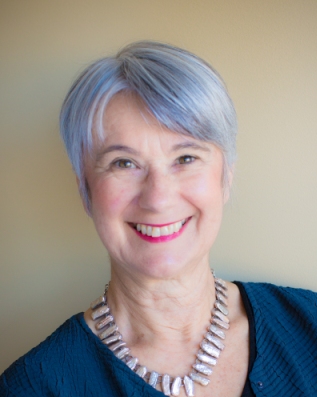
This month we welcome Diana Whitney as she talks about
Relational Practices in Appreciative Inquiry.
Relational Practices in Appreciative Inquiry
Appreciative Inquiry practitioners work with the relational patterns of communication among members (and stakeholders) of the organization. People individually and collectively get into grooves: they develop ways of relating and communicating with each other that quickly become the accepted organizational culture. Many organizations, unfortunately, find their groove in deficit habits of communication that adversely impact performance. Some of the more familiar deficit-based patterns of communication in organizations today include: criticism of ideas and people as a motivational strategy; blaming and exacting punishment from a few for system-wide mistakes; focus on why something won't work rather than taking the risk to experiment and explore novel opportunities; and performance evaluations based upon the assumption that people learn best and improve when aware of their weaknesses and failures. I could go on and on listing the many ways that organizations in all sectors of life, in the US and around the world, have become victims to negative, deficit-based relational habits of communication.
The purpose of our work is always to help a specific client change their organization's patterns of communication or deficit-based organizational narratives, thereby improving performance and wellbeing. Viewing communication patterns as habitual practices - narratives and norms that have developed over time - offers a clear and viable avenue for organization change. These habitual patterns of communication and social interaction, co-created by people interacting overtime, often with good intentions, as they seek to achieve their goals can be observed, assessed for their usefulness and be re-configured. New, more life-affirming patterns, habits and cultural norms can be co-created. This is where Appreciative Inquiry (AI) comes in.
AI is similar in many ways to other processes for large-scale transformation in that it is highly inclusive; yet it is distinguished in one essential way - it is fully affirmative. AI practitioners not only change the configuration of who is included in conversations, they significantly and strategically work with clients to change the topics of conversations within the organization. AI shifts the conversations within and about the organization from what might be considered negative topics to future-focused affirmative topics. In this way AI shifts an organization's discourse away from deficit-based narrative patterns toward value-based conversations that support the co-creation of a desired future. For example, a client whose employee satisfaction survey showed low morale and extensive organizational chatter about how little the company does for employees chose to engage over 500 employees in an Appreciative Inquiry process to create a new and meaningful company-wide career development program. Participation in the AI process and ultimately the new career development program shifted the topic of organizational dialogue from the all too familiar complaint about "what they are not doing for me" to a more empowered "here is where I am going with my career and this is how the company will help me".
This "flip" in the topic of organization communication, as Amanda Trosten-Bloom and I call in it our book Appreciative Leadership occurs when AI practitioners ask their clients the simple and infinitely important question, "What do you want more of in your organization?" This inevitably results in a shift from the problem to a viable future-oriented topic for Appreciative Inquiry. For example, constant talk about lack of coordination among medical professionals reveals the desire for inter-professional collaboration. For clients who are immersed in deficit narratives and norms, it can be a grand "ah ha" when they realize that they have been studying, assessing and learning about precisely what they don't want more of in their organization: turnover, wasteful spending or silos. With this awareness and AI they shift their organizational narratives to what they want more of in their teams, departments and organizations. For example, from turnover to employee retention; from wasteful spending to productive cost containment; or from conflict to customer-satisfying collaboration. The flip, from what is not working well, to what is wanted, is perhaps the most explicit way that AI helps members of an organization transform what they consider negative narratives and norms into life-affirming and productive organizational communication and performance.
*******************************************************************************
|
|
|
FRIENDS OF TAOS INSTITUTE WORKSHOPS
|
|
|
TAOS INSTITUTE EUROPE EVENTS
|
|
"Designing TIE´s Future" in Madrid, Spain,
22-24 January 2016
Everyone who is interested in the forming and connections related to Taos Institute Europe is invited to attend.
- Jan 22nd, Friday (9.00-14.00) Conference: Presentation of Social Constructionism (SC) and TIE in Spain and Workshop on SC
- Jan 22nd, Friday afternoon (16.00-20.00) Conference & Dialogues on "Social Construction in Europe: what TIE and the SC have to offer in the XXI century Europe"
- Jan 23rd Saturday and 24th Sunday: "Seminar on Social Construction and Design" with guest speakers, dialogues and design circles (hands-on design working groups) TIE's Future. Only for associates and candidates.
More Details>
|
|
|
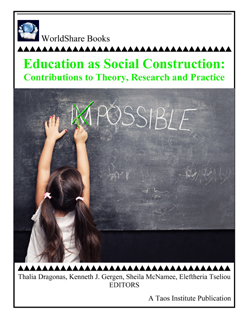
We are thrilled to introduce our newest WorldShare Book and we hope you will take a few minutes to download your free copy today.
EDUCATION AS SOCIAL CONSTRUCTION:
Contributions to Theory, Research and Practice.
Editors: Thalia Dragonas, Kenneth J. Gergen, Sheila McNamee, Eleftheria Tseliou
Drawing from the rich array of ideas and practices surrounding social constructionist theory, the present volume showcases work from a variety of different cultural settings in education. This demonstrates how constructionist initiatives in education can be successfully shared across national boundaries. More important, we come to see how ideas and practices can be re-formed as they shift from one cultural context to another. Social constructionist logics do not demand regimentation and restriction; rather, they invite continuous emergence.
See all the WorldShare Books >
|
|
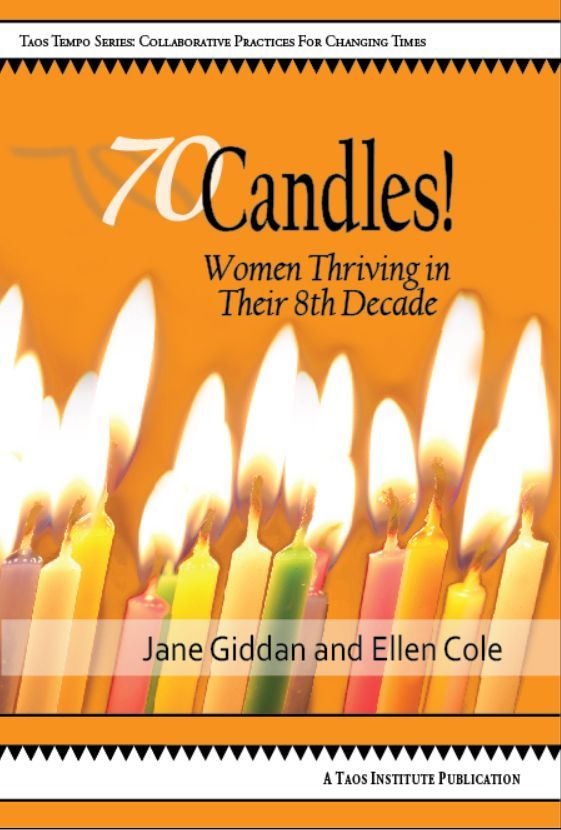
NEW BOOK Getting Great Reviews
70Candles! Women Thriving in Their 8th Decade
by Jane Giddan and Ellen Cole
Taos Institute Publications, 2015
Price: $19.00 US
plus shipping and handling
ISBN: 13-digit: 978-1-938552-35-9
See more at:
http://www.taosinstitute.net/70candles
|
|
|
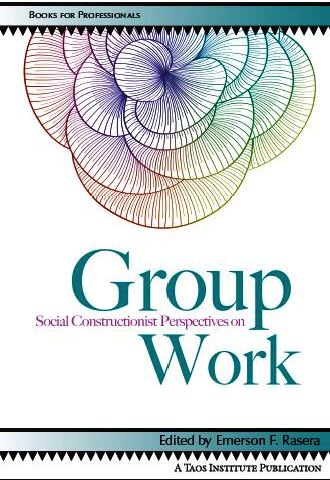
SOCIAL CONSTRUCTIONIST PERSPECTIVES ON GROUP WORK
|
by Emerson F. Rasera
Taos Institute Publications, 2015
ISBN: 978-1-938552-31-1
|
|
|
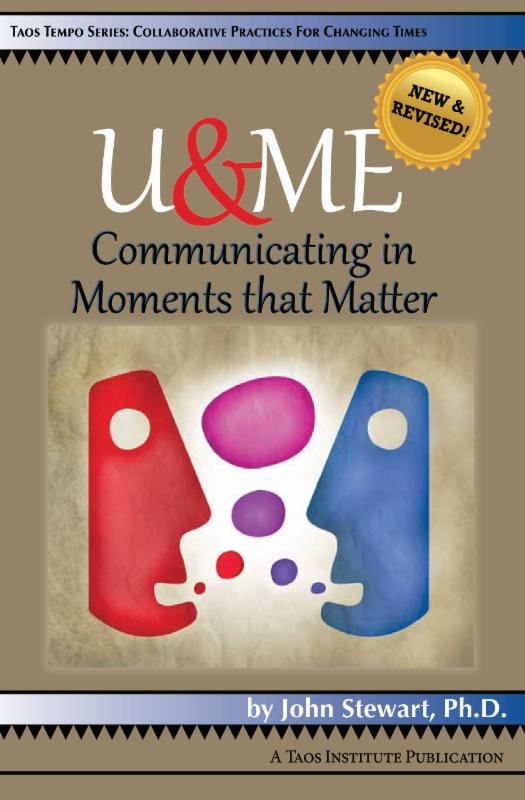
U&ME: Communicating in Moments that Matter - New and Revised Edition
|
by John Stewart
Taos Institute Publications, 2014 (new and revised edition)
Paperback, 281 pages
|
|
|
|
|
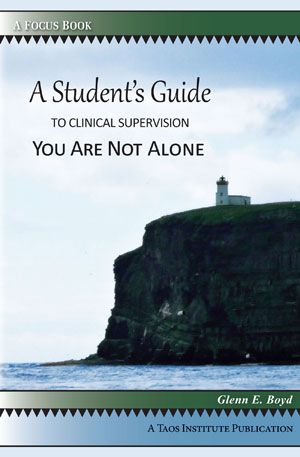
A STUDENT'S GUIDE TO CLINICAL SUPERVISION: You Are Not Alone
|
by Glenn E. Boyd
Taos Institute Publications, 2014
Paperback, 112 pages
ISBN: 978-1-938552-22-9
For more information
→
|
|
|
|
POSITIVE AGING NEWSLETTER
|
Sign up for this free newsletter in the following languages:
- English
- Spanish
- Danish
- German
- French
- Chinese
- Portuguese
|
|
A WEEK IN DIALOGUE
WITH THE AUTHORS
|
Kristin Bodiford, Ph.D. and Peter Whitehouse, MD
October 5 - 9, 2015
Join us online this week to share your own stories and participate with us in an online global conversation about
Intergenerativity in the Taos Online Community Space
www.taoslearning.ning.com
JOIN THE CONVERSATION NOW
|
|
|
|
|
INTERNATIONAL JOURNAL OF COLLABORATIVE PRACTICES
|
International Certificate Collaborative Practices is an international learning community and network. Relationships and conversations that make a difference
Sponsored by Taos Institute and Houston Galveston Institute
To find a program in your part of the world, take a look at:
collaborativepractices.ning.com
Issue 5 - Available Now
|
|
|
|
The Taos Institute's mission is to bring together scholars and practitioners concerned with the social processes essential for the construction of reason, knowledge, and human value.
We are committed to exploring, developing and disseminating ideas and practices that promote creative, appreciative and collaborative processes in families, communities and organizations around the world through a social constructionist lens.
We look forward to your participation in the dialogue.
Keep up with our updates!
Dawn Dole, Executive Director
The Taos Institute
|
|
|
|
|
|