October 2021 | Volume 13 Issue 10 |
|
Hello Grassland Enthusiasts! I hope everyone took the time last week to reflect and learn during the 1st National Day for Truth and Reconciliation. As conservationists, scientists, landowners and naturalists, we all have a roll to play in Reconciliation and to participate in the ongoing process of establishing and maintaining respectful relationships.
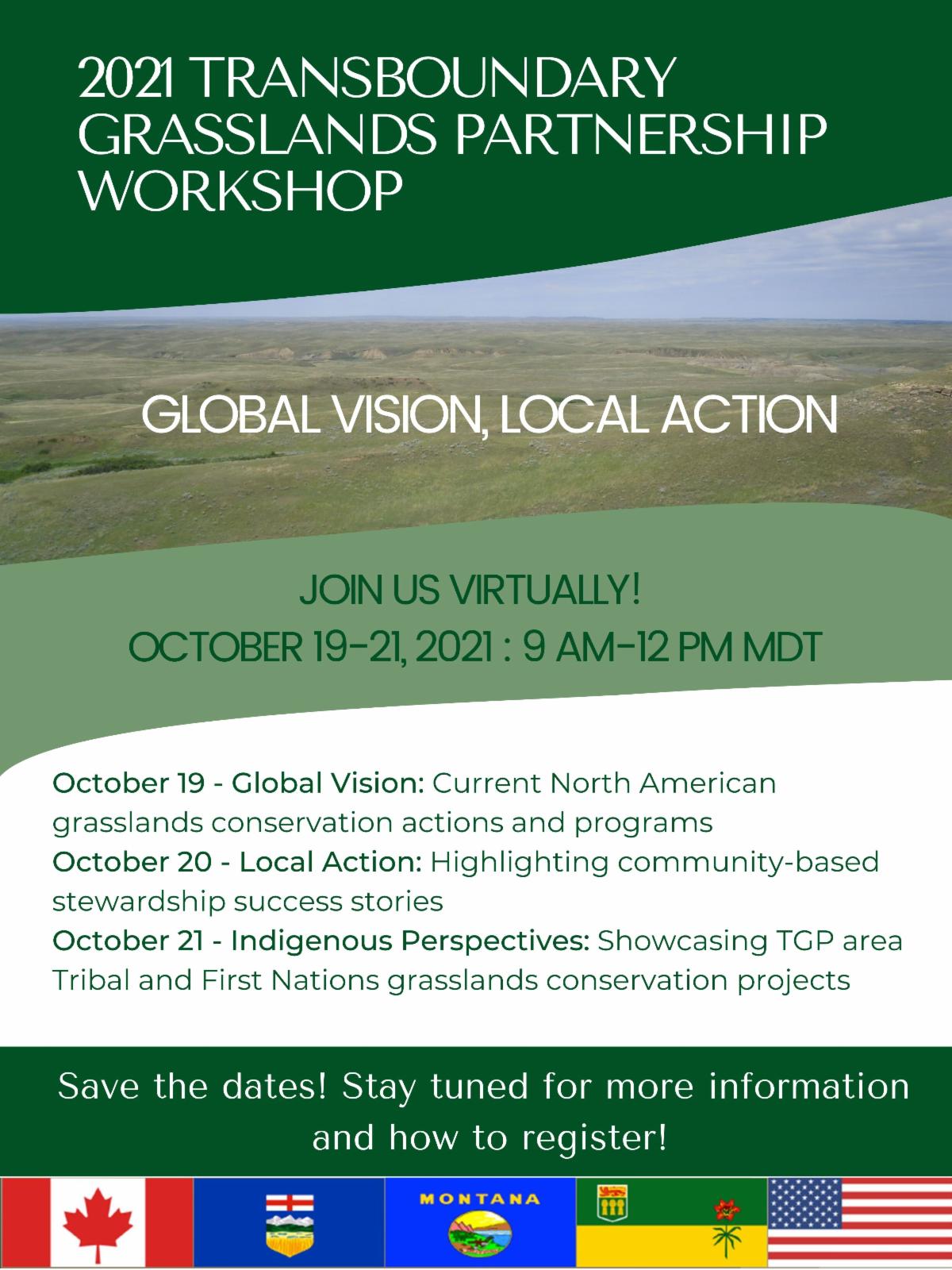
Make sure to register for the 2021 Transboundary Grasslands Partnership Workshop, October 19-21, 2021! We have 3 great mornings of presentations planned, including topics: Global Vision, Local Action and Indigenous Perspectives! You can register here! The presentation schedule can be found, here.
There is more information below about the 9th Native Prairie Restoration/ Reclamation Workshop, February 8-10, 2022! Including a link for the Call For Abstracts!
And finally, we would like to thank our sponsors for their generous support: Camp Wolf Willow, EcoFriendly Sask, K+S Potash, Pembina Pipelines, Saskatchewan Cattlemen's Association, SaskEnergy, SaskPower, SaskTel, Wildlife Habitat Canada and Environment and Climate Change Canada, as well as the continuous support of all the PCAP Partners.
Carolyn Gaudet, SK PCAP Manager
|
The 9th Native Prairie Restoration/ Reclamation Workshop will occur virtually February 8-10, 2022!
Theme: "Restoration, Reclamation, Resilience - Improving Soil, Water and Habitat"
Registration:
Registration will open in early November.
Early bird (by January 21st at 6 PM) : $120.00 + GST
Students : $60.00 + GST
Regular registration (after January 21st) : $160.00 + GST
Call for Abstracts:
We're looking for Industry-related webinar presentations, case studies and posters. We want to hear from you!
More information can be found here.
Tradeshow:
Corporate booth : $200 + GST
Non-profit booth : $160 + GST
Awards:
For years, instead of offering speaker gifts, SK PCAP has been making a donation on the speakers' behalf to a prairie-focused charity, such as the Alicia Hargrave Memorial Scholarship, who helps train the next generation of rangeland experts. This year we decided to combine the awards and the speaker gift donation, so that the award-winning project would receive a cash prize to put towards their restoration/reclamation project. More details to come!
|
PCAP Partner Spotlight...
Environment and Climate Change Canada - Canadian Wildlife Service
Submitted by Rachel Turnquist, ECCC-CWS
Rapid Habitat Assessment Protocol
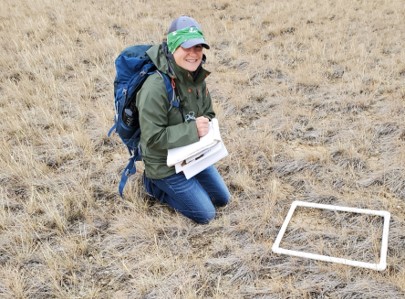
This summer I had the fortunate experience to test out the Rapid Habitat Assessment Protocol (RHAP) that Canadian Wildlife Service – Environment and Climate Change Canada (CWS-ECCC) is developing in collaboration with partner organizations and agencies.
So what is the RHAP? It’s a protocol to quickly assess habitat for multiple species at risk. Currently, it is being tested in the dry mixed grassland ecoregion of southeastern Alberta and southwestern Saskatchewan. The user decides the area they want to evaluate and then determines the ecosite or ecosites within that area. When out in the field, habitat attributes are visually estimated by the user. These include bare soil, litter cover and mass, and plant community. The habitat features are described to capture the heterogeneity on the landscape. Both inherent and disturbance driven heterogeneity are observed.
The intention of the RHAP is to have it applied by users already conducting range health assessments to assess habitat at the same time. It is also intended to be used as a method to monitor habitat and project effectiveness for some CWS-ECCC native grassland habitat conservation programming. Current methods of assessing habitat are generally for single species that may have overlapping ranges with different targets for those species. This can be difficult and confusing where multiple species overlap in habitat. Monitoring for single species is often intensive and expensive. The goal is to develop a standardized, scientific protocol using site-level habitat attribute concepts that are conducive to a rapid site level assessment.
The next steps will be to take what we have learned in the field this summer and make revisions to be ready for use next spring. None of this could be possible without partners. Partners involved with the development and testing of the protocol include Saskatchewan Ministry of Agriculture, Saskatchewan Ministry of Environment, Alberta Environment and Parks, Alberta Conservation Association, Parks Canada, and Royal Saskatchewan Museum. I look forward to sharing the RHAP with you all soon!
|
Rachel Turnquist testing the rapid habitat assessment protocol. Photo taken by Roger Bryan. |
The Saskatchewan Association of Watersheds and member stewardship groups need your help! We are looking for individuals to fill in our short survey about Climate Change. Results from the survey will be used to understand public opinion of climate change and help guide educational material! By filling in the survey, people will be entered to win a $500 gift card! Have your say – fill in our Climate Change Survey today! |
South of the Divide Conservation Action Program (SODCAP) is hiring a Rangeland Technician!
See more information here. Deadline for applications is October 11th!
|
|
Plan to attend our upcoming Native Prairie Speaker Series webinars!
October Native Prairie Speaker Series
Topic: Bioclimatology
Speaker: Dan Johnson, U of Lethbridge
Oct 28th, 2021 @ 12 PM
November Native Prairie Speaker Series
Topic: Prairie Grasslands Initiative
Speaker: Tamara Carter, NCC
Nov 17th, 2021 @ 12PM
More information is on the way for both webinars!
Stay tuned!
|
October 19-21, 2021
Saskatchewan Chapter of the Wildlife Society - Creatures of the Night Virtual Conservation Expo
October 28, 2021
In-person Native Prairie Speaker Series
Topic: Snakes
Speaker: Allie Gallon, GNP
Oct 28th, 2021 at 7 PM
Val Marie Hall, Val Marie, SK
Brandon, MB and virtual
Nov 15-17, 2021
Canadian Western Agribition
Nov 22-27, 2021
Feb 8-10, 2022
July 12-15, 2022
|
Native Prairie in the News
|
In case you are looking to do some early Christmas shopping, check out these prairie themed online shops!
|
2021/22 Speaker Series Supporting Sponsors
Camp Wolf Willow
|
2021/22 Education Programs:
Presenting Sponsors:
|
2021/22 Education Programs
Supporting Sponsors:
|
|
Carolyn Gaudet, Editor, Saskatchewan Prairie Conservation Action Plan Newsletter |
|
SK PCAP gratefully acknowledges financial support in 2021-2022 from:
Camp Wolf Willow, Ducks Unlimited Canada, EcoFriendlySask.ca, Parks Canada - Grasslands National Park of Canada, Pembina Pipelines, Saskatchewan Cattlemen's Association, Saskatchewan Ministry of Agriculture, Saskatchewan Ministry of Environment - Fish and Wildlife Development Fund, SaskEnergy, SaskPower, SaskTel, University of Regina, University of Saskatchewan - College of Agriculture and Bioresources, Water Security Agency and Wildlife Habitat Canada.
SK PCAP gratefully acknowledges in-kind support for 2021-22 from:
Agriculture and Agri-Food Canada - Science and Technology Branch, Canadian Parks and Wilderness Association, Environment Canada - Canadian Wildlife Service, Friends of the Royal Saskatchewan Museum, Friends of Wascana Marsh, Meewasin Valley Authority, Native Plant Society of Saskatchewan, Nature Conservancy Canada, Nature Saskatchewan, Parks Canada - Grasslands National Park, Prairie Wind & Silver Sage, Ranchers Stewardship Alliance Inc., Redberry Lake Biosphere Region, Saskatchewan Association of Rural Municipalities, Saskatchewan Association of Watersheds, Saskatchewan Bison Association, Saskatchewan Burrowing Owl Interpretive Centre, Saskatchewan Cattlemen's Association, Saskatchewan Environmental Society, Saskatchewan Forage Council, Saskatchewan Ministry of Agriculture, Saskatchewan Ministry of Environment, Saskatchewan Ministry of Energy and Resources, Saskatchewan Ministry of Parks, Culture and Sport, Saskatchewan Stock Growers Association, Saskatchewan Wildlife Federation, SaskEnergy, SaskOutdoors, SaskPower, Society for Range Management - Prairie Parkland Chapter, South of the Divide Conservation Action Program Inc., University of Regina, University of Saskatchewan - College of Agriculture and Bioresources.
|
|
|
|
|
|
|