October 2023 - Catch up on the latest news from CAARI! | |
|
Dear William,
A very full summer season at CAARI has given way to an even fuller autumn, with hostel rooms packed, library seats in hot demand, and communal spaces alive with inquiry. A program of public lectures is underway, and thanks to recent gifts--warmly welcomed and badly needed—we have powerful new equipment for broadcasting them by Zoom. Above all, fall is the time for fellowship applications. You’ll see below this text the basic information about CAARI’s fellowship opportunities, application procedures, and deadlines. Be seduced, and apply! Then, following the Director’s message, you’ll see research reports by two of 2022/23’s graduate student fellows, Clay Carpenter and Michał Michalik. They are followed by a solicitation for your help in sustaining the funding for CAARI’s fellowships. CAARI’s are the only available fellowships specifically earmarked for Cyprus, and they play an important role in realizing its mission.
Fellowships are just as vital for senior as for younger scholars. Dr. Steve Falconer, recipient of a prestigious Fulbright fellowship, describes here the project on which he will be working. And then Dr. Kevin Fisher presents a preview of his compelling new book, Monumentality, Place-making and Social Interaction on Late Bronze Age Cyprus. Drawing on many cutting-edge digital technologies and scientific methods to analyze the relationships between urban landscapes, social interaction, and social change on Cyprus during the Late Bronze Age (c. 1650-1100 BCE), his book has roots, as he tells us, in a summer of dissertation research in CAARI’s library, much like the summers described earlier in the Newsflash by Clay Carpenter and Michał Michalik.
| |
|
Apply for CAARI Fellowships!
Encourage your colleagues, students, and friends to apply for CAARI's fellowships. Information about each grant, including application forms, stipends, and expectations, is available at: www.caari.org/fellowships.
CAARI’s fellowships include:
-
Three graduate student stipends offering support for travel to Cyprus and lodging at CAARI. Application deadline: December 8, 2023.
-
Two CAARI/CAORC postdoctoral fellowships that fund a month's research in Cyprus: Application deadline: January 8, 2024.
-
The postdoctoral fellowship in honor of Professor Eddie Peltenburg, that can support a full academic year's research time on Cyprus. Application deadline: January 8, 2024.
-
Scholar in Residence: Application deadline: January 8, 2024.
Other relevant fellowship opportunities are listed on the Fellowships page, as well. Browse the possibilities, and apply!
| |
|
Message from CAARI’s Director
Dear friends and supporters of CAARI,
I write not from Nicosia but from Dakar, the capital of Senegal! I am here for a week, taking part in the Council of American Overseas Research Centres (CAORC) Directors’ meeting hosted by our colleagues here at the West African Research Centre (WARC) of the West Africa Research Association (WARA). In addition to being affiliated with the American Society of Overseas Research (ASOR)--along with ACOR in Jordan and the W.F. Albright Institute in Jerusalem--CAARI is one of 27 ORCs located around the world that receive support from CAORC, the US Department of State, and the US Department of Education for our efforts to promote and facilitate research and cultural exchange in the countries we are hosted by.
Dakar is extraordinary and beautiful, and our hosts are taking such great care of us. We have visited the Museum of Black Civilizations and several other sights in Dakar, including the African Renaissance Monument shown in the photo, as well as hearing a fascinating history of Senegal from Ousmane Sene, Director of WARC. We still have a packed program of talks from US Department of State and CAORC representatives as well as some more visits planned. This is only the second Directors’ meeting I have attended during my time overseeing CAARI. The first was in Tunisia in 2018, but then the pandemic intervened and this is the first time we have been able to get together since. These valuable sessions allow us all to share ideas, find solutions to common problems, and learn from each other about opportunities for funding and collaboration.
| |
Some of the CAORC staff and Overseas Research Centre Directors at the African Renaissance Monument in Dakar | |
|
Back in Cyprus we held our first lecture of the autumn last week. It was a fascinating talk on the current project of digital reconstruction of Hellenistic Nea Paphos by Professor Ewdoksia Papuci-Wladyka, and we all enjoyed the reception in the CAARI courtyard following the lecture. We continue with our next talk by Dr Frederick Whitling on the involvement of the Crown Prince of Sweden with the Swedish Cyprus Expedition on the last Thursday of October.
With best wishes,
Lindy Crewe, PhD
Director, CAARI
| |
|
Research Reports from Two Graduate Student Fellows
The Ktisis of Early Christian Kourion: Cosmic Symbolism of the Mosaics in the House of Eustolios and the Baptism of Ancient Kourion
Clay Carpenter
Lipscomb University
The Danielle Parks Memorial Fellowship
| |
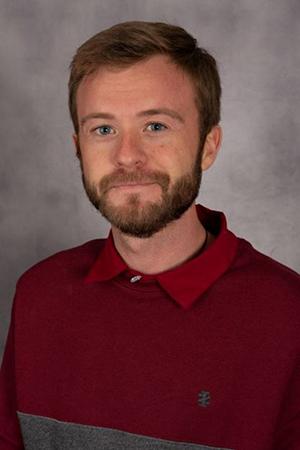 |  | I am still without words to express my deepest gratitude to CAARI for offering me the Danielle Parks Memorial Fellowship. With this fellowship I was able to spend the early part of July 2023 completing the research and writing of my dissertation titled “The Ktisis of Early Christian Kourion: The Cosmic Symbolism of the Mosaics in the House of Eustolios and the Baptism of Ancient Kourion.” In this dissertation, my research focuses primarily on the tessellated inscriptions and symbolic imagery of the floor mosaics in the House of Eustolios in relationship to the transition and transformation of the ancient city of Kourion from paganism to Christianity in the aftermath of the late fourth century AD earthquakes. By contextualizing these mosaics in their archaeological, historical, and theological contexts, the narrative which they express in their inscriptions and images is better apprehended. As such, the mosaics then serve as a “stone-laid” historical source documenting the manner in which the ancient inhabitants of Kourion understood the transition and transformation of their city, namely in a cosmological and theological manner.
| |
| | 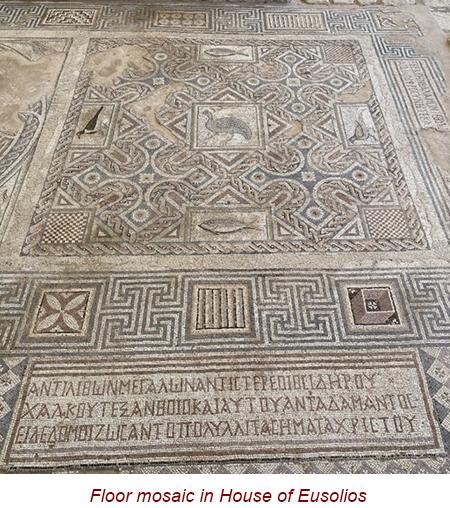 | The fellowship enabled me to spend my time in Cyprus traveling to certain sites pertaining to my research for the specific purposes of in-person examinations and for the acquisition of photographs. For instance, I was able to go to Kourion and the House of Eustolios and examine the floor mosaics as well as related archaeological remains throughout the site. Additionally, I was able to travel to and examine the remains of Ayias Trias, an early 5th century AD Christian basilica located in the Karpas Peninsula with comparable mosaic decoration and likely the work of the same mosaic workshop. Likewise, I was privileged to do much needed research with materials from Kourion and the House of Eustolios at the Episkopi Museum and the Nicosia Museum as well as utilize CAARI’s superb library. By having the opportunity to visit these places and do research, I was able to successfully finish my dissertation in preparations for its defense. Without the fellowship, I would not have been able to achieve these goals.
The fellowship also granted me the unexpected privilege to become acquainted with other fellows and scholars in residence at CAARI. Our time together proved to be full of joy and camaraderie, filled with interesting discussions concerning our shared and respective academic interests and researches. I am thankful to them and the CAARI Staff and Board for making my time in Cyprus and fruitful experience.
| |
|
Water Supply of the Nea Paphos Agora in Context
Michał Michalik
Jagiellonian University, Cracow
The Anita Cecil O’Donovan Fellowship
| |
 | | My doctoral thesis entitled “A sip of cold water in the shadow of the portico. The water supply of the Agora at Nea Paphos” started in 2020 as part of a joint Polish expedition of the Jagiellonian University in Krakow, the Centre for Mediterranean Archaeology of the University of Warsaw and the Warsaw University of Technology. The supervisors of the thesis are Professor Ewdoksia Papuci-Władyka and Dr Łukasz Miszk. The main objective of my research is to observe the transition from the Hellenistic period (312 - 30 BC) to the Early Roman period (30 BC - 2nd century AD) in Cyprus from the perspective of the water supply excavated at the Agora in Nea Paphos. So far, I have been able to identify numerous hydrological structures such as wells, pipelines, reservoirs, pools, and gargoyles investigated during the ongoing excavations. Nevertheless, the cognitive possibilities were limited by difficult stratigraphy due to frequent rebuilding of buildings and the poor state of preservation of the site, since all buildings are preserved only on the level of the foundations and have been subjected to extensive robbing activities. This led to the need for an extended comparative study.
Thanks to my fellowship, I was a CAARI resident for two months from April to May 2023. During my stay, I sought to collect data to contextualise the archaeological finds under investigation. Although the data collected is still being processed, it is worth presenting initial thoughts and issues. The first objective was to find similarities and differences between the water-related features discovered at the agora and hydrologic elements of other Cypriot buildings dating to the Late Classical, Hellenistic, and Roman periods. In order to achieve this goal, I carried out a query at the CAARI library and made trips to archaeological sites on the island. This allowed me to understand, as well as experience personally, the diversity of conditions in Cyprus and how they must have determined, in particular, the use of hydrological solutions in structures erected in different locations. On the other hand, I was able to observe similarities in the use of the same water systems and their frequent changes.
| |
|
The second objective was to understand cultural practices related to water in Cyprus. To achieve this, I carried out a search for limited representations of water-related practices from the Hellenistic-Roman period together with ethnographic and historical sources. This allowed me to understand how extremely valuable yet how dangerous water was in Cyprus. Furthermore, I could see how much the daily life of the islanders is entangled with it.
Overall, my stay at CAARI has benefited me greatly and allowed me to gather valuable information that I will use in my dissertation. Moreover, I am extremely grateful to the CAARI Fellowship Committee, CAARI staff, and resident colleagues for the experience I have gathered, the scientific camaraderie, and the opportunity to exchange ideas and make new friends.
| |
|
Help support our future fellows
Zuzana Chovanec
CAARI Development Chair
As a new season of public programs takes off, we extend our gratitude for those recent gifts that enabled the upgrade of equipment for broadcasting and recording of public lectures. These improvements will continue to connect those far beyond Nicosia who are drawn to CAARI and Cyprus. The reports from our most recent fellows in this issue remind us of the incredible range of topics open for research in Cyprus and how crucial funding opportunities are for emerging scholars as well as those long-invested in the study of Cyprus's history and culture. As applications open for our new round of funding, we invite you to help a new cohort of scholars to achieve their aims by supporting CAARI's fellowships. Both large and small gifts help us reach our goal.
WWW.CAARI.ORG/SUPPORT
or
| |
|
CAARI
11 Andrea Dimitriou Street
Nicosia 1066
Cyprus
| |
|
CAARI
209 Commerce Street
Alexandria, VA 22314
USA
| |
|
Achievements by Senior Scholars
The Emergence of Prehistoric Social Identity and Civilization on Cyprus
Dr. Steven Falconer
University of North Carolina Charlotte
Fulbright Fellows Program
| |
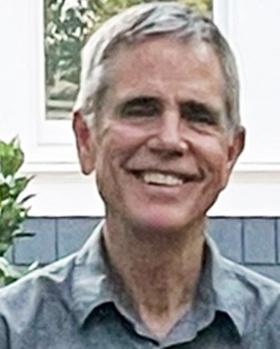 | | As a Fulbright US Scholar hosted by CAARI in fall 2023 and spring 2024, I plan to synthesize the major results of multi-disciplinary fieldwork conducted at and around Politiko-Troullia between 2004 and 2019. This Bronze Age settlement provides a highly-engaging portrait of life in a prehistoric Cypriot agrarian/metallurgical community during the formative centuries preceding the first cities on the island. The evidence from Early/Middle Bronze Age Politiko-Troullia particularly highlights the emergence of Cypriot community identity as a key element in the development toward Cypriot urbanized civilization in the subsequent Late Bronze Age. Anthropomorphic plank figures (including the only stone plank figure excavated on Cyprus), combined with concentrated deposition of spinning and weaving equipment and butchered fallow deer bones, provide compelling evidence of communal activities, including feasting in open courtyards that signaled and celebrated group social identity. Bayesian modeling of 25 AMS ages defines the lifespan of Troullia between about 2050 and 1850 cal BCE, and major landscape impacts just after 2000 cal BCE, when the settlement shifted upslope and abandoned its intramural well due to pronounced erosion possibly associated with regional climate change. Thus, Politiko-Troullia provides a particularly dramatic case study of pre-urban social change on dynamic cultural and environmental landscapes. This research highlights Cyprus’ own idiosyncratic coalescence of social identities in agrarian communities on a sparsely populated wooded countryside, in stark contrast to the aggregated cities and deforested anthropogenic landscapes of the mainland Middle East. In addition to academic publications, I hope to disseminate these results to popular audiences through an engagingly-illustrated e-book designed especially for younger school-age readers and interested adults.
| |
|
Heralding a New Book by Dr. Kevin Fisher
Re-thinking the Monumental Buildings of Late Bronze Age Cyprus
Dr. Kevin D. Fisher
University of British Columbia
| |
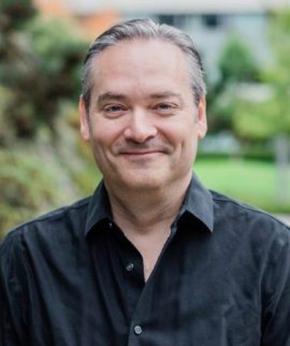 | | The research that eventually led to my new book, Monumentality, Place-making and Social Interaction on Late Bronze Age Cyprus (Equinox, 2023), owes much to my time at CAARI in the mid-2000s. As the Archaeological Institute of America’s Harriet and Leon Pomerance Fellow in 2004, I spent much of that summer in the air-conditioned splendor of the CAARI Library working on my dissertation (with perhaps an occasional sojourn to the balcony for refreshments and conversation). In June, Tom Davis (then CAARI Director) took a few of us residents on a tour of sites in northern Cyprus. The rugged beauty of the north coast was memorable, but the highlight for me was visiting Enkomi for the first time. The famous Late Bronze Age site, which I had only “experienced” through the lens of Dikaios’s masterful publications, had preoccupied much of my research up to that point, but exploring the ruins of the Ashlar Building and being in the spaces that I had only seen in plans and photos, left an indelible impression of this ancient city as a “place.”
| |
| |  | I saw the current book as an opportunity to revisit this earlier research in light of new scholarship and my own changing views, while making it more accessible to a wider audience. I also felt it important to show that audience that Late Bronze Age (LBA; ca. 1700-1100 BCE) Cyprus, often overshadowed by its more famous neighbors, offers a compelling case study in discussions of monumentality, urbanism and social dynamics. The idea of past built environments as places—that is “lived” spaces, imbued with meanings, identities, and memories that actively shaped, and were shaped by, the daily lives and experiences of their inhabitants—is a central premise. Rather than passive spaces within which social interactions occur, these buildings played an active role in shaping those interactions. I also wanted to move away from seeing monumental buildings exclusively as massive, “permanent”, “public” structures, and instead focus on their monumentality: their relationship to particular communities and the meanings those people ascribe to them—and the mutability of those meanings over time.
One of my main objectives in writing Monumentality was to develop an approach to investigating the role of past built environments in social interaction and social change—one that could potentially be used for any time period or region. The book lays out a theoretical framework and methodology for what I call an “integrative approach.” It is grounded in social theories that link social action and interaction to social organization and transformation. Of course, such theories rarely tell us how to analyze things on the ground. Using a critique of the contemporary “open office”, including the famous corporate headquarters of Apple and Facebook/Meta, as a case study, I highlight the critical ways that built environments, through their layout and materials, profoundly affect human behavior. My approach explores this dynamic by combining access analysis, which gets at how buildings configure space and structure patterns of movement and interaction, with methods that help us understand how buildings encode meanings and communicate them to people who use or otherwise encounter them, and how people may have experienced built environments visually and through other senses. Such an approach provides insights into the potential for spaces to host particular types of social interactions, from more formal occasions like ceremonial feasting, to passing encounters in a hallway.
I apply this approach in an analysis of several Late Bronze Age monumental buildings as a way to understand Cypriot society during this transformative period. Two buildings from Enkomi excavated by Dikaios, the Ashlar Building and the so-called Fortress, span nearly the entire LBA and underwent a series of destructions and reconstructions during their long use lives. Their “biographies” present an opportunity to examine the significance of changes in monumentality and spatial configuration through time and link them to processes of place-making and social transformation that played out at various scales. I also analyze three court-centered buildings from the later part of the LBA (Late Cypriot IIC-IIIA): Building X at Kalavasos Ayios Dhimitrios, the Ashlar Building at Maroni Vournes, and Building II at Alassa Paliotaverna. Each of these impressive buildings is assumed to be the center of administrative and economic power for their respective sites and, perhaps, their wider regions. Despite some superficial formal similarities and shared functions, they materialized monumentality in quite different ways with distinctive spatial configurations and deployment of materials.
What these various buildings shared was the dedication of significant amounts of space to hosting social interactions that brought visitors and the buildings’ inhabitants together. The Ashlar Building at Enkomi, for example, had no less than three large halls with hearths suited for such occasions, but their particular material and spatial characteristics indicate that they were aimed at discriminating among participants of various statuses. These buildings were places of ritual performance and memorable, embodied experiences. In many cases, these rituals centered on the commensal politics of feasting, enacted in social occasions that could be used to create, display and reify social distance between host and guest, or downplay social difference as a means of promoting solidarity and wider community identities. In some contexts, like “Sanctuary of the Horned God” that was built amidst the ruins of Enkomi’s Ashlar Building, feasting was tied to cultic practice, adding further potential for both the legitimation of inequalities and the formation of community.
An understanding of the properties and qualities of various building materials—that is, their materiality—was a key aspect of monumental construction and the creation of symbolically-charged contexts for interaction. I discuss the materiality of these materials: earth, wood, plaster and stone. I focus particularly on ashlar (cut stone) masonry, reconstructing the sequence of events through which it was created and used, from the affordances of its source material to its quarrying and carving and installation in walls, floors, thresholds and columns. It encoded and communicated various meanings, including control over human and material resources, elite identity and participation in a wider eastern Mediterranean koiné of monumental building, and the seeming durability of the social structures that enabled its use.
I conclude the book by considering the individual monumental buildings within the broader context of their urban landscapes and changing sociopolitical dynamics over the course of the Late Bronze Age. This begins with the fortress phenomenon of the MC III-LC I period—the island’s first large-scale monumental buildings. In the subsequent “Proto-urban” period (as I call it), the mortuary sphere served as the primary means of displaying status, negotiating identities and demarcating social boundaries. This changed in the fully-urban period of the Late Cypriot IIC-IIIA as monumental buildings in cities became the main arenas in which sociopolitical dynamics were enacted. These new built environments—from ashlar-lined rooms within particular buildings to the planned streets seen in some urban landscapes—materialized new patterns of social interaction and organization that fundamentally changed the way most Cypriots lived their lives. The cities emerged and developed along diverse local trajectories.
Whether they were destroyed in some kind of cataclysmic event, or their occupants simply left, the remains of these structures did not disappear at the end of the Late Bronze Age. The durability and seeming permanence that made these buildings and their ashlar walls such a potent symbol of LBA elite identity also ensured their survival beyond the lives of their creators, opening them up to alteration, erasure, appropriation and re-interpretation by the those who came after. The destroyed or abandoned cities of the LBA retained a significant presence in the landscape of Iron Age Cyprus and would come to play a role in the establishment and legitimation of the new social order that appeared with the emergence of the city kingdoms. This reminds us that monumentality is an ongoing process and that these buildings were (and still are) always in a process of becoming monumental.
| |
|
To All CAARI’s Friends and Supporters
One after another, the reports in this Newsflash bring with them the thrill of data interpreted and ideas newly realized. We send our sincerest thanks to all who join in giving CAARI the funds to support this work! We are very grateful for your assistance in sustaining our mission.
| |
Annemarie Weyl Carr
Vice President, CAARI Board
| | | | | |